
On this page
Start here
Quick answer
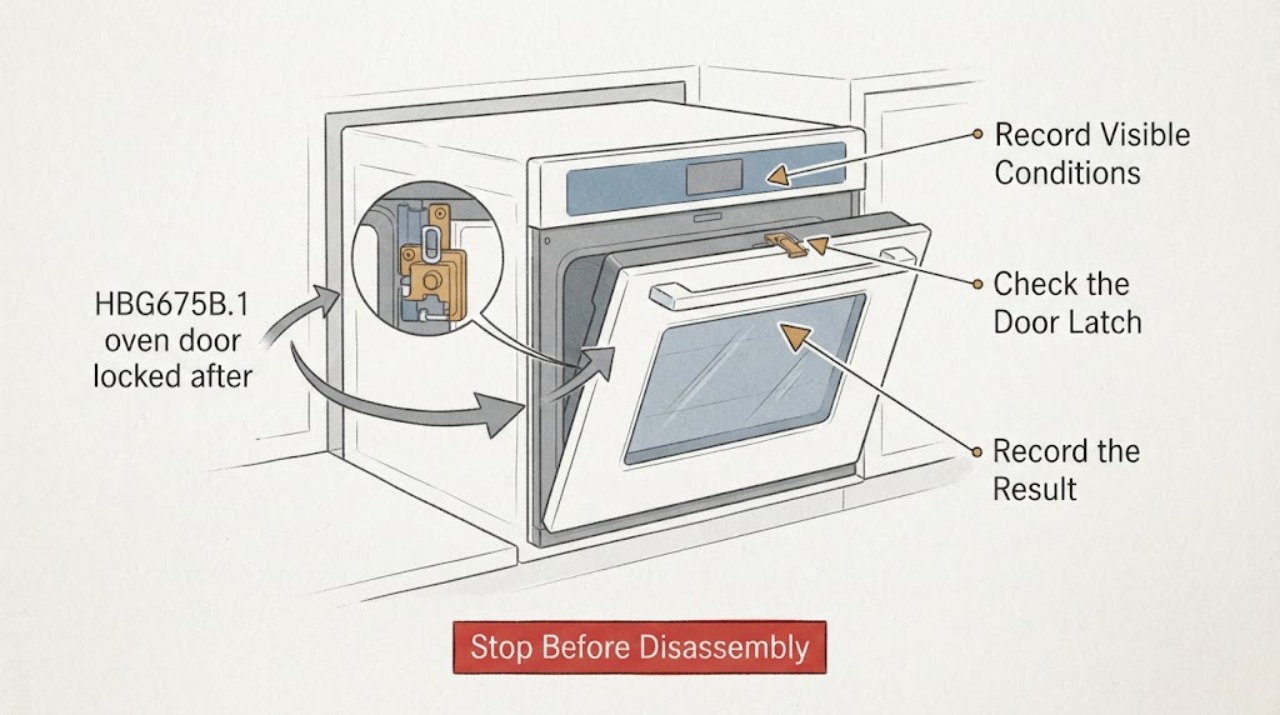
Do not pull on the door after a Bosch HBG675B.1 pyrolytic cleaning cycle. First confirm the complete E-Nr. from the rating plate, switch the oven off, and allow the cavity and door to cool fully; the Bosch HBG675B.1 manual says the cleaning function locks the door at a safety temperature and unlocks it only after cooling, when the lock symbol goes out. If the oven is cool but the lock symbol remains, check whether the childproof lock is active and use only the matching manual's documented control to deactivate it. If the complete E-Nr. does not match the HBG675B.1 documentation, the lock remains after cooling and the childproof-lock check, or there is smoke, burning smell, damaged glass, or a damaged control or cord, stop using the oven and arrange qualified Bosch service. Never force the door, defeat the lock, remove the latch, or restart pyrolytic cleaning to test it.
Work through in order
Diagnostic checks
Use only checks that match the exact appliance or system and its official guide.
-
Check 1
From the rating plate, record the complete Bosch E-Nr., including the slash and the two characters after it, plus the FD number if visible. Compare it with HBG675B.1 before using any door or lock instruction; do not treat HBG675B.1 without its suffix as a complete service identity.
Expected result: The plate confirms an HBG675B.1-family E-Nr. with its full suffix, the E-Nr. is a different model or market variant, or the plate cannot be read safely.
Next step: Use the exact Bosch owner-manual lookup for the complete E-Nr. If the identity is different or uncertain, stop model-specific troubleshooting and provide the plate photo to Bosch service.
Why this matters
Why: Bosch says the E-Nr. is on the rating plate and that the complete number is needed for support; the opened manual is for the HBG675B.1 family and cannot prove that every suffix has identical service steps.
-
Check 2
Switch the oven off and leave the door and surrounding trim untouched until the cavity is fully cool. Observe the display without opening the door or reaching near the latch; note whether the lock symbol is still present, whether the cleaning timer has ended, and whether the door releases on its own after cooling.
Expected result: The lock symbol goes out and the door opens normally; the oven is still hot or the lock symbol remains; or the cycle ended but the door is still locked after full cooling.
Next step: If the symbol clears, open the door gently and wipe ash only after the manual's cool-down condition is met. If the symbol remains after full cooling, continue only with the childproof-lock check and then arrange service if it does not clear.
Why this matters
Why: For HBG675B.1, Bosch says the cleaning function locks the door once a safety temperature is reached and unlocks it after cooling, when the lock symbol goes out. A persistent lock after full cooling is not a reason to pull harder or repeat the high-temperature cycle.
-
Check 3
If the exact HBG675B.1-family manual matches and the oven is completely cool, check whether the display indicates the childproof lock. Use only the documented childproof-lock touch field from that manual, which says to press and hold it for approximately four seconds; do not insert anything into the door gap or operate the latch by hand.
Expected result: The childproof-lock indication clears and the door opens; no childproof-lock indication is present; or the control does not respond and the door remains locked.
Next step: Open the door gently only if the lock indication clears and there is no heat or structural damage. Otherwise keep the oven off and contact Bosch or qualified appliance service with the complete E-Nr. and display message.
Why this matters
Why: Bosch lists the childproof lock as a separate reason the door may not open and provides a control-panel deactivation step. If that permitted step does not clear the lock, the remaining latch, sensor, or control diagnosis requires service.
-
Check 4
From a safe standing position after cooling, inspect the visible door glass, frame, handle, gasket, and control panel for cracks, displacement, scorching, a burning smell, or a cord or electrical problem. Do not remove the door, hinge, latch, glass, panels, or trim to reach the lock.
Expected result: The door and glass look intact with no abnormal smell or heat; glass, frame, seal, or handle damage is visible; or smoke, burning odor, or electrical damage is present.
Next step: If damage or an electrical hazard is present, stop using the oven and arrange qualified appliance or electrical service as appropriate. Do not hold the door shut, defeat the lock, or restart a cleaning or heating cycle.
Why this matters
Why: Bosch warns that the cleaning function becomes very hot and that improper repairs are dangerous; a damaged door or electrical symptom changes this from a normal lock wait into a service and safety issue.
-
Check 5
Prepare a service handoff if the door remains locked after full cooling and the documented childproof-lock check: provide the complete E-Nr., FD number, the lock symbol or message, whether the pyrolytic timer reached zero, how long the oven cooled, and photographs of the closed door and control display.
Expected result: The manual-matched lock clears, or the lock persists despite a fully cool oven and the permitted childproof-lock step.
Next step: Use Bosch's servicer route or a qualified appliance technician. Do not order a latch, control, or sensor from the symptom alone, and do not run another pyrolytic or heating cycle until the door releases and seals normally.
Why this matters
Why: A lock that persists beyond the documented release conditions is not safely distinguishable at the user level between a latch, temperature sensor, control, or other interlock fault.
Use your observations
Decision map
Find the observation that best matches what you see, then follow the next safe action.
-
PATH 01Next step
What you see
The cleaning cycle has ended, the oven is fully cool, the lock symbol goes out, and the door opens without resistance.
Do this next
Open gently, wipe ash as the manual permits, and do not start another cleaning cycle unless the door and seal are intact.
Why this path and its safety boundary
Why it matters: This matches the normal Bosch pyrolytic lock sequence: the interlock held the door during the hot phase and released after cooling.
-
PATH 02Next step
What you see
The oven is still hot or the lock symbol remains during or immediately after pyrolytic cleaning.
Do this next
Switch the oven off if the manual permits, wait without touching the door until it is fully cool and the lock symbol clears, and do not pry or defeat the interlock.
Why this path and its safety boundary
Why it matters: The safety interlock may still be correctly holding the door; opening it while hot creates a burn risk.
-
PATH 03Next step
What you see
The oven is fully cool but the childproof-lock indication is active and the exact manual's documented four-second touch-field action clears it.
Do this next
Open the door gently and keep the childproof-lock setting under control; arrange service if the lock reappears without being selected or the door still does not release.
Why this path and its safety boundary
Why it matters: The childproof lock, rather than a failed pyrolytic latch, was preventing the door from opening.
-
PATH 04Next step
What you see
The oven is fully cool, the lock symbol remains or the control does not respond, and the childproof-lock check does not release the door.
Do this next
Keep the oven off and arrange Bosch or qualified appliance service using the complete E-Nr. and display evidence. Do not remove the lock, door, hinges, or panels.
Why this path and its safety boundary
Why it matters: The documented user release conditions have not resolved the interlock; a latch, sensor, control, or other safety fault cannot be safely separated without service diagnosis.
-
PATH 05Next step
What you see
There is smoke, fire, a burning smell, damaged glass, scorching, electrical damage, or abnormal heat around the control or door.
Do this next
Stop using the oven; leave the area and contact emergency or gas professionals from a safe location for an active fire, smoke, or gas concern, then arrange qualified appliance service after the area is safe.
Why this path and its safety boundary
Why it matters: This is a safety event rather than a normal post-cleaning lock. The high-temperature cleaning function and damaged components can create burn, fire, glass, or electrical hazards.
When checks do not resolve it
Need a professional?
Arrange Bosch or qualified appliance service when the complete E-Nr. does not match the HBG675B.1 documentation, the door remains locked after the oven is fully cool and the documented childproof-lock check, the lock symbol or fault message persists, or any latch, hinge, frame, glass, control, cord, smoke, burning, or abnormal-heat concern is present. Do not order a latch, sensor, or control from the symptom alone.
Common questions
FAQ
How long should the Bosch HBG675B.1 door stay locked after self-cleaning?
The manual does not promise a universal clock time. It says the door unlocks after the cleaning function has ended and the oven has cooled, when the lock symbol goes out. Wait for the cool condition rather than pulling on the door.
Could the childproof lock be the reason the cool door still will not open?
Yes. Bosch lists the childproof lock separately from the hot-cleaning interlock and documents a control-panel deactivation action for the HBG675B.1 manual. Use it only after the oven is fully cool and only if the complete E-Nr. matches.
Can I pry open the door or remove the lock if it stays locked?
No. A persistent lock after cooling and the permitted manual check needs service diagnosis. Forcing the door or dismantling the latch can defeat a safety interlock and expose hot, sharp, or energized parts.
Read the exact guide
Official sources
- Search for Owner Manuals and Spec SheetsBosch Home Appliances · Opened Bosch's owner-manual lookup to support matching the full rating-plate E-Nr. before using a manual or reset step.
- Repair Service for large home appliances | Bosch HomeBosch Home Appliances · Opened Bosch US service guidance to verify that the complete E-Nr. is required and includes a slash plus two suffix characters; used for identity and escalation, not to infer a door-lock repair.
- User manual and installation instructions HBG675B.1Bosch Home Appliances · Opened Bosch's official HBG675B.1 manual; suffix and market must still be confirmed from the appliance rating plate before applying model-specific control steps.
Community feedback
Share a repair observation
Share a plain-text repair observation. Accepted observations are published automatically; this page may take a moment to update.