
On this page
Start here
Quick answer
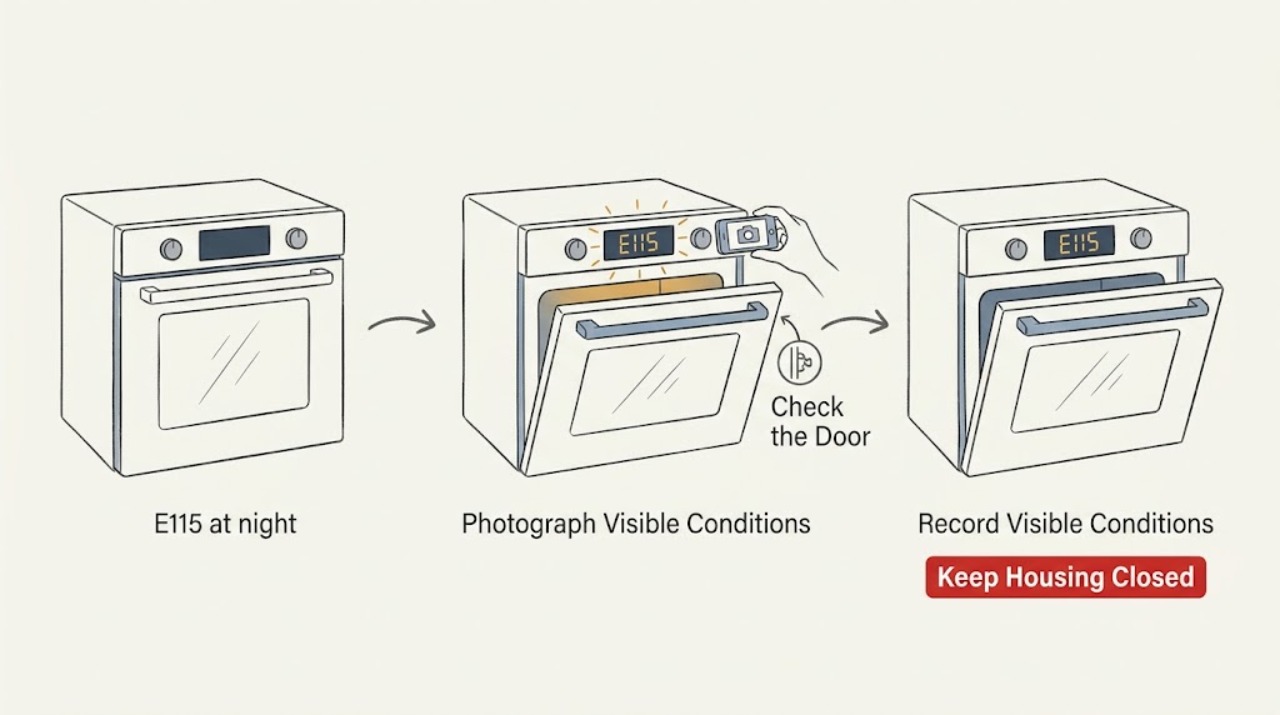
On a Bosch HEI8054C, E115 with a locked door after the oven was supposedly idle and cold should not be treated as proof that the oven is actually overheated. The exact Bosch use-and-care manual covers the HEI8054C family but does not provide an E115-specific owner diagnosis; it says that a continuously flashing and beeping error requires disconnecting power and calling a qualified technician. From a safe position, record the complete display, whether the oven is hot or heating, any smoke, smell, sparks, or breaker trip, and the model suffix from the rating plate. If the door is locked, do not force it. If a safety symptom is present, leave the range isolated and obtain urgent qualified help; otherwise arrange Bosch or qualified appliance service with the code, timing, and reset history. Do not enter service mode, remove the control console, or keep cycling power.
Work through in order
Diagnostic checks
Use only checks that match the exact appliance or system and its official guide.
-
Check 1
From outside the appliance, record the display exactly: E115 versus another E-code, the door-lock symbol, any COOLING DOWN text, beeps, and the time it appeared. Note whether the oven had been in Bake, Broil, Self Clean, a timer mode, or was idle, and take a photo only if it is safe.
Expected result: The code is clearly E115 on an HEI8054C, the code is incomplete or different, the door is locked, or the display also shows cooling or an active mode.
Next step: Keep the oven off while arranging the exact Bosch manual or service review. If the code is not clearly E115 or the model suffix is different, do not apply this article's code discussion.
Stop if: Do not force the door, reach through the door gap, or open the control area to read a hidden label while the appliance is energized or hot.
Why this matters
Why: The exact characters and state determine whether the event can be matched to Bosch documentation. A locked or cooling display does not prove current overheating, and an incomplete code cannot support a part diagnosis.
-
Check 2
Check only from a safe position for immediate hazards: unexpected heat from the door or vents, active or recent heating, smoke, burning or electrical smell, sparks, damaged wiring or cord, a tripped breaker, or the oven behaving as if it is heating without a command. Do not open the locked door to investigate.
Expected result: Any hazard or uncontrolled-heating sign is present, or the range is cool with no visible hazard but E115 and the lock remain.
Next step: For smoke, sparks, burning smell, uncontrolled heat, or a repeated breaker trip, keep people away and leave power isolated using the labeled disconnect only if it can be done without approaching a hazard; obtain qualified appliance/electrical help. Otherwise keep the oven off and book Bosch service.
Stop if: Do not restore power to see whether an element heats, repeatedly cycle the breaker, use a flame near the range, or continue cooking through the error.
Why this matters
Why: A safety symptom takes priority over interpreting the code. A cool exterior does not validate the code as harmless; the unexplained locked state still needs qualified diagnosis.
-
Check 3
Read the rating plate or owner documentation without moving or dismantling the range and record the complete E-Nr/model suffix, serial information, country, and whether the appliance is HEI8054C/01, /07, or another suffix. Match that identity to Bosch's official support page and manual before using any reset instruction.
Expected result: The suffix and region match an official Bosch manual, or only a generic HEI8054C result or a different HEI/ HGI/HDI product appears.
Next step: Use only the matching manual's ordinary owner instructions. If Bosch provides no E115 entry for the exact identity, treat the code as unresolved and give the model, code, and timing to service.
Stop if: Do not borrow E115 meanings or button sequences from another Bosch range, wall oven, gas model, or an online service-mode guide.
Why this matters
Why: Bosch groups closely related ranges and different product families under similar model strings, while error meanings and permitted owner steps can differ. A generic match is not evidence that E115 has the same meaning or reset on every unit.
-
Check 4
If the exact Bosch manual permits a normal power-off step and there is no active hazard, use the labeled breaker or disconnect to isolate the range once, then leave it off; do not remove covers or attempt to release the door. Record whether E115 returns, whether the door remains locked, and whether the display still says cooling down after power is restored once only if Bosch's matching guidance allows that observation.
Expected result: The code clears but the door stays locked or cooling down, the code returns immediately, the breaker trips again, or the oven remains unresponsive.
Next step: Leave the range off and arrange qualified Bosch service. Tell the technician whether the code cleared, whether the lock remained, and whether the range was cold before the event.
Stop if: Do not repeat the reset, enter service diagnostics, bypass the door lock, remove the rear or control panel, or test live circuits.
Why this matters
Why: Clearing the display does not establish that the lock, temperature sensing, heating safety, or control system is healthy. A persistent lock or returning message is an unresolved fault, and the exact-model Reddit report describes this same distinction after a short unplug.
-
Check 5
Prepare a service handoff with the exact model suffix, complete E115 display, door-lock and cooling-down status, idle or cooking history, temperature or smell observations, breaker events, and the result of at most one permitted power isolation. Do not describe a thermostat, sensor, relay, or control board as failed unless a qualified technician has documented that finding.
Expected result: The event is persistent, returns after one permitted isolation, cannot be matched to Bosch's exact documentation, or is accompanied by a heating or safety symptom.
Next step: Request qualified Bosch or appliance service and ask for the written diagnosis to identify the applicable HEI8054C documentation and the reason the lock remains engaged before authorizing any part.
Stop if: Do not order a replacement part from the code alone, force the door for access, or operate the range while the cause of the error and lock state is unresolved.
Why this matters
Why: This pattern is more informative for service than a guessed part name: it distinguishes an unexplained cold-state code from an ordinary post-cooking lock and preserves the evidence needed for safe diagnosis.
Use your observations
Decision map
Find the observation that best matches what you see, then follow the next safe action.
-
PATH 01Next step
What you see
HEI8054C is confirmed, the oven was idle and cold, E115 appears with a locked door, and there is no evidence that Self Clean or cooking was active.
Do this next
Keep the range off, perform no forced unlock or service-mode step, and arrange qualified Bosch service with the code, lock state, and idle/cold history.
Why this path and its safety boundary
Why it matters: The exact-model report supports treating this as the topic-specific cold-state pattern, but neither that report nor the exact Bosch manual identifies a safe owner repair or proves a thermostat, sensor, relay, or control-board failure.
-
PATH 02Next step
What you see
The locked door and COOLING DOWN message follow a documented Self Clean or hot cooking cycle, with no smoke, uncontrolled heat, or other hazard.
Do this next
Allow the oven to cool naturally and follow only the matching manual's ordinary clear/finish instructions. If the lock or code remains after the documented cool-down state, stop and call service.
Why this path and its safety boundary
Why it matters: The manual describes door locking until the oven cools after Self Clean, so a temporary lock can be part of the safety sequence; E115 itself still lacks an HEI8054C-specific code entry in that manual.
-
PATH 03Next step
What you see
Smoke, burning or electrical smell, sparks, unexpected heating, damaged wiring, a repeated breaker trip, or loss of normal control occurs with E115.
Do this next
Stop using the range, isolate power only from a safe labeled disconnect if possible, keep clear of hot or energized areas, and obtain qualified appliance or electrical service.
Why this path and its safety boundary
Why it matters: The display is secondary to an appliance or electrical safety event; a reset or door-release attempt is not an adequate response.
-
PATH 04Next step
What you see
The E-Nr suffix is not a confirmed HEI8054C-family identity, the display is incomplete, or no matching Bosch manual entry supports E115.
Do this next
Return to the exact model documentation or give the complete identity and display record to Bosch service while leaving the oven off if the lock or error persists.
Why this path and its safety boundary
Why it matters: A cross-model E115 meaning or reset would be speculative; similar Bosch oven, range, and wall-oven platforms are not interchangeable evidence.
Helpful context
Understand the symptom
Why a cold oven changes the response
E115 is often described online as a high-temperature message, but that interpretation is not established by the Bosch manual that specifically includes the HEI8054C. The exact-model report is useful because it records the same unusual combination—overnight ringing, E115, a locked door, and an oven the owner believed was cold—yet it does not prove which component caused it. Treat the mismatch between the displayed code and the observed cold state as an unresolved control, sensing, heating-safety, or power event, not as permission to force the door or select a thermostat or board.
What the official manual does and does not establish
Bosch's exact-family use-and-care manual identifies the HEI8054C and explains the door-lock and cooling behavior around Self Clean. It also says that an error which flashes and beeps continuously calls for disconnecting power and a qualified technician. It does not list E115 as a model-specific code with a user reset or a component diagnosis, so a code table from another Bosch oven or range cannot safely be transplanted here.
When checks do not resolve it
Need a professional?
Arrange qualified Bosch or appliance service when E115 remains or returns, the HEI8054C-family manual does not provide a matching owner step, the door stays locked after the permitted cool-down or one permitted power isolation, or any heating/control symptom appears. Electrical diagnosis, lock access, control-panel work, temperature-safety testing, and any internal repair are not owner procedures.
Common questions
FAQ
Does E115 prove that a cold Bosch HEI8054C oven is overheating?
No. The exact Bosch manual covering HEI8054C does not give an E115-specific diagnosis. A cold, idle oven with a locked door is an unresolved fault pattern, not proof of a particular sensor, thermostat, relay, or control-board failure.
Can I force the locked door open or use a hidden reset sequence?
No. The manual describes safety-related locking and instructs qualified service for a continuously flashing and beeping error. Do not pry the door, enter service mode, remove panels, or bypass the lock.
What should I tell Bosch service?
Give the complete HEI8054C model suffix, the exact E115 display, when the range was idle or last used, whether the oven was actually cold, whether the door and cooling message remained after one permitted power isolation, and any smell, smoke, heat, spark, or breaker symptom.
Read the exact guide
Official sources
- Service Assistance - HEI8054C/07Bosch · Official Bosch support page opened to verify the exact HEI8054C/07 identity and model-specific documentation route; it does not define E115.
- Bosch oven - E115 error middle of the nightReddit · Exact-model community report used only as a symptom and timing case, not as manufacturer code authority or repair instructions.
- Use and Care Manual - Electric Ranges / Slide-In RangesBosch · Official Bosch manual opened for the exact HEI8054C family; it covers door lock/cooling behavior and error safety but does not define E115 specifically.
Community feedback
Share a repair observation
Share a plain-text repair observation. Accepted observations are published automatically; this page may take a moment to update.