
On this page
Start here
Quick answer
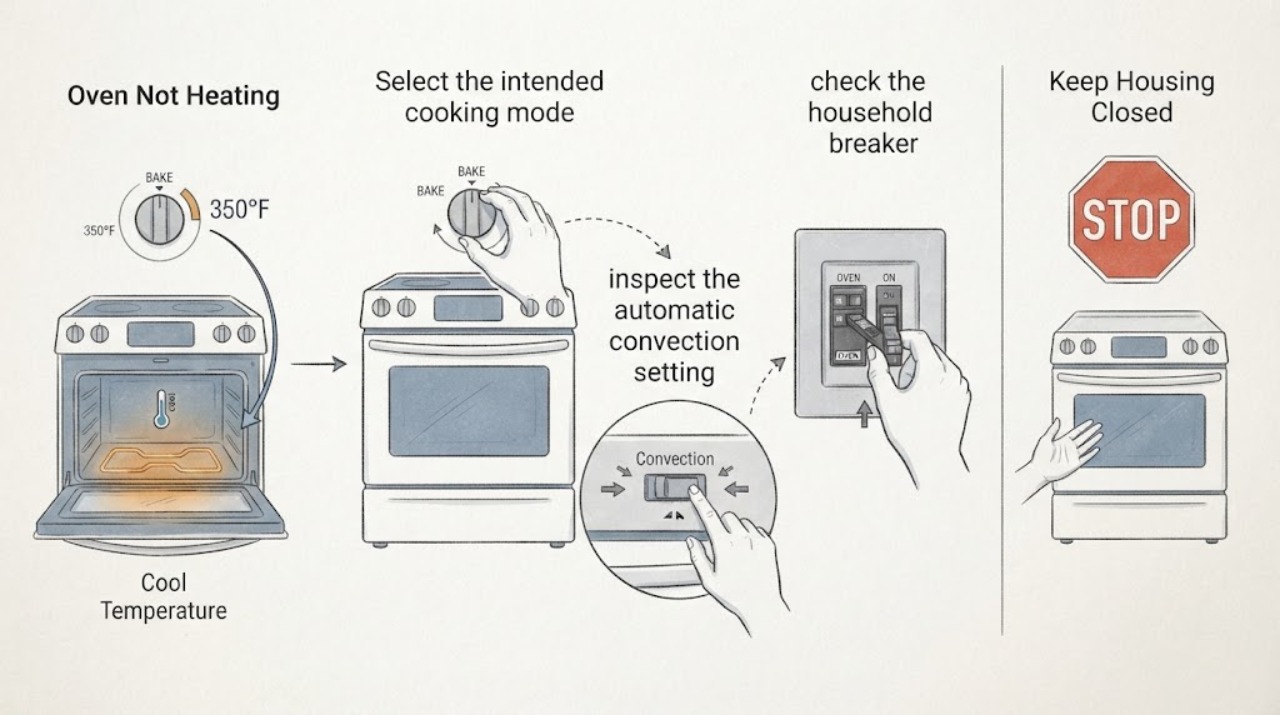
If a Bosch oven is not reaching the selected temperature, first confirm that a cooking mode and temperature are actually selected, the breaker or fuse has power, and the oven has had time to preheat. If it is a convection oven, Bosch notes that automatic settings can lower the entered temperature for convection performance. Keep air circulating around the shelf and do not cover the whole shelf with foil. If the oven remains cold or heats unevenly after these external checks, treat it as a technical fault: Bosch says oven heating-element repairs are high-voltage work for an expert. Do not open the oven, test live wiring, or replace an element from the symptom alone.
Before you begin
Safety first
- Do not open the oven, probe live wiring, replace a heating element, bypass a control, or repeatedly reset a tripping circuit.
Work through in order
Diagnostic checks
Use only checks that match the exact appliance or system and its official guide.
-
Check 1
Select the intended cooking mode and temperature, then allow the oven to preheat before judging whether it reaches the setting.
Expected result: The oven produces heat and reaches a preheat state, produces no heat, or heats but cooking remains uneven or slow.
Next step: Use the exact manual for the model-specific preheat display. If the oven remains cold or uneven after the power check, stop troubleshooting at the service boundary.
Why this matters
Why: A missing mode/temperature selection can mimic a no-heat complaint; continued cold or uneven heating after a valid selection is a possible technical fault.
-
Check 2
If the oven uses convection, inspect the automatic convection setting and how the rack and foil are positioned. Leave roughly 2 inches around the back sides of the shelf and do not cover the whole shelf with foil.
Expected result: Automatic convection conversion is active, the shelf/foil blocks circulation, or the air path is clear.
Next step: Use the recipe/manual setting intended for the mode and restore clear circulation. If the oven is still cold or uneven, do not compensate by guessing a failed part.
Why this matters
Why: Bosch says convection automatic settings can lower the set temperature by about 15 degrees and blocked circulation can affect oven heating and cooking performance.
-
Check 3
With the oven controls off, check the household breaker or fuse box that supplies the oven; do not remove an oven panel or perform live electrical measurements.
Expected result: The breaker/fuse is tripped or open, power appears restored, or the circuit will not hold/reset.
Next step: Reset only an obvious tripped breaker once if safe and permitted. If it trips again or the oven remains without power, stop and arrange qualified electrical/appliance service.
Why this matters
Why: Bosch identifies household power as a first check for an oven that does not heat; a repeated trip is an electrical safety boundary.
-
Check 4
Record whether the oven is completely cold, heats only in one mode, heats unevenly, or shows an error while the selected temperature is active.
Expected result: No mode heats, only one mode is affected, the oven heats unevenly, or an error/power symptom appears.
Next step: Keep the oven off if it remains cold, trips power, smells electrical, or shows a persistent error. Supply the model/E-Nr and symptom history to Bosch or an authorized servicer.
Why this matters
Why: The pattern can help a technician scope the exact model, but Bosch family guidance does not prove a particular element, sensor, relay, or control failure.
-
Check 5
Give service the exact E-Nr/model, oven type, selected mode and temperature, preheat behavior, convection-setting state, breaker/fuse behavior, and whether heat was absent or uneven.
Expected result: The oven still does not reach the selected temperature after the external checks, or heating-element trouble is suspected.
Next step: Arrange qualified Bosch or authorized service. Do not open the oven, test live wiring, bypass a control, or order a heating element from the symptom alone.
Why this matters
Why: Bosch says persistent no-heat or uneven heating may be a technical fault and warns that element repairs involve high-voltage electricity.
Use your observations
Decision map
Find the observation that best matches what you see, then follow the next safe action.
-
PATH 01Next step
What you see
The oven was not in a heating mode or no temperature had been selected, and it heats after selecting the mode and temperature.
Do this next
Use the exact model manual for normal preheat behavior and monitor the oven during the next normal use.
Why this path and its safety boundary
Why it matters: The original symptom was a control/setup condition rather than proof of a failed heating component.
-
PATH 02Next step
What you see
The oven is in convection mode and the cooking result seems lower than the entered number, while the oven otherwise heats.
Do this next
Check the model’s convection setting and recipe/manual instructions before calling it a heating failure.
Why this path and its safety boundary
Why it matters: Bosch says automatic convection settings can lower the entered temperature by about 15 degrees; this can explain an apparent set-temperature mismatch.
-
PATH 03Next step
What you see
The oven is powered and set correctly, but remains cold or heats unevenly after preheating.
Do this next
Keep the oven off and arrange authorized service; do not open the cabinet or replace an element based on this pattern.
Why this path and its safety boundary
Why it matters: Bosch identifies persistent no-heat or uneven heating as a possible technical fault, and the public family guidance does not identify the failed part without the model.
-
PATH 04Next step
What you see
The breaker trips again, an electrical smell or smoke appears, or the oven shows a persistent fault.
Do this next
Stop using the oven and arrange qualified electrical/appliance service. Do not reset repeatedly or perform live testing.
Why this path and its safety boundary
Why it matters: This is an electrical or appliance safety boundary, not a calibration or rack-position problem.
Helpful context
Understand the symptom
“Not heating to the set temperature” can mean the oven never heats, takes unusually long to preheat, or cooks unevenly. The display setting alone does not identify a failed element, sensor, relay, or control. Start with the selected mode, power, preheat behavior, and heat circulation that Bosch documents for its oven family.
Confirm the mode, temperature, and preheat state
Select the intended oven mode and temperature, then allow the oven to preheat before judging the result. Bosch specifically says to double-check that an oven temperature has been selected when testing whether it heats. Record whether the display shows a preheat state, whether any heat is produced, and whether the oven stays cold or only misses the expected cooking result.
Account for convection settings and blocked circulation
On a convection oven, check the automatic setting before interpreting a lower displayed or expected temperature as a failure; Bosch says an automatic convection setting can change the set temperature by about 15 degrees. Keep roughly 2 inches around the back sides of the shelf for circulation and never cover the entire shelf with foil.
Check household power without opening the oven
With the oven controls off, check the household breaker or fuse box for the oven circuit as Bosch directs. Do not remove panels, probe terminals, or perform live voltage tests. If the breaker trips again, will not reset, or the oven remains without power, stop and use qualified electrical or appliance service.
Treat persistent no-heat or uneven heat as service work
If the oven has proper power and a selected temperature but stays cold or heats unevenly, Bosch identifies this as a possible technical fault. A visible element appearance is not enough to select a replacement, and Bosch warns that heating-element repair involves high voltage. Keep the oven off and provide the exact E-Nr/model and the observed mode, temperature, preheat behavior, and power symptoms to an authorized servicer.
When checks do not resolve it
Need a professional?
Arrange qualified Bosch or authorized service if the oven remains cold or heats unevenly after confirming mode, temperature, circulation, and household power; stop immediately for repeated breaker trips, smoke, electrical odor, or a persistent fault.
Safety scope: Do not open the oven, probe live wiring, replace a heating element, bypass a control, or repeatedly reset a tripping circuit.
Have this ready
- Exact E-Nr/model, oven type, selected mode and temperature, preheat behavior, convection setting, rack/foil arrangement, breaker/fuse behavior, and whether the oven is cold or uneven.
Common questions
FAQ
Does a lower convection temperature always mean the Bosch oven is broken?
No. Bosch says automatic convection settings can change the set temperature by about 15 degrees for convection performance. Check the model’s setting and recipe/manual instructions before treating the difference as a heating fault.
What should I check first when a Bosch oven does not heat?
Confirm a cooking mode and temperature are selected, allow preheating, and check the household breaker or fuse box. Bosch says persistent no-heat or uneven heating may be a technical fault.
Can I replace the Bosch oven heating element myself?
Bosch says not to attempt heating-element repair because ovens and stoves use high-voltage electricity. Keep the oven off and arrange qualified service instead.
Can foil or crowded racks make the oven miss its temperature?
Bosch says to leave roughly 2 inches around the back sides of the shelf for heat circulation and never cover the entire shelf with foil. Restore circulation before concluding the oven has an internal fault.
Read the exact guide
Official sources
- Get Support - Ovens & RangesBosch · Official Bosch US oven support hub used for model-specific manual/service routing after family-level external checks.
- Oven Temperature Is InaccurateBosch · Official Bosch US support applies to Bosch ovens generally; exact convection options vary by model.
- Oven Troubleshooting: Broken heating elementBosch · Official Bosch US support applies to Bosch ovens and ranges generally; it does not establish a part diagnosis or fit for an unspecified model.
- Oven Troubleshooting: Convection Oven Not Heating UpBosch · Official Bosch US support applies to Bosch convection ovens generally; model-specific controls, modes, and service procedures remain subject to the exact manual.
Community feedback
Share a repair observation
Share a plain-text repair observation. Accepted observations are published automatically; this page may take a moment to update.