
On this page
Start here
Quick answer
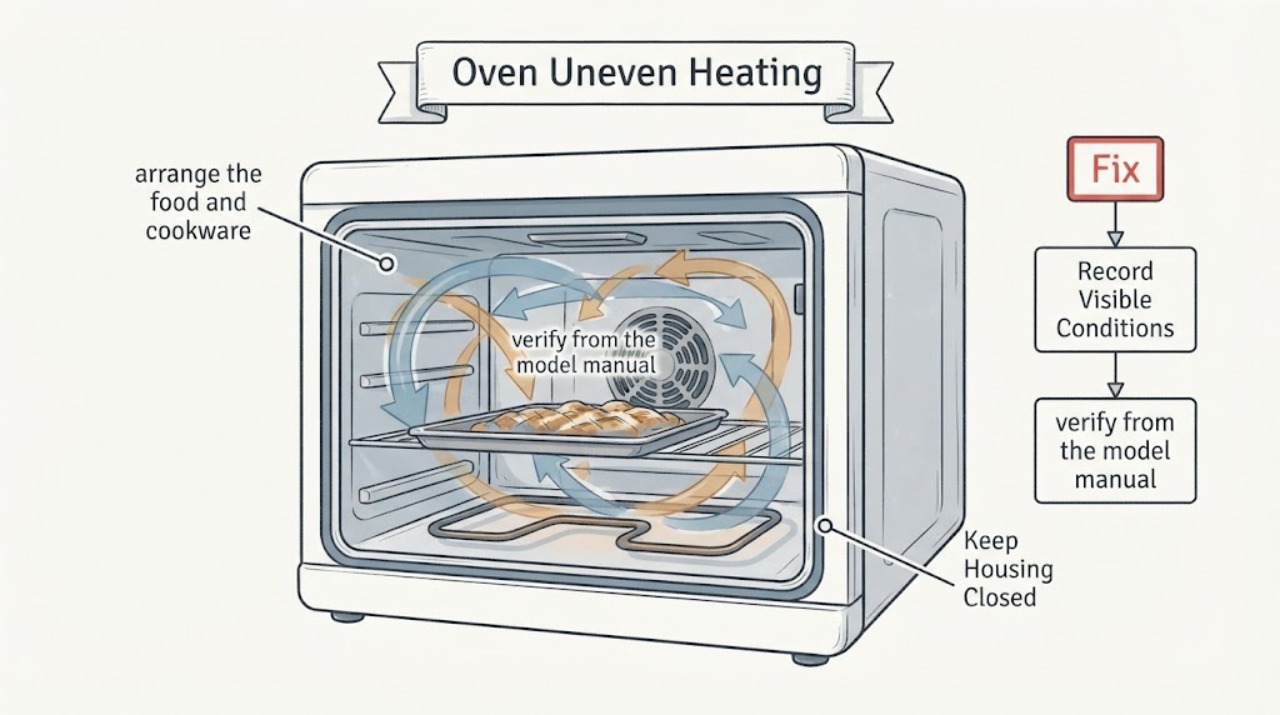
First record the Bosch model, heating mode, rack position, pan, recipe temperature and where the food is undercooked or over-browned. Bosch says convection settings can change the effective temperature, while blocked circulation, covering a shelf with foil, crowded cookware or an unsuitable rack position can produce uneven results. Preheat as the exact owner manual and recipe require, center the food, leave the documented circulation space around the shelf, and use the correct convection setting for the number of racks. If the same pattern remains with a clear oven, correct setup and a model-matched setting, or if an element is visibly damaged, treat it as a technical fault and arrange Bosch or qualified appliance service. Do not remove panels or test high-voltage heating parts yourself.
Work through in order
Diagnostic checks
Use only checks that match the exact appliance or system and its official guide.
-
Check 1
Record the complete Bosch model number, heating mode, selected temperature, preheat status, rack level, pan material and position, food quantity, and the exact location of the uneven result. Compare the same recipe result only after the oven has followed the model manual's preheat instruction.
Expected result: The issue occurs only in one mode, rack position or pan arrangement, or it repeats across modes and correctly positioned cookware.
Next step: Use the exact Bosch manual and the matching mode/rack guidance before changing calibration. If the pattern persists with correct setup, continue to the service boundary rather than opening the oven.
Why this matters
Why: A mode- or setup-specific result can reflect normal differences in radiant versus circulating heat or a recipe/setup mismatch. A repeatable result across correctly configured tests is stronger evidence of an appliance problem, but still does not identify a particular component.
-
Check 2
If using convection, verify from the model manual whether the oven has an automatic convection conversion feature and whether the selected recipe is written for convection or conventional baking. Do not transfer a temperature offset or conversion button sequence from another Bosch model.
Expected result: The oven is using convection with automatic conversion or a recipe intended for a different heating mode, or the correct model-matched mode is already selected.
Next step: Apply only the mode and recipe adjustment documented for the exact model. If uneven results remain in the documented mode, do not compensate indefinitely with guessed temperature changes; arrange service if the next external checks are clear.
Why this matters
Why: Bosch says convection settings can automatically change the set temperature for performance, and its general convection explanation says circulating air changes cooking speed and uniformity. A mode mismatch can look like uneven heating without proving a failed heater.
-
Check 3
With the oven cool, arrange the food and cookware so air can circulate: center the food as the recipe/manual directs, avoid overcrowding, leave about 2 inches around the back sides of the oven shelf where Bosch specifies it, and never cover the entire shelf with aluminum foil.
Expected result: The shelf is fully covered, cookware blocks the rear openings, pans are crowded or off-center, or the documented circulation space is available and the load is arranged correctly.
Next step: Remove only the external setup obstruction after the oven is cool and repeat the recipe using the exact manual's rack guidance. If the result remains uneven with clear circulation, stop changing the load and proceed to service assessment.
Why this matters
Why: Bosch identifies blocked circulation as a cause of uneven baking and warns that foil covering the entire shelf can block heat circulation. A clear, correctly arranged shelf removes one documented external cause but does not prove that internal airflow or heating components are healthy.
-
Check 4
From a safe distance during a normal preheat or bake, note whether the oven reaches the selected setting and whether any visible element behavior is abnormal; do not touch the cavity, remove guards, or expose wiring. Stop immediately for smoke, burning/electrical odor, sparks, damaged insulation, or a heater that appears physically broken.
Expected result: The oven heats without a hazard sign but the food remains uneven, or there is a visible damaged element or other hazard symptom.
Next step: For persistent uneven heating or any visible damage, keep the oven off and arrange Bosch or qualified appliance service. Do not remove panels or make energized measurements.
Why this matters
Why: The absence of a visible hazard does not prove that all elements, sensors or controls are working. Bosch says suspected broken or malfunctioning elements need customer-service troubleshooting and does not support user element repair.
-
Check 5
Prepare a service description instead of continuing repeated bake tests: provide the model number, mode, set temperature, rack and pan arrangement, preheat behavior, where the food is uneven, whether the result repeats, and any visible damage or odor.
Expected result: The setup and mode checks are correct but the result persists, or the oven does not heat normally or shows a hazard symptom.
Next step: Stop using the affected oven if there is damage, smoke, odor or abnormal heating, and arrange Bosch or qualified service. Keep the appliance closed and do not attempt a panel-level repair.
Why this matters
Why: Bosch's general support pages route persistent uneven heating or suspected element faults to customer service; they do not establish a universal model-independent repair or part diagnosis.
Use your observations
Decision map
Find the observation that best matches what you see, then follow the next safe action.
-
PATH 01Next step
What you see
Uneven browning changes when the documented rack position, pan spacing or correct convection/conventional mode is used, and there is no hazard symptom.
Do this next
Keep the model-matched mode and rack guidance, avoid covering the shelf, and adjust recipe timing only as permitted by the exact manual.
Why this path and its safety boundary
Why it matters: The result is consistent with a cooking-mode or air-circulation setup issue; it does not establish a failed heater.
-
PATH 02Next step
What you see
The oven is correctly preheated and arranged, but the same uneven result repeats across the documented mode and rack setup.
Do this next
Stop compensating with guessed offsets or part replacements and arrange Bosch or qualified appliance service with the model number and observations.
Why this path and its safety boundary
Why it matters: A technical issue is possible, but the general Bosch sources do not identify whether an element, sensor, control or airflow component is responsible.
-
PATH 03Next step
What you see
The oven does not heat normally, a heating element appears broken, or one heating phase is absent while the appliance is being observed from a safe distance.
Do this next
Turn the oven off, isolate power only from a safe location if needed, and arrange Bosch or qualified service. Do not remove covers or test high-voltage parts.
Why this path and its safety boundary
Why it matters: Bosch treats suspected malfunctioning heating elements or uneven heating with a possible element fault as a service matter, not a user repair.
-
PATH 04Next step
What you see
Smoke, burning or electrical odor, sparks, damaged insulation, scorching, or uncontrolled heating occurs.
Do this next
Stop using the oven, keep clear of hot or damaged parts, and arrange qualified service. Do not restart it to reproduce the symptom or open the cabinet.
Why this path and its safety boundary
Why it matters: This is outside a routine baking-result adjustment and creates a fire or electrical hazard.
Helpful context
Understand the symptom
Separate a recipe/setup result from a heating fault
Uneven browning or an undercooked center is not enough to identify a failed element. Record whether the result changes with the heating mode, rack position, pan load and preheating. Bosch notes that differences between old and new ovens are not unusual, and its convection guidance explains that conventional and convection modes distribute heat differently. A repeatable pattern after the documented setup checks is more useful than a single bake result.
Scope when the Bosch model is missing
This page covers Bosch's general user-level guidance for uneven baking and temperature results. Rack positions, automatic convection conversion, calibration controls, heating modes and service procedures vary by model. Find the complete model number and use its owner manual before applying a button sequence, temperature offset, rack chart or parts claim.
When to stop user checks
Bosch directs users to customer service when uneven baking suggests a malfunctioning element, and its element guidance says oven repairs should be left to experts because ovens use high-voltage electricity. The external checks below do not authorize opening the oven, probing wiring or replacing an element without model-matched service instructions.
When checks do not resolve it
Need a professional?
Arrange Bosch or qualified appliance service when uneven heating persists after the model-matched mode, preheat, rack, pan and circulation checks., Stop using the oven for smoke, burning/electrical odor, sparks, damaged insulation, a visibly broken element or uncontrolled heating., Do not open panels, probe high-voltage wiring, replace an element, or copy a temperature-calibration or convection sequence from another model.
Have this ready
- complete Bosch model number from the rating plate
- heating mode, selected temperature, preheat status and rack position
- pan type, food placement and exact location of uneven browning or undercooking
- whether the result repeats after correct setup
- any visible damage, smoke, odor, sparks or abnormal heating behavior
Common questions
FAQ
Can a Bosch convection setting make an oven seem uneven?
It can change cooking behavior. Bosch says convection circulates hot air and can cook faster, while its temperature guidance says automatic convection settings may change the set temperature. Confirm the exact model's mode and recipe instructions before treating a result as a hardware fault.
Can aluminum foil cause uneven baking?
Yes, if it covers the entire shelf. Bosch warns that full-shelf foil can block heat circulation. Remove only external setup obstructions while the oven is cool and follow the model manual for rack and cookware placement.
Should I replace a Bosch heating element when baking is uneven?
Do not infer or replace an element from uneven baking alone. Bosch says suspected broken or malfunctioning elements should be handled through customer-service troubleshooting, and its element guidance warns that ovens use high-voltage electricity.
What should I do if uneven heating continues after the setup checks?
Record the model, mode, rack, pan and repeatable result, then arrange Bosch or qualified appliance service. Persistent uneven heating may require model-specific diagnosis, and the general sources do not identify a universal internal part.
Read the exact guide
Official sources
- Convection Oven Not Heating Up - Oven TroubleshootingBosch · Official Bosch US troubleshooting page for convection ovens; used for the boundary between a no/uneven-heat symptom and professional troubleshooting, not for a model-specific component diagnosis.
- Broken Heating Element - Oven TroubleshootingBosch · Official Bosch US support page; it supports leaving element repairs to experts because ovens use high-voltage electricity, without identifying a part for an unspecified model.
- Wall Ovens & Ranges SupportBosch · Official Bosch US support portal; used to direct users to model-specific manuals and authorized service resources.
- What is a Convection Oven?Bosch · Official Bosch US educational page describing regular and true convection and general cooking behavior; it does not establish the hardware or controls of an unspecified model.
- Oven Temperature Is InaccurateBosch · Official Bosch US support page for general oven temperature and baking-result checks; exact model manual controls for mode, calibration and rack use.
Community feedback
Share a repair observation
Share a plain-text repair observation. Accepted observations are published automatically; this page may take a moment to update.