
On this page
Start here
Quick answer
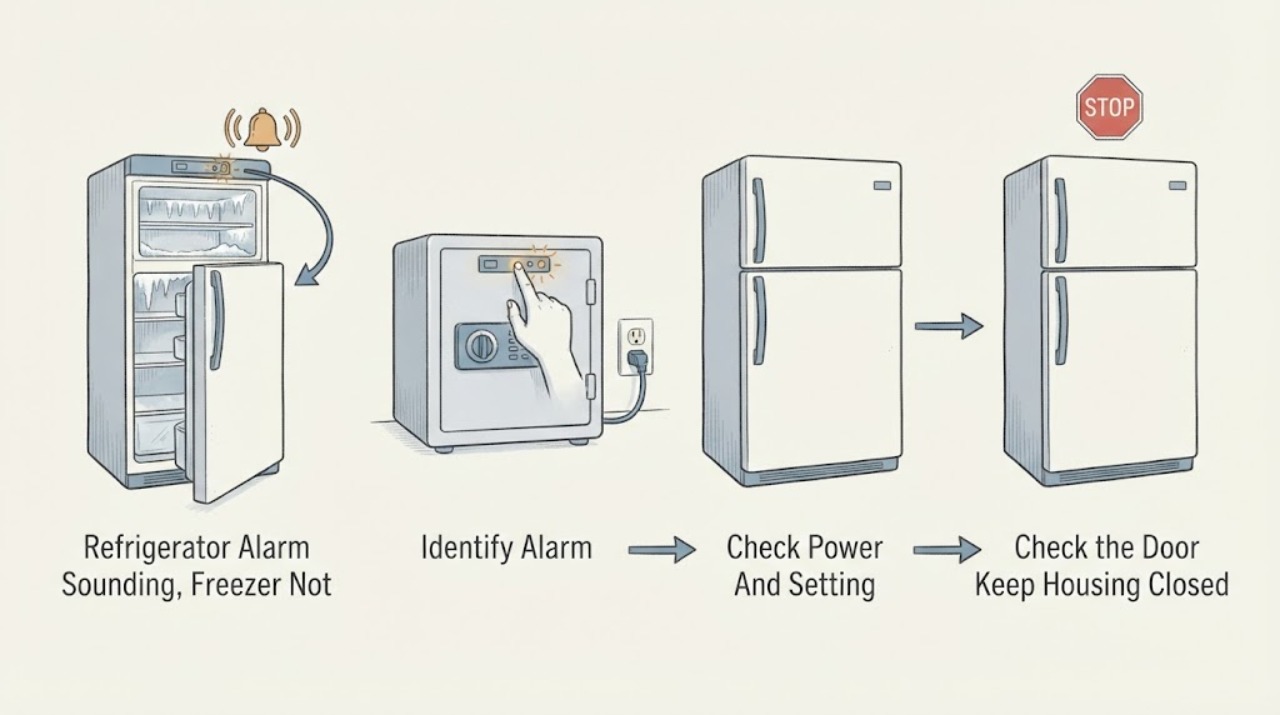
Treat the alarm as a signal to check the freezer condition, not as proof of one failed part. First identify whether the display indicates a door alarm or a temperature alarm, then confirm power, the freezer setting, complete door closure and unobstructed external ventilation. Bosch's opened manual says a temperature alarm can occur when the freezer is too warm, but also during initial startup or after a large amount of fresh food is loaded; silencing the tone does not prove that cooling has recovered. Keep the door closed, protect food that is thawing, and recheck temperature only after the model's documented recovery period. If the freezer remains warm with the correct setting and a closed door, the alarm returns, or food has started to thaw, arrange Bosch service rather than diagnosing a fan, compressor or sealed-system part.
Work through in order
Diagnostic checks
Use only checks that match the exact appliance or system and its official guide.
-
Check 1
Record the exact display, flashing symbol and alarm timing without opening panels. Check whether the alarm appears only with the door open, whether the freezer-temperature display flashes, and whether the appliance is newly switched on or was just loaded with a large amount of fresh food.
Expected result: The display points to a door alarm, a freezer-temperature alarm, an error message, or no clear message; startup or a large fresh-food load is or is not present.
Next step: Use the matching branch below and keep the exact model manual available before pressing an alarm-off or reset control.
Why this matters
Why: Bosch's opened manual treats door and temperature alarms differently and lists initial startup and large fresh-food loads as possible temperature-alarm triggers. An alarm sound alone does not identify a failed component.
-
Check 2
From a dry, safe position, confirm that the refrigerator is powered and that the freezer temperature setting was not changed accidentally. Do not repeatedly cycle power just to reproduce the alarm.
Expected result: The display and interior lighting are present, the outlet/circuit appears powered, and the freezer setting is correct or was found changed.
Next step: Restore only an obviously interrupted power connection or the documented temperature setting. If the appliance has no display/power or the setting is already correct, continue with door/ventilation checks and service escalation as needed.
Why this matters
Why: Bosch's US support lists an unplugged appliance and an accidentally changed thermostat setting as first checks for a freezer that is not running or is too warm.
-
Check 3
Close the freezer door fully and inspect the accessible gasket and door opening for an item preventing closure. From outside the cabinet, check that Bosch's external ventilation openings are not covered or blocked; do not remove panels.
Expected result: The door does not seal or an item blocks it, external ventilation is obstructed, or the door and external openings appear clear.
Next step: Correct only an obvious obstruction and close the door. If the gasket is damaged, the door will not seal, or the alarm persists with clear ventilation, arrange service.
Why this matters
Why: Bosch links an open or poorly closing door and covered external ventilation with freezer temperature problems. A clear door and vent do not rule in a compressor, fan or sealed-system fault.
-
Check 4
Keep the freezer door closed and recheck the displayed or measured temperature after the recovery period specified by the exact model manual. Inspect food only enough to determine whether it remains solid, is soft, or has started to thaw.
Expected result: The freezer reaches its setting and food remains solid, or it remains warm and food is soft/thawing.
Next step: If temperature is recovering and food is solid, continue monitoring. If food is thawing or temperature remains high, keep the door closed, protect the food and contact Bosch service.
Why this matters
Why: Bosch's manual says to check again after several hours for a warm-freezer alarm and separately warns that thawing food creates a food-safety decision. Silencing an alarm is not evidence of recovery.
-
Check 5
Stop user diagnosis when the alarm returns after the external checks, an error message appears, the freezer remains warm with the correct setting, or the door/ventilation issue cannot be corrected safely.
Expected result: The alarm or warm-freezer condition persists, an error is displayed, or food safety is uncertain.
Next step: Leave the appliance closed and arrange Bosch or authorized service with the model, display pattern, temperature observations and food condition. Do not open the sealed system or perform live electrical tests.
Why this matters
Why: The official guidance supports external observations and model-specific manual lookup but does not establish a remote diagnosis of a fan, compressor, sensor, refrigerant charge or control board.
Use your observations
Decision map
Find the observation that best matches what you see, then follow the next safe action.
-
PATH 01Next step
What you see
The alert appears when the freezer door is open or not sealing, while the freezer is otherwise at its normal temperature.
Do this next
Close the door, remove only an obvious obstruction and verify that the gasket makes contact. Use the exact model's alarm-off control if needed; request service if the door cannot seal.
Why this path and its safety boundary
Why it matters: This matches Bosch's door-alarm path rather than proof of a cooling-system failure.
-
PATH 02Next step
What you see
The freezer-temperature alarm began at initial startup or after a large amount of fresh food was loaded, and the freezer is otherwise running.
Do this next
Keep the door closed, use only the exact model's documented alarm control, and check temperature and food condition after the stated recovery period.
Why this path and its safety boundary
Why it matters: Bosch documents these as situations that can trigger a temperature alarm without automatically proving a component failure.
-
PATH 03Next step
What you see
The freezer remains too warm after recovery, with the correct setting, a closed door and unobstructed external ventilation.
Do this next
Protect food and arrange Bosch or authorized service. Do not remove covers, test the compressor/fan live or work on the sealed refrigerant system.
Why this path and its safety boundary
Why it matters: Bosch's external checks have not explained the condition, so a professional diagnosis is needed; the symptom does not identify a particular internal part.
-
PATH 04Next step
What you see
Frozen food is soft, thawing or has defrosted, or the temperature cannot be verified while the alarm remains active.
Do this next
Keep the door closed, move food to a working freezer or suitable cold storage if safe, follow the exact manual and applicable food-safety guidance, and contact service.
Why this path and its safety boundary
Why it matters: This is a food-safety escalation as well as an appliance troubleshooting issue. Bosch warns against refreezing thawing or thawed food.
Helpful context
Understand the symptom
An alarm is not the same as a confirmed cooling failure
Bosch documentation separates a door alarm from a temperature alarm. A warm freezer can trigger the latter, but the opened manual also lists initial startup and a large fresh-food load as situations that may trigger it. Pressing an alarm-off control only stops the audible signal; it does not establish that the freezer has returned to temperature. Use the display, door condition, measured temperature and food state together.
Use only safe external checks
Bosch's US freezer guidance starts with a connected appliance, a door that closes properly and a thermostat that was not changed accidentally. The opened manual also calls for clearing covered external ventilation openings. These checks do not prove a failed fan, compressor, sensor or refrigerant circuit, so the cabinet and sealed system remain service territory.
Protect food before troubleshooting further
Keep the freezer closed as much as possible while you determine whether the temperature is recovering. Bosch's opened manual says not to refreeze food that has thawed or started to thaw and to discard frozen food that has defrosted and is hotter than 5°C in its power-failure guidance. Follow the exact model instructions and applicable food-safety rules when deciding what to keep.
When checks do not resolve it
Need a professional?
Arrange Bosch or authorized service when the freezer remains warm after the model's recovery period, the alarm returns with correct settings and a sealed door, or an error message appears., Treat soft/thawing food as an immediate food-safety decision; do not refreeze thawed food solely because the alarm was silenced., Do not remove refrigerator panels, touch the sealed refrigerant circuit, or perform live electrical tests to identify a fan, compressor, sensor or control fault.
Have this ready
- complete Bosch model/E-Nr and region
- exact alarm symbol or display, timing and whether it is a door or temperature indication
- freezer setting and measured temperature with the time observed
- door/gasket and external-ventilation observations
- whether the appliance was newly started, heavily loaded or food has softened/thawed
Common questions
FAQ
Does a Bosch freezer alarm always mean a failed compressor?
No. Bosch's opened manual distinguishes door and temperature alarms and lists initial startup or a large fresh-food load as possible temperature-alarm triggers. If the freezer stays warm after the external checks and recovery period, service is needed without guessing the failed part.
Can I silence the Bosch refrigerator alarm?
Use only the alarm-off control shown in the exact model manual. The opened Bosch manual says a touch field can switch off the warning tone, but silencing the tone does not prove that freezer temperature or food safety has recovered.
What should I check if the freezer is warm?
Confirm power and the freezer setting, close the door fully, clear visible obstructions at the door and external ventilation openings, and recheck after the model's recovery period. Bosch directs persistent warm-freezer conditions to support.
Can thawed food be refrozen after the alarm?
Bosch's opened manual says not to refreeze food after it has thawed or started to thaw. Protect the food and follow the applicable food-safety guidance instead of relying on the alarm being silenced.
Read the exact guide
Official sources
- Bosch KFN96VPEAL User ManualBosch Home Appliances · Opened official Bosch manual used as a model-specific example for door/temperature alarm behavior, external ventilation, recovery and food-safety warnings. Exact task model is unspecified, so button names and timings remain conditional on the user's manual.
- Freezer problems | Common Freezer ProblemsBosch Home Appliances · Official Bosch US support page for external checks when a freezer is not running or is too warm; it routes unresolved warm-freezer conditions to Bosch support.
- Get Support - RefrigerationBosch Home Appliances · Official Bosch refrigeration support entry point used for exact model/manual lookup and authorized service; it does not supply a universal alarm diagnosis.
Community feedback
Share a repair observation
Share a plain-text repair observation. Accepted observations are published automatically; this page may take a moment to update.