
On this page
Start here
Quick answer
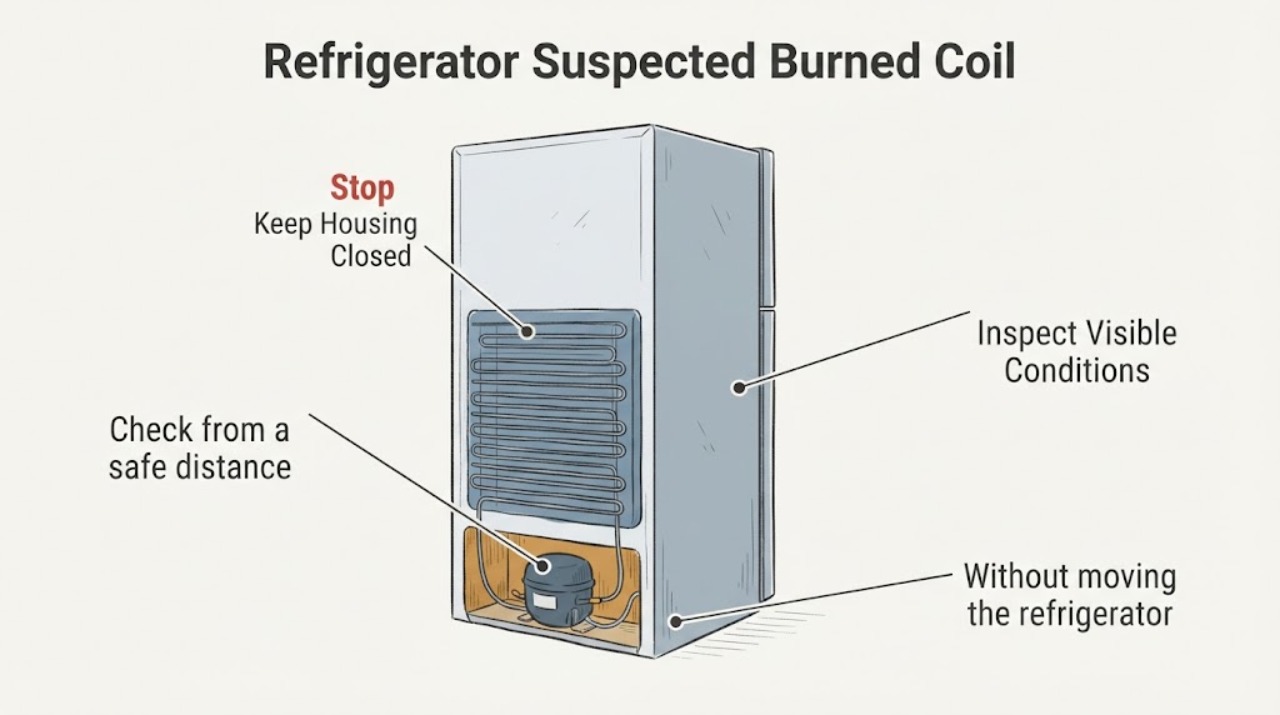
Treat a visibly burned, scorched or smoking area on a Bosch refrigerator as a stop-use problem, not as proof of a particular condenser, evaporator, heater or electrical coil. If there is smoke, flame, exposed wiring, liquid near electrical parts or active burning, keep clear and follow emergency procedures; do not touch, clean, scrape, move, open or re-energize the refrigerator. If the area is cool and no active hazard remains, record the location and visible condition from a safe distance, find the refrigerator's E-Nr. and contact Bosch or an authorized servicer. Bosch says refrigerator repair should be left to professionals, and its parts system requires the model number for fitment. Do not order a coil or attempt refrigerant/electrical work from the word “coil” alone.
Work through in order
Diagnostic checks
Use only checks that match the exact appliance or system and its official guide.
-
Check 1
Check from a safe distance whether there is active smoke, flame, sparking, exposed wiring, liquid at an electrical area, or a surface that is still hot or burning.
Expected result: An active hazard is present, or the area is cool with no ongoing smoke, heat or electrical activity.
Next step: For smoke or fire, leave the area and follow emergency procedures. Otherwise keep the refrigerator disconnected/out of use when safe and arrange qualified appliance/electrical service; do not touch or restart it to test the coil.
Why this matters
Why: An active hazard is a stop-use/emergency condition; a cool inactive mark still does not identify the damaged system.
-
Check 2
Without moving the refrigerator or opening a panel, note the location of the suspected burn and the surrounding signs: odor, discoloration, melted material, cooling loss, unusual noise, water or a tripped breaker.
Expected result: The mark is only a reported or distant visual observation, or there are signs of heat, electrical damage, leaking liquid or loss of cooling.
Next step: Keep the unit out of use if damage or hazard is present and provide the location and symptoms to service. Do not clean, scrape or dismantle the area.
Why this matters
Why: The signs help service triage but do not distinguish a condenser, sealed-system, heater, compressor or wiring fault; a refrigerator that has stopped cooling needs prompt Bosch support.
-
Check 3
If there is no visible burn or active hazard and the only complaint is poor cooling, observe only the Bosch-supported external basics: whether the interior light/power is present, whether the thermostat was changed accidentally, and whether the rear air vents are blocked by stored items.
Expected result: Power is absent, the thermostat is mis-set, or the rear vents are blocked; or those external conditions are normal.
Next step: Correct only a clearly accidental setting or movable obstruction when no damage or hazard exists. If cooling remains poor or any burned area is present, contact Bosch support instead of running more tests.
Why this matters
Why: These are possible simple cooling causes, but they do not confirm or rule out a burned coil. A visible burn takes priority over ordinary cooling troubleshooting.
-
Check 4
Locate and record the Bosch model number/E-Nr. and production information from the rating plate; give the model, location, photographs taken from a safe distance and symptom timeline to Bosch or an authorized servicer.
Expected result: The E-Nr. is available, or it cannot be read without moving/opening the appliance or approaching a damaged area.
Next step: Use Bosch support/service with the available identification. Do not move a hot, smoking, wet or electrically damaged refrigerator to reach the rating plate.
Why this matters
Why: Bosch's parts and support systems are model-specific; inability to safely obtain the label is a reason for service assistance, not a reason to guess a coil or part.
-
Check 5
Before any further operation, confirm that a qualified technician or Bosch support has cleared the appliance and that no burned wiring, refrigerant-system damage or structural heat damage remains.
Expected result: The issue has been professionally assessed and cleared, or no professional assessment has occurred.
Next step: Do not re-energize or use the refrigerator until qualified service provides the next safe step. Do not purchase or install an unverified coil.
Why this matters
Why: A visual reset or temporary cooling response cannot establish that a burned component is safe; Bosch assigns refrigerator repair and parts replacement to professionals.
Use your observations
Decision map
Find the observation that best matches what you see, then follow the next safe action.
-
PATH 01Next step
What you see
There is smoke, flame, sparking, exposed wiring, liquid near electrical parts or continuing heat/burning.
Do this next
Leave the area and follow emergency procedures for fire or smoke. Keep the appliance out of use and arrange qualified appliance/electrical service when safe.
Why this path and its safety boundary
Why it matters: This is an active safety hazard, not a refrigerator part-identification exercise.
-
PATH 02Next step
What you see
The refrigerator is cool and inactive, but a burned or scorched mark is visible or cooling has stopped.
Do this next
Document the location from a safe distance, obtain the E-Nr. only if safe, and use Bosch or authorized service. Do not clean, open or power-test the damaged area.
Why this path and its safety boundary
Why it matters: The evidence is sufficient to escalate the appliance, but not to name the coil type, cause or replacement part.
-
PATH 03Next step
What you see
No burn is confirmed and the complaint is only that cooling is poor, with no smoke, heat or electrical warning.
Do this next
Perform only those non-invasive checks if the appliance is otherwise safe; contact Bosch if cooling remains poor or the suspected burn is confirmed.
Why this path and its safety boundary
Why it matters: Bosch supports limited external checks for power, thermostat setting and blocked rear vents, but these do not validate the assigned burned-coil claim.
Helpful context
Understand the symptom
“Coil” is not enough to identify the failure
A refrigerator report may use “coil” for a visible condenser area, a sealed-system tube, an electrical winding or another component. Without the Bosch model, location and a technician's finding, the label does not establish which system is involved. The safe decision is based on visible danger—smoke, heat, arcing, exposed wiring or liquid—not on a guessed part name.
Stop before inspecting a burned area
Do not touch, wipe, scrape or photograph a burned area from close range while it is hot, smoking, wet or electrically exposed. Do not pull the refrigerator out, remove a rear cover, reset a tripped circuit repeatedly or restart it to see whether the coil still heats. Keep people away and use qualified emergency or appliance service when an active hazard is present.
Document the symptom without diagnosing it
Once the area is cool and safe, record where the suspected burn is seen—inside the cabinet, behind the unit, beneath it or near the power connection—along with smoke, odor, cooling loss, noise, water and any breaker event. A distant photograph and the time of the event can help a technician, but do not infer condenser, evaporator, compressor, heater or wiring failure from appearance alone.
Use the Bosch model-specific service path
Find the complete Bosch E-Nr. and production information from the rating plate and give it to Bosch or an authorized servicer with the symptom record. Bosch's parts page uses the model number to show diagrams and parts, so a generic “coil” listing is not a safe compatibility check. If cooling has stopped, protect the contents and tell support; do not power a visibly damaged unit just to run a cooling test.
When checks do not resolve it
Need a professional?
Stop using the refrigerator and arrange qualified service for any confirmed burn, scorch, smoke, sparking, exposed wiring, liquid near electrical parts, unusual heat or loss of cooling., Do not order a condenser, evaporator, compressor, heater, electrical coil or other part from the word “coil” alone; Bosch requires the E-Nr. for model-specific parts information., Do not open covers, perform live tests, handle refrigerant, scrape residue or repeatedly re-energize a damaged appliance.
Have this ready
- Bosch model number/E-Nr. and production information
- safe-distance description or photograph of the location
- when the mark, odor, smoke, heat or cooling change began
- whether a breaker, outlet, water leak or unusual noise was involved
- whether the appliance is currently disconnected and whether food temperatures changed
Common questions
FAQ
Which coil is burned in my Bosch refrigerator?
The word “coil” does not identify a Bosch refrigerator component. Without the E-Nr., location and professional inspection, do not assume condenser, evaporator, heater, compressor or electrical-winding damage.
Can I clean or replace a burned refrigerator coil myself?
Do not touch, scrape, clean or replace a suspected burned component. Bosch says refrigerator repairs should be left to professionals, and its parts system uses the model number to identify compatible parts.
What if the Bosch refrigerator is no longer cooling?
If a burn or electrical hazard is present, keep the refrigerator out of use and contact Bosch service. Without a hazard, Bosch's limited external checks are power, thermostat setting and unobstructed rear vents, followed by support if cooling remains poor.
What information should I give Bosch service?
Provide the complete E-Nr. and production information, the safe-distance location and appearance of the suspected burn, when it began, any odor/smoke/heat or breaker event, and whether cooling changed. Bosch routes service and repair-document requests through its support channels.
Read the exact guide
Official sources
- Fridge repairsBosch Home Appliances · Opened Bosch's official refrigerator repair page directly. It applies to Bosch refrigerators generally and says repair should be left to professionals; it does not identify the type or cause of a burned coil.
- Fridge and Fridge Freezer Spare PartsBosch Home Appliances · Opened Bosch's official refrigerator parts page directly. It requires the model number/E-Nr. for diagrams and parts, and is used only to establish model-specific fitment and service routing, not to name a coil.
- What to do if your refrigerator isn't cooling properlyBosch Home Appliances · Opened Bosch's official refrigerator troubleshooting page directly. It supports only external power, thermostat and rear-vent checks before support; it is not evidence that a burned coil exists or can be user-repaired.
- Contact UsBosch Home Appliances · Opened Bosch's official contact page directly. It provides appliance advice, service/repair and technical-document channels for large appliances; it does not diagnose the reported component.
Community feedback
Share a repair observation
Share a plain-text repair observation. Accepted observations are published automatically; this page may take a moment to update.