
On this page
Start here
Quick answer
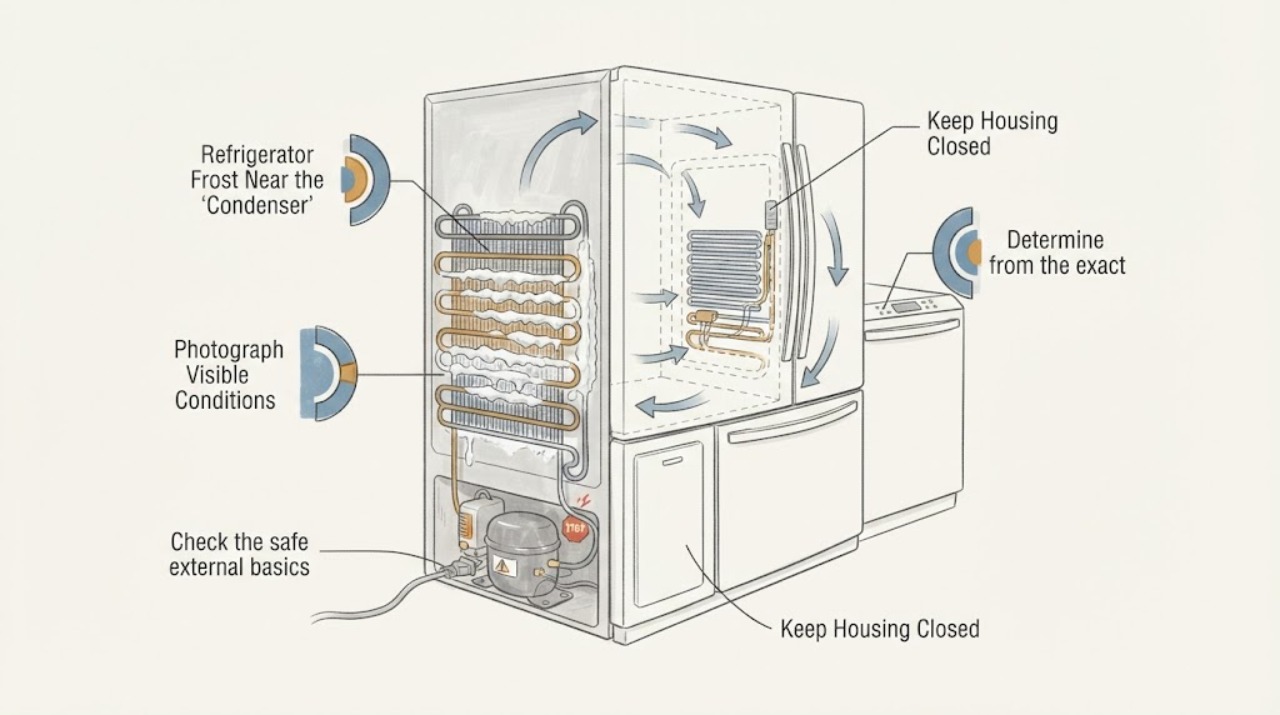
Before calling this a Bosch condenser that is freezing, record exactly where the ice is: the freezer wall, refrigerator rear wall, an air vent, a drain area, or an external rear component. Bosch's consumer guidance says NoFrost appliances are designed to prevent interior ice, while a Bosch refrigerator guide says some rear-wall frost can be functional and defrost automatically. A heavy frost pattern that blocks airflow, prevents the set temperature from being reached, or returns after the model-approved defrost needs Bosch service. Check power, temperature setting, doors, food clearance and external ventilation first. Do not remove covers, damage refrigerant tubes, or assume that a dual-compressor description applies to every Bosch model; provide the exact E-Nr and FD numbers for model-specific diagnosis.
Work through in order
Diagnostic checks
Use only checks that match the exact appliance or system and its official guide.
-
Check 1
Photograph and map the frost before changing settings: identify whether it is on the freezer wall, refrigerator rear wall, a vent, a drain area or an external rear component. Record the complete Bosch E-Nr and FD numbers from the rating plate and note both compartment temperatures.
Expected result: The ice is confined to a rear interior wall or vent, covers a broad freezer area, appears around a drain, or is on an external rear assembly; the model and production numbers are readable or missing.
Next step: Keep the photo and model data. Do not remove panels or identify a compressor, evaporator, heater or condenser from appearance alone.
Why this matters
Why: Different locations represent different diagnostic paths, and Bosch's published guides do not establish one universal “condenser freezing” condition across Bosch refrigerators. The E-Nr and FD are required to match the manual and service information.
-
Check 2
Determine from the exact Bosch manual whether the appliance is NoFrost/fully automatic or a design that requires user defrosting. Do not apply a defrost instruction from a different Bosch series or region.
Expected result: The manual says the freezer is fully automatic NoFrost, the refrigerator compartment defrosts automatically, or the appliance has a user defrost procedure.
Next step: Follow only the exact manual's defrost and food-storage instructions. If the model is NoFrost and heavy ice returns or temperature is not reached, arrange service.
Why this matters
Why: A NoFrost appliance is intended to remain free of ordinary interior frost, while automatic rear-wall frost may still be functional on some models. A manual-defrost design has a different baseline and cannot be judged by NoFrost expectations.
-
Check 3
Check the safe external basics: confirm the interior light and power response, verify the thermostat has not been changed, keep food away from interior vents and the back wall, and make sure the external ventilation openings are not covered.
Expected result: Power is absent, the setting was changed, vents or rear ventilation are blocked, food is pressed against the wall, or these conditions are normal.
Next step: Correct only accessible obstructions or settings described by the manual. If the target temperature remains unmet, keep the doors closed and request Bosch troubleshooting.
Why this matters
Why: Bosch identifies power, thermostat position and blocked vents as simple causes of poor cooling; blocked food clearance and external ventilation can also affect temperature and moisture behavior. These findings do not identify an internal defrost part.
-
Check 4
Check door closure and moisture entry without dismantling the appliance: make sure the door is not obstructed, avoid prolonged openings, cover food and allow hot food to cool before loading. Inspect the visible gasket for a gap or damage.
Expected result: The door was left open, is obstructed or poorly sealed, hot food or uncovered food added moisture, or the door closes and seals normally.
Next step: Correct a safe obstruction or usage condition and monitor temperature and frost recurrence. Arrange service for a damaged gasket, recurring heavy frost or continued warming.
Why this matters
Why: Warm humid air can increase condensation and frost, so an ice pattern caused by air entry should not be labeled a defrost-system failure. A normal visible seal does not prove the internal defrost system is healthy.
-
Check 5
If the exact Bosch manual permits user defrosting, disconnect power as instructed, move frozen food to a safe insulated location, collect meltwater and complete only that procedure. Never chip ice, damage tubing, or open the rear cover to reach a heater or refrigeration component.
Expected result: The ice clears and the target temperature returns, the ice returns after the permitted defrost, or the temperature remains high after defrosting.
Next step: Stop repeating manual defrosts when the problem returns and provide Bosch service with the E-Nr, FD, frost location, temperature history and defrost result.
Why this matters
Why: A temporary improvement shows that ice affected operation but does not distinguish moisture entry, airflow, drain, sensor, heater, control or sealed-system causes. Recurrence or persistent warming is a service signal.
Use your observations
Decision map
Find the observation that best matches what you see, then follow the next safe action.
-
PATH 01Next step
What you see
A thin frost layer is limited to the Bosch refrigerator rear wall, temperatures are normal and the exact guide describes automatic rear-wall defrost.
Do this next
Keep food away from the wall, cover food, cool hot items before storage and minimize door-open time while monitoring temperature.
Why this path and its safety boundary
Why it matters: The frost may be functional condensation and automatic defrost rather than a failed condenser or heater.
-
PATH 02Next step
What you see
A Bosch NoFrost model has heavy interior ice that blocks airflow, the freezer or refrigerator does not reach its set temperature, or the ice returns after the exact manual's safe defrost.
Do this next
Protect perishable food, keep the refrigeration circuit closed and arrange Bosch service with the E-Nr, FD and frost photographs.
Why this path and its safety boundary
Why it matters: This is a model-specific refrigeration or automatic-defrost service pattern; frost recurrence alone cannot name a heater, sensor, compressor or refrigerant fault.
-
PATH 03Next step
What you see
The frost is concentrated near blocked vents, food touching the rear wall, an obstructed door or a visible gasket gap, while the appliance otherwise reaches temperature.
Do this next
Correct the accessible obstruction or closure condition allowed by the manual and monitor for recurrence before requesting component diagnosis.
Why this path and its safety boundary
Why it matters: Airflow or warm-moist-air entry can explain the ice without proving a defrost failure.
-
PATH 04Next step
What you see
The ice is on an external rear component, the exact component cannot be identified, or the user would need to remove a panel or touch refrigerant tubing to inspect it.
Do this next
Stop at visual documentation and external ventilation checks, then request model-specific professional diagnosis; do not disassemble or puncture the refrigeration system.
Why this path and its safety boundary
Why it matters: The assigned word “condenser” and the generic dual-compressor description do not establish which Bosch architecture or fault is present.
Helpful context
Understand the symptom
Confirm what is actually freezing
“Condenser” is not a location description that can safely identify a defrost fault. Photograph the ice before moving food or unplugging the appliance and note whether it is on the freezer wall, refrigerator rear wall, around a vent or drain, or on an external rear assembly. Bosch's general de-icing page describes NoFrost as a humidity-removal system that prevents ice inside the refrigerator and freezer, while a Bosch refrigerator document says rear-wall frost can form for functional reasons and defrost automatically. The location and the exact E-Nr are therefore more useful than the label alone.
Separate normal cycling from a heavy-ice condition
A matching Bosch guide treats a thin rear-wall frost layer as a normal automatic-defrost condition and advises keeping food away from the wall, covering food, cooling hot food first and opening the door briefly. The same manual treats a set temperature that is not reached together with a heavily iced NoFrost evaporator as a fault path. This distinction matters: frost by itself is not enough to name a heater, sensor, compressor or refrigerant problem.
Use Bosch's external checks before service
Bosch's refrigerator troubleshooting page recommends confirming power, checking the thermostat and making sure rear vents are not blocked. The model manual also warns that blocked external ventilation openings and frequent opening can change operation. If those checks do not restore the target temperature, or ice returns after the exact model's safe defrost procedure, stop repeating resets and arrange Bosch service rather than opening the refrigeration system.
Common questions
FAQ
Can a Bosch refrigerator condenser really freeze?
The word condenser does not identify the frost location or the appliance architecture. First photograph the ice and confirm the E-Nr and FD. Bosch's public guidance discusses NoFrost and interior rear-wall frost, while an external rear component needs model-specific professional diagnosis.
Is frost on the refrigerator rear wall always a fault?
No. Bosch documentation for a refrigerator family says rear-wall frost can form for functional reasons and defrost automatically. Heavy frost, blocked airflow or a temperature that is not reached changes the situation and calls for the exact manual and service path.
What Bosch information does a technician need?
Provide the product number (E-Nr), production number (FD), frost location, temperatures, photographs and what changed after any model-approved defrost. Bosch's manual specifically directs customers to the E-Nr and FD when contacting service.
Read the exact guide
Official sources
- Spare parts, accessories & online support - KGN36A73/16Bosch Home Appliances · Opened Bosch exact-model support page used only to show that Bosch organizes troubleshooting and parts by an identified E-Nr/model; it is not evidence that KGN36A73/16 is the assigned refrigerator.
- De-icing your fridgeBosch · Official Bosch general refrigerator guidance used for the distinction between NoFrost and user-defrost designs and for safe power-off/food/water handling; exact controls remain model-specific.
- Refrigerator Not Cooling Properly | TroubleshootingBosch Home Appliances · Official Bosch support page used for safe external checks before professional assessment; it does not define a dual-compressor condenser fault.
- Information for Use KGN36..Bosch · Opened Bosch manual for the KGN36.. family only. It is cited for explicitly scoped examples of NoFrost, rear-wall frost, temperature/vent/door checks, safe defrost and E-Nr/FD service identification; those model-specific details are not claimed as universal for every Bosch refrigerator.
- Defrosting in the refrigerator compartmentBosch · Opened Bosch-hosted document used only for its stated rear-wall condensation and automatic-defrost behavior; it is not used to infer the assigned refrigerator's model architecture.
Community feedback
Share a repair observation
Share a plain-text repair observation. Accepted observations are published automatically; this page may take a moment to update.