
On this page
Start here
Quick answer
If a Bosch 800 French-door refrigerator opens fully only after it is pulled out of a niche, treat the symptom as an installation-clearance question first, not as proof of a bad hinge. “800” is a series, not the complete Bosch E-Nr.; different 800 French-door models have different cabinet dimensions and door-clearance drawings. Photograph the rating plate, obtain the full E-Nr. and market, and compare the exact installation sheet with the niche width, wall-side reveal, depth, and door-swing path. Bosch's published 800-series examples show that door and drawer access depends on the opening angle and side space; one B26FT50SNS sheet is only an example, not a universal 800 measurement. Do not cut the cabinet, bend or replace hinges, or keep dragging the refrigerator out against a taut water or power line. Have the installer or Bosch service resolve a clearance mismatch; treat an exposed unfinished-looking side as an installation/finish question until the exact product documentation confirms what should be visible.
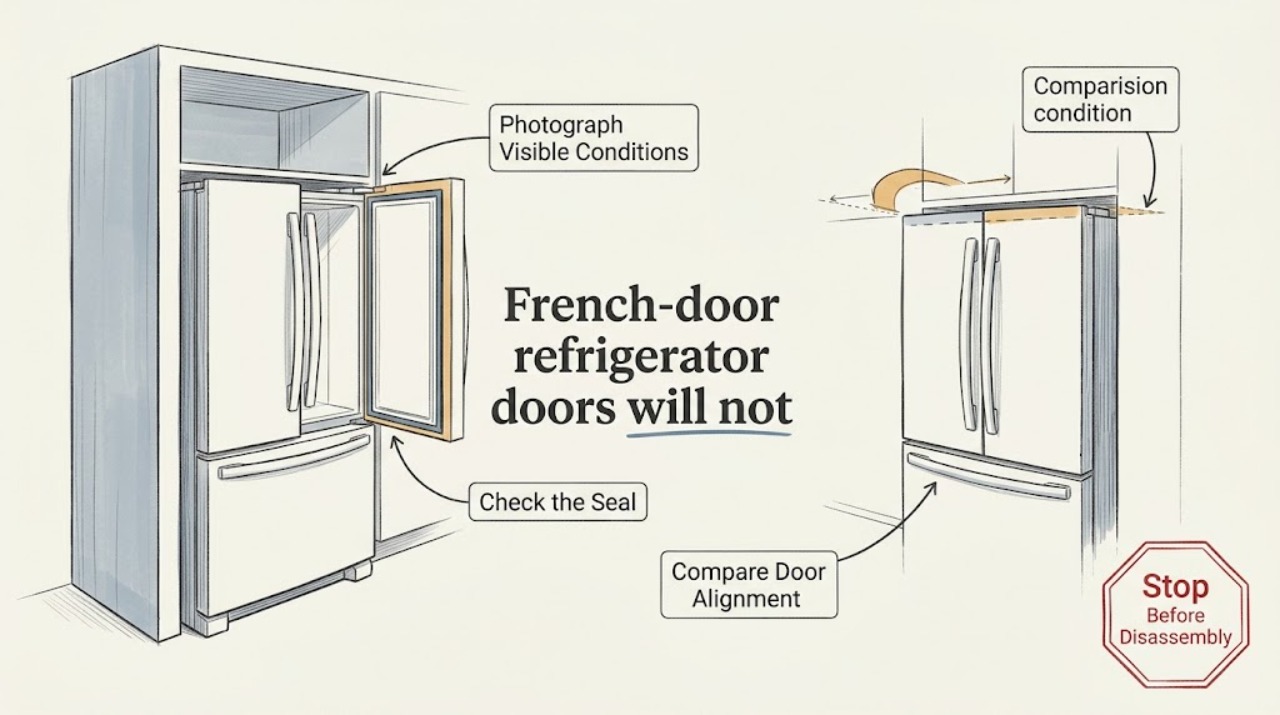
Work through in order
Diagnostic checks
Use only checks that match the exact appliance or system and its official guide.
-
Check 1
Without moving the refrigerator, photograph the rating plate and copy the complete Bosch E-Nr., FD/production information if shown, market, door configuration, and whether the unit is freestanding, counter-depth, or built into cabinetry. Record which door edge or handle stops and whether a drawer can still open.
Expected result: Only “800” is known, the full E-Nr. is available, or the label identifies a different 800 French-door configuration; the door stops against a wall, panel, handle collision, or an internal position stop.
Next step: Use the complete E-Nr. in Bosch's owner-manual/specification search before changing anything. Do not order hinges, alter the cabinet, or treat a visible side panel as a defect from the series name alone.
Why this matters
Why: The series name cannot select the correct door-clearance drawing or installation instruction. A collision with the niche is an installation geometry clue, while a stop with generous clearance may need model-specific alignment or hinge service.
-
Check 2
From the front, measure or photograph the clear space between each door's swing path and the adjacent wall, filler, cabinet side, backsplash, or handle obstruction with the doors closed. Do not pull the refrigerator forward to gain access to a hidden measurement.
Expected result: The handle or door edge meets the wall/panel before the documented opening angle, the niche is visibly tighter on one side, or both sides remain clear but the door still stops early.
Next step: Compare the measured path with the exact E-Nr. installation drawing and involve the installer for any clearance mismatch. Do not copy a gap or angle from another 800 model and do not adjust the hinge to compensate for cabinetry.
Why this matters
Why: A side-wall or filler obstruction makes the niche clearance the leading branch. Bosch's 800-series drawings demonstrate that door swing and drawer access are geometry-dependent; an open area that looks wide at the front may still be insufficient at the hinge or handle line.
-
Check 3
Check the appliance's visible position and floor condition without moving it: look for a unit sitting hard against a side wall, an uneven floor, a displaced trim/filler, a protruding handle, or a door that sits visibly low or high. Keep hands clear of the hinge gap and do not remove covers.
Expected result: The refrigerator is visibly skewed or unstable, a trim/panel contacts the door, the door alignment looks uneven, or the unit is stable and the obstruction is part of the niche itself.
Next step: Document the position and ask the installer or qualified Bosch service to assess leveling and alignment against the exact installation instructions. Do not shim, loosen hinge fasteners, or cut the surrounding cabinetry as a DIY correction.
Why this matters
Why: A placement or alignment issue can change the door path, but it does not prove a bent hinge or authorize hinge adjustment. If the cabinet geometry is the limiting factor, leveling alone will not create the required side reveal.
-
Check 4
If the refrigerator has already been pulled forward, stop and inspect only what is safely visible: note whether the water line, power cord, anti-tip hardware, flooring, or rear spacer appears taut, strained, crushed, or displaced. Photograph the newly visible side panel and the original niche position; do not pull farther.
Expected result: A line or cord is taut, a spacer or anti-tip arrangement is displaced, the floor is being marked, or nothing is strained and only a painted/non-stainless side becomes visible.
Next step: Return the appliance only as the installation instructions or installer permits, or leave it in the safe position and arrange professional help if anything is strained. Ask Bosch or the seller/installer to confirm the intended exposed finish from the exact E-Nr.; do not repaint, drill, trim, or detach the panel.
Why this matters
Why: Tension or displacement creates an installation and safety boundary, not a door-diagnosis opportunity. A side panel that appears only after moving the appliance may be a normally hidden finish or a fit/finish concern; the series name cannot decide which.
-
Check 5
Use the exact Bosch installation sheet to check whether the refrigerator is intended to sit in that niche and whether the door opening required for shelf and drawer access is available. Record the model's required cutout, side clearance, rear/top spacing, and any door-stop or spacer instruction without substituting another 800 model's figures.
Expected result: The exact sheet specifies more side space or a different depth/door arrangement than the niche provides, the sheet matches the niche but the door still stops, or no matching sheet can be found because the E-Nr. is incomplete.
Next step: Give the E-Nr., measurements, photos, and the sheet to the installer, retailer, or Bosch service. Do not alter the niche or replace hinges until the responsible party confirms the model-specific remedy.
Why this matters
Why: A documented mismatch supports an installer/cabinet-clearance remedy rather than an appliance part. A matching installation plan with a persistent stop leaves door alignment, obstruction, or hardware diagnosis for qualified service; no exact sheet means the decision remains unresolved.
Use your observations
Decision map
Find the observation that best matches what you see, then follow the next safe action.
-
PATH 01Next step
What you see
The door stops at the same wall, filler, or handle position every time, and pulling the refrigerator forward creates the needed opening angle.
Do this next
Stop moving the appliance and have the installer or Bosch service compare the E-Nr.-specific clearance plan with the cabinet. Do not cut the cabinet or bend the hinge.
Why this path and its safety boundary
Why it matters: The niche or adjacent obstruction is more likely than an internal hinge failure. The exact 800 model's door-swing drawing, not the family label, determines the required reveal.
-
PATH 02Next step
What you see
The niche meets the exact installation drawing, but the door is visibly low, high, skewed, rubbing without a wall collision, or stops with clear side space.
Do this next
Arrange model-specific Bosch or qualified appliance service and provide the photos, E-Nr., and stop location. Keep the door use gentle and do not loosen hinge fasteners.
Why this path and its safety boundary
Why it matters: Alignment, leveling, a door-stop setting, or a hardware issue remains possible, but the observation does not identify a hinge or authorize adjustment.
-
PATH 03Next step
What you see
The refrigerator only exposes an unfinished-looking side after being pulled out, while the door path is normal when positioned according to the exact installation plan.
Do this next
Photograph the side and ask the installer, retailer, or Bosch to confirm the specified finish and placement for the full E-Nr. Do not repaint, cover, drill, or modify the panel.
Why this path and its safety boundary
Why it matters: This is not enough evidence of a refrigerator defect. The side may be intended to remain hidden, or the installation/finish package may be wrong; the exact product record and purchase/installation scope decide that question.
-
PATH 04Next step
What you see
Moving the refrigerator makes the water line, power cord, anti-tip hardware, floor, or rear spacer taut, damaged, or displaced, or the door cannot be used without force.
Do this next
Stop and keep the refrigerator in the safest stable position. Do not pull, push, or test it again; obtain installer or qualified Bosch service, and isolate water or power only from a dry safe location if an active hazard exists.
Why this path and its safety boundary
Why it matters: The situation has crossed into an installation and safety boundary. Continued movement or forced opening can cause water damage, electrical damage, tipping, or finish damage.
Helpful context
Understand the symptom
A Bosch 800 refrigerator that opens farther after being pulled forward is showing a changed geometry: the niche, a side wall, an adjacent panel, or the appliance's position is affecting the door path. That observation is useful, but it does not identify a hinge or door defect. Bosch's manual portal asks for the full E-Nr. because the 800 label covers multiple refrigerator models and configurations.
The published 800-series B26FT50SNS specification sheet illustrates why copying a dimension from a different 800 model is unsafe: it provides a defined door-swing drawing and says drawers can be pulled out with the door open 90 degrees, while complete drawer removal requires the door to open farther. Use that sheet only as evidence that clearance is part of the design; use the exact E-Nr. installation instructions for the actual niche.
Do not modify the cabinet, trim a wall, force the door, bend a hinge, or repeatedly pull a heavy refrigerator forward to make a temporary test. If the unit has been pulled out, stop before stressing the water line, power cord, flooring, or anti-tip arrangement. A side that becomes visible only when the refrigerator is outside its intended position is not enough to call the finish defective; document it and have the installer or Bosch service compare it with the exact product record.
When checks do not resolve it
Need a professional?
Contact the installer, retailer, or Bosch service when the full E-Nr.-specific clearance drawing does not match the niche, the door remains restricted with documented clearance, the door is misaligned or rubbing, the refrigerator has been pulled far enough to strain a water line, cord, spacer, or anti-tip arrangement, or the intended side finish is disputed. Stop immediately for a damaged line, water leak, unstable appliance, pinched cord, or forced door. Do not alter the cabinet, remove hinge covers, loosen hinge hardware, drill or repaint the side panel, or keep moving the refrigerator to repeat the test.
Common questions
FAQ
Is Bosch 800 a complete refrigerator model number?
No. Bosch uses 800 as a product series. The complete E-Nr. on the rating plate is needed to retrieve the matching manual and installation/specification documents; different 800 French-door models can have different dimensions and clearance drawings.
How much side clearance does a Bosch 800 French-door refrigerator need?
There is no single safe number for every 800 model. Bosch's 800-series specification examples show model-specific door-swing geometry; use the exact E-Nr. installation sheet rather than copying a gap from another 800 refrigerator. A clearance mismatch should be handled by the installer or Bosch service, not by bending the hinge or cutting the cabinet.
Does the exposed painted side mean the Bosch refrigerator is defective?
Not necessarily. If the side is visible only after the refrigerator is pulled out of the niche, document it and ask the installer, retailer, or Bosch to confirm the intended finish and placement for the full E-Nr. Do not repaint, cover, drill, or alter the panel before that confirmation.
Read the exact guide
Official sources
- B36CT80SNS French Door Bottom Mount RefrigeratorBosch US · The opened product page identifies B36CT80SNS as an 800 Series French Door refrigerator and exposes model-specific manuals/specification/installation documents; it is not evidence that B36CT80SNS dimensions apply to every 800 model.
- Search for Owner Manuals and Spec SheetsBosch US · Bosch's official portal requires the appliance's complete Model Number (E-Nr.) and directs owners to the rating plate; it does not provide one universal clearance specification for the 800 series.
- 36" French Door Bottom-Freezer — 800 Series — Stainless Steel B26FT50SNSBosch / BSH Home Appliances · This is one specific 800-series model sheet, used to demonstrate model-specific door-swing and drawer-access geometry. Its measurements must not be transferred to an unspecified Bosch 800 refrigerator.
Community feedback
Share a repair observation
Share a plain-text repair observation. Accepted observations are published automatically; this page may take a moment to update.