
On this page
Start here
Quick answer
Treat the two observations separately before naming a part. Bosch family manuals show that a refrigerator or freezer display can represent the set temperature rather than a live cabinet measurement, while Bosch guidance also says temperature can vary with door openings, load, newly stored food, ambient temperature and sunlight. Identify the exact E-Nr, compare the cabinet with a suitable refrigerator/freezer thermometer after the appliance has had time to stabilize, and check the ice bin, panel lock, water connection, filter status and visible ice clumping only as the model manual allows. Keep hands out of the dispenser opening; if food is warming, there is a leak, an alarm/error returns or the dispenser remains inoperative after these external checks, stop using the affected function and arrange Bosch or qualified appliance service.
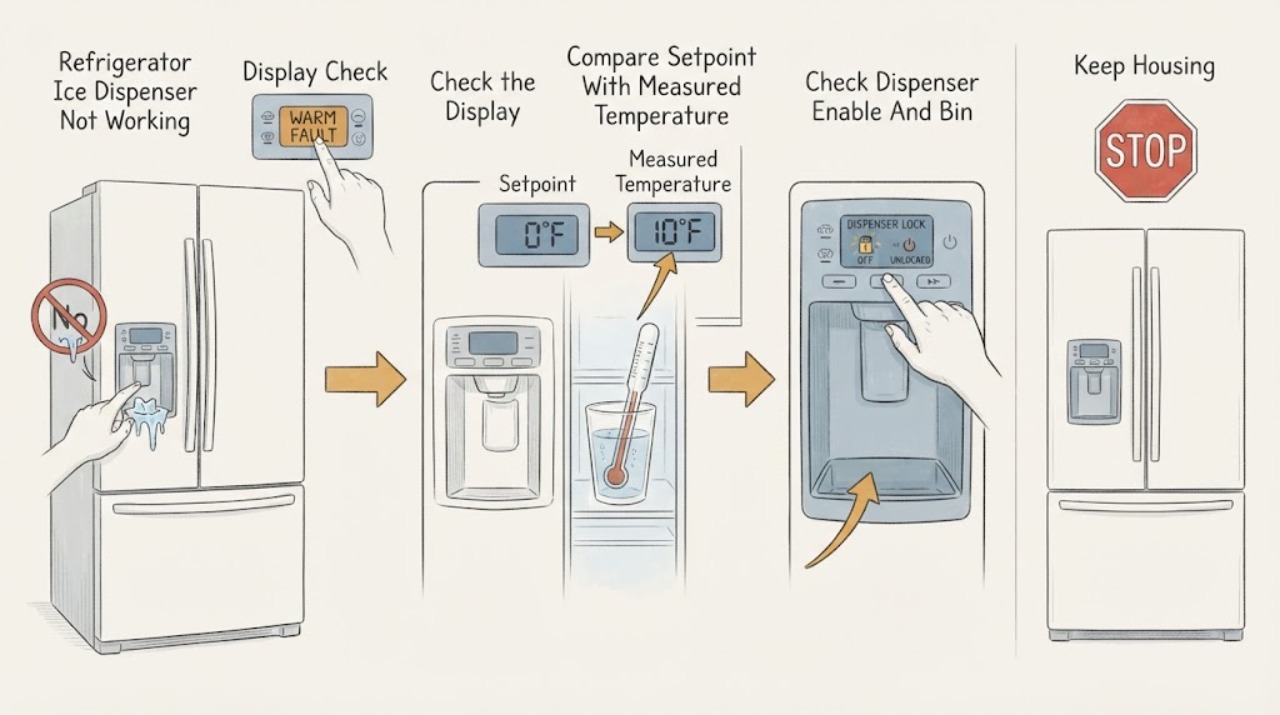
Work through in order
Diagnostic checks
Use only checks that match the exact appliance or system and its official guide.
-
Check 1
Read the complete Bosch E-Nr from the rating plate and open that exact owner manual. Find the control-panel description for the refrigerator/freezer temperature display, the ice-maker/dispenser enable control and any panel-lock indicator.
Expected result: The model-matched manual says the displayed value is a set temperature, or it documents a live/diagnostic temperature view; the exact dispenser controls are also identified, or they are not.
Next step: Use the exact manual for the rest of the checks. If the E-Nr cannot be read or the display behavior is not documented, do not assign a code, tolerance or reset sequence; provide the E-Nr to Bosch service.
Why this matters
Why: A displayed value cannot be compared with a thermometer until its meaning is known. Bosch manuals in the opened families describe the normal refrigerator/freezer indicators as set temperatures, but that does not prove the same interface exists on every Bosch model.
-
Check 2
With the refrigerator closed as normally used, place a suitable refrigerator/freezer thermometer where the model manual permits and record the compartment reading after allowing the appliance time to stabilize. Also note recent door openings, a large load, newly stored warm food, high room temperature or direct sun.
Expected result: The measured compartment is near the model-selected setting, or it remains materially warmer and food is softening/warming.
Next step: If the measured temperature is stable and food is safe, continue to the dispenser checks. If it remains high, protect perishable food, keep the appliance closed and arrange model-matched service; do not remove panels or diagnose the compressor/control board.
Why this matters
Why: A difference between a setpoint display and a momentary thermometer reading is not automatically a failed sensor. Bosch documents several normal causes of temperature variation; a sustained warm measurement with food warming is a cooling/service concern.
-
Check 3
Use the exact manual to verify that ice production/dispenser operation is enabled, the panel lock is off, and the removable ice bin is fully seated. Do not reach into the dispenser opening.
Expected result: The lock or ice-maker control was off, the bin was mis-seated, or those conditions were already correct.
Next step: Correct only the documented control or seating condition and make one normal dispensing attempt. If the controls and bin are correct, continue to the water and visible-ice checks rather than ordering a part.
Why this matters
Why: Bosch manuals identify panel lock/ice controls and state that the ice bin fits the dispenser by its shape; a disabled control or poor seating can stop dispensing without proving a broken motor or board.
-
Check 4
If the exact manual permits bin removal, remove the bin with the appliance idle and inspect only the visible ice, feed-screw area and chute for clumping or a cube blockage; clean/reseat the bin exactly as documented. Keep hands and implements outside the crusher/dispenser opening.
Expected result: The bin is empty, cubes are frozen together or a visible blockage is present, or the bin/path looks clear.
Next step: Follow the exact manual for safe bin handling and discard/replace clumped ice as directed. Never use a knife, heat source or fingers in the chute; if the path is clear and no ice dispenses, stop at the external checks and request service.
Why this matters
Why: An empty bin points toward ice production/water/freezer conditions; clumped cubes or a blocked feed path can prevent delivery even when ice exists. A clear path does not prove an internal drive fault.
-
Check 5
From outside the appliance, confirm that the water supply is connected and open, the visible line is not kinked, and the filter status is not calling for replacement. Replace a filter only with the exact model-approved procedure and filter; after a documented filter change, follow Bosch’s purge/discard instructions.
Expected result: Water supply/filter status is abnormal, or water supply and filter status are normal.
Next step: Correct only the documented external supply/filter condition, then allow the model’s normal ice-making time. If water and filter checks are normal but ice remains unavailable, arrange service rather than opening the inlet or ice-maker assembly.
Why this matters
Why: Bosch identifies water connection and filter condition as dispenser dependencies and recommends filter replacement on applicable refrigerators; a generic filter or guessed pressure value cannot establish fit or cure this model.
-
Check 6
Stop troubleshooting and record the E-Nr, measured compartment temperature, display setting, food condition, ice-bin state and any alarm/error when there is sustained warming, thawing food, a leak, repeated failure after the documented external checks or an electrical/smoke symptom.
Expected result: The compartment is genuinely warming, food is unsafe/softening, water is leaking, an alarm/error returns or the dispenser remains inoperative with the documented external conditions satisfied.
Next step: Protect food and keep the affected function/appliance off as appropriate; contact Bosch or a qualified appliance technician with the recorded model and observations. Do not open panels, bypass interlocks or test live wiring.
Why this matters
Why: These combined results exceed a safe generic dispenser adjustment. They can involve model-specific water, ice-maker, temperature-control or electrical service work that the no-model task cannot identify.
Use your observations
Decision map
Find the observation that best matches what you see, then follow the next safe action.
-
PATH 01Next step
What you see
The exact Bosch manual says the display is a set temperature, and a separate thermometer is near that setting while food remains properly cold.
Do this next
Keep the door closed during stabilization, account for load/ambient conditions, and use the exact manual’s temperature guidance; do not order a sensor from the display mismatch alone.
Why this path and its safety boundary
Why it matters: The apparent “higher than displayed” problem may be a comparison between a target setting and a changing measured temperature, not proof of a failed sensor.
-
PATH 02Next step
What you see
A model-appropriate thermometer remains warmer than the selected setting and food is warming or thawing after normal stabilization.
Do this next
Protect perishables, minimize door opening and arrange Bosch/qualified service with the E-Nr and readings. Do not diagnose or replace a compressor, sensor or control board without model-matched service evidence.
Why this path and its safety boundary
Why it matters: This is a real cooling-performance concern even if the display is only a setpoint; the ice failure may be secondary to insufficient freezing or may be a separate water/dispenser issue.
-
PATH 03Next step
What you see
The bin contains ice but cubes are frozen together or a visible feed/chute blockage prevents delivery.
Do this next
Follow the exact manual’s bin removal/reseating and cleaning instructions, keep fingers and tools out of the crusher opening, and request service if the path remains blocked or the mechanism will not move.
Why this path and its safety boundary
Why it matters: The dispenser path is restricted; this observation does not establish a failed motor or control board.
-
PATH 04Next step
What you see
The bin is empty and the ice-maker control, panel lock and bin seating are correct, but the water/filter check is abnormal or the freezer is not maintaining the model-selected condition.
Do this next
Correct only the model-documented external water/filter condition and allow the normal production interval. If no ice returns, provide the E-Nr and readings to service.
Why this path and its safety boundary
Why it matters: Ice production can be limited by the documented water/filter path or by insufficient freezing; an empty bin alone does not identify a component.
-
PATH 05Next step
What you see
There is a water leak near electricity, smoke/electrical odor, an alarm/error that returns, unsafe food warming, or repeated dispenser failure after the documented external checks.
Do this next
Stop the affected operation, isolate power or water only when safe, protect food and contact Bosch or a qualified technician; use emergency help for active smoke/fire or an unsafe electrical condition.
Why this path and its safety boundary
Why it matters: This is a stop-use/service boundary rather than a reason to reach into the chute, bypass a lock or open the appliance.
Helpful context
Understand the symptom
A displayed temperature may be a setting, not a live thermometer reading
The exact display behavior depends on the Bosch family. In the opened Bosch manuals, the refrigerator and freezer indicators are described as showing the set temperature. A newer Bosch B30/B36 manual separately says the appliance may take several hours to reach the set temperature and that cabinet temperature varies with door openings, load, newly stored food, ambient temperature and direct sunlight. Get the complete E-Nr from the rating plate and use the matching manual before treating a display number as proof of a cooling failure.
The ice symptom has its own external checks
Bosch dispenser instructions identify the water connection, filter, control lock, ice-bin seating and the visible ice path as separate dependencies. A bin that is empty, a bin that is full but clumped, and a bin that is not seated do not mean the same thing. Remove and reseat only removable parts described by the exact manual, and keep hands and tools out of the chute or crusher opening.
Use the model gate before parts or resets
Bosch owner support asks for the appliance E-Nr to retrieve the correct manual. Because the task supplies no model, this page keeps the checks outside the cabinet and avoids claiming a universal ice-maker reset, filter fit, temperature tolerance or replacement part. If the measured temperature is genuinely high or food is warming, protect the food and arrange service instead of repeatedly cycling the dispenser.
When checks do not resolve it
Need a professional?
Arrange Bosch or qualified appliance service when measured temperature remains high after normal stabilization, food is warming, a leak/alarm/error returns, or the dispenser remains inoperative after model-documented external checks., Do not reach into the ice dispenser opening, bypass the panel/door interlock, open the cabinet, test live wiring or guess a sensor, inlet valve, motor or control-board replacement from symptoms alone., For smoke, burning electrical odor, arcing or an unsafe water/electrical leak, stop using the appliance and seek emergency or qualified help as appropriate.
Have this ready
- complete Bosch E-Nr/model and serial information
- displayed refrigerator/freezer settings and unit
- thermometer readings and when they were taken
- whether food is warming or thawing
- ice-bin state, lock/ice-maker state and visible clumping
- filter/supply observations and any alarm/error
Common questions
FAQ
Does the Bosch refrigerator display show the actual temperature?
That depends on the Bosch family and interface. The opened Bosch manuals for two families describe the refrigerator/freezer display as the set temperature, while a newer manual separately documents normal temperature variation. Check the exact E-Nr manual and use a suitable thermometer before concluding that a sensor or control has failed.
Why does a Bosch ice dispenser stop even when there is ice in the bin?
Bosch documentation points to separate conditions such as panel lock, bin seating, clumped ice/feed path, water supply or filter status. Inspect only the visible, user-accessible path described by the exact manual and never reach into the crusher opening.
Should I replace the filter or ice-maker part first?
Do not choose a part from the symptom alone. Confirm the E-Nr, water/filter status, bin condition and measured temperature first; Bosch’s owner-manual lookup is model-number based, and fitment or internal diagnosis is model-specific.
What if the displayed temperature seems high and food is warming?
Protect perishable food, keep the door closed, record a thermometer reading after normal stabilization and arrange Bosch or qualified service if the measured temperature remains high. Do not open panels or repeatedly cycle the dispenser to diagnose cooling components.
Read the exact guide
Official sources
- Dokument:Bosch Home Appliances · Official Bosch-hosted dispenser manual PDF. Used only for the documented user-level ice-bin/feed/chute checks and crusher safety; exact model instructions remain controlling.
- Search for Owner Manuals and Spec SheetsBosch Home Appliances · Official Bosch US owner-manual portal. Supports the model gate because it requires the appliance Model Number (E-Nr); it is not evidence for an unseen model’s technical behavior.
- FBM_Europa_Bosch_9000881384_en_20130221Bosch Home Appliances · Official Bosch-hosted manual PDF. Used to corroborate that the covered family displays set temperatures and has separate lock/quick-ice/dispenser controls; exact E-Nr remains controlling.
- Get Support - Refrigeration | Bosch Home AppliancesBosch Home Appliances · Official Bosch US refrigeration support hub. Supports exact-model manual lookup, troubleshooting/support access and service contact; it does not define a universal Bosch refrigerator fault or part.
- Refrigerator FAQs | Tips and Tricks | Bosch Home AppliancesBosch Home Appliances · Official Bosch US refrigerator FAQ. Supports recommended refrigerator/freezer settings and filter replacement/purge guidance; exact model controls the display and dispenser implementation.
- 8001068741_FBM_en_fr_es 9905Bosch Home Appliances · Official Bosch-hosted manual PDF for the family/model range stated in the document. Used narrowly for set-temperature display semantics, panel lock/ice controls, bin/dispenser warnings and initial cooling behavior; not a universal Bosch model claim.
- Use and Care Manual B30BB130SS, B30IB100SP | BoschBosch Home Appliances · Official Bosch-hosted B30 family manual. Used only for its explicitly named models as an example of stabilization time, recommended temperatures and documented causes of temperature variation; it does not establish behavior for an unknown Bosch E-Nr.
Community feedback
Share a repair observation
Share a plain-text repair observation. Accepted observations are published automatically; this page may take a moment to update.