
On this page
Start here
Quick answer
A Bosch 800 Series refrigerator with no ice does not by itself prove a coolant or refrigerant leak. First separate an ice-maker, water-supply, filter, bin, or freezer-temperature problem from evidence that the sealed cooling circuit is not maintaining temperature. If cooling is weak or refrigeration tubing appears damaged, stop using the appliance and obtain qualified Bosch service; do not open the sealed system. This is an appliance-failure decision, not a recommendation to buy a different refrigerator, and the full model number is required before any model-specific part or procedure is considered.
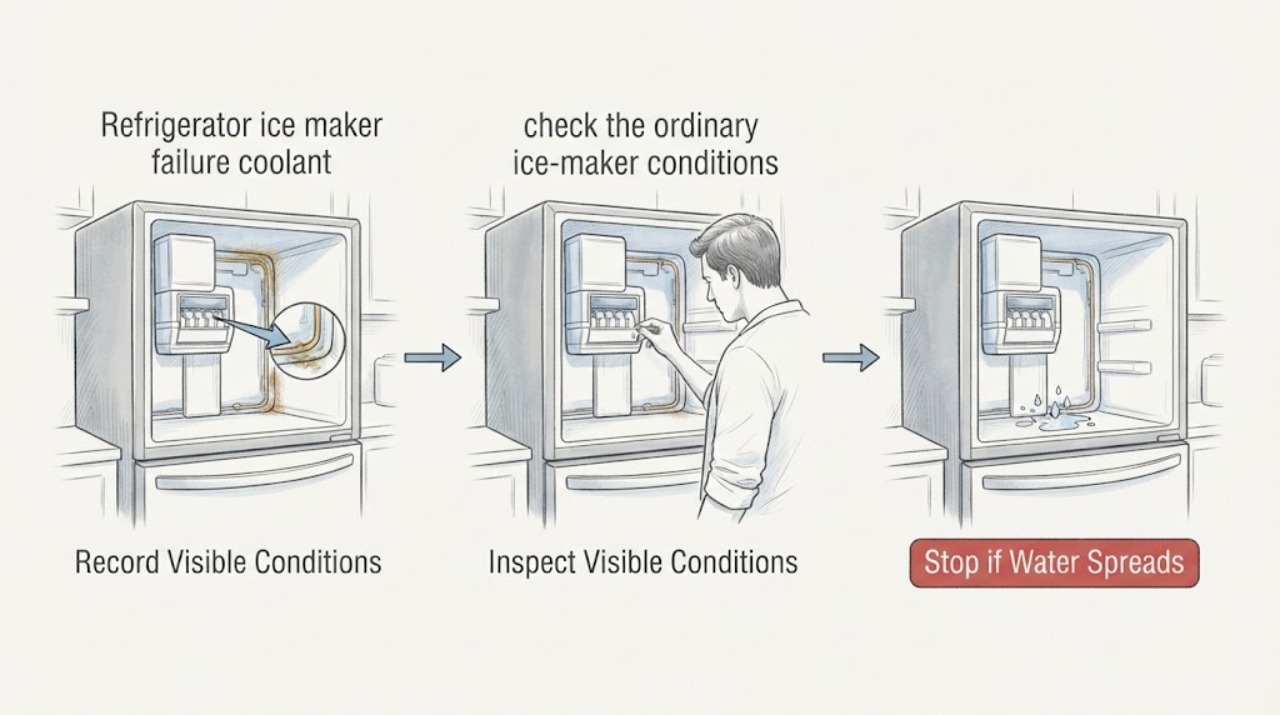
Work through in order
Diagnostic checks
Use only checks that match the exact appliance or system and its official guide.
-
Check 1
Read the complete Bosch model and production label, not just '800 Series' or 'counter-depth,' and record whether the refrigerator section and freezer are maintaining their normal temperatures. Note whether only ice production stopped or whether food compartments are also warming.
Expected result: The full model is available and only ice production is affected, or the full model is missing and cooling is also weak or changing.
Next step: Use the full model for the correct Bosch manual and service request. If cooling is deteriorating, protect perishable food and arrange qualified appliance service rather than continuing ice-maker experiments.
Stop if: Do not diagnose or order a sealed-system component from the family name alone, and do not remove rear covers to look for a leak.
Why this matters
Why: Bosch uses model-specific manuals and configurations within a product family. An ice-only symptom keeps the water and ice-maker paths in consideration; a simultaneous cooling problem makes a sealed-system or broader refrigeration fault more important, but does not prove a refrigerant leak.
-
Check 2
With the appliance operating normally and hands clear of the mechanism, check the ordinary ice-maker conditions Bosch documents: ice production is enabled, the ice container is fully inserted, the freezer is cold enough for production, and the accessible water connection is present without a visible kink or leak.
Expected result: Ice production was switched off, the container was not seated, the freezer is too warm, the water supply is absent or restricted, or all of these conditions appear normal.
Next step: Correct only an accessible condition explicitly covered by the exact manual, then allow the documented recovery period. If the basic conditions are normal and ice still does not return, request service instead of opening the ice maker.
Stop if: Do not reach into a moving ejector, chip frozen parts, disconnect water tubing, or bypass a filter or sensor.
Why this matters
Why: Bosch's refrigerator manual lists the ice-maker setting, freezer temperature, container position, water supply, low pressure, hose kinks, and filter condition as separate causes of no ice. These checks can explain an ice-only failure without establishing a coolant leak.
-
Check 3
Inspect only the accessible water path and cabinet exterior: look at the visible connection area and floor for water, check the filter housing for correct seating if the model has one, and note any unusual frost, damaged refrigeration tubing, hissing, or oily residue without touching or removing anything.
Expected result: There is a water connection leak, only the ice maker is dry, cooling remains normal, or cooling is weak and the refrigeration circuit appears damaged or otherwise abnormal.
Next step: Close the water shutoff for a leaking supply connection and use plumbing or appliance service as appropriate. For weak cooling or suspected sealed-system damage, stop using the refrigerator and arrange qualified Bosch refrigeration service.
Stop if: Do not puncture tubing, scrape frost with a sharp tool, apply heat, vent refrigerant, or remove panels or sealed-system covers.
Why this matters
Why: A water leak can interrupt ice production without being a refrigerant leak. Conversely, weak cooling or visible damage to the sealed refrigeration circuit is a different, professional-level branch; appearance alone cannot identify the refrigerant charge or failed component.
-
Check 4
If the ice-maker conditions are normal, record the timing of the failure: after installation or a long power interruption, after a filter change, after a large amount of ice was removed, or after cooling performance changed. Do not repeatedly cycle or reset the ice maker to force a result.
Expected result: The ice maker was recently enabled or emptied, a filter was recently changed, the refrigerator had a power event, or the ice maker remains inactive after the documented recovery period.
Next step: Allow only the exact manual's stated recovery period once. If production remains absent, provide the full model and timing to qualified service and ask them to distinguish the ice-maker/water path from cooling-system performance.
Stop if: Do not force a harvest cycle, jumper a sensor, or keep running the appliance if it is leaking, overheating, making abnormal sounds, or warming food.
Why this matters
Why: Bosch manuals describe delayed production after startup or substantial ice removal and separate those delays from no-water, low-pressure, filter, temperature, and ice-maker faults. A delay is not evidence of a refrigerant leak, while persistent failure after normal conditions needs model-specific diagnosis.
-
Check 5
Prepare a repair-versus-replacement discussion only after diagnosis: provide the full Bosch model, age and service history if known, separate ice-only symptoms from cooling symptoms, photos of any accessible water or tubing damage, and the technician's confirmed failed system. Do not use a product comparison as a substitute for fault confirmation.
Expected result: A technician confirms an ice-maker or water-path fault, confirms a sealed cooling-system fault, or cannot confirm the reported coolant leak.
Next step: Follow the qualified technician's model-specific diagnosis and safety advice. If the sealed system is involved, use a technician authorized for refrigeration work; if the problem is only water supply, use plumbing or appliance service as appropriate.
Stop if: Do not buy an ice-maker assembly, compressor, refrigerant, or replacement refrigerator based only on an unverified symptom or a generic compatibility listing.
Why this matters
Why: The repair decision depends on which system actually failed and on the exact model, not on the phrase 'coolant leak' or the 800 Series label. An unconfirmed leak should remain an observation to investigate, not a reason to replace or purchase another appliance.
Use your observations
Decision map
Find the observation that best matches what you see, then follow the next safe action.
-
PATH 01Next step
What you see
Only ice production has stopped, the refrigerator and freezer are maintaining normal cooling, and the ice-maker setting, bin, water path, and filter conditions are not obviously wrong.
Do this next
Stop repeated experiments and arrange Bosch appliance service with the full model and the recorded ice-maker observations.
Why this path and its safety boundary
Why it matters: The remaining decision is an ice-maker or model-specific water/control fault; the symptom does not establish a coolant leak.
-
PATH 02Next step
What you see
Ice production failed together with warming compartments, visible damage to refrigeration tubing, or another strong cooling-system abnormality.
Do this next
Stop using the refrigerator, protect food as appropriate, avoid ignition sources around suspected refrigerant damage, and obtain qualified Bosch refrigeration service. Do not open or recharge the sealed circuit.
Why this path and its safety boundary
Why it matters: A broader refrigeration or sealed-system fault is more concerning than an ice-only fault, but a refrigerant leak still requires professional confirmation.
-
PATH 03Next step
What you see
Water is visible at the supply connection or filter housing while cooling remains normal.
Do this next
Close the accessible water shutoff if safe, keep the floor dry, and arrange plumbing or appliance service for the leaking connection. Do not disconnect tubing under pressure.
Why this path and its safety boundary
Why it matters: The immediate branch is a water-supply or filter connection issue, not proof of a coolant leak.
-
PATH 04Next step
What you see
The full model cannot be identified, the claimed coolant leak is only a guess, or the symptom does not match the Bosch manual for the appliance.
Do this next
Preserve the exact label and symptom record, do not purchase a component, and request Bosch service or model-specific documentation before continuing.
Why this path and its safety boundary
Why it matters: The evidence is insufficient for a part, repair, or replacement recommendation. '800 Series' and 'counter-depth' do not select one ice-maker or cooling platform.
Helpful context
Understand the symptom
The Bosch 800 Series is a product family, not a complete model identity. Bosch's product page for one 800 Series refrigerator shows that the family includes an ice-maker system and model-specific manuals, while Bosch's support guidance requires the appliance's full model information for the correct documentation. Record the label before ordering anything.
Treat a reported coolant leak as unconfirmed unless a qualified technician has identified a sealed-system fault. A refrigerator can stop making ice because of water flow, filter, bin, temperature, or ice-maker conditions even while the cooling circuit is working normally.
When checks do not resolve it
Need a professional?
Stop using the refrigerator and arrange qualified Bosch refrigeration service for weak cooling, visible refrigeration-tubing damage, suspected coolant or refrigerant leakage, repeated water leaks, burning odor, unusual heat, or electrical symptoms. Keep away from ignition sources if a refrigerant leak is suspected. Do not open covers, puncture tubing, vent or recharge refrigerant, apply heat to frost, disconnect pressurized water tubing, or buy a part or replacement appliance before the exact model and failed system are confirmed.
Common questions
FAQ
Does a Bosch refrigerator that stops making ice have a coolant leak?
Not necessarily. Bosch lists ice-maker setting, bin position, freezer temperature, water supply, pressure, hose kinks, and filter condition as separate no-ice causes. A coolant or refrigerant leak should remain unconfirmed until qualified service assesses cooling-system evidence.
Can I remove the rear cover to check the suspected leak?
No. Keep the check external and arrange qualified service for suspected refrigeration-circuit damage. Do not puncture tubing, vent refrigerant, apply heat, or work near a suspected leak source or ignition source.
Is 'Bosch 800 Series counter-depth' enough to order an ice-maker part?
No. It is a family description, not a complete model identity. Read the full rating-plate model and production information and confirm fit through Bosch documentation or qualified service before selecting any part.
Read the exact guide
Official sources
- Refrigerator-freezerBosch · The opened Bosch manual gives symptom-level guidance for ice production: enable the ice maker, seat the ice container, check freezer temperature, water supply, pressure, hose kinks, and filter; it also states that a leaking water hose requires customer service. It is not treated as a model-specific parts list for an unidentified 800 Series refrigerator.
- Safety informationBosch · Bosch safety information warns that refrigerant-circuit damage can cause eye injury or ignition risk and directs people to avoid flames or ignition sources and ventilate if a leak occurs. It supports a professional boundary and does not confirm that the reported appliance has a refrigerant leak.
- B36CD80SNS French Door Bottom Mount Refrigerator | BOSCH USBosch US · The opened Bosch product page identifies an 800 Series refrigerator and lists its ice-maker feature, manuals, and owner-support resources. It is used to establish the family-level identity and the need for model-specific documentation, not to claim that every 800 Series refrigerator has the same ice-maker or sealed-system configuration.
Community feedback
Share a repair observation
Share a plain-text repair observation. Accepted observations are published automatically; this page may take a moment to update.