
On this page
Start here
Quick answer
For the Bosch B21CL81SNS/04, first distinguish a few cubes sticking together from a wet, solid, or repeatedly refrozen mass. Bosch's B21CL81SNS owner instructions say some cubes may stick together or be crushed, but the ice maker should be upright and level, the ice box must be correctly locked in place, and production depends on freezer temperature, room temperature, door opening, and water connection. Empty and dry the accessible ice box only by the model instructions; do not chip or heat the maker. The B21CL81SNS specification lists two freezer drawers, an ice maker, and no water filter, so do not assume a filter is installed. If clumping returns with water in the box, the ice maker frozen in place, a leak, or a door/drawer that cannot close, stop using the maker and have a qualified Bosch technician check the water fill, level, cooling, and maker cycle instead of replacing a valve, heater, or assembly by guesswork.
Before you begin
Safety first
- Do not remove the ice-maker cover, probe live wiring, jumper contacts, force an ejector or tray, chip ice with metal tools, thaw with a hair dryer or heat gun, disconnect water tubing, or move/tilt this heavy refrigerator as a user test. Keep the maker off for a leak, water near electrical parts, abnormal noise, or repeated freeze-up.
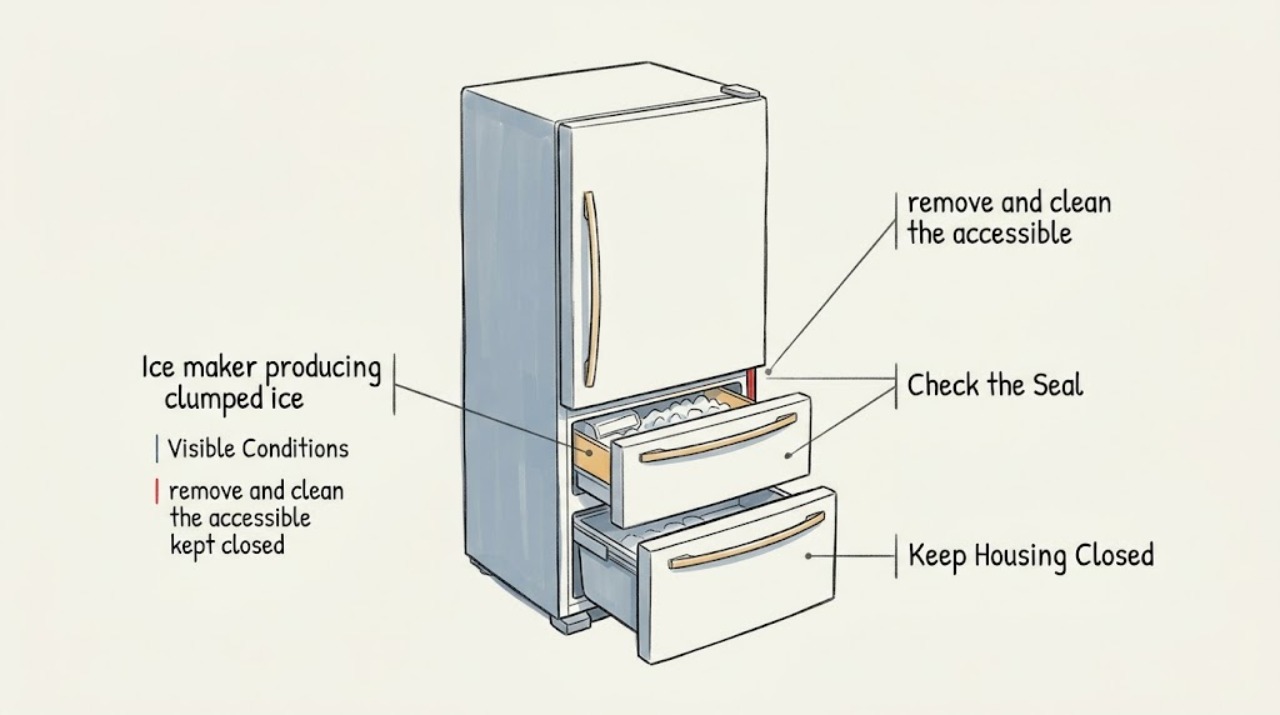
Work through in order
Diagnostic checks
Use only checks that match the exact appliance or system and its official guide.
-
Check 1
Read the nameplate and record the complete B21CL81SNS/04 E-Nr./model suffix. Photograph the ice box before clearing it, and classify the result as a few loose cubes stuck together, a dry compact mass, a wet solid block, cubes frozen to the ejector or tray, or water/ice outside the box.
Expected result: Only a few cubes are joined and the box is dry, or the mass is wet, repeatedly refrozen, obstructing the ejector, accompanied by water, or different from the B21CL81SNS documentation.
Next step: If it is only an occasional loose cluster, continue with the cleaning and condition checks. If it is a recurring wet block, leak, or mechanism obstruction, keep the maker off and continue only with safe external observations before arranging service.
Stop if: Do not chip, pry, twist, or manually cycle the ejector or tray, and do not use a knife, screwdriver, hair dryer, or heat gun.
Why this matters
Why: Occasional sticking or crushing can be normal; a recurring wet mass or freeze-up is a different diagnostic branch and may reflect overfill, melt-and-refreeze, temperature or door conditions, leveling, or a service-level cycle fault. A suffix mismatch means this manual cannot be assumed to apply.
-
Check 2
With the maker stopped and hands clear, remove and clean the accessible ice cube box only as the Bosch manual allows. Rinse it with plain warm water, let it air-dry completely, reinstall it on its rack, push the rack fully in, and lock the handle or box exactly as shown for this model.
Expected result: The box was wet, mis-seated, unlocked, or contaminated; after complete drying and correct locking the next batch remains loose, or the same wet clump returns.
Next step: Allow a normal production cycle after the documented reset or startup condition; if the box will not seat or the clump returns, stop repeated cycling and arrange Bosch service.
Stop if: Do not use detergent, sharp tools, direct heat, force the rack, or reach behind the ice-maker cover.
Why this matters
Why: Residual water or an incorrectly locked box can make an otherwise normal batch freeze together or prevent the maker from operating. A correctly seated, dry box followed by repeated wet clumping shifts attention to fill amount, melt-and-refreeze conditions, cooling, level, or internal cycle diagnosis.
-
Check 3
Check ordinary external conditions: verify the freezer drawers close fully, food is not blocking visible vents or the drawer, the door or drawer seal is intact, and the refrigerator is not visibly tilted. Note frequent opening, a warm room, recent installation, or a power interruption without moving or tilting the appliance.
Expected result: A drawer does not close, a seal or visible vent is obstructed, the unit is visibly out of level, the freezer is warmer than usual, or clumping is worse after frequent openings or warm conditions; alternatively, the drawers close and the freezer remains normally cold.
Next step: Correct only an ordinary obstruction or control setting allowed by the manual and allow recovery. Arrange service for leveling adjustment, a damaged seal or hinge, persistent warmth, or repeated clumping after conditions are normal.
Stop if: Do not move or tilt the refrigerator, adjust leveling hardware under load, or keep using a drawer that cannot seal.
Why this matters
Why: Bosch states that level affects ice-maker water behavior and that freezer temperature, surrounding temperature, and door opening affect production. Warmth or an unsealed drawer can allow partial melt and refreezing, while a cold, sealed, correctly positioned appliance makes a water-fill or internal cycle issue more plausible but does not name a part.
-
Check 4
Inspect the accessible household cold-water shutoff and visible connection for a normally open valve, kink, or leak without pulling the refrigerator or loosening tubing. Confirm from the B21CL81SNS specification that there is no listed water filter before looking for a filter-reset explanation.
Expected result: The valve is partly closed, a visible line is kinked or leaking, water pressure is suspected to be unstable, or the connection appears normal while wet clumps continue.
Next step: Restore only an accessible valve that operates normally; use a plumber for household pressure or connection problems, and qualified appliance service for an internal fill or maker problem.
Stop if: Do not disconnect the water line, test pressure by loosening a fitting, bypass filtration, or run the refrigerator with water near electrical parts.
Why this matters
Why: The Bosch instructions identify water connection, kinks, and low pressure as ice-maker causes. A restricted or intermittent fill can leave irregular or oversized wet ice, but normal-looking external plumbing does not rule out an internal fill or control fault.
-
Check 5
Observe one normal cycle without touching the mechanism: record whether the box receives water, whether the ice later releases into the box, whether the mass freezes to the ejector, and whether clumping returns after the appliance has reached its set temperature. Do not force a test cycle or use a generic service-mode sequence.
Expected result: Water enters and produces a loose batch, water enters and creates a wet block, the box stays dry, the maker binds or does not release ice, or the problem returns despite a dry correctly locked box and normal cooling.
Next step: Stop observing and request qualified Bosch diagnosis for repeated wet clumps, no fill, no release, abnormal noise, a leak, or a frozen mechanism. Provide the photos and cycle sequence rather than naming a valve, heater, or assembly.
Stop if: Do not remove covers, probe wiring, apply heat, jumper contacts, or touch the tray/ejector during operation.
Why this matters
Why: A loose batch makes an ongoing mechanical failure less likely. A wet block points toward fill, melt-and-refreeze, level, or temperature conditions; a dry box points toward supply, control, or fill; binding or no release makes an internal maker or sensor problem more likely. None of these observations alone proves a replacement part.
Use your observations
Decision map
Find the observation that best matches what you see, then follow the next safe action.
-
PATH 01Next step
What you see
Only a few cubes stick together, the ice box is dry and correctly locked, the drawers seal, and the clump does not recur as a solid or wet mass.
Do this next
Monitor production under normal use. Clean and dry the box if odor or residue is present, and seek service if the pattern changes to repeated wet blocks or a mechanism obstruction.
Why this path and its safety boundary
Why it matters: This matches Bosch's stated possibility that several cubes may stick together or be crushed and does not by itself establish a fault.
-
PATH 02Next step
What you see
The box is wet or mis-seated, or the clump clears after cleaning, complete drying, correct rack insertion, and locking.
Do this next
Leave the box correctly locked and allow a normal cycle. Do not repeatedly remove or force it; arrange service if it will not stay seated or clumping returns without a new obstruction.
Why this path and its safety boundary
Why it matters: Residual water or box seating was more likely than a failed ice-maker component.
-
PATH 03Next step
What you see
The clump is wet or repeatedly refrozen and the freezer is warm, a drawer or seal is not closing, the unit is visibly out of level, or the problem follows frequent openings or a warm-room period.
Do this next
Correct only ordinary obstructions or settings permitted by the manual, protect frozen food, and arrange service for persistent warmth, seal, hinge, leveling, or cooling problems.
Why this path and its safety boundary
Why it matters: Melt-and-refreeze or installation/cooling conditions are more likely than a purely mechanical ejector failure.
-
PATH 04Next step
What you see
The visible water connection is kinked, partly closed, leaking, or subject to suspected low pressure; or the box remains dry during a normal cycle.
Do this next
Use a plumber for household connection or pressure faults and qualified Bosch service for an internal fill path, control, or ice-maker diagnosis. Do not loosen tubing yourself.
Why this path and its safety boundary
Why it matters: Water delivery is plausible, but the B21CL81SNS specification lists no water filter, so a generic filter replacement or reset is not the correct first explanation.
-
PATH 05Next step
What you see
The ice maker binds, repeatedly freezes into a solid mass, leaks, makes abnormal noise, or diagnosis would require a cover, wiring access, forced cycling, or moving the refrigerator.
Do this next
Keep the ice maker off, close the accessible water shutoff if safe, and arrange qualified Bosch appliance service. Request prompt help for water near electrical parts or an unstable appliance.
Why this path and its safety boundary
Why it matters: The problem has crossed from a safe cleaning/observation check into an internal appliance or water-safety repair.
Helpful context
Understand the symptom
Clumped does not always mean failed
A few cubes sticking together or being crushed can be normal for this Bosch ice maker. The useful distinction is whether the ice is merely a small loose cluster, or a wet, solid mass that repeatedly freezes together, blocks the ejector, leaves water in the box, or returns soon after cleaning. The second pattern needs a water-fill, level, temperature, door, or cycle diagnosis; it does not identify a valve, heater, or ice-maker assembly on its own.
This model has no listed water filter
Bosch's B21CL81SNS specification lists an ice maker but no water filter. Check the household water connection and the installed model instructions instead of applying a generic filter-reset or replacement procedure. The /04 suffix should be read from the nameplate and kept with the service request because the exact manual and parts fit must match the appliance.
When checks do not resolve it
Need a professional?
Call qualified Bosch appliance service for repeated wet clumps, no fill, a stuck or frozen mechanism, persistent abnormal noise, an incorrectly seated box that will not stay locked, or any diagnosis beyond ordinary box cleaning and external observation. Call a plumber for the household water connection, shutoff, or pressure.
Safety scope: Do not remove the ice-maker cover, probe live wiring, jumper contacts, force an ejector or tray, chip ice with metal tools, thaw with a hair dryer or heat gun, disconnect water tubing, or move/tilt this heavy refrigerator as a user test. Keep the maker off for a leak, water near electrical parts, abnormal noise, or repeated freeze-up.
Have this ready
- Provide the exact B21CL81SNS/04 E-Nr./model and serial information, market, photos before and after cleaning, whether the clump is loose, dry, wet, or frozen to the ejector, freezer and drawer-seal observations, water connection history, and confirmation that this model's specification lists no water filter.
Common questions
FAQ
Is it normal for Bosch B21CL81SNS/04 ice cubes to stick together?
Bosch says several cubes may stick together or be crushed. A few loose cubes are different from a recurring wet solid mass, water in the box, or ice frozen to the ejector; those patterns need further checks.
Does this Bosch model use a water filter?
The opened B21CL81SNS specification lists an ice maker and explicitly lists no water filter. Confirm the nameplate and market before applying any filter procedure; do not invent a filter-reset path.
Can I break up the clumped ice or thaw the maker?
Only handle loose, accessible ice as the exact manual allows. Do not chip, pry, twist, manually cycle, or heat the ejector, tray, fill path, or cover. Repeated freeze-up is a service decision, not a reason to use a heat source.
Could low water pressure cause clumped ice?
Bosch lists water connection, a kinked line, and low pressure among ice-maker causes. Check only the accessible valve and visible connection; a household pressure or hidden connection issue belongs with a plumber or qualified appliance technician.
Read the exact guide
Official sources
- 36-inch Counter-Depth 4-Door Refrigerator - B21CL81SNSBosch Home Appliances · Opened specification for the B21CL81SNS base model; use the exact B21CL81SNS/04 service page to confirm suffix and market.
- B21CL81SNS French Door Bottom freezer, multi doorBosch Home Appliances USA · Base-model product page used to corroborate the two-drawer/four-door identity and Bosch support boundary; it is not a substitute for the /04 manual.
- Service Assistance - B21CL81SNS/04Bosch Home Appliances USA · Exact suffix identity and the model-specific manuals, specifications, parts, and service resources linked by Bosch; confirm local-market documentation before applying US materials.
- B21CL81SNS Operating and installation instructionsBosch Home Appliances · Opened Bosch owner manual for the B21CL81SNS family; use the exact /04 support page and nameplate to confirm suffix/market before applying any model-specific procedure.
Community feedback
Share a repair observation
Share a plain-text repair observation. Accepted observations are published automatically; this page may take a moment to update.