
On this page
Start here
Quick answer
First identify whether this is one or two drops immediately after dispensing, water coming from the chute or drip tray, or a continuing leak from the hose or refrigerator cabinet. Bosch manuals for several refrigerator families list trapped air in the water system and melting ice residue in the chute as causes of dispenser dripping; they also point to blocked filters, low water pressure, kinked hoses, and loose or damaged water connections. Wipe up water, keep the dispenser and ice chute free of residue, and use only the exact model's instructions for purging air or changing a filter. If water continues to run, appears behind the refrigerator, reaches electrical parts, or comes from a damaged hose or connection, close the water shutoff and arrange Bosch service or qualified plumbing help. Do not open the dispenser housing or guess a valve or hose part without the E-Nr.
Before you begin
Safety first
- Close the water shutoff for a continuous or connection leak. Do not move a wet refrigerator, disconnect pressurized tubing, reach into the ice chute, open dispenser panels, bypass controls, or order an internal part without model-specific fitment.
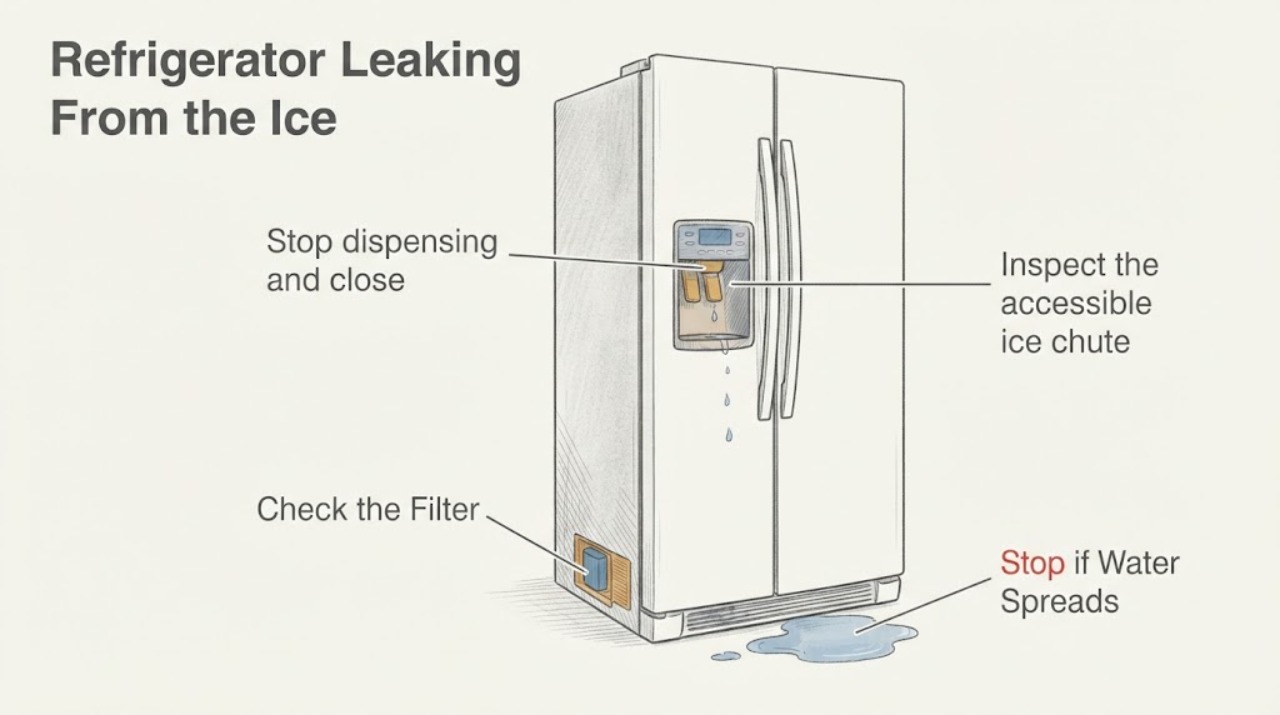
Work through in order
Diagnostic checks
Use only checks that match the exact appliance or system and its official guide.
-
Check 1
Stop dispensing and close the refrigerator water shutoff if water is running, pooling behind the unit, or reaching an electrical area.
Expected result: The leak is continuous or at a hose/connection, the floor or electrical area is wet, or the only symptom is an occasional drop at the nozzle after use.
Next step: For a continuous or wet-area leak, keep water off and arrange qualified service or plumbing help. Do not move a wet refrigerator or disconnect a pressurized hose. For an isolated post-dispense drop, continue with the dry visual checks.
Why this matters
Why: A continuous or connection leak is a water-damage and shock risk. An occasional nozzle drop may instead reflect air or melting ice residue in the dispenser path.
-
Check 2
Use a dry cup and towel to locate where the next drop forms after dispensing: nozzle/chute, drip grate, ice-storage outlet, filter area, rear hose, or cabinet floor.
Expected result: Drops form only at the chute after dispensing, continue from the chute when idle, appear around the ice outlet, or appear at the filter/hose/cabinet.
Next step: Clean only accessible residue and condensation. If the source is a connection, filter housing, hose, or cabinet, keep the water supply off and arrange service rather than repeatedly dispensing.
Why this matters
Why: Bosch lists air in the water system and melting ice residue for dispenser dripping; condensation can form at the ice shaft. Water at a filter, hose, or cabinet points to the supply path or a leak requiring service.
-
Check 3
Inspect the accessible ice chute and ice container for loose ice residue, a clump, an incorrectly seated container, or objects blocking the dispenser; do not insert fingers or force a frozen assembly.
Expected result: Ice residue or clumping is visible, the container is not fully seated, the chute is clear, or the ice-storage design does not match the opened Bosch manual.
Next step: Remove only loose accessible residue with the method allowed by the exact manual and fully seat the container. If the chute is frozen, blocked internally, or does not match the manual, stop and use model-specific service.
Why this matters
Why: Bosch identifies melting ice residue and a partially inserted or blocked ice container as dispenser problems. Different Bosch models use different container and control layouts.
-
Check 4
With water shut off before touching the tubing, inspect the visible hose and connection for a kink, damage, looseness, or a closed shutoff; check the filter indicator without removing an unconfirmed filter.
Expected result: The hose is kinked or damaged, the connection is wet or loose, the shutoff is closed, the filter is blocked/overdue, or the visible supply path is dry and clear.
Next step: Leave damaged or wet connections for qualified service. Follow the exact E-Nr. instructions for a matched filter or visible kink; if the path is clear and dripping continues, escalate to Bosch service.
Why this matters
Why: Bosch links no water, reduced output, and dispenser faults to supply, pressure, hose, and filter conditions. A dry visible path does not exclude a hidden dispenser fault.
-
Check 5
Record the Bosch E-Nr. and FD number and identify whether the symptom occurs with water, cubed ice, crushed ice, or all dispenser functions.
Expected result: The identity is readable and the leaking mode is clear, or the label/function cannot be confirmed safely.
Next step: Provide the identity and observations to Bosch support or an authorized service provider. Do not select a valve, hose, filter, or dispenser assembly from the symptom alone.
Why this matters
Why: Bosch manuals and controls are family specific; the opened documents explicitly say features depend on the model. Without the E-Nr., filter, chute, and reset instructions remain unresolved.
-
Check 6
Arrange Bosch service when the leak is continuous, at a hidden connection, recurring after external checks, or accompanied by a dispenser fault.
Expected result: Water continues when idle, the supply path is damaged, the chute or filter housing is inaccessible, or the model-specific checks do not resolve the leak.
Next step: Keep the water supply off if leakage continues and give service the E-Nr., FD number, photos of the source, and the dispensing mode involved. Do not open panels or bypass the dispenser.
Why this matters
Why: The remaining fault may involve a hidden line, dispenser valve, filter housing, chute, or control and cannot be identified safely from a generic Bosch family page.
Use your observations
Decision map
Find the observation that best matches what you see, then follow the next safe action.
-
PATH 01Next step
What you see
Water continues to run, appears behind the refrigerator, or reaches an electrical area.
Do this next
Close the water shutoff if safe, keep the area dry, and arrange qualified Bosch service or plumbing help. Do not move the wet appliance or disconnect a pressurized line.
Why this path and its safety boundary
Why it matters: This is a supply or appliance leak rather than a minor post-dispense drip.
-
PATH 02Next step
What you see
The only drops occur at the dispenser after use and loose ice residue or condensation is visible at the chute or ice outlet.
Do this next
Clean accessible residue or condensation only as the exact manual permits, observe whether dripping stops, and escalate if it continues while idle.
Why this path and its safety boundary
Why it matters: Bosch identifies air in the water system, melting ice residue, and condensation as possible dispenser-area explanations.
-
PATH 03Next step
What you see
The hose is kinked/damaged, the shutoff is closed, the filter is blocked, or water output is reduced.
Do this next
Turn water off before handling tubing; correct only a visible kink or matched filter issue under the E-Nr. manual, and use qualified service for damage or fittings.
Why this path and its safety boundary
Why it matters: The water supply path may be restricting flow or leaking and can affect dispenser behavior.
-
PATH 04Next step
What you see
The visible path is dry and clear, but the dispenser still leaks or the correct Bosch model manual cannot be identified.
Do this next
Keep the dispenser unused and request Bosch service with the E-Nr., FD number, leak mode, and photos. Do not order or install an unverified valve, hose, filter, or dispenser assembly.
Why this path and its safety boundary
Why it matters: An internal dispenser or hidden-line fault remains possible, but the available family guidance does not identify its component or part.
Helpful context
Understand the symptom
A dispenser that drips briefly after use is a different observation from a continuous leak at the supply connection. Bosch's troubleshooting tables separate air in the water system, melting ice residue, condensation, low pressure, blocked filters, and loose or damaged connections. Start with the water path and chute that can be seen without removing panels.
Make a continuous leak safe
If water is running, pooling behind the refrigerator, or reaching an electrical area, close the refrigerator's water shutoff if it can be reached safely and keep the area dry. Do not pull a wet refrigerator, disconnect a pressurized hose, or remove a dispenser cover. Bosch guidance says a damaged water hose should be replaced by customer service or a similarly qualified person in the covered family manuals.
Separate normal post-dispense drips from an ongoing leak
Use a dry cup and towel to observe where the next drop forms: the nozzle or chute, the drip grate, the ice-storage outlet, the filter area, the rear hose, or the cabinet floor. Bosch lists air in the system and melting ice residue for dispenser dripping, while condensation can form around the ice shaft in warm, humid air. A drip that continues when the dispenser is not being used or appears at a connection needs a water-path inspection or service rather than repeated dispensing.
Check the chute, ice container, and filter without forcing anything
Look for loose ice or residue in the chute and wipe accessible condensation with a soft, dry cloth. Confirm the ice container is fully inserted and the dispenser is not blocked by stored objects. If the filter indicator is on or the filter is overdue, use the exact E-Nr. manual for replacement and flushing; Bosch advises keeping the model and FD number available for support. Do not pry a frozen chute or twist a filter that does not match the model.
Check supply, hose, and pressure from safe access points
With the water supply off before touching a hose or connection, look for a kink, damaged tubing, a loose connection, or a shutoff that is not fully open. Low pressure or a blocked external filter can reduce flow and contribute to dispenser symptoms. Do not loosen fittings to test pressure and do not install a replacement hose, filter, or valve without confirming the E-Nr. and the connection type.
Use a model-specific reset only as the manual directs
Some Bosch family manuals describe switching the appliance off, disconnecting power for several minutes, and calling customer service if a dispenser fault persists. That sequence is not a substitute for leak isolation and should not be copied across models. If the leak returns after the external checks, stop using the dispenser and give Bosch service the E-Nr., FD number, leak location, and whether it occurs during water, crushed-ice, or cubed-ice dispensing.
When checks do not resolve it
Need a professional?
Call Bosch service or qualified plumbing help for a continuous leak, damaged hose or connection, water near electrical parts, a recurring drip after the accessible checks, or any fault that cannot be matched to the exact E-Nr. manual.
Safety scope: Close the water shutoff for a continuous or connection leak. Do not move a wet refrigerator, disconnect pressurized tubing, reach into the ice chute, open dispenser panels, bypass controls, or order an internal part without model-specific fitment.
Have this ready
- Bosch E-Nr. and FD number, refrigerator form factor, exact leak location, whether it occurs after water/cubed-ice/crushed-ice dispensing or while idle, filter age, hose and shutoff observations, and photographs if safe.
Common questions
FAQ
Are one or two drops after dispensing normal?
The amount and model behavior vary. Bosch family manuals identify air in the water system and melting ice residue as causes of dispenser dripping; a drip that continues while idle or comes from a hose or connection should be treated as a leak and escalated.
What can cause water to drip from a Bosch ice chute?
Bosch lists trapped air in the water system and melting ice residue in the chute. Condensation around the ice shaft can also occur in warm, humid air. Clean only accessible residue using the exact manual and stop if water comes from a hidden connection.
Should I remove the water filter to test the dispenser?
Do not improvise a filter bypass. Bosch says blocked filters can reduce output and directs filter replacement or bypass-cartridge handling by the applicable manual. Confirm the E-Nr. and use the matching Bosch instructions before removing or replacing the filter.
What information does Bosch service need?
Provide the E-Nr. and FD number, the leak location, the dispensing mode, whether water continues while idle, filter age, and any hose or shutoff observation. Bosch's refrigeration support page directs owners to service, manuals, and product advice by model.
Read the exact guide
Official sources
- Use and Care Manual B36FD..Bosch Home Appliances · Official B36FD family manual. Used conditionally for dispenser dripping from air or melting ice residue, filter/pressure/hose checks, container seating, and service escalation; it is not asserted for every Bosch refrigerator without E-Nr. confirmation.
- Get Support - RefrigerationBosch Home Appliances · Official Bosch support hub used to route owners to model-specific Service Assistant, manuals, and service; it does not replace the missing E-Nr. manual.
- Information for Use KFD96..Bosch Home Appliances · Official KFD96 family manual. Used conditionally for dripping, condensation, chute residue, filter, pressure, hose, and service checks; layout and controls must be matched to the E-Nr.
- Use and Care Manual B24...80Bosch Home Appliances · Official B24 family manual. Used conditionally for water connection, shutoff, hose, pressure, filter, and service boundaries; it is not used to claim the task refrigerator is a B24 model.
- Refrigerator FAQs | Top TipsBosch Home Appliances · Official Bosch refrigerator tips used for filter timing and retaining the complete model/FD information; it is not a dispenser repair manual for an unknown model.
Community feedback
Share a repair observation
Share a plain-text repair observation. Accepted observations are published automatically; this page may take a moment to update.