
On this page
Start here
Quick answer
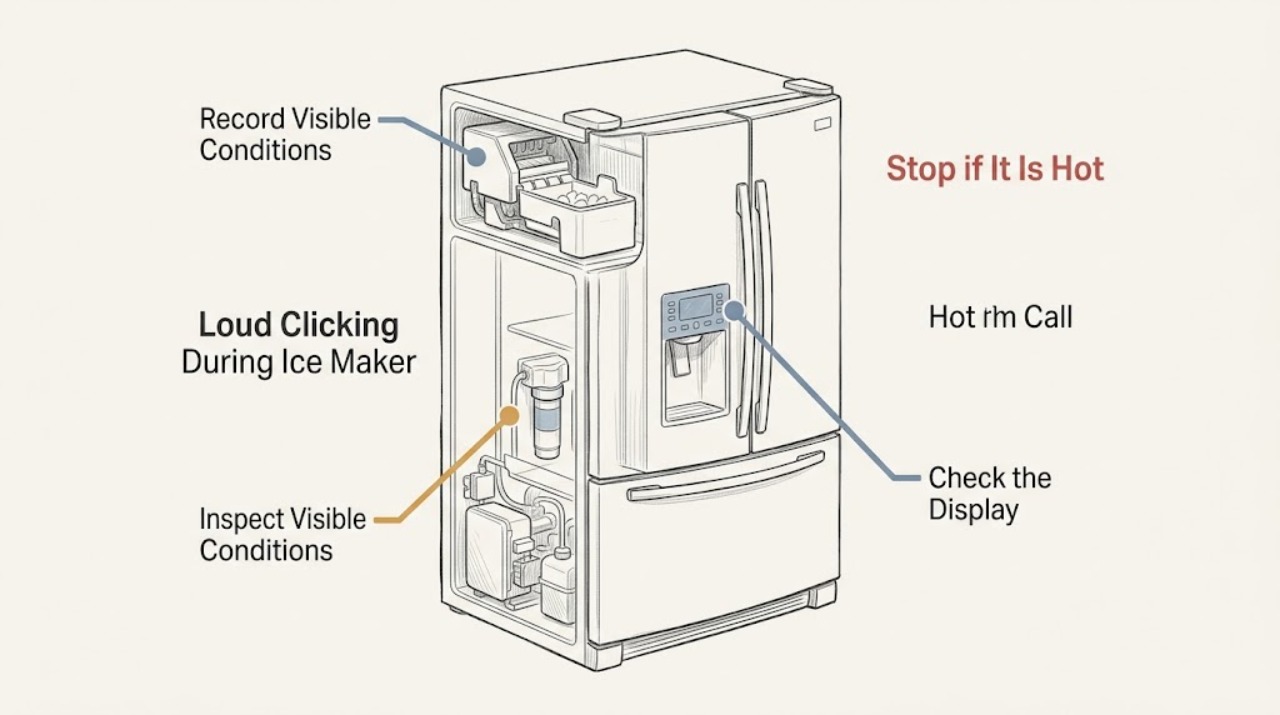
On the Bosch B36CD50SNS, a click during ice-maker operation is not automatically a failed part. Bosch's B36CD.. manual says clicking can come from a motor, switch, solenoid valve, or water valve changing state, and that ice cubes falling into the storage container can also be a normal sound. First record whether the click coincides with ice harvest, water fill, or cubes dropping, and whether ice production is normal. Then check only accessible ice-bin/chute, water-supply, filter, and hose conditions. If the click continues with no ice-maker event, ice production fails despite normal supply, the storage path is jammed, or a warning, leak, burning odor, or electrical symptom appears, stop repeated testing and arrange qualified Bosch service.
Work through in order
Diagnostic checks
Use only checks that match the exact appliance or system and its official guide.
-
Check 1
Confirm the complete rating-plate model is B36CD50SNS with its suffix, and record when the click occurs: immediately after an ice-maker command, during a water fill, during harvest, when cubes drop, or at unrelated times. Note whether ice is being made, the freezer is at its set temperature, and whether there is a leak, display warning, burning odor, smoke, or electrical damage.
Expected result: The model matches, the click is tied to an ice-maker event, ice production is normal, the click is continuous or unrelated to ice operation, or a safety symptom is present.
Next step: Continue only with a confirmed B36CD50SNS and no hazard. If the model differs, use its exact manual; if a leak, smoke, burning odor, or electrical symptom is present, stop the refrigerator and arrange service.
Stop if: Do not keep dispensing or cycling the ice maker to reproduce a click when there is water near electrical parts, a hot/damaged cord, smoke, arcing, or repeated breaker tripping.
Why this matters
Why: Bosch provides variant-specific manuals through the B36CD50SNS support page, while the B36CD.. manual describes several normal ice-maker and water-system sounds. A different model or safety symptom changes the safe path.
-
Check 2
Observe one normal ice-making sequence without touching the mechanism. Listen for whether the click is followed by water entering the ice maker, an ice harvest, or cubes falling into the storage container; do not put fingers or tools into the ice maker or chute.
Expected result: The click occurs once or briefly with a fill/harvest/cube-drop event, or it repeats without a visible ice-maker event and without producing ice.
Next step: If ice production and storage are normal, monitor the event. If the click repeats without water/harvest/cube movement or ice production fails, continue with the accessible bin and water checks and plan service if the cause remains.
Stop if: Do not hold or force the ice-maker rake, bypass the door or dispenser interlock, or access the valve or wiring.
Why this matters
Why: Bosch says motors, switches, solenoid valves, and water valves can click as they switch, and that ice cubes falling into the storage container can make a normal sound. Repeated clicking without the expected event is not explained by that normal-sound statement alone.
-
Check 3
Check the freezer temperature setting and whether ice production is enabled in the normal controls. If the refrigerator was recently connected or the freezer has just reached temperature, allow the manual's initial production period before judging the click; do not repeatedly toggle the ice maker.
Expected result: The freezer has reached its set temperature and ice production is enabled, the appliance is newly connected and has not yet produced its first batch, or ice production is disabled/has not resumed after the expected period.
Next step: Use only the normal control to enable ice production and check again after the documented initial period. If no ice is made or the click remains abnormal after that period, inspect accessible supply conditions and arrange service if needed.
Stop if: Do not change unknown service settings, remove the ice maker, or run a repeated reset sequence to force production.
Why this matters
Why: Bosch says ice production starts after the freezer reaches its set temperature and the first batch may take approximately four hours. A newly connected unit can therefore click during setup without proving a fault, while persistent failure after the expected conditions needs another branch.
-
Check 4
Inspect the accessible ice storage container and chute for a visible frozen clump, ice residue, or a container that is not fully inserted. Remove only loose visible ice according to the manual's ordinary user guidance; do not chip at a hidden mechanism or use a sharp object.
Expected result: The storage container is not fully seated, ice cubes are frozen together in the chute, loose residue is present, or the bin and chute are clear.
Next step: Fully seat the container or remove only the accessible ice residue as the exact manual directs, then stop and observe rather than repeatedly dispensing. If the jam returns or the click persists, leave the ice maker off and arrange service.
Stop if: Do not force the container, reach into the auger or ice-maker mechanism, use a knife or metal tool, or remove the dispenser assembly.
Why this matters
Why: Bosch identifies an incompletely inserted storage container and frozen-together cubes as ice/dispenser problems. A jam can make the ice-maker/dispenser work against resistance, but the observation does not identify a motor or valve part.
-
Check 5
If the click coincides with a failed fill or low ice production, inspect only the accessible water connection, shutoff position, hose for a kink, and filter condition as the manual permits. Do not disconnect a pressurized filter or water line unless the exact instructions and safe shutoff procedure apply.
Expected result: Water pressure is low, the filter is blocked, the hose is kinked, the shutoff is closed, or the accessible supply path is normal but the ice maker still clicks without filling.
Next step: Correct only a visible, safe supply issue using the model instructions and avoid repeated ice-maker cycles. If the path is normal or the click continues after the correction, switch off ice production and contact qualified Bosch service.
Stop if: Do not open the water valve assembly, probe wiring, make live measurements, or continue if water leaks or reaches electrical parts.
Why this matters
Why: Bosch lists water pressure, filter condition, absence of water supply, and a kinked hose as causes of low or absent ice production. A normal supply path with repeated clicking leaves a valve, ice-maker mechanism, control, or wiring issue for service diagnosis.
Use your observations
Decision map
Find the observation that best matches what you see, then follow the next safe action.
-
PATH 01Next step
What you see
The click occurs only during a documented ice-maker event, ice cubes drop normally, and ice production and storage remain normal.
Do this next
Monitor the sound without opening the mechanism. Arrange service if it becomes continuous, harsher, unrelated to ice operation, or joined by reduced ice production or a warning.
Why this path and its safety boundary
Why it matters: The pattern is consistent with Bosch's documented normal switching, water-valve, or cube-drop sounds rather than an established failed part.
-
PATH 02Next step
What you see
The freezer has only recently reached temperature or the refrigerator was newly connected, and the click is accompanied by the expected delay before the first ice batch.
Do this next
Allow the documented initial period and avoid repeated resets. If the click continues without ice after that period, use the supply and service branch.
Why this path and its safety boundary
Why it matters: The ice maker may be completing its normal startup and fill sequence; Bosch says the first batch can take approximately four hours after the freezer reaches its set temperature.
-
PATH 03Next step
What you see
The click repeats during attempted filling but there is no water or ice, and the filter, hose, shutoff, and accessible water supply are abnormal or normal.
Do this next
Correct only the safe visible supply issue under the exact manual. If the supply is normal or the click persists, turn off ice production and arrange qualified Bosch service.
Why this path and its safety boundary
Why it matters: A visible supply restriction may explain the failed fill; if the supply is normal, the ice-maker valve, mechanism, control, or wiring remains unresolved and cannot be selected from sound alone.
-
PATH 04Next step
What you see
The storage container is not seated, cubes are frozen together in the chute, or the dispenser is jammed; alternatively, the container and chute are clear but the loud click continues.
Do this next
Remove only accessible residue or seat the container as directed, then stop repeated dispensing. If the sound returns, leave ice production off and contact Bosch service.
Why this path and its safety boundary
Why it matters: A visible ice-path obstruction is more likely in the first pattern. A clear path with a persistent click requires service-level diagnosis rather than a guessed replacement ice maker or valve.
-
PATH 05Next step
What you see
Clicking is accompanied by a leak, water near electrical parts, smoke, burning odor, sparks, a hot/damaged cord, or repeated breaker trips.
Do this next
Stop using the refrigerator and ice/water system. Isolate power or water only if it is dry and safe to do so without touching damaged parts, then contact qualified appliance/electrical service; use emergency services for an active fire.
Why this path and its safety boundary
Why it matters: This is an immediate electrical, water, or fire-safety condition, not a routine ice-maker sound check.
Helpful context
Understand the symptom
The useful distinction is not simply loud versus quiet. A click that occurs once during a harvest or fill event and is followed by normal ice production has a different meaning from a repeated click while no ice is made, a click with a jammed chute, or a click accompanied by a leak or electrical symptom. Bosch's manual does not use the sound alone to name a motor, valve, or control part.
Use the full E-Nr/model suffix when consulting Bosch documents. Keep checks external and accessible: do not reach into the ice-maker mechanism, remove panels, probe a valve, or use a live electrical test.
When checks do not resolve it
Need a professional?
Arrange qualified Bosch appliance service if loud clicking continues when no ice-maker event is occurring, ice production fails after the documented startup period and accessible supply checks, the ice path repeatedly jams, or the exact manual's one-time appliance reset does not resolve a dispenser fault. Stop immediately for a leak, water near electrical parts, smoke, burning odor, sparks, a hot/damaged cord, or repeated breaker trips. Do not remove the ice maker, open panels, probe valves or wiring, bypass interlocks, or choose a part from the sound alone.
Common questions
FAQ
Is clicking normal during Bosch B36CD50SNS ice-maker operation?
It can be. Bosch's B36CD.. manual lists clicking from motors, switches, solenoid or water valves, and says ice cubes falling into the storage container can make a normal sound. A repeated click with no ice-making event or reduced production needs further checks and possibly service.
How long should a newly connected Bosch B36CD50SNS take to make ice?
Bosch says ice production starts after the freezer reaches its set temperature and the first batch may be ready in approximately four hours. If the click persists without ice after the documented startup period, check the accessible water path and contact service if the problem remains.
Should I replace the Bosch ice-maker or water valve because it clicks?
Not from the sound alone. First correlate the click with fill, harvest, or cube drop, check the accessible ice path and water supply, and use qualified service for a persistent click or failed production. Do not open the mechanism or test live wiring.
Read the exact guide
Official sources
- B36CD50SNS French Door Bottom Mount Refrigerator | BOSCH USBosch · Opened official Bosch product page for B36CD50SNS; it identifies the 500 Series refrigerator and lists the QuickIce Pro ice-maker system and product documents.
- Service Assistance - B36CD50SNS/05 | BOSCH USBosch · Opened official Bosch US product-service page for a B36CD50SNS variant; used to confirm the exact product family and model-specific document path.
- Use and Care Manual B36CD.. | BoschBosch · Opened official Bosch use-and-care PDF whose English cover identifies the B36CD.. family; the troubleshooting section provides the ice-maker and noise guidance used here. Confirm the complete E-Nr/suffix before applying model-specific controls.
Community feedback
Share a repair observation
Share a plain-text repair observation. Accepted observations are published automatically; this page may take a moment to update.