
On this page
Start here
Quick answer
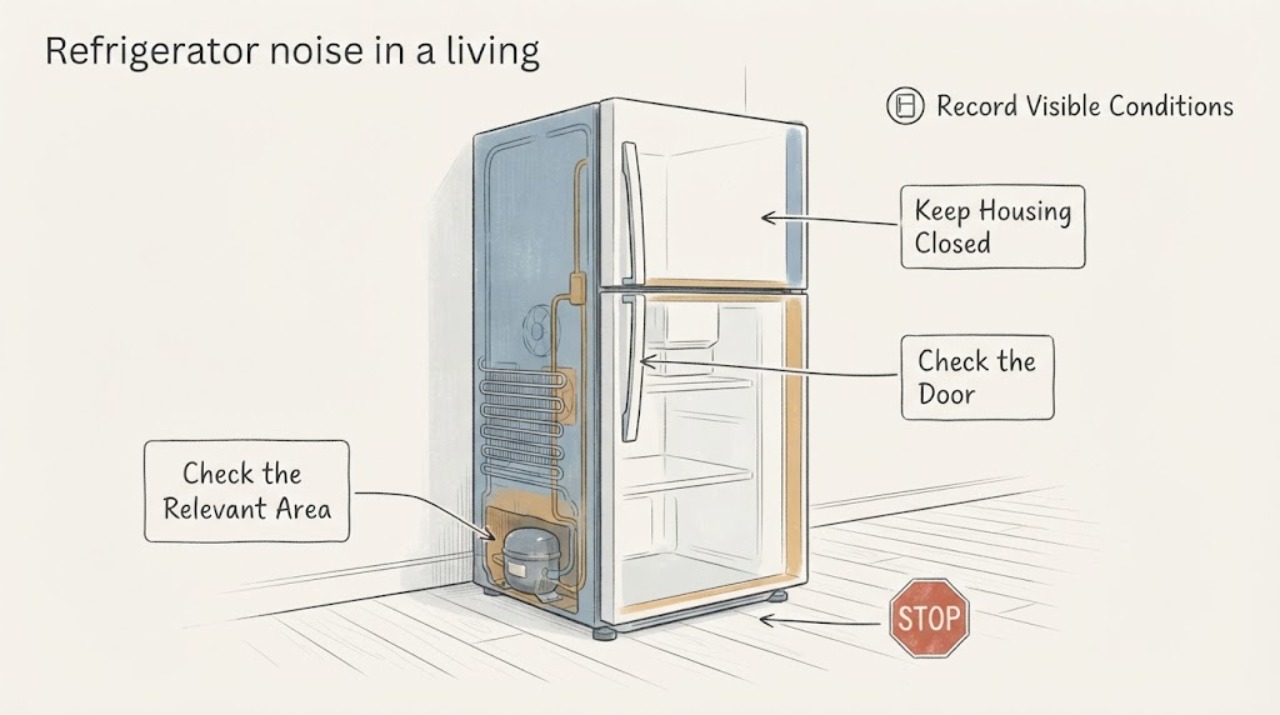
The Bosch B36CL80SNS can make operating sounds from its compressors, fans, refrigerant flow, valves, defrost, and ice dropping, and the Bosch B36CL.. manual lists humming, bubbling, buzzing, gurgling, clicking, crackling, and rumbling as possible normal sounds. That does not make every new noise normal. First verify the complete E-Nr suffix and market, then record whether the sound is a steady hum, intermittent click, water-like gurgle, ringing, rubbing, rattle, knock, or electrical buzz; where it is loudest; and whether it follows cooling, ice making, door use, or defrost. Check only visible cabinet clearance, level, feet, shelves, bottles, and door contact. Do not remove panels, touch fans, or promise a dBA limit. A sound that is new, worsening, metallic, scraping, accompanied by vibration or warming, or associated with burning odor, smoke, arcing, or repeated trips needs Bosch or qualified service.
Work through in order
Diagnostic checks
Use only checks that match the exact appliance or system and its official guide.
-
Check 1
Read the complete Bosch E-Nr/model from the rating plate and record the suffix, market, installation date, and whether the appliance is freestanding or installed in cabinetry. Compare it with the official B36CL80SNS product and service entries.
Expected result: The label is B36CL80SNS with a suffix such as /48; it has a different suffix or market; or the installation has unusual side, rear, or top clearances.
Next step: Use the exact E-Nr in Bosch Owner Support and provide it with the noise report. Do not compare this refrigerator with another B36 series by appearance alone.
Stop if: Stop if the rating plate is inaccessible because moving the appliance would be required; arrange safe assistance rather than pulling a loaded refrigerator.
Why this matters
Why: Bosch service documents and operating details are E-Nr-specific. A base model without its suffix does not prove that a manual, sound behavior, clearance, or service path applies unchanged.
-
Check 2
From a safe standing position, describe the sound in plain terms and record whether it is a steady hum, intermittent click, water-like gurgle, brief crackle, ringing, rubbing, scraping, knock, rattle, or electrical buzz. Do not use a phone app as a pass/fail noise meter.
Expected result: The sound matches a brief hum/click/gurgle that comes and goes with operation; it is a new ringing or vibration; it is metallic rubbing/knocking; or it resembles arcing or a hot electrical buzz.
Next step: Record a short description and when it occurs. Continue only with external checks for ordinary operating sounds; keep the refrigerator off and arrange service for scraping, repeated impact, burning odor, arcing, or a hot electrical smell.
Stop if: Stop immediately for smoke, sparks, burning odor, exposed wiring, a hot plug/outlet, or repeated breaker trips.
Why this matters
Why: The Bosch manual lists several intermittent operating sounds as possible normal events, while a new mechanical or electrical character is a change that needs escalation. Sound character alone cannot identify a fan, compressor, or other part.
-
Check 3
Without opening covers, note where the sound is loudest—inside the freezer, refrigerator compartment, behind the cabinet, at the bottom, at a door, or through the floor—and whether it starts with compressor/fan operation, ice production, water dispensing, defrost, door movement, or a temperature-mode change.
Expected result: The sound is inside and airflow-related, at the bottom/rear near cooling equipment, at a door or shelf, during ice/water activity, or unrelated to any observable cycle.
Next step: Write down the loudest location, cycle, duration, and whether cooling and food temperature remain normal. Arrange Bosch service for a persistent location-specific or unexplained noise rather than removing a panel.
Stop if: Do not touch a fan, compressor, tubing, or rear electrical area; stop for warming food, oil/water leakage, smoke, or electrical symptoms.
Why this matters
Why: Location and timing separate normal refrigeration/ice/water events from a loose fitting, cabinet resonance, fan interference, compressor-area vibration, or an unexplained new noise. The exact B36CL80SNS report associated ringing with compressor operation and also heard noise from the bottom, but did not establish a component fault.
-
Check 4
Check only from outside that the refrigerator stands level, has the Bosch-specified visible clearance, and is not touching a wall, cabinet, trim, floor transition, or loose object. Confirm bottles, containers, shelves, and door fittings are not touching or wobbling.
Expected result: The cabinet is not level, a foot or panel contacts the floor or wall, a bottle/shelf vibrates, or all visible clearances and fittings are stable.
Next step: Move only the loose external object and use the exact installation instructions for any accessible leveling correction. Arrange service if leveling requires moving the loaded unit or if the noise remains after stable clearance.
Stop if: Do not wedge, enclose, shim with loose material, or pull the refrigerator across the floor to reach the rear.
Why this matters
Why: The Bosch manual directs level, clearance, and loose-fitting checks for appliance noise. A resonance source can make ordinary compressor or fan operation seem much louder in a living area, while stable external conditions keep the internal sound branch open.
-
Check 5
Observe normal operation over a safe period without forcing a diagnostic cycle: note whether the sound changes after a door closes, during ice drops or water use, during automatic defrost, or when Super cooling/freezing is selected according to the exact manual. Do not repeatedly power-cycle the refrigerator to reproduce a sound.
Expected result: The sound occurs briefly with an expected function; it runs continuously; it is getting louder; or the noise coincides with warming, poor ice production, a display warning, or water leakage.
Next step: Record the function, duration, and cooling/ice result. Keep the exact manual and service route for ordinary but intrusive noise; arrange prompt service for a worsening or symptom-linked noise.
Stop if: Stop for food warming, a temperature alarm that will not clear, smoke, burning odor, arcing, or a leak near electrical parts.
Why this matters
Why: The Bosch manual says compressor/fan, valve, defrost, and ice events can create different sounds and that Super cooling or Super freezing can increase noise. A continuous, worsening, or symptom-linked sound is not cleared by that general note.
-
Check 6
Create a service note with the full E-Nr, sound description, loudest location, cycle/timing, changes over time, cabinet/floor observations, and whether cooling, water, ice, or alarms changed. Keep the refrigerator accessible for the technician; do not open the back or evaporator area.
Expected result: The sound is unchanged and matches a documented operating pattern; it persists despite stable external conditions; or it is accompanied by a hazard or cooling failure.
Next step: Use Bosch's exact-E-Nr support or qualified refrigerator service. Protect food if cooling is affected and seek emergency help for smoke, fire, or a suspected electrical hazard.
Stop if: Do not continue operation solely to collect recordings when the unit is hot, sparking, smoking, leaking, or repeatedly tripping power.
Why this matters
Why: A complete pattern lets Bosch or qualified service compare normal operating events with a fan, compressor, mounting, sealed-system, or electrical fault without guessing a part from sound alone.
Use your observations
Decision map
Find the observation that best matches what you see, then follow the next safe action.
-
PATH 01Next step
What you see
The sound is a brief hum, click, gurgle, crackle, or rumble that matches compressor, fan, valve, defrost, or ice activity; cooling is normal; and there is no vibration or damage.
Do this next
Record the cycle and monitor for change. Use Bosch support if the sound remains intrusive or differs from the manual's pattern; do not use a dBA threshold as a substitute for service assessment.
Why this path and its safety boundary
Why it matters: This pattern is consistent with the operating events listed in the Bosch manual, although it does not guarantee that a particular unit's sound is acceptable in a living area.
-
PATH 02Next step
What you see
The sound is loudest at the bottom/rear, appears as a new ringing or vibration during compressor operation, or remains after bottles, fittings, walls, and visible clearances are stable.
Do this next
Arrange Bosch or qualified service with the E-Nr and pattern. Do not enclose the refrigerator, remove panels, or alter ventilation to mask the sound.
Why this path and its safety boundary
Why it matters: The exact B36CL80SNS report describes this kind of location/cycle pattern, but it did not prove whether the cause was normal compressor behavior, resonance, mounting, or a component fault.
-
PATH 03Next step
What you see
The cabinet is level and clear, but the sound is metallic, scraping, repeated knocking, continuously worsening, or accompanied by warming, a fan symptom, water, or an alarm.
Do this next
Keep the refrigerator closed and arrange prompt qualified service. Do not touch internal components or select a fan, compressor, or other part from the sound alone.
Why this path and its safety boundary
Why it matters: The sound is no longer explained by a simple loose fitting or a documented intermittent operating event; internal fan, compressor, defrost, sealed-system, or structural diagnosis may be required.
-
PATH 04Next step
What you see
Smoke, burning odor, arcing, a hot connection, exposed wiring, uncontrolled water, repeated breaker trip, or rapidly warming food appears.
Do this next
Keep clear, disconnect power only from a dry and safe location if needed, protect food without entering the hazard, and obtain qualified or emergency help. Do not restart to test the noise.
Why this path and its safety boundary
Why it matters: This is a stop-use safety condition, not a normal refrigerator-noise adjustment.
Helpful context
Understand the symptom
Bosch's official product page identifies B36CL80SNS as an 800 Series French Door Bottom Mount Refrigerator. Bosch's service page shows a model-specific E-Nr variant, B36CL80SNS/48, and provides the matching manual and service resources. The task model omits the suffix, so confirm the rating-plate E-Nr before treating any sound or support instruction as exact.
The opened Bosch B36CL.. manual says that humming, bubbling, buzzing, gurgling, clicking, crackling, or rumbling may come from a running motor or fan, refrigerant flowing, switches or valves changing state, automatic defrost, or ice cubes falling. The same manual separately directs level, clearance, and loose-fitting checks for persistent appliance noise. Use the pattern and change over time; do not use a generic noise label or a dBA assumption as a diagnosis.
A noise that seems intrusive in a living area may be amplified by the floor, cabinet, wall, or nearby objects. An exact B36CL80SNS community report describes a ringing sound near compressor operation and noise from the bottom of the refrigerator, but that report is not proof that the sound is normal or that enclosure is a safe fix. Do not enclose the appliance or change ventilation to mask sound.
When checks do not resolve it
Need a professional?
Have this ready
- Complete Bosch E-Nr including suffix and market, installation/clearance details, sound character, loudest location, cycle and duration, change over time, level/foot/fitting observations, cooling and food-temperature status, ice/water behavior, display alarms, and a short recording only if safe. Do not request a fan, compressor, or other part solely from the noise.
Common questions
FAQ
Are humming and clicking normal on the Bosch B36CL80SNS?
Bosch's B36CL.. manual lists humming, bubbling, buzzing, gurgling, clicking, crackling, and rumbling as sounds that can come from motors, fans, refrigerant, valves, defrost, or ice drops. A new, harsh, worsening, or symptom-linked sound still needs pattern-based assessment.
Why is my B36CL80SNS loudest in the living area or at the bottom?
The exact-model community report described ringing near compressor operation and noise from the bottom, but it did not establish a cause. Check visible level, wall/cabinet clearance, and loose objects, then arrange Bosch service if the sound persists; do not enclose the refrigerator.
Can I use a phone app or dBA number to decide whether the noise is safe?
No. Bosch does not establish a universal user dBA pass/fail threshold in the opened material. Sound type, location, cycle, change over time, cooling, vibration, and hazards are more useful for triage.
Should I remove the back panel to find the noisy fan or compressor?
No. Keep panels and internal components closed. Record where the sound is loudest and when it occurs, then use the exact E-Nr for Bosch or qualified service.
Does Super cooling or Super freezing make this Bosch refrigerator louder?
The Bosch manual says increased noise may occur while Super cooling or Super freezing is switched on. That explains a temporary mode-related change, not a continuous or worsening metallic sound, vibration, warming, or electrical hazard.
Read the exact guide
Official sources
- Use and Care Manual B36CL.. | BoschBSH Home Appliances Corporation / Bosch · Opened the official Bosch B36CL.. use-and-care PDF. It documents model-dependent equipment, installation and clearance, normal operating sounds, Super cooling/freezing noise changes, and service escalation; confirm the exact B36CL80SNS suffix before applying controls.
- Does anyone else have a noisy Bosch 800 Series Refrigerator?Reddit r/Appliances · Opened an exact-model community post for Bosch B36CL80SNS/08; the owner describes a ringing sound believed to occur when a compressor starts and noise from the bottom of the refrigerator.
- Appliance Information - French Door Bottom Mount Refrigerator | B36CL80SNS/48BSH Home Appliances Corporation / Bosch USA · Opened the official Bosch U.S. service page for the B36CL80SNS/48 variant; it exposes E-Nr-specific manuals, service, and support resources and warns that the complete variant should be used.
- B36CL80SNS French Door Bottom Mount Refrigerator | BOSCH USBSH Home Appliances Corporation / Bosch USA · Opened the official Bosch U.S. product page; it identifies B36CL80SNS as an 800 Series French Door Bottom Mount Refrigerator and links manuals, self-help, service, warranty, and contact resources.
Community feedback
Share a repair observation
Share a plain-text repair observation. Accepted observations are published automatically; this page may take a moment to update.