
On this page
Start here
Quick answer
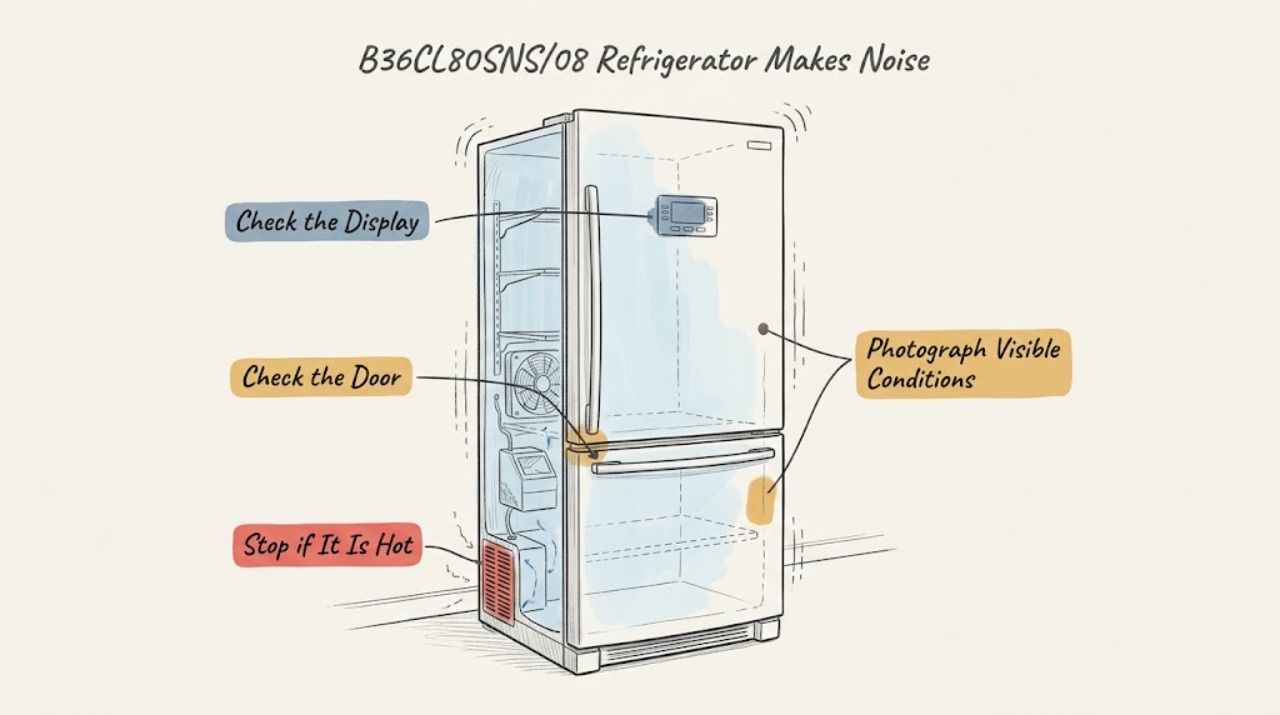
Bosch identifies humming, bubbling or gurgling, and clicking as possible normal refrigerator operating sounds, but a new or harsh noise still needs a location and pattern check. For the exact Bosch B36CL80SNS/08, record whether the sound comes from the freezer, fresh-food compartment, rear/bottom, doors, or removable shelves; whether it follows compressor/fan cooling, ice-making, or door use; and whether cooling remains normal. Bosch's product record identifies B36CL80SNS/08 as an 800 Series French Door Bottom Mount Refrigerator, but do not use the family name to assign a sound to one part or set a decibel threshold. Reposition only visibly touching or loose containers and verify the unit is not visibly rocking. Stop using the refrigerator and arrange qualified service for smoke, burning odor, arcing, a hot connection, exposed wiring, uncontrolled water, rapidly warming food, or a noise that is harsh, grinding, or paired with a fault.
Work through in order
Diagnostic checks
Use only checks that match the exact appliance or system and its official guide.
-
Check 1
From a dry position, check for smoke, a burning or electrical odor, arcing, exposed wiring, a hot or damaged plug/connection, uncontrolled water, or food warming rapidly. Keep the refrigerator out of service and arrange qualified help if any warning is present; do not open the rear or electrical covers.
Expected result: The sound occurs with no hazard and cooling is stable, or the noise is accompanied by smoke, odor, heat, water, exposed wiring, or rapidly worsening cooling.
Next step: For any hazard, stop using the refrigerator and request qualified Bosch refrigeration service; use electrical or plumbing help when the problem is in those systems.
Stop if: Do not touch wet or hot electrical parts, repeatedly restart the appliance, or continue listening tests after a burning odor, arcing, active leak, or rapid warming.
Why this matters
Why: A sound-only complaint can be characterized by location and cycle. A safety or cooling-loss symptom is not a normal-noise comparison and may involve electrical, water, sealed-system, or control work.
-
Check 2
Photograph the rating plate and record the complete Bosch E-Nr B36CL80SNS/08, then note which compartment, side, rear/bottom area, door, shelf, or container seems closest to the sound. Record whether the sound is a hum, buzz, click, gurgle, rattle, vibration, scraping, or grinding and when it starts or stops.
Expected result: The sound is localized to a compartment or removable fitting, comes from the rear/bottom, follows door or ice-maker use, or cannot be localized without moving the appliance.
Next step: Use the exact E-Nr to open the matching manual and preserve a short recording for service. Do not move the refrigerator or remove a panel just to reach the suspected source.
Stop if: Stop if the model plate is missing or mismatched, or if localizing the sound would require pulling the appliance, touching wiring, or entering a restricted area.
Why this matters
Why: Bosch's exact product record ties manuals and support to B36CL80SNS/08, while its noise guidance separates normal motor/refrigerant sounds from possible fan or compressor concerns. Location and timing narrow the next safe check without naming a part by sound alone.
-
Check 3
Listen during ordinary cooling without opening doors repeatedly: note whether the sound is a steady low hum, a brief click at start/stop, a bubbling or gurgling flow, or a new intermittent fan-like sound. Compare the sound with cooling performance and do not use a decibel threshold or touch the fan.
Expected result: The sound cycles with cooling and remains a mild hum/click/flow sound, or it is new, harsh, scraping, grinding, rapidly repeating, or paired with poor cooling.
Next step: For a stable normal-pattern sound with normal cooling, continue to the external fitting and level checks. For a new harsh sound or cooling loss, leave the refrigerator closed and arrange Bosch service.
Stop if: Do not insert a hand or tool into a fan opening, remove an evaporator cover, or run a self-test to reproduce a harsh noise.
Why this matters
Why: Bosch describes motor/fan droning, refrigerant flow, and switching clicks as normal possibilities; Bosch also says an evaporator-fan or compressor concern needs further diagnosis. A harsh sound or cooling loss is more significant than volume alone.
-
Check 4
Without shifting the refrigerator or changing service settings, check that the cabinet is not visibly rocking and that bottles, shelves, drawers, and bins are seated and not touching one another or the cabinet. Move only a plainly contacting container or refit a removable item as the manual permits.
Expected result: A bottle, shelf, drawer, or bin was touching or loose; the refrigerator is visibly unlevel or vibrating against surrounding furniture; or all accessible fittings are clear and stable.
Next step: Correct only the visible contact or seating issue and observe one normal cooling period. Arrange service if vibration or noise persists, the unit is not stable, or leveling would require moving a heavy appliance or altering installation.
Stop if: Do not wedge under the cabinet, loosen installation hardware, pull the refrigerator out, or work near the rear electrical or refrigeration components.
Why this matters
Why: Bosch's operating-noise guidance lists an unlevel appliance and loose or touching removable fittings as causes of preventable noise. If those checks are clear, the sound is less likely to be a simple cabinet resonance, but it is not proof of a compressor or fan failure.
-
Check 5
Correlate the sound with a door opening, water dispensing, ice production, or a change in food temperature, while keeping doors closed as much as practical. Note whether the sound is a brief event tied to an expected operation or repeats independently with cooling, and preserve the time and location for service.
Expected result: The sound occurs only briefly after a door, water, or ice event with normal cooling, or it persists independently, becomes harsher, or accompanies a fault indication, leak, or temperature rise.
Next step: Keep the refrigerator in normal use only for a stable, harmless pattern with normal cooling. Request qualified Bosch service for recurrence with poor cooling, a code, leak, harsh noise, or any safety warning.
Stop if: Do not disable safety controls, force an ice maker, remove tubing, or repeat water/ice cycles to provoke the sound.
Why this matters
Why: A short operation-linked event can be different from a continuous motor/fan or vibration complaint. An independent recurring noise with a cooling, leak, or control symptom needs model-specific diagnosis and is not safely assigned to an ice maker, fan, or compressor from observation alone.
Use your observations
Decision map
Find the observation that best matches what you see, then follow the next safe action.
-
PATH 01Next step
What you see
The B36CL80SNS/08 makes a mild hum, brief click, or bubbling/gurgling sound during ordinary cooling, and the cabinet is stable with normal temperatures and no hazard.
Do this next
Monitor the sound's location and cycle without repeated door opening. Use the exact manual if the pattern changes, and arrange service if cooling or safety symptoms appear.
Why this path and its safety boundary
Why it matters: This pattern is consistent with Bosch's listed normal motor, switching, or refrigerant-flow sounds rather than a confirmed failed component.
-
PATH 02Next step
What you see
A bottle, shelf, drawer, or bin is touching another fitting or the cabinet, or the refrigerator visibly rocks or vibrates against its surroundings.
Do this next
Move only the visibly contacting item or reseat the removable fitting. Do not move the heavy appliance or alter leveling hardware unless the exact installation instructions and a qualified installer support it.
Why this path and its safety boundary
Why it matters: The noise may be a preventable resonance or loose-fitting vibration rather than an internal refrigeration fault.
-
PATH 03Next step
What you see
The noise is localized near the freezer fan area, is new or scraping/grinding, or is accompanied by reduced cooling, while no removable fitting is touching.
Do this next
Keep the doors closed, preserve the sound recording and temperature observations, and arrange qualified Bosch refrigerator service. Do not remove the fan cover or test it yourself.
Why this path and its safety boundary
Why it matters: Bosch identifies the evaporator fan as a possible source of unusually loud noise and recommends professional help for compressor diagnosis; the sound cannot establish which internal part is at fault.
-
PATH 04Next step
What you see
The sound is tied only to a brief door, water, or ice event, then the refrigerator returns to its normal cooling sound with stable temperatures.
Do this next
Record the event and monitor without repeatedly triggering it. Escalate if it becomes continuous, harsh, leaks, produces an error, or affects cooling.
Why this path and its safety boundary
Why it matters: An operation-linked event is more likely than a continuously failing cooling motor, but the exact manual is needed for this model's controls and ice/water behavior.
-
PATH 05Next step
What you see
The noise is harsh, grinding, rapidly repeating, or paired with smoke, burning/electrical odor, arcing, a hot connection, active water, exposed wiring, or rapidly warming food.
Do this next
Keep clear and arrange qualified Bosch appliance service; use electrical or plumbing help for hazards in those systems. Do not restart the refrigerator to test it.
Why this path and its safety boundary
Why it matters: This is a stop-use condition beyond a normal operating-noise comparison and may create equipment, food, water, shock, or fire risk.
Helpful context
Understand the symptom
Noise is identified by pattern, not loudness alone
A refrigerator can hum, click, or make refrigerant-flow sounds during normal cooling. The useful home observation is where the sound starts, what it sounds like, whether it cycles on and off, and whether cooling or the ice maker changes at the same time. There is no safe universal decibel cutoff for this individual installation, so compare with the appliance's recent behavior and the exact Bosch documentation rather than a phone-meter number.
Why the B36CL80SNS/08 needs exact-model context
Bosch's service record identifies B36CL80SNS/08 as an 800 Series French Door Bottom Mount Refrigerator and provides its manuals and support links. The related B36CL80SNS product data lists two compressors and two evaporators, so recording whether a noise comes from the freezer or fresh-food side is more useful than calling every sound a compressor fault. This does not identify a failed part without inspection.
Safe home boundary
Keep the inspection external. A homeowner can listen from a dry position, note cooling and door behavior, and move a visibly touching bottle or shelf item. Do not remove covers, reach for a fan, test live wiring, disturb the sealed refrigeration circuit, or restart a refrigerator that shows an electrical, heat, leak, or rapid-cooling-loss warning.
When checks do not resolve it
Need a professional?
Arrange qualified Bosch refrigeration service when the exact B36CL80SNS/08 noise persists after visible fitting and installation checks, is harsh or grinding, localizes near an internal fan or compressor area, or is accompanied by poor cooling, a fault indication, water, smoke, burning/electrical odor, arcing, a hot connection, or rapidly warming food. Provide the full E-Nr, sound recording, location, timing, temperature observations, and any door, water, or ice event that preceded it.
Common questions
FAQ
Is humming from the Bosch B36CL80SNS/08 always a fault?
No. Bosch says humming can be normal, and its operating-noise guidance describes motor/fan droning, refrigerant bubbling or gurgling, and switching clicks as possible normal sounds. A new harsh noise, cooling loss, leak, odor, or electrical warning changes the decision.
Can I identify the bad part by listening to the sound?
No. Location and timing can separate a removable fitting, cooling-cycle sound, fan-area noise, or operation-linked event, but they do not prove a compressor, fan, ice-maker, or control part. Use the complete E-Nr and have Bosch service confirm the diagnosis.
Should I use a phone app to decide whether the refrigerator is too loud?
Do not use a universal decibel cutoff. Compare the sound with the refrigerator's recent pattern, location, cycle, cooling, and hazard signs, then use the exact Bosch manual or service path for the B36CL80SNS/08.
Read the exact guide
Official sources
- Refrigerator Making Loud Noises | TroubleshootingBosch Home Appliances · Official Bosch US refrigerator owner-support guidance for loud-noise symptom triage
- 40815356.fmBosch Home Appliances · Official Bosch refrigerator instruction manual used for general operating-noise categories; its text notes that instructions cover several models, so it is not treated as the exact B36CL80SNS/08 manual
- Appliance Information - French Door Bottom Mount Refrigerator | B36CL80SNS/08Bosch Home Appliances · Official Bosch US service-assistance record for the exact E-Nr B36CL80SNS/08
- Repair Service for large home appliancesBosch Home Appliances · Official Bosch US large-appliance repair-service guidance, including refrigerators
- 36" Counter-Depth 4-Door RefrigeratorBSH Home Appliances Corporation · Official Bosch product specification for the B36CL80SNS base model; used only for model-family architecture context, not for assigning a repair part by sound
Community feedback
Share a repair observation
Share a plain-text repair observation. Accepted observations are published automatically; this page may take a moment to update.