
On this page
Start here
Quick answer
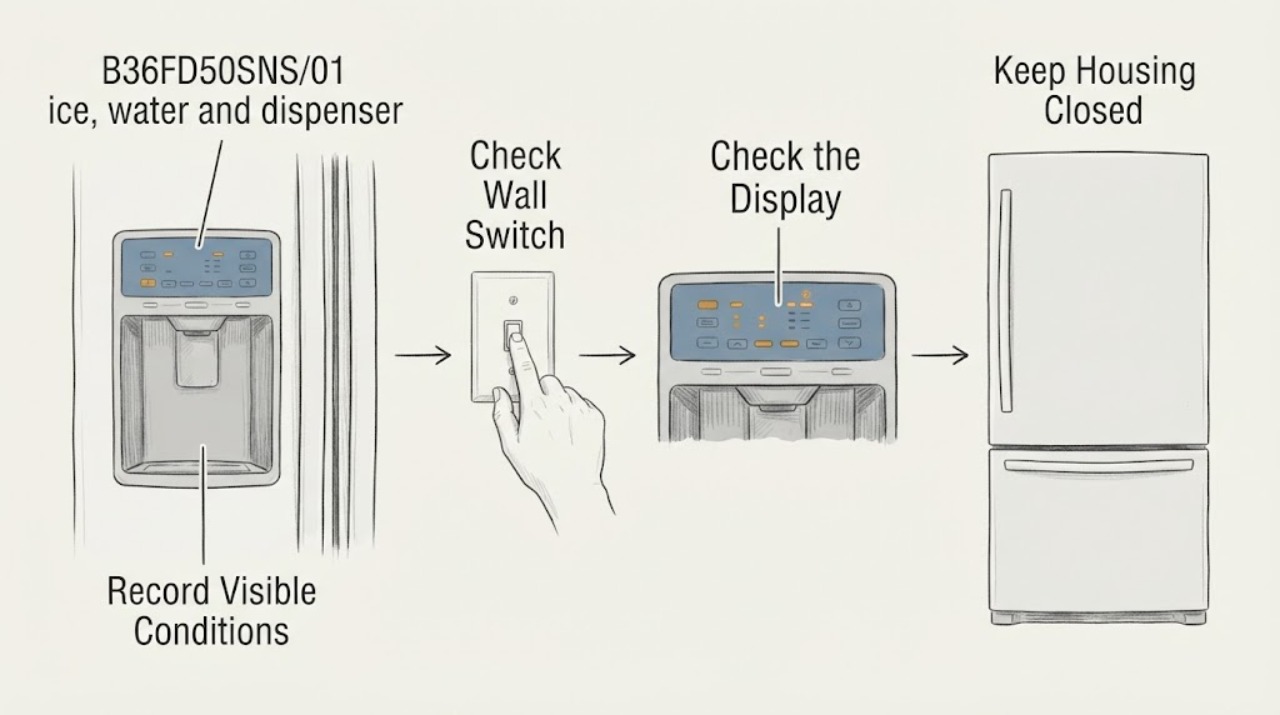
For the Bosch B36FD50SNS/01, a dark ice-and-water dispenser panel together with no ice and no water is a control-area symptom, not proof that the ice maker, inlet valve, or control board has failed. First verify that the refrigerator still has power, the freezer door is closed, the dispenser is not locked, and ice production is enabled through the normal controls. Bosch's manual says the dispenser is locked while a door is open, documents the button-lock and permanent-light controls separately, and gives a one-time five-minute power-cycle step when the dispenser fault persists. If the panel remains dark or the ice/water functions stay unavailable after that safe check, stop repeating resets and arrange Bosch service with the exact model and what still works. Do not copy an online 'found the fix' sequence as a model-approved repair.
Work through in order
Diagnostic checks
Use only checks that match the exact appliance or system and its official guide.
-
Check 1
Confirm the rating-label model is B36FD50SNS/01 and record what is actually working: interior lights, main temperature display, cooling, dispenser panel lights, water, and ice. Keep the freezer door closed while observing the panel.
Expected result: The refrigerator cools and its main display or interior lights work, but the door dispenser panel is dark and neither ice nor water dispenses; or the whole appliance is without power.
Next step: If all appliance power is absent, use the normal household breaker or outlet check only if it is safe and accessible. If only the dispenser area is affected, continue with the door and lock checks below.
Stop if: Do not remove the dispenser panel, pull the refrigerator, open covers, or probe wiring to identify a control-board fault.
Why this matters
Why: A working refrigerator with an isolated dark dispenser points toward a dispenser control/lock state or local fault, while loss of all appliance power requires an electrical-supply check before dispenser diagnosis. The reported headline is not a confirmed repair result.
-
Check 2
Close both refrigerator doors fully and check from the outside that no food, shelf, or container prevents the freezer door from sealing. Do not hold a door switch open or reach behind the dispenser.
Expected result: The freezer or refrigerator door was open, obstructed, or not sealing; or both doors close normally and the dispenser remains dark.
Next step: Remove only the ordinary external obstruction and close the door normally. If a hinge, seal, or door switch appears damaged, arrange service rather than forcing the door or bypassing its sensing.
Stop if: Do not bypass a door switch, force a damaged door, or continue using the dispenser if water is leaking near electrical parts.
Why this matters
Why: Bosch states that the ice-and-water dispenser is locked when an appliance door is open, so an open or obstructed door can explain an apparently dead dispenser without proving a failed part. A correctly closed door makes a local control condition or fault more likely.
-
Check 3
Use the dispenser's normal controls to check whether the button lock is visibly active and whether the permanent-light control changes the light as the manual describes. Use clean, dry fingers and do not treat a beep or a dark panel as proof of a particular board failure.
Expected result: The lock indicator is active, the panel responds and the light can be toggled, or the panel gives no visible response at all.
Next step: Unlock only with the normal button-lock control described in the exact manual. If no control responds, record the exact behavior and continue to the single documented power-cycle step rather than trying combinations from another model.
Stop if: Do not hold undocumented button combinations, enter service mode, or remove the dispenser trim to make the controls respond.
Why this matters
Why: The manual documents a button lock that prevents accidental dispenser operation and a separate permanent-light control. A normal response supports a lock or setting condition; no response across the panel is a stronger local-control symptom but still does not identify the failed component.
-
Check 4
Confirm through the normal dispenser controls that ice production has not been switched off and that the ice-storage container is present and seated as the manual allows. Keep hands out of the dispenser opening and do not force the container.
Expected result: Ice production was disabled, the container was not seated, or both settings and container are correct while the panel and water/ice functions remain unavailable.
Next step: Restore only the documented setting or seating and allow the appliance's normal production time. If the panel is still dark or the container will not seat, stop and arrange Bosch service.
Stop if: Never reach into the ice outlet, chip ice with a tool, bypass a bin sensor, or remove a cover around the ice mechanism.
Why this matters
Why: A disabled ice setting or mis-seated container can explain no ice, but it cannot by itself explain a dark control area or a simultaneous loss of water dispensing. Correct seating narrows the issue toward water supply, the dispenser control path, or service-level diagnosis.
-
Check 5
Check the accessible water-supply status without moving the refrigerator or loosening tubing: confirm an accessible shutoff is open, look for a visible kink or leak, and observe whether the dispenser has any normal water flow if the panel can be selected.
Expected result: The shutoff is closed or unknown, a hose is visibly kinked or leaking, water flow is weak/absent, or water flow is normal while ice and the panel remain unavailable.
Next step: Restore only an accessible shutoff or visible external condition that can be corrected without moving the refrigerator. Use a plumber for the household connection and Bosch service for an appliance-side restriction or simultaneous control failure.
Stop if: Do not disconnect water tubing, bypass the filter, pull the appliance, or operate with a leaking connection or water near electrical parts.
Why this matters
Why: Bosch lists absent supply, a blocked filter, and a kinked hose as dispenser causes. A normal water flow makes a household supply restriction less likely but does not prove an inlet valve, ice maker, wiring, or control fault; a leak changes this to a safety stop.
-
Check 6
If the refrigerator is powered and the dispenser fault remains, perform only Bosch's documented one-time reset: switch the appliance off, disconnect power at the plug or breaker, wait five minutes, reconnect, and switch it on. Record whether the panel, water, and ice return; do not repeat the cycle as a repair strategy.
Expected result: The dispenser returns after the one-time reset, returns only briefly, or remains dark and unusable while the refrigerator still cools.
Next step: If the panel and functions recover, monitor without applying an undocumented 'fix.' If the fault recurs or remains, keep the doors closed, preserve the exact symptom sequence, and book qualified Bosch service using B36FD50SNS/01.
Stop if: Do not open the control housing, force a harvest cycle, test live voltage, or replace a board, valve, filter, or ice-maker assembly from a generic parts list.
Why this matters
Why: A lasting recovery supports a transient dispenser-control state. A brief or absent recovery leaves a local dispenser/control fault possible, but the safe checks cannot distinguish a control interface, wiring, valve, sensor, or ice-maker assembly failure.
Use your observations
Decision map
Find the observation that best matches what you see, then follow the next safe action.
-
PATH 01Safety boundary
What you see
The refrigerator cools and its interior/main display works, but the dispenser panel is dark and neither ice nor water works.
Do this next
Check closed doors and the normal lock/light controls, then use the single five-minute Bosch reset. Escalate if the panel stays dark or the condition returns.
Why this path and its safety boundary
Why it matters: This is an isolated ice-and-water control-area failure or state; it is not enough evidence to name a failed ice maker or control board.
Safety stop: Do not copy an online button-combination 'fix' as though Bosch approved it, and do not open the panel.
-
PATH 02Safety boundary
What you see
The dispenser responds after unlocking or closing a door, but only ice or only water remains unavailable.
Do this next
Follow the model manual's corresponding accessible setting, container, filter, or supply check and allow normal recovery; arrange service for leaks, repeated failure, or any appliance-side restriction.
Why this path and its safety boundary
Why it matters: A setting, container, ice path, filter, or water-supply branch is more likely than a total dispenser-control outage; the exact failed component is still unproved.
Safety stop: Do not reach into the outlet, force ice, disconnect tubing, or bypass sensors or filtration.
-
PATH 03Safety boundary
What you see
The accessible shutoff is closed/unknown, the hose is visibly kinked, or there is weak/absent water flow.
Do this next
Correct only an accessible shutoff or visible kink without moving the refrigerator; use a plumber or Bosch service for connections and hidden restrictions.
Why this path and its safety boundary
Why it matters: An external supply, filter, or flow restriction is more likely than a purely electronic dispenser failure, while a leak requires immediate stop.
Safety stop: Stop for leaks or water near electrics; do not loosen a fitting or run the dispenser to chase a pressure diagnosis.
-
PATH 04Safety boundary
What you see
The doors close, lock/light controls do not respond, water supply is normal, and the five-minute reset does not restore the panel or both functions.
Do this next
Arrange qualified Bosch appliance service and provide the exact model, the power/cooling status, the dark-panel behavior, and the reset result.
Why this path and its safety boundary
Why it matters: A persistent local control-path or internal dispenser fault is more likely, but safe external checks cannot identify whether the cause is the interface, wiring, valve, sensor, or ice-maker system.
Safety stop: Do not continue undocumented resets, disassemble the dispenser, probe live parts, or order a component solely from the online headline.
-
PATH 05Safety boundary
What you see
There is a water leak, damaged hose, exposed wiring, burning smell, arcing, or a breaker that trips again.
Do this next
Stop using the dispenser and disconnect power only if it can be done without contact with water or exposed conductors; shut the accessible water supply if safe, leave the appliance closed, and obtain qualified appliance/electrical service.
Why this path and its safety boundary
Why it matters: This is a safety condition, not a normal dispenser troubleshooting branch.
Safety stop: Do not re-energize to reproduce the symptom or attempt a wiring, valve, or control-board repair.
Helpful context
Understand the symptom
The important split is whether the refrigerator itself is operating or only the door dispenser/control area has gone dark. Cooling, interior lighting, and the main temperature display can continue while the ice-and-water interface is locked, disabled, or faulted. The wording attached to the online report is not an official Bosch diagnosis, so use the exact panel behavior and the model manual to decide whether this is a normal state, a reversible control condition, or a service fault.
When checks do not resolve it
Need a professional?
Call qualified Bosch appliance service if the B36FD50SNS/01 dispenser remains dark or both functions remain unavailable after the safe checks and one five-minute reset, or sooner for a leak, exposed wiring, burning smell, arcing, repeated breaker trip, or a door that cannot seal. Do not re-energize a wet or visibly damaged appliance.
Common questions
FAQ
Does a dark ice-and-water panel prove the control board is bad?
No. It can reflect a door-open lock, button-lock or light state, a transient control condition, power interruption, or an internal dispenser fault. Bosch's manual does not let a user identify a specific failed board from this symptom alone.
Should I try the lock-and-light button combination described online?
Treat the Reddit report as an owner experience, not a Bosch-approved repair sequence. Use the exact manual's normal controls and its one-time five-minute power-cycle instruction; if the panel remains dark or the problem returns, arrange service rather than repeating undocumented combinations.
Why can the refrigerator cool while ice and water do not work?
The ice-and-water dispenser has its own door control area and water/ice functions. Bosch documents separate dispenser lock, light, selection, and dispensing controls, so an isolated dispenser issue can coexist with normal cooling; the exact internal cause still requires model-specific diagnosis if safe checks fail.
Read the exact guide
Official sources
- Appliance Information - French Door Bottom Mount Refrigerator | B36FD50SNS/01Bosch · Exact B36FD50SNS/01 model identity and Bosch owner-support/service resources
- BOSCH refrigerator freezer B36FD50SNS/01 ice, water and lights on working. I FOUND THE FIXReddit · Exact-model owner report of isolated dark ice/water panel with cooling still operating
- Use and Care Manual B36FD.. | Bosch, Manuel d'utilisation B36FD.. | Bosch, Manual del usuario B36FD.. | BoschBosch · Bosch B36FD refrigerator ice/water dispenser controls, door lock behavior, production, water supply, and dispenser troubleshooting
Community feedback
Share a repair observation
Share a plain-text repair observation. Accepted observations are published automatically; this page may take a moment to update.