
On this page
Start here
Quick answer
First separate an empty or non-producing ice maker from a dispenser that has ice but cannot deliver it. Bosch guidance supports checking that the ice maker is on, the ice bin is correctly seated, the visible ice is not frozen together, and the accessible water/filter path is connected and unrestricted. Use the exact model manual for controls and any displayed code: Bosch identifies E02 as an ice-maker or ice-water-system communication fault and E03 as a dispenser user-interface fault, but those definitions should not be transferred to an unidentified interface without the model match. Do not reach into the dispenser opening or crusher, use sharp tools, open the cabinet, or keep resetting a fault. Stop for a leak, smoke, burning smell, water near electrics or a returning code and arrange Bosch or qualified appliance service.
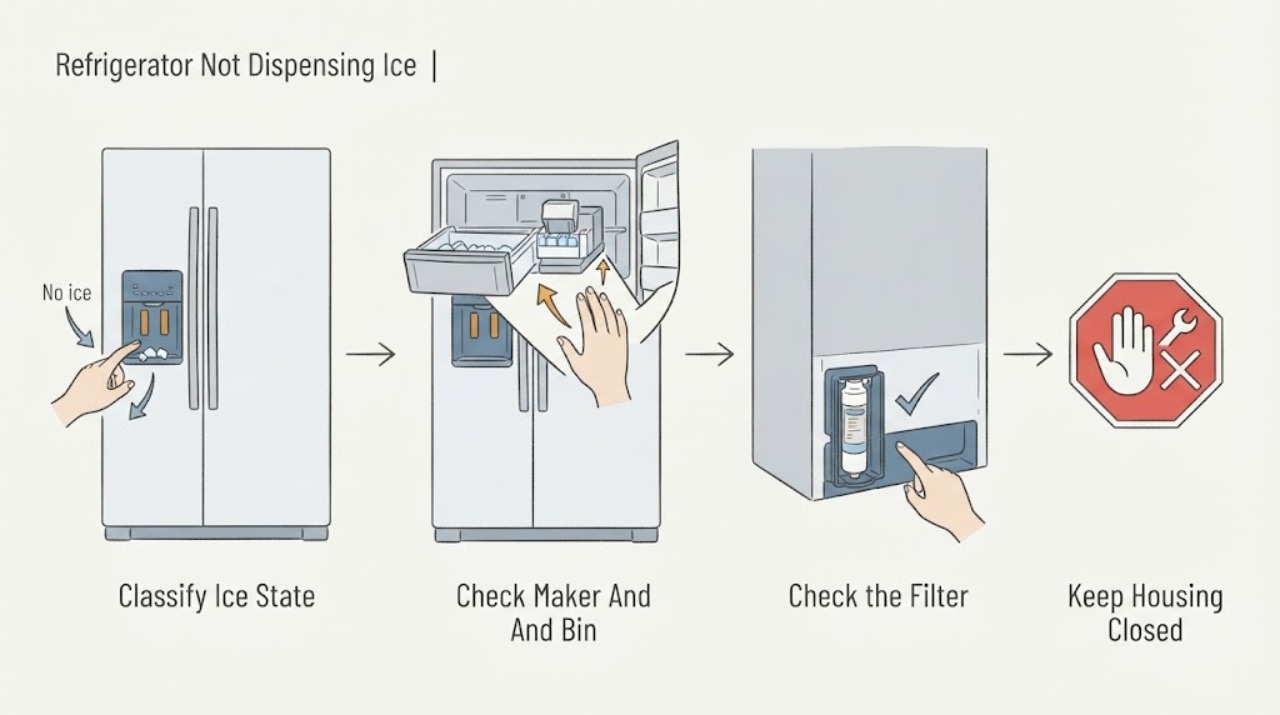
Work through in order
Diagnostic checks
Use only checks that match the exact appliance or system and its official guide.
-
Check 1
With the refrigerator closed between observations and from a dry, safe position, record whether the ice bin is empty, contains loose cubes, contains one frozen mass, or is full while the dispenser produces no ice. Also note whether water dispensing works and whether any indicator or code is present.
Expected result: The bin is empty, clumped, full with no output, or the appliance has a separate water or display symptom.
Next step: Follow the matching branch below and record the exact model before applying a control sequence. Do not repeatedly activate the dispenser to force a result.
Why this matters
Why: An empty bin points to ice production, maker state or water/freezer conditions; a clumped bin points to storage or feed blockage; a full bin with no output points to the dispenser/bin path. Water and display symptoms create separate branches.
-
Check 2
Check only the accessible ice-maker control and whether the ice container is seated and aligned as the matching Bosch manual shows. Look for an obvious visible cube obstructing the fill-level arm or a bin that is not fully inserted; do not reach into the mechanism.
Expected result: The maker is off, the bin is mis-seated, a visible cube is obstructing the arm, or the control and bin appear correct.
Next step: Correct only the documented external state for the exact model. If the maker is on and the bin is correctly seated but no ice returns, continue with the water/freezer checks and service boundary.
Why this matters
Why: Bosch lists maker-off, bin alignment and a visible obstruction as user-level reasons for no or low ice on the documented families. A correct external state does not prove an internal motor or board fault.
-
Check 3
Inspect the accessible water shutoff position, visible supply hose for a kink, and the filter status or replacement guidance shown for the exact Bosch model. Do not disconnect a pressurized line, open a cabinet or guess a filter fit.
Expected result: The supply is off, a visible hose is kinked, the filter is due or restricted, water pressure is visibly inadequate, or the accessible path appears normal.
Next step: Restore only an obvious accessible supply condition and follow the exact model’s filter replacement/flush instructions. If the path is normal or the symptom persists, arrange service rather than opening the water system.
Why this matters
Why: Bosch manuals associate no/low ice with water-supply, hose, pressure and filter conditions. These observations do not identify an internal inlet valve or water-system component.
-
Check 4
With the dispenser not activated, remove and inspect the ice container only as the exact manual permits. Look for cubes frozen together, a layer on the feed screw, or a visible blockage at the opening; use no fingers, knife or pointed tool in the chute/crusher.
Expected result: Cubes are frozen together, the feed screw area is visibly iced, the bin was not fully inserted, or the bin is clear but delivery still fails.
Next step: Clean and reseat the container only according to the exact model manual. If the bin is clear and properly seated but no ice dispenses, stop repeated attempts and provide the model and symptom record to service.
Why this matters
Why: Bosch’s dispenser troubleshooting treats clumping, feed-screw icing and incomplete bin insertion as distinct user-level causes. A clear bin with no delivery does not establish a failed dispenser motor or board.
-
Check 5
Read the complete model/FD or E-Nr label and write down any displayed code or indicator before resetting anything. Compare it only with Bosch’s matching refrigeration page and manual.
Expected result: The exact source identifies a model-scoped code, or the code is absent, returns, or belongs to an unmatched interface.
Next step: Use one documented model-specific reset only when the matching source permits it. If the code returns or the model cannot be matched, leave the appliance off as appropriate and arrange service.
Why this matters
Why: Bosch lists E02 as an ice-maker/ice-water-system controls communication issue and E03 as a dispenser user-interface fault, while the page routes persistent codes to service. A generic reset cannot confirm either fault or a part.
-
Check 6
Stop using the ice and water functions for an active leak, smoke, burning or electrical smell, water near electrics, repeated breaker trips, damaged wiring, or a code/fault that returns after the documented external checks. Isolate water or power only from a dry, safe location.
Expected result: The hazard cannot be isolated safely, food or water may be contaminated, or the dispenser remains inoperative without a model-documented user fix.
Next step: Keep the refrigerator off if safe to do so, protect perishable food as appropriate, and contact Bosch or a qualified appliance technician. Use emergency services for smoke or fire.
Why this matters
Why: These conditions exceed safe external troubleshooting. Repeated resets or opening the cabinet could worsen water, electrical or mechanical injury risk.
Use your observations
Decision map
Find the observation that best matches what you see, then follow the next safe action.
-
PATH 01Next step
What you see
The ice bin is empty or no new ice is being made.
Do this next
Confirm the maker is on, the bin is seated, and the exact model’s accessible water/filter path is normal. If ice does not return, arrange service.
Why this path and its safety boundary
Why it matters: This is an ice-production, maker-state, freezer-condition or water-path branch rather than proof of a blocked dispenser.
-
PATH 02Next step
What you see
The bin contains one frozen mass, visible ice on the feed screw, or a stuck cube at the documented fill-level/dispenser area.
Do this next
Turn the function off and follow the exact model manual for safe bin removal and cleaning. Do not use a sharp tool or reach into the crusher opening.
Why this path and its safety boundary
Why it matters: Bosch treats clumping and visible feed-path obstruction as user-level dispensing conditions on its dispenser guidance; it does not prove a failed motor.
-
PATH 03Next step
What you see
The bin contains loose ice and is properly seated, but pressing the dispenser produces no ice.
Do this next
Confirm the exact model, check only the model-documented selection/control state, and arrange service if no documented external correction restores delivery.
Why this path and its safety boundary
Why it matters: The issue is now in the selected dispenser path, user interface, water/control state or an internal fault; the symptom alone cannot identify a part.
-
PATH 04Next step
What you see
The refrigerator displays E02, E03 or another indicator while ice dispensing fails.
Do this next
Verify the exact model against the Bosch error-code page and use only its documented reset/service instruction; do not infer a board or motor replacement.
Why this path and its safety boundary
Why it matters: Bosch’s published meanings are model/interface-scoped: E02 concerns an ice-maker or ice-water-system controls communication issue and E03 concerns a dispenser user interface fault.
-
PATH 05Next step
What you see
There is a leak, smoke, burning smell, water near electrics, repeated breaker trip, damaged wiring or a returning fault.
Do this next
Isolate water/power only when safe, keep the refrigerator and affected functions off, protect food, and contact Bosch or qualified service; use emergency help for smoke or fire.
Why this path and its safety boundary
Why it matters: This is a stop-and-service condition, not a reason to keep cycling the dispenser or open the cabinet.
Helpful context
Understand the symptom
Start by separating ice production from ice dispensing
If the bin is empty, the ice maker may be off, the freezer may not have reached its operating condition, or the water path may be restricted. If the bin contains loose cubes but none come through the chute, the dispenser path, bin fit, selection or user interface is the more relevant branch. Ice frozen into a block can also stop delivery without proving that the motor or control board has failed. Record which state you see before trying another cycle.
Use the exact Bosch manual for controls and codes
Bosch provides model-specific manuals and a refrigeration support route. The opened Bosch B24 family manual documents the ice maker switch, water-supply checks and an external power reset for a persistent ice-maker fault; the separate Bosch dispenser manual documents bin, feed-screw and chute checks. Those manuals are useful scoped examples, not a universal control sequence for every Bosch refrigerator. Find the complete model number before interpreting an indicator or ordering a component.
Keep hands and tools out of the crusher opening
The Bosch dispenser manual warns about rotating crusher blades. Do not reach into the opening or probe it with a finger, knife or other sharp object. If the visible bin has clumped cubes, use only the exact model manual’s user-level removal instruction and keep the appliance off while handling the bin. A leak, electrical smell, smoke, repeated breaker trip or returning error is a stop-and-service condition.
When checks do not resolve it
Need a professional?
Arrange Bosch or qualified appliance service if the bin is full and correctly seated but no ice dispenses after the exact model’s user-level checks, or if a documented code returns., Leave the refrigerator or the affected water/ice function off for a leak, smoke, burning/electrical smell, water near electrics, damaged wiring or repeated breaker trip; use emergency help for fire., Do not open the cabinet, perform live electrical tests, bypass an interlock, reach into the crusher, or order a motor, valve, board or other part without the complete model and matching parts documentation.
Have this ready
- complete Bosch model/E-Nr and FD information
- whether the bin is empty, clumped or full with loose cubes
- whether water dispensing works
- visible hose/filter/bin observations
- any E02, E03 or other display pattern and whether it returns
- whether there was a leak, smoke, electrical smell or breaker trip
Common questions
FAQ
Why does a Bosch refrigerator have ice in the bin but not dispense it?
Check whether cubes are frozen together, the feed screw or visible opening is blocked, or the bin is not fully seated. The Bosch dispenser manual treats these as separate user-level checks; if the bin is clear and correctly seated, the exact model and service boundary control the next step.
Does Bosch E02 mean the ice-dispenser motor is bad?
No. Bosch’s refrigeration page describes E02 as an ice-maker or ice-water-system controls communication issue and directs persistent faults to service. It does not justify naming a motor or board without the exact model and diagnosis.
Can I use a knife to break up ice in the dispenser?
No. Bosch warns about rotating crusher blades and its dispenser troubleshooting directs removal of certain visible obstructions with a blunt plastic implement rather than a sharp object. Do not reach into the opening.
What information should I give Bosch service?
Give the complete model/E-Nr and FD, whether the bin is empty or full, whether water dispensing works, the exact indicator or code, and any leak or electrical-smell history.
Read the exact guide
Official sources
- Refrigerator FAQs | Top Tips | BoschBosch Home Appliances · Official Bosch US owner guidance for Bosch refrigerators. Used for model/FD identification, ice-bin alignment, filter replacement and the scope of family-specific refrigerator guidance; exact model remains controlling.
- Refrigeration | Error Codes | BoschBosch Home Appliances · Official Bosch US refrigeration error-code page. Used narrowly for the published E02/E03 meanings and reset/service boundary; verify the exact refrigerator interface/model before applying a code.
- Get Support - Refrigeration | Bosch Home AppliancesBosch Home Appliances · Official Bosch US refrigeration support hub. Used for model-specific manual/service lookup and escalation, not as proof of an unseen model-specific control sequence.
- Dokument:Bosch Home Appliances · Official Bosch-hosted refrigerator dispenser manual used as a scoped example because the task has no exact model. It supports bin, feed-screw, chute, water-supply and crusher safety checks; the exact model manual controls any differing layout or sequence.
- Use and Care Manual B24...80 | BoschBosch Home Appliances · Official Bosch-hosted B24 family use-and-care PDF. Used as a clearly scoped family example for ice-maker state, water supply, fill-level sensor, external reset and service boundary; it does not establish controls for every Bosch refrigerator.
Community feedback
Share a repair observation
Share a plain-text repair observation. Accepted observations are published automatically; this page may take a moment to update.