
On this page
Start here
Quick answer
Treat “not fitting” as a measurement and access problem before trying to force the refrigerator into place. Bosch says to measure the opening at its narrowest width, use the shorter front/back height, measure depth, compare the exact model's overall and required cutout dimensions, allow model-specific ventilation and door-swing clearance, and measure the delivery path. Bosch also says some delivery paths may require doors to be removed. If the model, opening or path does not match, stop and use professional delivery/installation or choose a correctly sized model; do not trim cabinets, force the appliance, remove doors without model instructions or connect utilities to make a mismatch work.
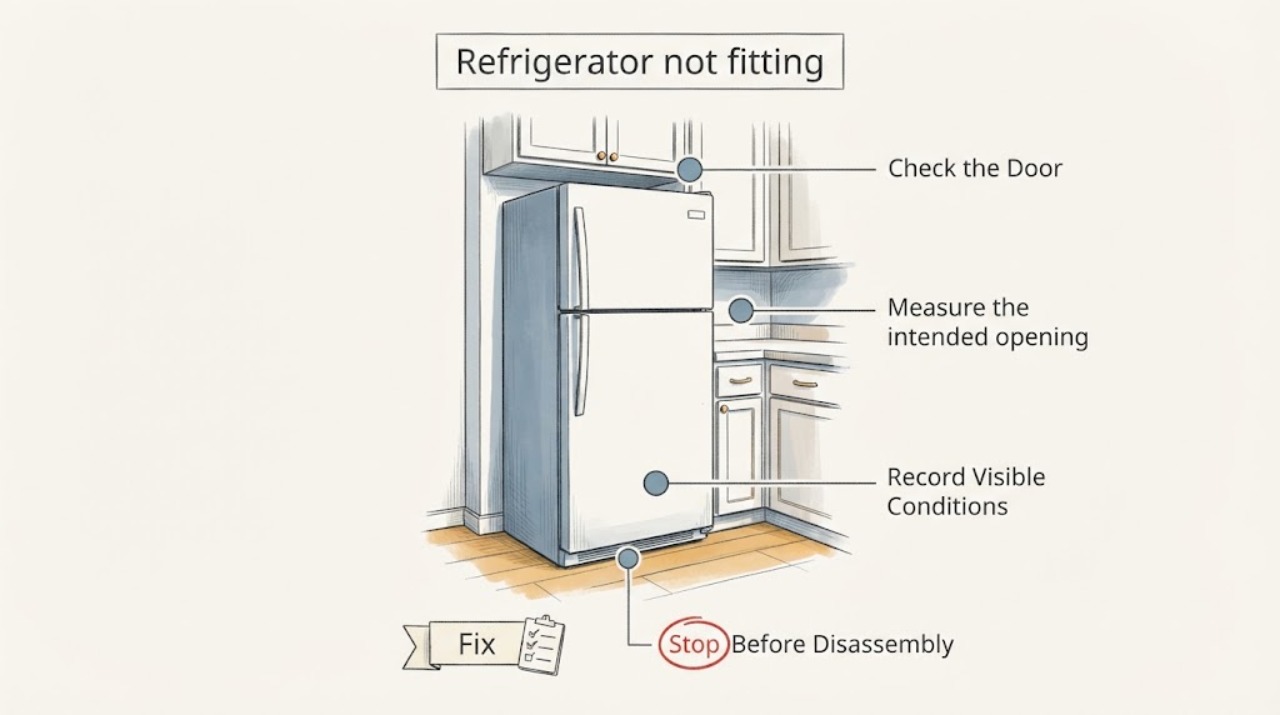
Work through in order
Diagnostic checks
Use only checks that match the exact appliance or system and its official guide.
-
Check 1
Write down the exact Bosch model and identify the first obstruction: cabinet width/height/depth, door or drawer swing, doorway/hallway route, or outlet/water location.
Expected result: The appliance is too large for the opening, cannot pass the route, a door/drawer hits nearby cabinetry, or a required connection cannot be reached; alternatively, the obstruction is not yet known.
Next step: Use the corresponding measurement branch and keep the appliance stationary until the dimensions are checked.
Stop if: Do not force the refrigerator or start modifying the kitchen to discover the cause.
Why this matters
Why: These are different fit decisions. A cutout fit does not prove delivery-path or door-swing fit, and a missing model prevents a reliable dimension comparison.
-
Check 2
Measure the intended opening at its narrowest width at the upper cabinet, countertop and base levels; measure height at both front and back from the floor to the lowest obstruction and use the shorter height; measure depth from the back wall to the counter edge.
Expected result: One measurement is smaller than the exact model requirement, or the opening meets the model dimensions with the specified clearances.
Next step: If any required dimension fails, stop and resolve the model/opening mismatch before moving the appliance.
Stop if: Compare door swing, ventilation and delivery path next; do not assume the fit is complete.
Why this matters
Why: Bosch says narrow-point and front/back measurements matter because an apparently adequate opening can be smaller at one location.
-
Check 3
Open the exact Bosch product page or installation document for the model and compare overall height, width, depth, required cutout and model-specific ventilation/door-swing requirements.
Expected result: The exact documents list a different dimension or clearance than the opening provides, or the documents match the measured space.
Next step: Use the exact installation document to choose a correction or a properly sized model; do not transfer dimensions from a similar refrigerator.
Stop if: Continue to the route and utility checks, while preserving the exact model documentation.
Why this matters
Why: Bosch publishes model-specific overall and cutout dimensions; a different Bosch model or series cannot supply the missing fit value.
-
Check 4
Measure the delivery path from the entrance to the final location, including doorways, hallways, turns, thresholds and the space needed to open doors and freezer drawers fully.
Expected result: A doorway, turn or final door swing is narrower than the appliance/path requirement, or the route is clear.
Next step: Stop and ask the delivery or qualified installation team whether model-approved door removal or a different route is appropriate; do not remove refrigerator doors without exact instructions.
Stop if: Proceed only with the exact model installation plan and floor/path protection.
Why this matters
Why: Bosch says delivery-path obstructions and door outswing/freezer-drawer clearance are separate from the cabinet cutout; some paths may require door removal.
-
Check 5
Check the exact model installation document for ventilation, grounded power and any water connection; compare the connection locations with the actual wall and floor before final positioning.
Expected result: The model requires a connection that is absent, out of reach or blocked, or the model-specific connections are available without pinching the appliance against the wall.
Next step: Do not improvise an extension, crush a water line or energize an unverified connection; arrange qualified installation.
Stop if: Keep the required clearances and follow the exact installation document during positioning.
Why this matters
Why: Bosch delivery guidance lists a grounded 110V outlet and, for refrigeration installation, a water connection kit and nearby shutoff; exact appliance and installation scope control whether water is required.
-
Check 6
If any dimension or route still fails, stop the move and have a qualified installer or delivery team assess the model, opening and path rather than cutting cabinets, forcing the refrigerator or altering hinges.
Expected result: The team confirms a model-approved route/installation, or the appliance remains physically incompatible with the space.
Next step: Follow the documented professional plan and recheck the final door swing, ventilation and utilities before use.
Stop if: Return or replace the appliance through the appropriate seller/installer process or redesign the opening; do not create a hazardous partial installation.
Why this matters
Why: Bosch documentation supports planning and model-specific installation; it does not authorize structural modification or improvised fitting.
Use your observations
Decision map
Find the observation that best matches what you see, then follow the next safe action.
-
PATH 01Next step
What you see
The opening is narrower, shorter or shallower than the exact model requirement at any measured point.
Do this next
Stop moving it and resolve the opening/model mismatch using the exact installation document or a qualified installer.
Why this path and its safety boundary
Why it matters: The appliance is dimensionally incompatible with the opening; forcing it could remove required clearance or damage the appliance/cabinet.
-
PATH 02Next step
What you see
The cabinet opening fits, but a doorway, hallway, turn or threshold blocks delivery.
Do this next
Have the delivery/installation team assess the route and any model-approved door removal; do not dismantle refrigerator doors or force the load yourself.
Why this path and its safety boundary
Why it matters: Delivery-path clearance is a separate constraint from the final cutout.
-
PATH 03Next step
What you see
The refrigerator body fits but a door, drawer or handle hits a wall, island or adjacent cabinet.
Do this next
Compare the exact model door-swing requirements and change the model/layout or use qualified installation planning.
Why this path and its safety boundary
Why it matters: Bosch says door outswing and freezer-drawer paths must be measured for full opening, not just body width.
-
PATH 04Next step
What you see
The exact model documents require ventilation or utilities that the opening cannot provide.
Do this next
Do not pinch lines, improvise connections or eliminate clearance; have the exact installation requirements corrected professionally.
Why this path and its safety boundary
Why it matters: A tight physical fit can still be an invalid installation if clearances or connections are blocked.
-
PATH 05Next step
What you see
The model or the meaning of “not fitting” is unknown, or the problem is actually a door/panel/part fit rather than installation space.
Do this next
Confirm the complete model and the physical interference before using any part or door-removal procedure.
Why this path and its safety boundary
Why it matters: Dimension guidance cannot identify compatibility for an unknown component or a different problem identity.
Helpful context
Understand the symptom
First identify where it fails to fit
“Not fitting” can mean the refrigerator is too wide, too tall or too deep for the opening; the doors or drawers hit a wall or island; the appliance cannot pass through the delivery route; or the required outlet/water connection is inaccessible. Record the exact Bosch model and the first point of interference before moving or modifying anything.
Measure the space and the route separately
Bosch treats the kitchen opening and delivery path as separate checks. Measure the opening at its narrowest points and measure doorways, halls, turns and other obstructions. A refrigerator can match the cabinet cutout and still fail at a doorway or at the final door-swing clearance.
Use the exact model documents
Bosch product pages publish overall dimensions, required cutout size and installation documents for a specific model. Use those documents instead of a nearby Bosch series or an online dimension from another refrigerator. Clearance and utility requirements remain model and installation dependent.
Do not force a dimensional mismatch
If the opening, door swing, delivery route or utility location fails the exact model requirements, stop before cutting cabinets, forcing the appliance or improvising a connection. Ask a qualified installer or delivery team to assess the route and model-specific installation documents.
When checks do not resolve it
Need a professional?
Use qualified delivery or installation help when the appliance does not match the opening or route, when doors/drawers need model-specific removal, or when ventilation, outlet or water-connection requirements cannot be met. Do not force or modify the appliance to make it fit.
Have this ready
- complete Bosch model and serial
- overall appliance dimensions from the model page/manual
- opening width/height/depth at all measured points
- delivery-path measurements
- door/drawer interference point
- ventilation, outlet and water-connection location
- photos or a drawing only if safe
Common questions
FAQ
What should I measure when a Bosch refrigerator does not fit?
Measure the opening at its narrowest width, height at both front and back using the shorter result, depth to the counter edge, door/drawer swing and the full delivery path. Then compare with the exact model documents.
Can a refrigerator fit the cabinet but fail during delivery?
Yes. Bosch treats delivery-path measurements as separate from the final opening and says doors may need to be removed in some cases. Have the delivery or installation team assess that step for the exact model.
Can I use another Bosch model’s dimensions?
No. Bosch product pages publish model-specific overall dimensions, required cutout and installation documents. Use the exact model rather than a similar series.
What if the refrigerator body fits but the door will not open?
Check exact door-outswing and drawer-clearance requirements. Bosch says the doors must open fully without hitting adjacent cabinets, islands, walls or hallways; change the layout/model or use qualified installation planning.
Read the exact guide
Official sources
- Delivery & InstallationBosch Home Appliances · Official Bosch delivery guidance; refrigeration water/electrical requirements apply according to exact appliance and installation scope.
- B36FD52SNS French Door Bottom Mount Refrigerator | BOSCH USBosch Home Appliances · Opened Bosch product page is used only to show that exact Bosch models publish their own overall and required cutout dimensions; its B36FD52SNS dimensions are not transferred to the assigned model.
- Refrigerator Buying Guide | How to Buy a FridgeBosch Home Appliances · Official Bosch buying/fit guidance; the stated at-least-one-inch ventilation note is general guidance and must yield to the exact model documents.
- Stylish Counter-Depth Refrigerator V.S. Standard Size for Storage? | Bosch – What's Counter-Depth & How to Measure your Fridge?Bosch Home Appliances · Official Bosch refrigerator fit guidance; exact model installation documents control final dimensions and clearances.
Community feedback
Share a repair observation
Share a plain-text repair observation. Accepted observations are published automatically; this page may take a moment to update.