
On this page
Start here
Quick answer
A Bosch refrigerator that seems not to shut off does not automatically have a failed compressor, relay, thermostat or control board. Bosch says longer compressor operation can be normal after installation or a long shutdown, after adding warm food, in a warm room, with frequent or open doors, or when a colder setting is selected. First confirm whether the compartments are actually too warm, check the model-supported temperature setting and controls, make sure doors and gaskets close, keep air outlets clear, and check food placement and appliance clearance. If the refrigerator stays warm after these external checks, develops heavy frost, has a damaged gasket, or runs continuously without maintaining temperature, stop trying to diagnose internal parts and use the Bosch model-specific manual or authorized service. Do not open the refrigeration circuit, handle refrigerant, remove cabinet panels or perform live electrical tests.
Before you begin
Safety first
- No internal compressor, relay, thermostat, control-board, refrigerant or live-electrical repair instructions are provided.
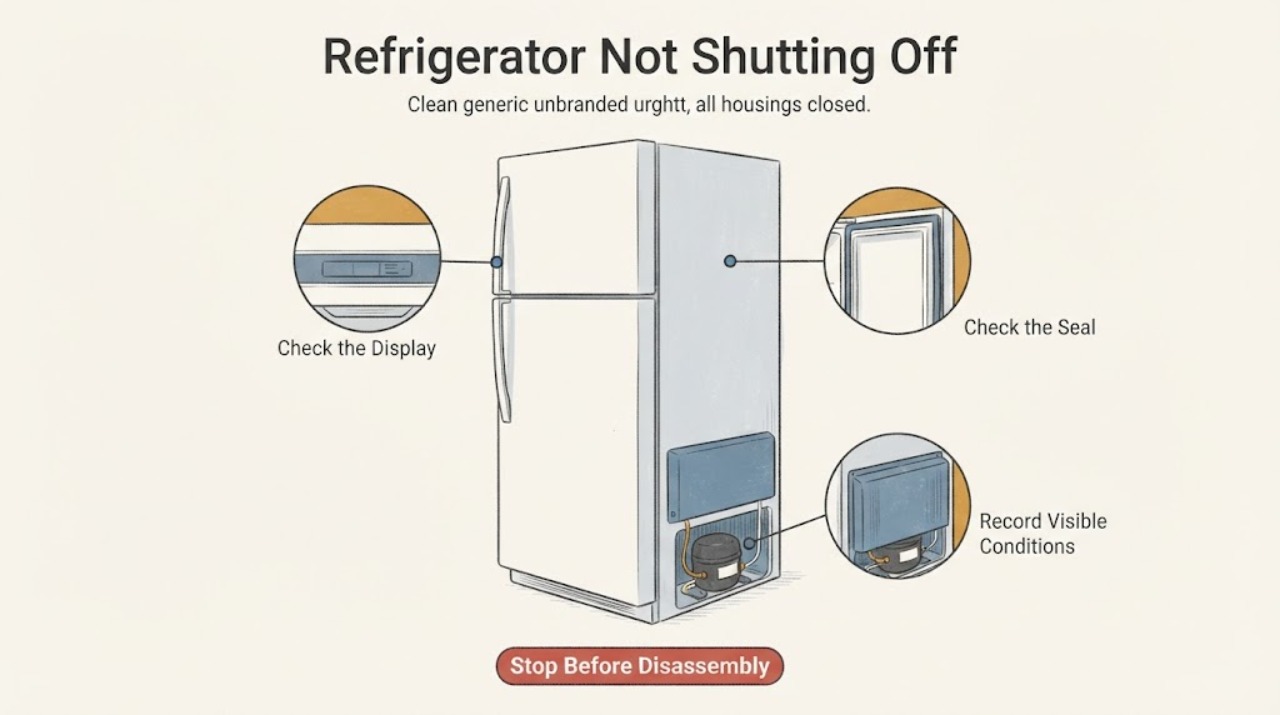
Work through in order
Diagnostic checks
Use only checks that match the exact appliance or system and its official guide.
-
Check 1
Separate continuous sound from continuous cooling demand: record whether the refrigerator and freezer are holding their normal food temperature, whether the compressor/fan sound is steady or intermittent, and whether the report began after installation, a move or a long shutdown.
Expected result: The compartments are cold and the sound began after a recent installation, warm-up or large load, or the compartments are actually too warm while the sound continues.
Next step: Use the matching branch below, allow the appliance to stabilize according to the exact model manual, and record the E-Nr. for any service request.
Stop if: If the temperature state cannot be determined safely, avoid repeated setting changes and arrange model-specific service rather than guessing at an internal component.
Why this matters
Why: Bosch documents longer running in those normal recovery conditions, while warm compartments with continuous operation need additional external checks. Sound alone does not identify a failed compressor or relay.
-
Check 2
Check the model-supported control setting and confirm the refrigerator is on; do not leave the setting colder than needed or repeatedly turn the control to its coldest position as a test.
Expected result: The setting is colder than needed, a control is off or incorrectly selected, or the control appears correct but the refrigerator remains warm.
Next step: Return the control only to the model's documented normal setting and allow the appliance to stabilize; if the control will not respond or temperature remains abnormal, use Bosch support.
Stop if: Continue with the door, airflow and installation checks without removing a panel or testing the thermostat.
Why this matters
Why: Bosch lists a colder-than-needed setting as a reason the motor may run more and says changing controls to the coldest setting will not cool a refrigerator faster. A correct setting does not clear an internal control fault.
-
Check 3
Inspect the refrigerator and freezer doors from outside: move packages, bins or shelves that prevent closure, check that the gasket contacts the cabinet, and minimize unnecessary or prolonged door openings.
Expected result: A door is obstructed or not fully closed, the gasket is dirty/damaged or not contacting, or doors close and seal normally.
Next step: Remove only the accessible obstruction, clean the gasket/contact surface as the model manual permits, and close the door fully. Arrange service if the gasket or alignment is damaged.
Stop if: If doors seal normally but the refrigerator remains warm while running, continue with air outlet, frost and clearance checks.
Why this matters
Why: Bosch says open or obstructed doors let warm air in and can extend motor operation; its manuals also link an incompletely closed door to frost and temperature problems.
-
Check 4
Check from inside and outside that food is not blocking model-designated air outlets, the cabinet has the installation clearance specified by its manual, and visible frost is not obstructing airflow.
Expected result: Air outlets are covered, food is packed against the airflow path, frost is building, ventilation/clearance is inadequate, or these areas are clear.
Next step: Reposition accessible food and restore only the clearance or defrost procedure the exact manual permits. If frost is heavy or returns, stop at the external check and arrange service.
Stop if: If airflow, frost and clearance are normal but the refrigerator is warm and never cycles off, preserve the findings for qualified service.
Why this matters
Why: Bosch associates blocked outlets, insufficient ventilation, frost and inadequate clearance with temperature problems and longer running. These observations do not prove a fan, compressor or control-board failure.
-
Check 5
Check the surrounding conditions and recent use: note a hot room, a large warm food load, frequent door openings, or a refrigerator that has just been installed or switched on after a long shutdown.
Expected result: One of those recovery conditions is present, or none is present and the appliance has been running continuously under ordinary use.
Next step: Reduce unnecessary door openings, keep food placement within the manual's guidance, and allow the documented stabilization period; do not repeatedly force colder settings.
Stop if: If the running is persistent without a documented recovery condition, arrange service and provide the E-Nr., temperature symptoms and external-check results.
Why this matters
Why: Bosch lists the recovery conditions as reasons for longer running. Continuous operation in ordinary conditions while temperature remains abnormal needs model-specific diagnosis, not a guessed relay or compressor conclusion.
-
Check 6
Stop user troubleshooting and arrange qualified service when the refrigerator remains warm after the external checks, develops heavy or recurring frost, has a damaged gasket, shows an electrical hazard, or the compressor/fan runs continuously without maintaining temperature.
Expected result: Cooling performance is abnormal, a safety warning is present, or the symptom persists with correct controls, closed doors, clear outlets and normal clearance.
Next step: Keep the refrigerator closed to protect food, switch it off or disconnect power only when safe, record the complete E-Nr./FD and the observations, and contact Bosch or a qualified appliance technician. Do not open the refrigeration circuit or perform live electrical tests.
Why this matters
Why: The opened Bosch guidance supports model-specific support and authorized service for unresolved cooling or thermostat concerns; it does not identify a relay, board, compressor or sealed-system fault from external symptoms.
Use your observations
Decision map
Find the observation that best matches what you see, then follow the next safe action.
-
PATH 01Next step
What you see
The refrigerator is cold, the sound began after installation, a long shutdown, a warm room or a large warm food load, and no safety warning is present.
Do this next
Minimize door openings and allow the exact model's documented stabilization period; service is appropriate if normal cycling does not return after the recovery condition ends.
Why this path and its safety boundary
Why it matters: Longer compressor/fan operation can be normal recovery behavior for Bosch refrigerators.
-
PATH 02Next step
What you see
The refrigerator is warm while the compressor or fan appears to run continuously, or the symptom persists in ordinary room and load conditions.
Do this next
Check controls, door sealing, outlets, frost and clearance once, then arrange qualified service if temperature remains abnormal.
Why this path and its safety boundary
Why it matters: This is not explained by sound alone and needs model-specific troubleshooting; a relay, thermostat, board or compressor cannot be selected from this observation.
-
PATH 03Next step
What you see
A door does not close or seal, airflow is blocked, frost is heavy, or clearance/ventilation is inadequate.
Do this next
Correct only accessible obstruction, gasket-surface or placement issues allowed by the exact manual; escalate a damaged gasket, recurring frost or hidden restriction.
Why this path and its safety boundary
Why it matters: Warm air entry or restricted airflow can keep the refrigerator working longer and can affect temperature.
-
PATH 04Next step
What you see
There is burning odor, repeated breaker tripping, damaged wiring, a damaged power cord, water near electrical parts, or another immediate hazard.
Do this next
Stop using it, avoid touching exposed parts or repeatedly resetting power, disconnect only if safe, and obtain qualified electrical/appliance service.
Why this path and its safety boundary
Why it matters: The appliance is outside routine user troubleshooting and continued operation may be unsafe.
Helpful context
Understand the symptom
“Not shutting off” describes what you hear or observe, not a confirmed failed part. Bosch's opened manuals say a high-efficiency compressor can run longer than an older refrigerator and list normal situations such as a recent installation, a warm room, a large warm food load, frequent door openings or a colder-than-needed setting. First decide whether the refrigerator is actually too warm or whether it is cooling normally while running for a long period.
If the compartments are warm, check only the model-supported controls, doors, gaskets, air outlets, food placement, frost and clearance. Keep the E-Nr. available because Bosch directs owners to its model-specific Service Assistant and owner manual. A thermostat or other internal control cannot be confirmed from the sound of a running compressor, and a Bosch support page routes suspected thermostat problems to support.
Do not pull the cabinet apart, open the sealed refrigeration system, handle refrigerant, test compressor terminals or work on live wiring. If the appliance stays warm, has heavy frost, a damaged gasket, repeated electrical trips, burning odor or another hazard after the external checks, leave it off when safe and arrange qualified Bosch service.
When checks do not resolve it
Need a professional?
Use Bosch model-specific support or qualified appliance service when the refrigerator remains warm after checking the controls, door closure, gasket, outlets, frost, clearance and recent-use conditions; when a suspected thermostat or control problem remains; or when the compressor/fan never cycles under ordinary conditions. Provide the complete E-Nr./FD, model family, temperature symptoms, timing, recent installation/load history and external-check results.
Safety scope: No internal compressor, relay, thermostat, control-board, refrigerant or live-electrical repair instructions are provided.
Common questions
FAQ
Is it normal for a Bosch refrigerator compressor to run for a long time?
It can be. Bosch's opened manuals list high-efficiency operation, a warm room, a large warm food load, frequent or open doors, colder settings, recent installation and recovery after a long shutdown as reasons for longer running. If the refrigerator stays warm or never cycles under ordinary conditions, use model-specific service.
Does continuous running prove the compressor or relay is bad?
No. The same symptom can result from normal recovery, warm-air entry, blocked airflow, frost, clearance or control settings. Bosch's support guidance does not support identifying a relay, compressor or control board from sound alone.
What should I check before calling for service?
Record the complete E-Nr./FD, confirm the controls are on, make sure doors and gaskets close, remove accessible obstructions from air outlets, review visible frost and clearance, and note recent installation, warm loads or frequent door openings. Do not remove panels or work on the sealed system.
Read the exact guide
Official sources
- B22CT80SNS / B22CT80SNP Fridge-Freezer Operating InstructionsBosch Home Appliances · Bosch B22CT80SNS/B22CT80SNP refrigerator family in the US/Canada; owner troubleshooting for long motor operation, temperature, doors, airflow and clearance
- Bosch Fridge-Freezer Operating Instructions 8001161547_CBosch Home Appliances · The named Bosch fridge-freezer manual family; troubleshooting table for continuous motor operation, frost, ventilation and door closure
- Refrigerator Troubleshooting: What to do if your refrigerator thermostat isn't workingBosch Home Appliances US · Bosch US refrigerator thermostat support and service boundary
- Get Support - RefrigerationBosch Home Appliances US · Bosch US refrigeration model lookup, Service Assistant, owner manuals and authorized-service guidance
Community feedback
Share a repair observation
Share a plain-text repair observation. Accepted observations are published automatically; this page may take a moment to update.