
On this page
Start here
Quick answer
A polyurethane-like smell in the freezer of a Bosch B36CT80SNS after hardwood floors were refinished should first be separated into an indoor-air source, an odor from food or packaging, and an appliance problem. Compare the timing and strength of the floor or room odor with the refrigerator and freezer, keep food closed and move any food or ice that has acquired a chemical smell, and ventilate the newly finished area with fresh air. Bosch's refrigerator guidance says to switch the appliance off, remove food, clean the interior and packaging, seal strong-smelling food, restore operation, and check after 24 hours; it also identifies an odor-filter change as a later step. Do not assume the smell is refrigerant or an electrical fault. If the odor remains after that model-guided sequence, cooling changes, food is suspect, or anyone develops eye, nose, throat, headache, nausea, dizziness, or breathing symptoms, leave the area as appropriate and arrange qualified appliance, building, or health-safety help.
Before you begin
Safety first
- Do not diagnose or open the sealed refrigeration system, electrical covers, fans, or air path from an odor alone. Keep food out of service when it has a chemical smell or unsafe temperature. Leave the room for strong coating fumes or symptoms, and disconnect power only from a dry, safe location for smoke, a hot connection, water near electrics, or other immediate hazard.
Work through in order
Diagnostic checks
Use only checks that match the exact appliance or system and its official guide.
-
Check 1
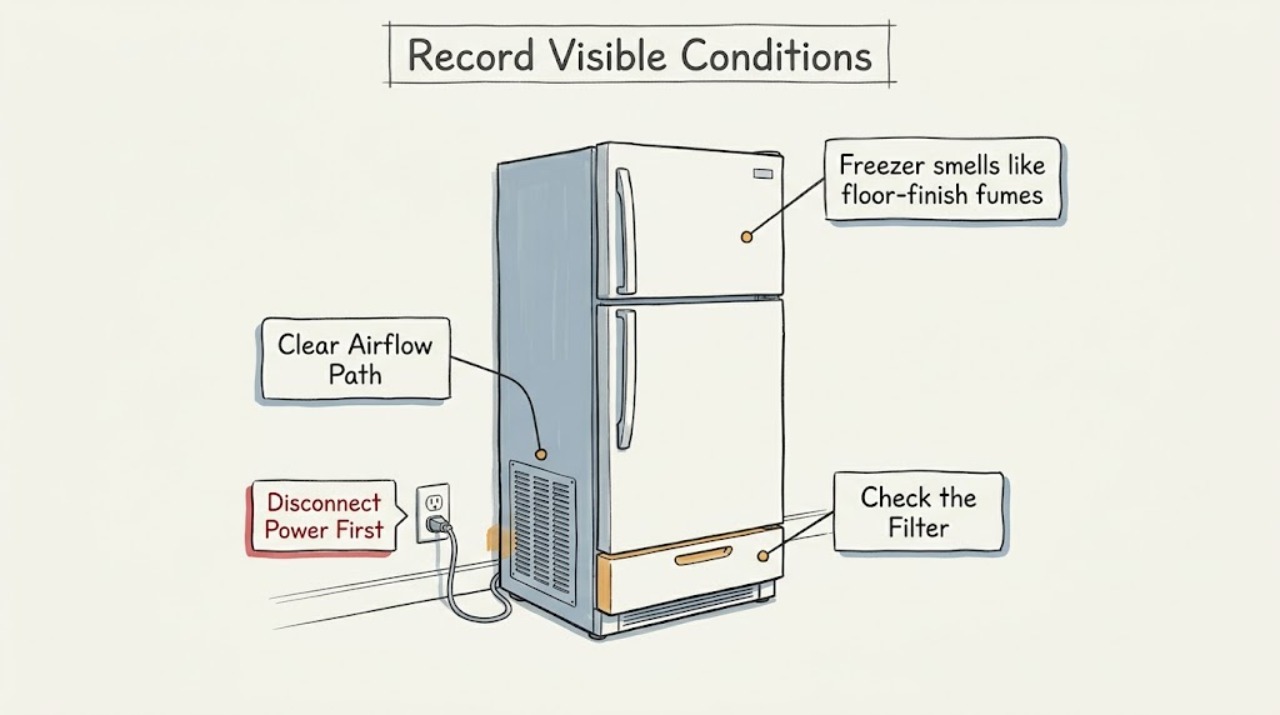
Record when the odor began, what floor or coating work occurred, whether the room and floor still smell the same, and whether the smell is stronger in the freezer, refrigerator compartment, on the door seal, or on a particular food package. Keep the doors closed except for this brief observation and do not use the smell alone to identify a refrigerator part.
Expected result: The room and floor odor started first and is still present; the room odor faded but the freezer odor remains; the smell is on food or packaging; or the odor exists only at the appliance exterior or electrical connection.
Next step: Photograph or write down the timeline and odor locations. Continue with ventilation, food protection, and Bosch's odor sequence; arrange service promptly for an odor at a hot or damaged electrical connection or with cooling loss.
Why this matters
Why: A matching building-work timeline supports an environmental source, while a smell limited to food, packaging, or one appliance area requires a different check. None of these observations proves a refrigerant or electrical failure.
-
Check 2
Check food and ice without tasting anything questionable. Move exposed or strongly odorous contents to a suitable clean, cold location, keep unopened packaging separate from items with an odor, and record which packages or ice had contact with the smell.
Expected result: Only the empty freezer smells; a food or ice item smells chemical; a porous package or opened container smells; or no food has an abnormal odor.
Next step: Do not eat or serve food with a chemical odor or suspected contamination until product-specific food-safety advice is obtained. Keep the product label or floor-finish information for the food-safety or health professional; do not put questionable contents back merely because the appliance still cools.
Why this matters
Why: An odor on contents is a food-safety question, not proof of a refrigerator defect. The FDA explains that chemical-food safety depends on the chemical, amount, and exposure, so a polyurethane-like odor cannot be cleared by guessing from the appliance symptom.
-
Check 3
Follow Bosch's odor-cleaning sequence with the exact refrigerator identity: switch the appliance off, remove food to a suitable cool location, clean the interior and packaging, seal strong-smelling food, then restore operation and check whether the odor is still present after 24 hours. Use only the cleaning method in the Bosch manual; do not pour cleaner into vents, drains, lights, or the air path.
Expected result: The odor clears after the interior and packaging are clean; it remains after 24 hours; it returns when a specific package is reintroduced; or food cannot be kept safely cold during the cleaning period.
Next step: If the odor remains after 24 hours, use the exact manual's conditional odor-filter step or arrange Bosch service rather than opening the air system. Keep food cold by another safe method while the appliance is off.
Why this matters
Why: A clearing odor points toward an interior or packaging source. Persistence after Bosch's sequence is not evidence that the refrigerator's sealed system is contaminated; it is the point to review the model's odor-filter guidance and service boundary.
-
Check 4
Ventilate the room where the floors were refinished and follow the coating manufacturer's label and re-entry instructions. If safe for the building and weather, bring in fresh air and exhaust it outdoors; keep children, pregnant people, and anyone with breathing sensitivity away from the strongest fumes.
Expected result: The room odor decreases with ventilation; the freezer odor decreases at the same time; the odor causes eye, nose, throat, headache, nausea, dizziness, or breathing symptoms; or ventilation does not change the freezer odor.
Next step: Leave the affected area and obtain building or health-safety guidance for symptoms or a strong persistent chemical odor. If room ventilation changes nothing and the odor is confined to the refrigerator, continue with Bosch service and food-protection steps.
Why this matters
Why: EPA identifies paints, lacquers, varnishes, waxes, and remodeling materials as possible VOC sources and recommends fresh-air ventilation. Symptoms or a persistent strong odor are an indoor-air and exposure concern, not a reason to run the refrigerator harder.
-
Check 5
Confirm the refrigerator still holds normal temperatures, the display and lighting behave normally, and the outside power cord and accessible ventilation openings have no visible damage or obstruction. Do not remove panels, touch a fan, inject any substance, or perform energized tests to chase the smell.
Expected result: Cooling and controls are normal; the cabinet is warming; an opening or vent is blocked; there is a new electrical smell, hot connection, smoke, or water; or a new abnormal compressor or fan noise appears.
Next step: Keep food safe and arrange qualified Bosch refrigerator service for warming, recurring odor after the manual sequence, abnormal noise, water, or electrical signs. Do not restart repeatedly or open the rear or interior panels.
Why this matters
Why: Normal cooling with a remodeling-linked odor makes a building or interior source more plausible, but warming or electrical/moisture signs create a separate appliance safety path. Bosch's manual does not support diagnosing refrigerant or electrical parts from odor alone.
-
Check 6
Verify the complete rating-plate identity and region as B36CT80SNS, save photos of the freezer and packaging, and note the coating product, date of application, ventilation used, food exposure, temperatures, and the 24-hour odor result. Use the exact Bosch manual and support record, not a similar refrigerator series.
Expected result: The complete model and region are confirmed; only the product family is known; or the model suffix differs from B36CT80SNS.
Next step: Give the exact model, region, odor timeline, food exposure, cooling readings, and cleaning result to Bosch or qualified service. Do not order an odor filter or other component until the exact documentation confirms it.
Why this matters
Why: Bosch documentation, filter configuration, controls, and service records can vary by model suffix and market. A suffix mismatch prevents a confident part or filter decision.
Use your observations
Decision map
Find the observation that best matches what you see, then follow the next safe action.
-
PATH 01Next step
What you see
The floor and room smelled strongly after refinishing, the refrigerator still cools normally, food and packaging have no chemical odor, and the appliance odor decreases as the room is ventilated.
Do this next
Continue safe fresh-air ventilation and follow Bosch's interior/packaging odor sequence. Do not replace refrigerator parts based only on the polyurethane-like smell.
Why this path and its safety boundary
Why it matters: An indoor-air or surface source is more likely than a confirmed sealed-system or electrical refrigerator fault.
-
PATH 02Next step
What you see
The room odor has faded, but the freezer odor remains after food, packaging, and interior cleaning, and Bosch's 24-hour check does not clear it.
Do this next
Use the exact manual's conditional odor-filter instruction or arrange Bosch service. Do not open the filter housing beyond the documented user step, inject cleaners, or dismantle the air path.
Why this path and its safety boundary
Why it matters: The odor may be retained by an appliance surface, packaging, or the model's odor-control path, but the opened sources do not prove that the filter or sealed system is contaminated.
-
PATH 03Next step
What you see
Food, ice, or porous packaging has acquired the chemical odor, or the identity or coating product is unknown.
Do this next
Keep questionable contents out of service and obtain product-specific food-safety or health guidance. Retain the coating label or safety information and do not taste-test the food.
Why this path and its safety boundary
Why it matters: The exposure cannot be judged from smell alone; this is a food and chemical-exposure decision rather than a refrigerator-part diagnosis.
-
PATH 04Next step
What you see
The chemical odor is strong enough to cause eye, nose, throat, headache, nausea, dizziness, or breathing symptoms, or the freshly refinished area has inadequate ventilation.
Do this next
Leave the affected area, ventilate only when safe, and contact the builder, coating professional, or appropriate health/emergency service. Address the refrigerator after the air-safety concern is controlled.
Why this path and its safety boundary
Why it matters: EPA treats remodeling and coating vapors as an indoor-air concern; continuing to stand in the area to troubleshoot the refrigerator is not appropriate.
-
PATH 05Next step
What you see
Cooling worsens, temperatures rise, water or moisture reaches electrical areas, a hot connection or smoke appears, or a new abnormal mechanical sound accompanies the odor.
Do this next
Protect food without entering the hazard, disconnect power only from a dry and safe location if needed, and arrange qualified Bosch refrigerator or electrical service. Do not open panels or restart to test.
Why this path and its safety boundary
Why it matters: The odor now has an appliance safety or food-preservation signal that cannot be resolved by cleaning or ventilation alone.
Helpful context
Understand the symptom
Start with the timing, not a guessed part
The assigned appliance is the Bosch B36CT80SNS 800 Series French Door Bottom Mount Refrigerator. A smell that began when a new home or refinished hardwood floor smelled of polyurethane can travel with the room air, but that timing does not prove that the refrigerator created it or that refrigerant entered the freezer. The open Reddit report for this same model and scenario is useful as a symptom timeline only: it records the room odor fading while the freezer odor persisted, without a verified repair result.
Protect people and food first
Floor finishes and other remodeling products can release volatile organic compounds. Ventilate the work area and leave it if the odor causes eye or throat irritation, headache, nausea, dizziness, or breathing problems. Do not taste food to decide whether it absorbed a chemical odor; isolate questionable food and obtain product-specific food-safety advice.
When checks do not resolve it
Need a professional?
Arrange Bosch or qualified refrigerator service when the odor persists after the exact manual's cleaning and 24-hour check, when cooling or food temperatures change, when the full model suffix is uncertain, or when abnormal noise, water, electrical smell, heat, smoke, or cord damage appears. Involve the builder or coating professional for persistent room fumes and appropriate health or emergency help for symptoms.
Safety scope: Do not diagnose or open the sealed refrigeration system, electrical covers, fans, or air path from an odor alone. Keep food out of service when it has a chemical smell or unsafe temperature. Leave the room for strong coating fumes or symptoms, and disconnect power only from a dry, safe location for smoke, a hot connection, water near electrics, or other immediate hazard.
Have this ready
- Provide B36CT80SNS and region, the rating-plate photo, the floor-finish product and application date, room-versus-freezer odor timing, food and packaging exposure, temperature observations, ventilation steps, cleaning performed, and the 24-hour result.
Common questions
FAQ
Could the refrigerator be leaking refrigerant because it smells like polyurethane?
The timing can fit floor-finish vapors, and the opened Bosch sources do not establish that a polyurethane-like odor identifies refrigerant. Check room versus freezer timing, cooling, food exposure, and the Bosch odor sequence; use service for cooling loss or persistent unexplained odor.
Should I discard food from the freezer?
Do not taste-test food with a chemical odor or suspected exposure. Separate it, keep safe unopened food cold, and obtain product-specific food-safety advice; the FDA notes that chemical-food safety depends on the chemical, amount, and exposure.
What does Bosch recommend for a persistent refrigerator odor?
Bosch's manual says to switch off, remove food, clean the interior and packaging, seal strong-smelling food, restore operation, and check after 24 hours; it then lists changing the odor filter. Confirm the exact model and use only the documented user step before requesting service.
Read the exact guide
Official sources
- Is Food Safe if it Has Chemicals?U.S. Food and Drug Administration · Government food-safety context for questionable food or ice with a chemical odor; it is not a refrigerator diagnosis.
- Refrigerator-freezer Owner's ManualBosch · Official Bosch-hosted refrigerator manual used for odor handling, cleaning, food protection, ventilation, temperature, and safety boundaries. It is not used to infer a sealed-system or electrical fault from odor.
- Fridge (Bosch) freezer compartment smells like poly after hardwood floors were repoly'edReddit r/appliancerepair · Exact Reddit post for lived-experience context only; not manufacturer evidence and not used to endorse a repair or cleaning remedy.
- Healthy Indoor Painting Practices: A Safety GuideU.S. Environmental Protection Agency · Government guidance for paint and floor-finish vapor precautions; it does not establish a refrigerator fault or a safe exposure level for a specific coating.
- Care for Your Air: A Guide to Indoor Air QualityU.S. Environmental Protection Agency · Government indoor-air guidance used for the new-house and floor-finish exposure branch, not for diagnosing the refrigerator.
- B36CT80SNS French Door Bottom Mount Refrigerator | BOSCH USBosch US · Official Bosch US product page for the exact B36CT80SNS refrigerator identity and product class; used for model matching and normal product context, not for assigning an odor cause or part.
- Service Assistance - B36CT80SNS/09 | BOSCH USBosch US · Official Bosch support page showing that suffix-specific documentation and service resources are selected by the complete E-Nr; use to confirm the rating-plate suffix before a filter or service decision.
Community feedback
Share a repair observation
Share a plain-text repair observation. Accepted observations are published automatically; this page may take a moment to update.