
On this page
Start here
Quick answer
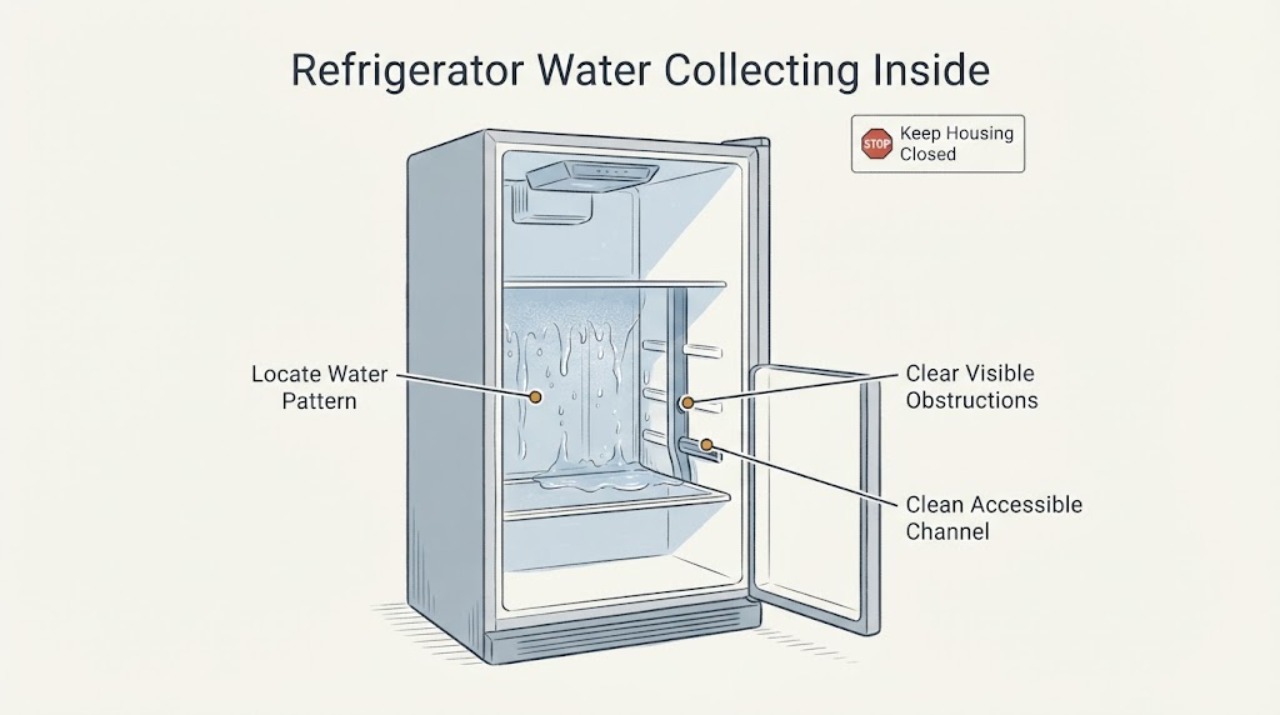
First identify where the water is collecting. Bosch says droplets or frost on the rear refrigerator wall can be part of normal automatic defrosting, while a wet compartment base points to a blocked condensation channel or drainage hole. Remove only visible food or containers that obstruct the rear wall, then inspect the channel and hole when the appliance is safe to clean; Bosch's official guidance permits careful cleaning with a cotton bud. If water continues, reaches lights or controls, comes from a crack or external line, or the appliance is not maintaining temperature, stop and use the exact model manual or Bosch service rather than pouring water into the drain or opening panels.
Work through in order
Diagnostic checks
Use only checks that match the exact appliance or system and its official guide.
-
Check 1
With the refrigerator door open only briefly, locate the water: on the rear wall as droplets/frost, in the condensation channel, pooled on the base under drawers, around a light/control, on a shelf or door bin, or outside the cabinet.
Expected result: Only rear-wall droplets/frost are present, the compartment base is wet, water is near electrical parts, or the source is not identifiable.
Next step: Use the matching branch below. Keep the door closed if food is warming; stop and arrange service for water near controls, cabinet damage, or an external leak.
Why this matters
Why: Bosch describes rear-wall condensation/frost as part of automatic defrosting, but identifies a wet compartment base with a blocked condensation channel or drainage hole. Water near lighting/controls or an unexplained external leak is outside that simple pattern.
-
Check 2
Check the accessible rear wall, shelf above the vegetable drawer, and base area for food packaging, containers, or spilled liquid that could be touching the wall or hiding the channel. Do not move interior wiring, covers, or panels.
Expected result: A container/package or spill is the source, or the area is wet without an obvious spill and the drain path remains visible.
Next step: Remove only the obvious spill source and dry accessible surfaces. If the base becomes wet again, continue with the model-approved accessible drain check rather than adding more liquid.
Why this matters
Why: A spill or item can imitate a drain problem. A recurring wet base with no spill is consistent with Bosch's blocked-channel/drainage-hole troubleshooting path, but it does not identify a hidden internal blockage or leak.
-
Check 3
When the appliance is safe to clean and the exact manual permits it, carefully clear the visible condensation channel and drainage opening with a cotton bud or equivalent gentle implement as Bosch describes. Do not pour water, cleaner, wire, or a sharp object into the hole.
Expected result: The visible channel/hole is obstructed and clears gently, or it is clear but water still pools or returns.
Next step: Dry the accessible area and monitor without repeatedly flushing it. If water returns, stop user cleaning and use the exact owner manual or service path.
Why this matters
Why: Bosch says the channel and drainage hole must remain clean so condensation can drain. A clear opening that still produces a pool leaves a model-specific drain path, evaporation area, door/seal or other leak to assess.
-
Check 4
After the water is contained, check whether the refrigerator is maintaining its normal model setting and whether food or packaging has been wetted or warmed. Minimize door opening while observing.
Expected result: The refrigerator is cold and the water stops, or water persists with warming food, heavy frost, odors, or uncertain food temperature.
Next step: Protect temperature-sensitive food and arrange Bosch service if temperature is not maintained or the water returns. Do not restart repeatedly to reproduce a leak.
Why this matters
Why: A stopped drain symptom may be limited to condensation management. Persistent water combined with warming or heavy frost can indicate a broader appliance condition; the water alone does not prove a refrigerant, fan, defrost or control failure.
-
Check 5
Stop user troubleshooting if water reaches a light or control, appears outside the cabinet, the liner or drain fitting is cracked, the channel cannot be accessed safely, the appliance has a damaged cord, or the wet base returns after the accessible check.
Expected result: An electrical/water hazard or recurring unexplained leak is present.
Next step: Keep the appliance and surrounding floor safe, disconnect power only if it can be done without touching water or damaged equipment, and arrange Bosch or qualified service. Do not open panels, work on the sealed system, or bypass a drain or safety device.
Why this matters
Why: Bosch's public support provides model-specific manuals, troubleshooting and authorized service, but no model is supplied and the symptom does not identify a safe internal repair.
Use your observations
Decision map
Find the observation that best matches what you see, then follow the next safe action.
-
PATH 01Next step
What you see
Only small droplets or a light frost layer appear on the rear wall, with no pool on the base and normal cooling.
Do this next
Keep food and containers from pressing against the rear wall, avoid unnecessary door opening, and monitor. Arrange service if the pattern changes to pooling, warming or a persistent leak.
Why this path and its safety boundary
Why it matters: Bosch describes rear-wall condensation/frost as a normal part of automatic defrosting when it drains through the channel.
-
PATH 02Next step
What you see
Water repeatedly pools on the base under the drawers and the accessible condensation channel or hole is visibly dirty or obstructed.
Do this next
Use the exact model manual and the gentle accessible cleaning method Bosch documents; if the pool returns or the opening is not safely accessible, arrange service.
Why this path and its safety boundary
Why it matters: This matches Bosch's wet-base troubleshooting scope for a blocked condensation channel or drainage hole.
-
PATH 03Next step
What you see
The liquid is limited to a shelf, door bin, or a visible food/container spill and the condensation channel is dry.
Do this next
Remove the spill source, dry the accessible surface, and observe without pouring liquid into the drain. Escalate if water reappears without a new spill.
Why this path and its safety boundary
Why it matters: The immediate source is an external spill or placement issue rather than evidence of a blocked drain.
-
PATH 04Next step
What you see
Water reaches lighting or controls, appears outside the cabinet, comes from a crack or hose, returns after cleaning, or occurs with warming food or loss of cooling.
Do this next
Protect food and the surrounding area, avoid electrical contact, and arrange Bosch or qualified service with the model and photographs. Do not remove panels or work on refrigerant lines.
Why this path and its safety boundary
Why it matters: The problem is outside the bounded accessible-drain check and may involve an internal leak, cabinet, door, or cooling condition that cannot be diagnosed from the symptom alone.
Helpful context
Understand the symptom
Rear-wall droplets are different from a pooled base
Bosch says condensation droplets or frost on the rear refrigerator wall can be normal because the panel defrosts automatically and the water runs through a condensation channel to a drainage hole. Water collecting on the compartment base is a different pattern: Bosch's troubleshooting page associates it with a blocked channel or drainage hole.
Clean only the accessible drain path
After identifying the model and following its owner manual, clean the visible channel and drain opening carefully. Bosch's official cleaning page gives a cotton-bud example. Do not pour water or chemicals into the hole, force a blockage deeper, remove interior panels, or probe the appliance.
Escalate water that is not a simple drain symptom
Water around lighting or controls, water outside the cabinet, a damaged liner, a persistent leak, food warming, or a recurring pool after the accessible drain check is outside a no-model cleanup answer. Keep food and electrical safety in view and use Bosch's model-specific support or an authorized service provider.
When checks do not resolve it
Need a professional?
Arrange Bosch or qualified refrigerator service when water returns after the model-approved accessible drain check, the opening cannot be reached safely, or the source is outside the condensation channel., Stop immediately for water near lights or controls, an external leak, a damaged liner or cord, loss of cooling, or food-safety uncertainty., Provide the complete Bosch model/E-Nr, region, water location, photos, whether the rear wall has frost, and the result of the accessible drain inspection.
Have this ready
- complete Bosch model/E-Nr and region
- exact water location and whether it is a pool, droplets, frost or an external leak
- photos of the rear wall, channel, drain opening, base and any wet controls
- whether the accessible channel was clear or gently cleaned
- temperature, frost, odor and food-condition observations
Common questions
FAQ
Is water on the rear wall of a Bosch refrigerator always a fault?
No. Bosch says condensation droplets or frost on the rear wall can be normal because the panel defrosts automatically and the water drains through a channel. A recurring pool on the compartment base is a different symptom.
Why is the bottom of my Bosch refrigerator compartment wet?
Bosch's opened troubleshooting page associates a wet compartment base with a blocked condensation channel or drainage hole. Check the exact model manual and use only the documented gentle accessible cleaning method; recurring water needs service.
Can I pour hot water or cleaner into the Bosch refrigerator drain?
Do not improvise a flush. Bosch's official cleaning page says to clean the channel and drainage hole carefully, for example with a cotton bud. Keep liquid away from lights, controls and the drain opening unless the exact manual explicitly directs otherwise.
When is water inside a Bosch refrigerator an urgent service issue?
Arrange service for water near lights or controls, water outside the cabinet, a recurring pool after the accessible check, a damaged liner or cord, loss of cooling, or uncertain food temperature. Do not open panels or work on the sealed system.
Read the exact guide
Official sources
- Get Support - RefrigerationBosch Home Appliances · Supports the need to use the exact owner manual/Service Assistant and Bosch service path when a no-model symptom remains unresolved.
- Cleaning the condensation channel and drainage holeBosch Home Appliances · Supports only the gentle accessible cleaning instruction; it does not authorize flushing, sharp tools, panel removal or model-independent disassembly.
- Defrosting in the refrigerator compartmentBosch Home Appliances · Supports the general distinction between normal rear-wall condensation/frost and drainage through a channel/hole. It is not a model-specific manual and does not establish model-specific settings or parts.
- The base of the refrigerator compartment is wet.Bosch Home Appliances · Supports the scoped wet-base observation that a blocked condensation channel or drainage hole is a possible cause. It does not identify a universal internal repair or model fit.
Community feedback
Share a repair observation
Share a plain-text repair observation. Accepted observations are published automatically; this page may take a moment to update.