
On this page
Start here
Quick answer
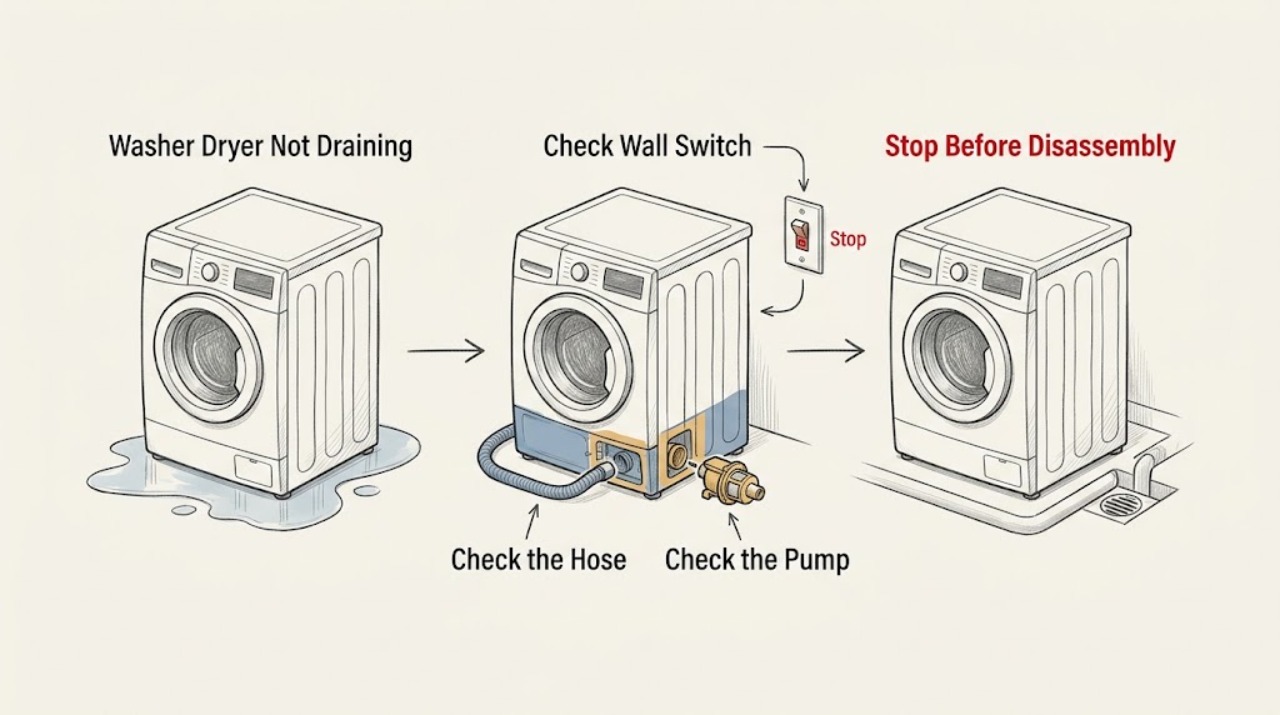
When a Bosch washer-dryer will not drain, the common user-checkable causes are a kinked or blocked waste hose, a blocked pump or filter, a selected rinse-hold state, or a programme that has not reached final drain. Stop the programme, switch off, unplug, and let hot water cool before opening any drain or pump access. Check the visible drain hose and the model's user instructions for the pump procedure; use a container because residual water may escape. If the water remains, a leak appears, the pump makes an unusual sound, the appliance trips power, or it still will not drain after one model-directed clean and test, stop and arrange qualified service.
Work through in order
Diagnostic checks
Use only checks that match the exact appliance or system and its official guide.
-
Check 1
Set the programme to Off, switch the washer-dryer off, unplug it, and let any water in the drum cool before opening a drain flap or touching a hose or pump cover.
Expected result: The appliance is isolated and the water is cool enough to manage, or the plug, outlet, floor, or water is unsafe to approach.
Next step: If the plug or outlet is wet, do not touch it; keep away and arrange qualified electrical help. If the area is safe, place a suitable container and cloth before continuing to the hose and pump checks.
Why this matters
Why: Isolation prevents the pump or drum from starting while the drain path is open, and cooling reduces scald risk. A wet electrical area or hot water makes this a service situation rather than a routine clean.
-
Check 2
Inspect the visible waste hose and its outlet route for a kink, crush point, blockage, trapped section, or an incorrectly seated connection; do not pull the appliance through standing water.
Expected result: The hose is restricted or disconnected, the outlet path is blocked, or the visible hose route is clear.
Next step: Correct only a safe visible hose position or connection, then continue to the model-directed pump check. Do not disconnect a hose with uncontrolled residual water or replace it based on appearance alone; use service for a damaged hose or persistent leak.
Why this matters
Why: A restricted or blocked drain hose can prevent the washer-dryer from emptying even when the pump is otherwise able to run. A clear route shifts suspicion toward the pump, filter, programme state, or an internal fault.
-
Check 3
Following the exact Bosch manual for the model, drain residual water through its emergency tube or by slowly opening the pump cover, then inspect the user-accessible pump area for lint, coins, or other debris and refit the cover securely.
Expected result: Debris is found and the pump area can be cleaned, the cover was not seated, no debris is present, or water cannot be drained safely.
Next step: Clean and refit only as the exact manual directs, with power disconnected and water cool. Stop for a leak, damaged cover, unusual resistance or noise, or any procedure not documented for the model; request service instead.
Why this matters
Why: A blocked pump or poorly seated cover can stop drainage or cause a leak. No debris, an impeller that will not move as the manual expects, or water that cannot be managed leaves a pump, hose, sensor, or control fault possible.
-
Check 4
With the door closed and the drum safe, check the display and selected programme for a rinse-hold state, drain or pump code, water-protection indication, or a cycle that is waiting at a different stage.
Expected result: A rinse-hold or programme setting explains the retained water, a drain-related display appears, or no setting explains the no-drain symptom.
Next step: Use the exact manual to end rinse hold or select the documented drain programme. If a water-protection indication or other code appears, turn off the tap when safe and stop for service; do not clear an unknown code by repeated restarts.
Why this matters
Why: Retained water is not always a failed pump: a rinse-hold state can intentionally omit the final empty or spin. A drain code or no explanation after the hose and pump checks points to a fault path that needs model-specific interpretation.
-
Check 5
After the visible hose and model-directed pump checks are complete, run one short drain or empty programme while watching from a dry safe position for flow, leaks, abnormal sound, or a returning display.
Expected result: Water drains and the appliance completes, water drains slowly, no water moves, or the same code, leak, or unusual sound returns.
Next step: Stop immediately for a leak, hot water, unusual noise, or electrical symptom. If the no-drain condition remains, keep the appliance off and give service the code, water level, hose result, pump-area finding, and programme stage.
Why this matters
Why: A completed drain test supports a corrected restriction, while slow or absent flow indicates the path or pump still has a problem. A returning code or leak is evidence for service, not a reason to keep operating the machine.
Use your observations
Decision map
Find the observation that best matches what you see, then follow the next safe action.
-
PATH 01Safety boundary
What you see
The drum contains hot water or the plug, outlet, or floor is wet.
Do this next
Do not touch the electrical connection or open the door. Keep the appliance off, let hot water cool where safe, and arrange qualified appliance or electrical help.
Why this path and its safety boundary
Safety stop: Continue with the visible hose and pump-path checks.
-
PATH 02Safety boundary
What you see
The waste hose is kinked, trapped, blocked, or poorly seated.
Do this next
Correct only the safe visible routing or connection, then perform the model-directed drain test and check for leaks.
Why this path and its safety boundary
Safety stop: Inspect the user-accessible pump area only as the exact manual describes.
-
PATH 03Safety boundary
What you see
The model-directed pump check finds debris, a loose cover, or a pump that cannot move as expected.
Do this next
Clean and refit only with power disconnected and cooled water, then run one drain test. Stop for damage, leak, unusual resistance, or a result that does not improve.
Why this path and its safety boundary
Safety stop: Use the programme-state and code branch; do not assume the pump is proven good.
-
PATH 04Safety boundary
What you see
The manual or display shows rinse hold or another setting that omits final empty or spin.
Do this next
End the setting or select the documented drain programme, then observe one safe cycle without opening the door while water is visible.
Why this path and its safety boundary
Safety stop: Treat a drain display or unexplained retained water as a fault path after the physical checks.
-
PATH 05Safety boundary
What you see
The washer-dryer still does not drain or the same code, leak, or noise returns after one user procedure and one test.
Do this next
Switch off, keep the appliance disconnected when safe, preserve the exact display and findings, and arrange qualified appliance service.
Why this path and its safety boundary
Safety stop: A completed test supports a corrected external restriction; stop and reassess if the symptom returns on the next normal use.
Helpful context
Understand the symptom
Make the appliance safe before opening the drain path
Water in the drum can be hot and can spill quickly. Set the appliance to Off, unplug it, and wait for hot water to cool before opening a service flap, pump cover, or hose connection. Keep the door closed if water is visible through the glass. Do not reach into a moving drum or work near wet electrical parts.
A no-drain symptom has several decision points
First distinguish a hose restriction from a pump-area blockage: a kink or blocked outlet can stop flow, while debris at the pump can prevent the impeller from moving. If the drum is empty but the cycle does not finish, check whether a rinse-hold or programme setting is selected before assuming a mechanical failure.
Use the exact Bosch manual for access details
Pump covers, emergency drain tubes, filter positions, and programme names vary by model. The checks below describe the decision, not a universal disassembly sequence. Stop if the manual does not cover your appliance, if water is too hot to handle, or if the path remains blocked after the user procedure.
Safety boundary
Stop conditions
- Stop for hot water that cannot cool safely, an active leak, water near the plug or outlet, smoke, burning odor, a damaged cord, or a breaker that trips.
- Do not open the door when water is visible through the glass, the drum is moving, or the water may be hot.
- Do not remove a pump cover, hose, or service flap while powered; do not reach into the pump or drum while it is moving.
- Do not remove the appliance covering, test live wiring, bypass a water or door safety device, or force a blocked pump.
- After one exact model-directed clean and one drain test, stop if no water moves or the same code, leak, or unusual sound returns and arrange qualified service.
When checks do not resolve it
Need a professional?
Arrange qualified appliance service when water cannot be drained safely, the hose and model-directed pump check do not restore flow, a water-protection or leak condition appears, the pump is noisy or damaged, the same code returns, or the appliance trips power.
Common questions
FAQ
What should I do first if my Bosch washer dryer will not drain?
Set it to Off, unplug it, and let the water cool. Then check the visible waste hose for kinks or blockage and follow the exact model manual for any pump or filter procedure.
Could a blocked pump cause water to remain in the drum?
Yes. Bosch lists a blocked pump and restricted drain path as causes of no-drain symptoms. Use a container and the manual's cooled-water procedure; stop for a leak, unusual resistance, or a pump that still will not clear.
Why is the machine not draining even though nothing seems blocked?
A rinse-hold setting, programme state, incorrectly seated pump cover, sensor or control issue, or an internal blockage can produce the same symptom. Record the programme stage and display, then use the model manual before service.
Is it safe to open the washer dryer door when water remains?
No. Keep it closed if water is visible, especially when the water may be hot or the drum may still move. Drain only through the exact safe procedure in the model manual after switching off and unplugging.
When should I stop troubleshooting a Bosch washer dryer drain problem?
Stop after one model-directed hose or pump procedure and one drain test if water still does not move, the same code returns, a leak or unusual pump sound appears, or power trips. Keep the appliance off and arrange qualified service.
Read the exact guide
Official sources
- Why Won't My Bosch Washing Machine Drain? How to ResolveBosch · Bosch laundry drain troubleshooting guidance
- Washer | Error CodesBosch · Bosch washer drain error guidance
- Washer dryerBosch · Bosch washer-dryer instruction and fault manual
Community feedback
Share a repair observation
Share a plain-text repair observation. Accepted observations are published automatically; this page may take a moment to update.