
On this page
Start here
Quick answer
If a Bosch washer-dryer is not drying, first let the warm laundry cool and spread it out before judging the result. Then check that the drying load is within the model's lower drying capacity, the load was spun sufficiently, the water tap is open for a condensing dryer, and visible airflow or filter areas are not blocked. Select a drying programme suitable for the fabric and allow thick or multilayered items more time. Do not overload the drum, open the cabinet, remove hidden panels, disconnect hoses, or work on the heater, condenser, fan, or wiring. If the machine stays damp after a correctly sized load and model-approved checks, shows a recurring fault, leaks, has a damaged cord, or becomes unusually hot, stop using it and arrange Bosch or qualified appliance service.
Work through in order
Diagnostic checks
Use only checks that match the exact appliance or system and its official guide.
-
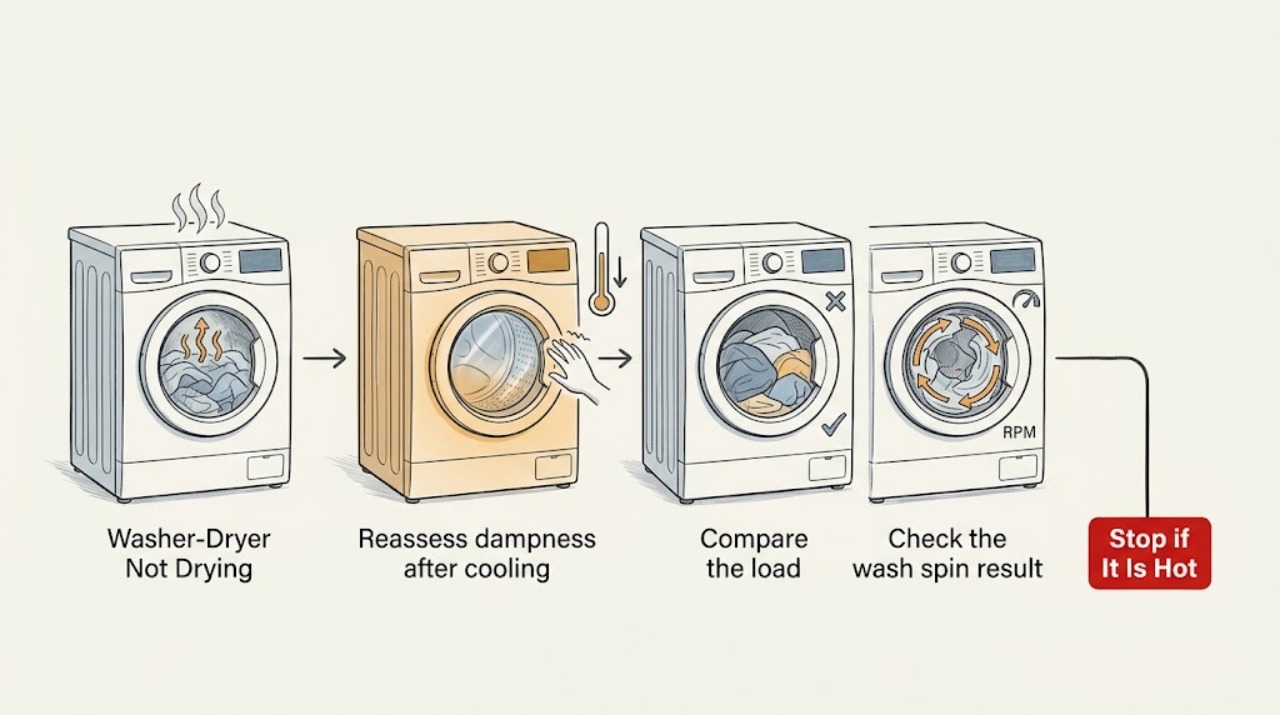
Reassess dampness after cooling
Remove the laundry only through the normal door operation, spread it out, and let the warm items cool before deciding whether the drying result is inadequate. Do not force the door or open it while water is visible through the glass.
Expected result: The laundry becomes acceptably dry after cooling, remains damp throughout, is dry on the outside but wet inside, or the door cannot open normally.
Next step: If the load is truly damp, continue with the load, spin, water, airflow, and programme checks. If the door or water state is abnormal, stop and arrange service.
Stop if: Stop for visible water behind a locked door, a door that will not release normally, smoke, burning odor, or a hot or damaged cord.
Why this matters
Why: Warm fabric can feel damper than it is. Damp interiors point toward thick or multilayered textiles or insufficient drying time, while an abnormal door or visible water is a safety or drain condition rather than a simple drying setting.
-
Compare the load with the drying capacity
Read the exact model's programme table or load display and compare the laundry amount with the listed drying capacity, not just the wash capacity. Remove some items and divide the load into separate drying cycles when the drying limit is lower.
Expected result: The load is above the drying limit, near the limit, small, or impossible to assess from the available manual.
Next step: Use a smaller load within the model's drying limit and select the appropriate programme once. If a correctly sized load remains damp, continue the diagnosis and do not keep adding time blindly.
Stop if: Stop if the drum is overfilled, the door seal is compressed by laundry, the machine is unstable, or the manual cannot establish a safe load limit.
Why this matters
Why: A washer-dryer can wash a larger load than it can dry effectively. An overloaded drying drum restricts the space and airflow needed for moisture removal; a small load with poor results points toward another cause.
-
Check the wash spin result
Review the selected wash programme and its final spin setting, then inspect whether the laundry entered drying very wet or with water pooling in heavy items. Do not change to an unapproved high-speed setting for delicate fabric; use the programme table for the load.
Expected result: The laundry was heavily waterlogged, the spin was low or omitted, the load was balanced and well spun, or the washer did not complete the spin.
Next step: For a suitable fabric load, use the highest selectable spin speed allowed by the model and care label before drying. If the washer cannot complete spin or repeatedly leaves the load saturated, arrange service for the wash-side fault.
Stop if: Stop if the machine repeatedly becomes unbalanced, bangs severely, leaks, or cannot complete spin without intervention.
Why this matters
Why: Bosch manuals identify insufficient spinning before drying as a reason for a poor drying result. A load that never spins properly can make the drying phase appear faulty even when the dryer is operating.
-
Verify the water tap for condensation drying
From a safe position, confirm that the connected water tap is open during the drying programme when the model uses water condensation. Look for a kinked or visibly leaking inlet hose without disconnecting it.
Expected result: The tap is closed, water flow is restricted, the hose is kinked or leaking, or the supply appears normal.
Next step: Open a clearly closed tap only if it turns normally and there is no leak; then run one model-appropriate drying check. If the tap, hose, or supply is abnormal, stop and arrange appliance or plumbing service.
Stop if: Stop for a leak, burst or swollen hose, a stuck tap, water near electrics, or any need to disconnect the hose without a safe isolation procedure.
Why this matters
Why: Bosch washer-dryer manuals state that a closed tap or low water pressure can prevent evaporated moisture from condensing properly on condensing designs. A leak or uncertain connection needs service rather than a forced adjustment.
-
Check visible airflow and accessible filters
With the appliance off and cool, inspect only the external airflow area and any filter that the exact Bosch manual identifies as user-accessible. Remove lint or a loose obstruction as directed by that manual; do not open the cabinet or reach into a fan, condenser, heater, or hidden duct.
Expected result: A visible filter or airflow path is blocked, the area is clear, the filter cannot be reached safely, or lint returns quickly after cleaning.
Next step: Restore only the manual-approved filter and keep the external area clear. If drying remains poor or internal cleaning is required, stop and request Bosch or qualified appliance service.
Stop if: Stop for a hot appliance, sharp or hidden parts, a blocked internal path, water inside the cabinet, or any need to remove a cover.
Why this matters
Why: Restricted airflow can extend drying time and reduce moisture removal. A clear user-accessible filter does not rule out an internal condenser, fan, sensor, or airflow fault, especially when lint returns rapidly.
-
Match the programme to the fabric
Compare the selected drying programme with the care label and the exact Bosch programme table. Note whether the textiles are thick, multilayered, filled, or unsuitable for machine drying; do not raise heat beyond the programme's permitted range.
Expected result: The programme is intended for the load, the load needs more time because it is thick or filled, or the fabric is not suitable for the selected drying process.
Next step: Use a model-approved timed or fabric-appropriate programme only when the care label allows it. If ordinary fabrics remain damp on a correctly sized load, continue to error and service checks.
Stop if: Stop if the care label forbids machine drying, the item is damaged, the drum is overheating, or the programme repeatedly stops with a warning.
Why this matters
Why: Bosch notes that thick or filled textiles can dry at the surface while remaining wet inside, and care instructions determine whether an item is suitable. A programme mismatch can resemble a machine fault.
-
Record errors and repeatability
Photograph or transcribe any display code, warning light, programme interruption, unusual sound, heat, or water change. After the permitted user-level checks, run no more than one normal test with a suitable small load; do not repeatedly reset or run an empty high-heat cycle.
Expected result: The same code or symptom returns, the machine dries normally once, the programme stops without a code, or the appliance becomes unusually hot or leaks.
Next step: Keep the machine unused if the fault repeats and provide the code, model, load, programme, tap and filter observations, and test result to Bosch or a qualified technician.
Stop if: Stop for a recurring code, leak, smoke, burning odor, electrical symptom, severe heat, or any diagnosis requiring internal access.
Why this matters
Why: A one-time recovery may reflect load, supply, or programme conditions, but recurrence points to a model-specific fault. Bosch directs owners to the exact instruction manual and professional service when the washer-dryer remains out of action.
Use your observations
Decision map
Find the observation that best matches what you see, then follow the next safe action.
-
PATH 01Safety boundary
What you see
The laundry feels damp while warm but becomes acceptable after it is spread out and cooled.
Do this next
Treat the result as a heat-perception issue, then use the model's load and care guidance on the next cycle.
Why this path and its safety boundary
Safety stop: Do not touch hot surfaces or assume the machine is safe if smoke, odor, or abnormal heat is present.
-
PATH 02Safety boundary
What you see
The drying load exceeds the model's drying limit or contains a full wash load.
Do this next
Divide the laundry into loads within the exact drying capacity and repeat only a suitable drying programme.
Why this path and its safety boundary
Safety stop: Do not overload the drum or use a guessed capacity from another Bosch model.
-
PATH 03Safety boundary
What you see
Laundry enters the drying phase very wet because the wash spin was low, omitted, or incomplete.
Do this next
Use a fabric-appropriate higher selectable spin setting before drying, or request service if the washer cannot complete spin.
Why this path and its safety boundary
Safety stop: Do not force a high spin setting on unsuitable fabric or keep running a severely unbalanced machine.
-
PATH 04Safety boundary
What you see
The model uses water condensation and the water tap is closed, restricted, kinked, or leaking.
Do this next
Restore a clearly closed tap only when safe and dry; arrange appliance or plumbing service for a leak, restriction, or uncertain supply.
Why this path and its safety boundary
Safety stop: Do not disconnect the inlet hose or continue a drying cycle with an active leak.
-
PATH 05Safety boundary
What you see
The visible filter or airflow path is blocked, but the exact manual identifies it as user-accessible.
Do this next
Clean or clear only that user-accessible area as directed, then reassess with a suitable load. Escalate if lint returns or internal cleaning is needed.
Why this path and its safety boundary
Safety stop: Do not remove panels or reach into hidden airflow, condenser, fan, heater, or duct parts.
-
PATH 06Safety boundary
What you see
The load is thick, filled, or not suitable for the selected drying programme.
Do this next
Follow the care label and exact programme table; use a permitted fabric-appropriate or timed programme if the item allows machine drying.
Why this path and its safety boundary
Safety stop: Do not increase heat beyond the manual or dry an item whose care label forbids machine drying.
-
PATH 07Safety boundary
What you see
A correctly sized, properly spun load remains damp, or a warning, leak, unusual heat, or recurring error appears.
Do this next
Stop using the washer-dryer and arrange Bosch or qualified appliance service with the exact model and recorded symptom.
Why this path and its safety boundary
Safety stop: Do not repeatedly reset, dismantle, or test internal drying components.
Helpful context
Understand the symptom
Check the result after the laundry cools
Warm laundry can feel damper than it actually is immediately after a programme. Spread it out and reassess once heat has dispersed. If it is still wet, the result can reflect too much laundry, insufficient spin, restricted airflow, a closed water tap on a condensing design, a programme mismatch, or thick fabric that dries more slowly inside than on the surface.
Washer-dryer limits are model-specific
A washer-dryer does not necessarily have the same capacity for washing and drying. Bosch describes a lower drying load on some models and uses moisture and temperature sensing to manage the drying process. Use the exact programme table and manual for the appliance; do not infer a safe load or a fault code from another model.
Keep internal drying parts closed
User-level checks can cover the load, programme, spin result, water tap, visible airflow, and any accessible filter named in the manual. Do not open the cabinet, access the heater or condenser, disconnect internal hoses, or test wiring. If an accessible maintenance step requires power or water isolation, follow the exact manual and stop when the condition is unclear.
When checks do not resolve it
Need a professional?
Arrange Bosch or qualified appliance service when a correctly sized load remains damp after the model-approved load, spin, water, airflow, and programme checks; when the same fault returns; or when the washer-dryer leaks, overheats, produces an unusual odor or sound, shows a recurring code, or needs internal condenser, heater, fan, sensor, pump, or wiring access. Stop immediately for smoke, sparking, a hot cord, or uncontrolled water.
Have this ready
- Provide the Bosch model or E-Nr. if safely visible, drying programme, load type and approximate size, wash spin setting and result, water-tap state, visible filter or airflow observation, exact display code, whether laundry was warm or cool when judged, and the sequence of any leak, heat, or stop.
Common questions
FAQ
Why is my Bosch washer-dryer leaving clothes damp?
Check the cool, dry result rather than the warm load, then compare the load with the lower drying capacity, review the spin result, confirm the water tap is open if the model condenses with water, and check visible airflow or user-accessible filters. Persistent poor drying needs service.
Can I dry a full wash load in my Bosch washer-dryer?
Not necessarily. Bosch notes that the maximum drying load can be lower than the wash load. Use the exact model's programme table and divide a full wash load when the drying limit is lower.
Does a Bosch washer-dryer need the water tap open while drying?
Some Bosch washer-dryers use water condensation during drying, so the manual may require the connected tap to remain open. Check the exact model; if the tap or hose leaks or is restricted, stop and arrange service.
Why are thick clothes still wet inside?
Bosch notes that multilayered or filled textiles can dry at the surface while remaining damp inside. Follow the care label and model programme table, and use a permitted fabric-appropriate or timed programme if available.
When should I stop troubleshooting a Bosch washer-dryer?
Stop for a recurring fault, leak, smoke, burning odor, unusual heat, damaged cord, repeated programme failure, or any need to open the cabinet or access the condenser, heater, fan, pump, sensors, or wiring. Arrange Bosch or qualified appliance service.
Read the exact guide
Official sources
- User manual and installation instructionsBosch Home Appliances · Official Bosch washer-dryer manual used for drying-result causes and model-family instructions. The listed product models and limits are not universal; owners must use the manual for their exact appliance.
- What to Do When Your Washer-Dryer Isn’t Drying?Bosch Home Appliances · Official Bosch support page used for the exact washer-dryer not-drying problem, the recommendation to use care instructions, and the professional boundary for faulty internal parts. It does not replace the exact model manual.
- How does a washer-dryer work?Bosch Home Appliances · Official Bosch support page used to explain why drying needs space and why the exact instruction manual matters. It is general functionality guidance, not a repair procedure for a specific model.
Community feedback
Share a repair observation
Share a plain-text repair observation. Accepted observations are published automatically; this page may take a moment to update.