
On this page
Start here
Quick answer
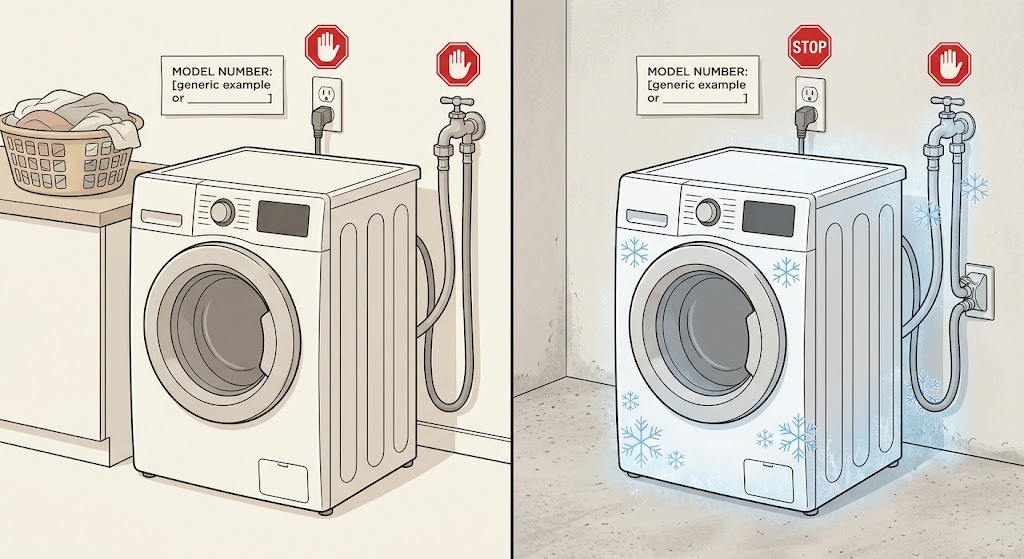
“Freezing” on a Bosch washing machine can mean two different problems: the display or program is frozen and not responding, or water inside the inlet hose, pump, or drain path has actually frozen after exposure to below-freezing conditions. Separate those paths before resetting or opening anything. If the display is responsive and there is no ice or cold-storage exposure, record the exact message and use only the Bosch model's documented operational reset. If the machine or hoses were in a freezing space, do not power the appliance, force the door, or apply direct heat; Bosch operating instructions say not to install a washer where it can freeze and to drain residual water from the pump and inlet hoses for winter storage. Stop for a leak, cracked hose or body, water near electricity, or a door that cannot safely release, and arrange Bosch appliance service.
Before you begin
Safety first
- This article supports only symptom classification, model identification, exterior checks, and one exact model-approved operational reset for a dry non-frozen machine. Thawing, draining frozen water, opening panels, electrical diagnosis, leak testing under pressure, and component replacement belong to qualified Bosch appliance service.
Work through in order
Diagnostic checks
Use only checks that match the exact appliance or system and its official guide.
-
Check 1
Record what is frozen: an unresponsive Bosch display or control, a program that has stopped, a locked door, or water and hoses exposed to a cold or unheated space.
Expected result: Note the exact display state, remaining-time behavior, button response, room conditions, visible frost or ice, water in the drum, and whether the fault began after cold storage or a power event.
Next step: Use the appropriate branch only after recording the Bosch model or E-Nr and exact message.
Stop if: Stop for a leak, cracked hose or cabinet, water near electricity, hot water, a jammed door, or a machine that may contain ice under pressure.
Why this matters
Why: A frozen-looking control and physically frozen water are separate diagnostic paths. The first requires an operational-fault and exact-code path; the second requires a no-power and freeze-damage safety path.
-
Check 2
Photograph or write the complete Bosch display message, symbol, code, remaining time, program, and door-lock state before pressing reset repeatedly.
Expected result: Record a tap symbol, key symbol, pump or drain code, generic operational fault, blank screen, or no visible message; note whether water remains and whether the drum is stopped.
Next step: Look up the exact Bosch model manual or the matching official error entry; continue only if there is no electrical, water, heat, or door hazard.
Stop if: Do not force the door, keep pressing controls against a locked program, or disconnect a wet appliance.
Why this matters
Why: Bosch assigns different causes and actions to symbols and codes. A generic frozen display cannot be translated into a physical-freeze diagnosis without cold exposure or the exact model documentation.
-
Check 3
Without opening the washer, inspect the room, water inlet hose, drain hose, visible pump or service area, and floor for frost, ice, bulging, cracks, leaks, or an unheated location.
Expected result: Record no cold exposure, recent below-freezing storage, visible ice, a stiff or swollen hose, split plastic, water on the floor, or a drain path that cannot be safely reached.
Next step: If physical freezing or damage is possible, keep the water tap closed and the appliance unplugged from a dry safe location and arrange model-specific service.
Stop if: Do not apply a torch, hair dryer, space heater, boiling water, or other direct heat; do not touch wet electrical equipment.
Why this matters
Why: Cold exposure makes residual water freezing more plausible, while a dry machine at normal room conditions makes a control or program fault more likely. External damage means the appliance should not be powered.
-
Check 4
If there is no physical-freeze exposure, verify from the control panel whether the Bosch washer responds to a normal program-off or cancel command and whether the display changes.
Expected result: Record whether the display responds, the program cancels, the door remains safely locked because water is present, or the same message remains after the normal command.
Next step: Use one exact model-documented off/on or operational reset only when the washer is dry, stopped, and free of water or door hazards.
Stop if: Do not repeat resets, bypass the door lock, or open the control panel.
Why this matters
Why: A responsive control supports an operational or program-state issue; a completely unresponsive display may involve power or control hardware. Bosch's reset guidance is model-specific and does not authorize panel access.
-
Check 5
For a Bosch tap or water-inlet warning without physical-freeze exposure, check from the outside that the cold-water tap is open, the visible inlet hose is not kinked, and no connection is leaking.
Expected result: Record a closed tap, kinked hose, water on the floor, a tap symbol, normal external water path, or a warning that persists despite the accessible checks.
Next step: Correct only an accessible tap or kink as the exact manual permits; arrange service for a persistent warning, leak, blocked pump, or any suspected ice.
Stop if: Do not remove an inlet hose, filter, pump cover, or service flap when water may be hot, frozen, pressurized, or near electricity.
Why this matters
Why: Bosch says a tap symbol can involve the tap, pressure, inlet filters, drain hose, pump, or another water-entry condition. The warning alone does not prove frozen water.
-
Check 6
If the washer was stored in freezing conditions, read the exact Bosch manual for its winter-storage and residual-water procedure before any drain operation; do not improvise access.
Expected result: Record whether the manual specifies residual water in the pump or inlet hoses, whether the appliance is fully thawed and dry, and whether the procedure requires a technician or special access.
Next step: Keep the washer off and have qualified service inspect, drain, thaw, and leak-check a machine with suspected frozen water or visible damage.
Stop if: Do not loosen hoses, remove a pump cover, force a drain, or power the machine to melt suspected ice.
Why this matters
Why: Bosch's freezing precaution is a storage and damage-prevention instruction, not a universal homeowner thawing recipe. Frozen water can expand and damage hoses, pumps, seals, or the cabinet.
-
Check 7
Only when the washer was not exposed to freezing conditions, is dry and fully stopped, and the exact Bosch manual permits it, perform one documented operational reset.
Expected result: Record whether the display returns to normal, the program starts, water enters and drains normally, and the same symbol or message returns.
Next step: Stop after one unsuccessful reset and arrange Bosch appliance service with the exact code, model, and prior cold-exposure answer.
Stop if: Do not run a reset on a wet, cracked, frozen, leaking, hot, or electrically compromised machine.
Why this matters
Why: A one-time recovery supports a transient control state; a returning message is an unresolved Bosch operational fault. It does not prove that the machine is safe after physical freezing.
-
Check 8
Prepare a service record with the Bosch E-Nr/model, exact display message, program stage, room and cold-exposure history, water and door state, visible hose or cabinet condition, and reset result.
Expected result: Note whether the symptom is a frozen interface, a frozen water path, a tap or drain warning, a leak after cold exposure, or a repeat operational fault.
Next step: Arrange qualified Bosch washer service and keep the appliance unplugged and water-isolated when physical freezing, leaking, damage, or a recurring fault is present.
Stop if: Do not continue cycles to reproduce the fault or attempt internal thawing, draining, or electrical diagnosis.
Why this matters
Why: This record keeps control-state and physical-freeze evidence separate and helps a technician choose a safe inspection without repeated energizing or forced access.
Use your observations
Decision map
Find the observation that best matches what you see, then follow the next safe action.
-
PATH 01Safety boundary
What you see
The Bosch controls are unresponsive or the program appears stuck, but the washer has remained in a normal-temperature, dry location with no suspected ice or water damage.
Do this next
Use one exact model reset only, record the result, and arrange Bosch service for a repeat or blank display.
Why this path and its safety boundary
Why it matters: An operational or control-state fault is more likely than physical freezing. Bosch's official error guidance supports one model-documented off/on path for an operational fault, followed by service if it returns.
Safety stop: Do not open panels, bypass the lock, or repeatedly cycle power.
-
PATH 02Safety boundary
What you see
The washer, inlet hose, pump or drain path was in a freezing or unheated space, or frost, ice, bulging, cracks, or frozen standing water is visible.
Do this next
Keep the water tap closed and washer unplugged from a dry safe location; arrange model-specific Bosch service for controlled thawing, draining, leak inspection, and restart.
Why this path and its safety boundary
Why it matters: Residual water may have frozen and damaged a hose, pump, seal, valve, or cabinet. A control reset cannot safely diagnose or thaw this condition.
Safety stop: Do not power the machine, apply direct heat, force the door, or loosen a frozen or pressurized connection.
-
PATH 03Safety boundary
What you see
A Bosch tap symbol or water-entry warning appears, but there is no cold exposure, visible ice, or freeze damage.
Do this next
Use the exact Bosch water-warning instructions for exterior tap and hose checks; service a persistent warning or any leak.
Why this path and its safety boundary
Why it matters: A closed tap, low pressure, kinked hose, blocked inlet filter, drain restriction, pump issue, or model-specific water fault is more likely than freezing.
Safety stop: Do not remove filters, hoses, or pump covers when water may be hot, pressurized, or near electricity.
-
PATH 04Safety boundary
What you see
The washer has water in the drum, a locked door, a leak, hot residual water, or a drain failure, regardless of whether the display also looks frozen.
Do this next
Keep the machine off and use only the exact manual's safe drain or release procedure, or arrange Bosch service.
Why this path and its safety boundary
Why it matters: Water and door safety take priority. A locked door may be protecting against flooding or movement, and the source of the water must not be guessed.
Safety stop: Do not force the door, reach into the drum, or open a drain or pump area with hot or frozen water.
-
PATH 05Safety boundary
What you see
The display responds but the same Bosch code or operational message returns after one exact model reset, or the program still cannot start.
Do this next
Keep the washer off and arrange Bosch appliance service with the exact code and model.
Why this path and its safety boundary
Why it matters: The issue has crossed the user-check boundary and may involve control, pump, valve, sensor, or another model-specific component; freezing is not established by repetition alone.
Safety stop: Do not keep resetting, bypass the door lock, or replace a part from the message alone.
-
PATH 06Safety boundary
What you see
After a cold event or attempted thaw, a hose, cabinet, pump area, or connection leaks, or the washer trips power or shows a new fault.
Do this next
Close the water tap, isolate power only from a dry safe location, contain access to the area, and arrange urgent Bosch service.
Why this path and its safety boundary
Why it matters: Expansion or water damage is more likely and the appliance may be unsafe to energize.
Safety stop: Do not run another cycle, touch wet electrical parts, or continue thawing with direct heat.
Helpful context
Understand the symptom
First decide what “freezing” describes
Write down whether the display is stuck, buttons do nothing, the program timer stops, or the machine is in an unheated space with suspected ice, stiff hoses, or frozen standing water. A control that is unresponsive with no cold exposure follows an operational-fault path. A machine exposed to freezing conditions follows a physical-water path; do not mix a reset procedure with thawing or drain work.
The Bosch model and exact message matter
Bosch washer error codes and symbols are model-specific. Photograph the display, key symbol, tap symbol, remaining-time display, and any code, and record whether water is in the drum and whether the door is locked. Bosch's error page says an operational fault may be switched off and on once, then escalated if it returns; it does not make every frozen-looking display the same fault.
If the machine was exposed to freezing temperatures
Do not energize a washer that may contain frozen water. Bosch operating instructions warn against placing a washing machine in a room exposed to freezing conditions and say that residual water in the pump or water inlet hoses must be drained before winter storage. The exact manual determines how a safe drain is done; a homeowner should not remove a pump cover, hose, or panel when ice, pressure, hot water, or electrical exposure is possible.
Do not mistake a water warning for ice
A Bosch tap symbol can indicate that cold water cannot enter because of a closed tap, low pressure, blocked inlet filters, a kinked hose, a blocked pump or drain path, or another model-specific issue. Check only the exterior condition and exact code. A tap symbol without cold exposure does not prove that a hose is frozen.
Use a single safe path, then service
For a responsive machine with no physical-freeze exposure, perform one model-approved reset and see whether the exact message returns. For suspected physical freezing, keep the machine off and allow a qualified technician or the exact Bosch manual to determine safe thawing, draining, leak inspection, and restart. Never force the door or use a heat source to accelerate thawing.
Safety boundary
Stop conditions
- Stop and keep the washer unplugged if it was exposed to freezing conditions or if ice, a bulging hose, crack, leak, or frozen standing water is suspected.
- Do not apply a torch, hair dryer, space heater, boiling water, or other direct heat to thaw the washer; do not power it to melt ice.
- Do not force a locked door, remove a pump cover or inlet hose, or open panels when water may be hot, frozen, pressurized, or near electricity.
- Do not treat a frozen-looking display, tap symbol, or repeated code as proof of physical freezing without cold-exposure evidence or the exact Bosch manual.
- Do not repeatedly reset the washer, bypass an interlock, or select a replacement part from a code or symptom alone.
- After one safe model-approved reset for a dry, non-frozen operational fault, arrange Bosch service for a returning message, no start, leak, drain failure, or any suspected freeze damage.
Only after diagnosis
Potential parts
- Bosch water inlet or drain hose
Consider this category only when cold exposure or inspection confirms a cracked, bulged, split, or otherwise damaged hose and the exact model requires replacement.
Match the complete Bosch model, hose routing, connection type, temperature and pressure requirements, and approved installation procedure. - Bosch drain pump or inlet valve
Consider this category only after qualified diagnosis links a persistent water-path fault or freeze damage to the pump or inlet valve.
Confirm the complete model, electrical and hydraulic specification, connector, and safety procedure; a tap symbol does not select a part. - Bosch control or display component
Consider this category only when a dry, non-frozen washer has a repeatable unresponsive control or operational fault and service diagnosis identifies the control component.
Confirm the exact E-Nr, control revision, firmware or configuration requirements, and approved service documentation.
When checks do not resolve it
Need a professional?
Arrange qualified Bosch washer service immediately for suspected physical freezing, visible cracks or leaks, water near electricity, a locked door with water or heat present, a failed or inaccessible isolation/drain procedure, power trips, or a recurring error. For a dry machine with an unresponsive display and no cold exposure, one exact model-approved reset is reasonable; service it if the message returns or the control remains frozen.
Safety scope: This article supports only symptom classification, model identification, exterior checks, and one exact model-approved operational reset for a dry non-frozen machine. Thawing, draining frozen water, opening panels, electrical diagnosis, leak testing under pressure, and component replacement belong to qualified Bosch appliance service.
Common questions
FAQ
What does “freezing” mean on a Bosch washing machine?
It may mean the display or program is unresponsive, or it may mean the washer or its water paths were exposed to below-freezing conditions. Record the exact message and cold-exposure history before choosing a reset or freeze-damage path.
Can I run a Bosch washer after it has frozen?
Do not power it while physical freezing, ice, cracked hoses, or residual water damage is suspected. Bosch operating instructions warn against freezing conditions and require residual water to be drained for winter storage; use the exact model manual or qualified service before restart.
How do I reset a Bosch washer with a frozen display?
If the machine is dry, fully stopped, and has no physical-freeze exposure, use only the exact Bosch model's documented operational reset once. If the message returns or the display remains unresponsive, arrange Bosch service rather than repeating resets.
Does a Bosch tap symbol mean the inlet hose is frozen?
No. Bosch says a tap symbol can involve a closed tap, low pressure, blocked inlet filters, a kinked hose, a drain or pump restriction, or another water-entry issue. Cold exposure and visible ice are needed before treating freezing as plausible.
Can I thaw a Bosch washer with a hair dryer or heater?
No. Do not apply direct heat or energize a machine that may contain ice. Direct heat can damage plastics, seals, hoses, and electrical parts; keep the appliance off and arrange model-specific service.
When should I call Bosch service for a frozen washer?
Call for suspected freeze damage, leaks, cracks, water near electricity, a locked door with water or heat present, a failed drain or inlet path, repeated codes, or a control that remains frozen after one safe model-approved reset.
Read the exact guide
Official sources
- Bosch Washing Machine Troubleshooting & RepairBosch Home Appliances · Official Bosch US washer support hub; use the exact model manual and service assistant for a specific machine.
- What Does the Tap Symbol on a Bosch Washer Mean?Bosch Home Appliances · Official Bosch US support article for a tap symbol; it is not a universal diagnosis of freezing and exact model instructions control any filter or pump access.
- Bosch Washer Error CodesBosch Home Appliances · Official Bosch US washer error-code page; codes and remedies vary by model and the exact message must be matched.
- Bosch washing machine operating instructionsBosch Home Appliances · Official Bosch washing-machine operating-instructions PDF; freezing precautions and any drain access are model-specific and must not be generalized beyond the applicable manual.
Community feedback
Share a repair observation
Share a plain-text repair observation. Accepted observations are published automatically; this page may take a moment to update.