
On this page
Start here
Quick answer
“Freezing” on an LG washing machine can mean a frozen or unresponsive display, a control lock or paused cycle, or actual ice in the water-supply or drain path after exposure to below-freezing temperatures. First record what the display shows and whether the tub is failing to fill or drain. Dry hands and the control panel, check for the model's control-lock indication, and use only the documented reset with the washer dry and safely accessible. If cold weather caused an FF freeze message, an IE no-water condition, or an OE drain condition, do not force hoses or run the washer against ice: shut off the water before loosening a hose, thaw with warm—not boiling—water only as the exact LG model guide allows, and check for leaks before a test cycle. Stop for a wet electrical area, damaged or bulging hose, flooding, a burning smell, a damaged cord, repeated error, or a control that remains frozen, and arrange qualified LG service.
Before you begin
Safety first
- Keep the washer off and do not handle wet electrical equipment, open panels, bypass locks, test energized circuits, force frozen connections, or run repeated cycles after a hazard, leak, damaged hose, or returning error.
Work through in order
Diagnostic checks
Use only checks that match the exact appliance or system and its official guide.
-
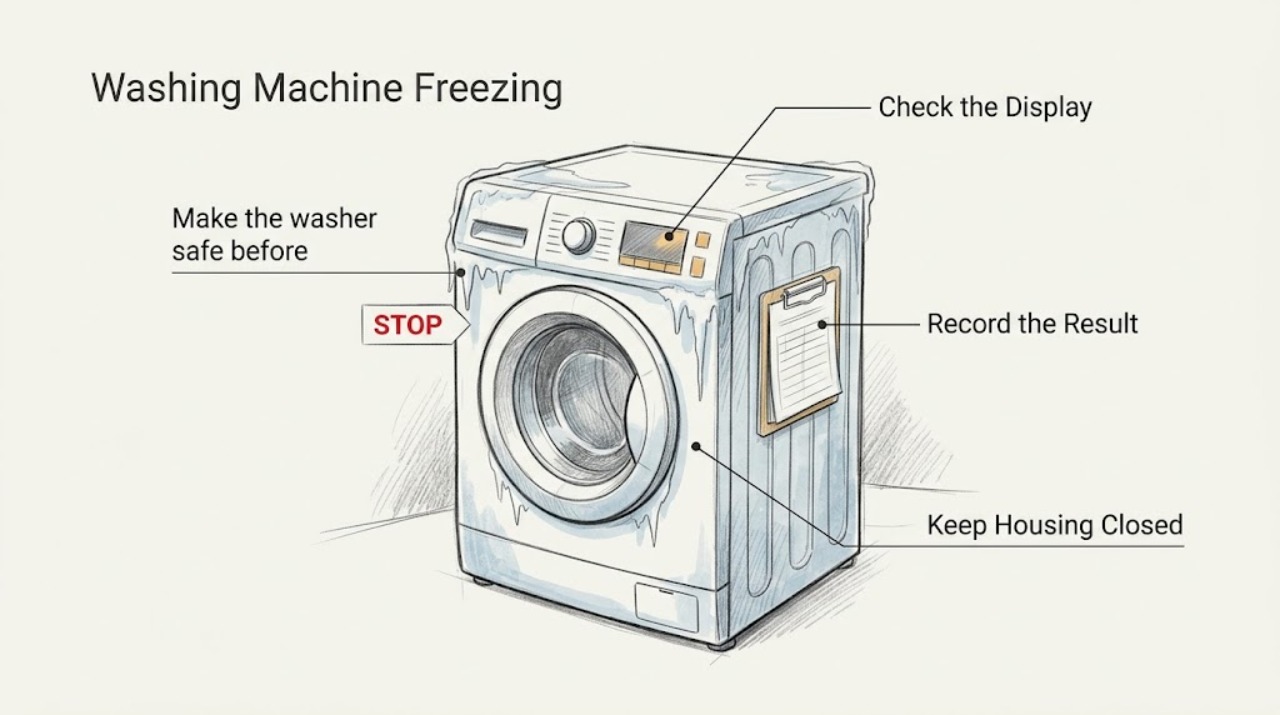
Make the washer safe before diagnosing a freeze
From a dry position, look for standing water, a wet receptacle or cord, a split, bulging, or displaced inlet or drain hose, water on the floor, a burning smell, smoke, or a hot plug. If the area around the receptacle is dry and the cord can be reached without stepping in water, switch the washer off; otherwise leave it untouched and use a qualified technician or electrician. Close the washer's water taps if doing so is safe and accessible.
Expected result: The electrical area is wet, a hose or fitting is damaged, water is actively escaping, the cord or receptacle is hot or scorched, or the washer is dry and intact.
Next step: For a hazard, keep people away, do not energize the washer or operate a wet switch, and call emergency help, a plumber, an electrician, or qualified LG service from a safe location. For an intact dry unit, continue without removing covers.
Stop if: Do not touch a wet plug or receptacle, force a frozen fitting, run the washer to test a leak, or use an open flame or high heat to thaw it.
Why this matters
Why: Water near electricity, a damaged pressure hose, or overheating is an immediate shock, flood, or fire risk; an intact dry washer can proceed to non-invasive identification.
-
Separate a frozen control from actual ice in the water path
Record the exact display message, whether the screen or buttons respond, whether a CL or control-lock indication is present, whether the tub has water, and whether the failure began after below-freezing exposure. Note whether the washer is a top-load, front-load, or combination model and keep its model number available.
Expected result: The screen is visibly frozen or unresponsive, CL is shown, the washer has FF, IE, or OE, the tub will not fill or drain, or the washer is merely paused or powered off.
Next step: Use the control branch for an unresponsive panel or lock indication, the cold-weather branch for a documented freeze code or no flow, and the mid-cycle branch for a pause or shutdown. Do not pour water or disconnect a hose until the model and hazard screen are clear.
Stop if: Stop if a code is accompanied by a leak, wet electrical area, cracked hose, unusual heat, smoke, or a burning smell.
Why this matters
Why: A frozen screen or CL points to controls or operating state; FF, IE, OE, no water, or no drain after cold exposure makes an iced hose, faucet, tub, or drain path plausible. A powered-off or paused cycle is not evidence of ice.
-
Clear a control-state symptom without opening the panel
If the washer is dry and the issue is a frozen or unresponsive control, dry your hands and the outside of the panel. If CL or another lock indication is present, use only the model's documented button combination to release it; the combination varies by model. If the panel remains frozen, switch the washer off and disconnect power only when the cord and receptacle are dry and safely reachable.
Expected result: The buttons respond after drying, the lock indication clears, the display returns after a documented power reset, or the panel remains frozen or immediately freezes again.
Next step: Run no more than one model-documented reset and observe whether the display and cycle remain stable. If it does not respond or freezes again, record the model and display state and request LG service.
Stop if: Do not remove the console, bridge terminals, bypass a lock, probe wiring, or repeatedly cycle power; do not reset a washer with water around the electrical connection.
Why this matters
Why: Moisture on the panel or an active lock can imitate a frozen control. Persistent freezing after those low-risk checks suggests a control, power, or internal fault rather than water ice in the hoses.
-
Check for a paused or interrupted cycle before calling it frozen
If the display is active, check whether PAUSE was selected, whether the washer powered off during spin, and whether a code appears when power is restored. If the load is visibly bunched and the machine stopped during spin, redistribute the load only with the drum stopped and the door or lid safely released according to the model instructions. Do not add detergent just to restart a stopped cycle.
Expected result: The machine had been paused, powered off after an extended pause, stopped during spin with a shifted load, or shows a recurring error or will not resume.
Next step: Restart only the documented cycle or use the model's spin-only option when appropriate. If it stops again, capture the code and timing and arrange service rather than assuming freezing.
Stop if: Do not reach into a moving drum, force a locked door or lid, or keep restarting a machine that leaks, smells hot, trips power, or returns an error.
Why this matters
Why: LG notes that an extended pause can power the unit off and that an unbalanced load can stop spin to prevent damage. A recurring code or failure to resume is not explained by a normal pause and needs model-specific diagnosis.
-
Check the water faucet and inlet hose for cold-weather blockage
For an IE or no-fill symptom after cold exposure, close the washer's water tap before loosening any hose. Only if the fitting and floor are dry and the hose can be handled safely, separate the inlet hose from the washer and briefly check whether water comes from the faucet. If the faucet does not flow, do not force it; warm the faucet with a warm, wet towel. Thaw a disconnected hose with warm water below 50°C (122°F), reconnect only after all visible ice has melted, and open the tap slowly while watching for leaks.
Expected result: No water leaves the faucet, the disconnected hose is visibly iced, water flows at the faucet but not into the tub, or water flows normally after thawing.
Next step: After a complete, leak-free thaw, follow the exact model instructions for a rinse test. If the faucet, hose, connection, or inlet remains blocked, leaks, or refreezes, stop and call a plumber or LG service.
Stop if: Never use boiling water, a torch, a heat gun, or a space heater aimed at hoses; do not reconnect a hose that is still iced, cracked, or leaking.
Why this matters
Why: No faucet flow supports a frozen household supply or faucet; ice in the disconnected hose supports a frozen inlet path. Normal faucet flow with continued IE can indicate a filter, valve, pressure, or control issue rather than freezing.
-
Thaw a documented frozen tub or drain path conservatively
For an OE or FF condition with confirmed cold-weather exposure, remove laundry and follow the exact LG guide for the model. LG's top-load guidance uses warm water—not boiling water—in the tub and a waiting period so ice in the tub or drain hose can melt; it also says to wait longer if water still will not drain. Do not pour water into a front-load, combination, or electrically wet unit unless that exact model's instructions call for it.
Expected result: Water begins to drain after thawing, no water comes out, the tub or hose leaks, or OE/FF returns after the ice should have melted.
Next step: Keep power off while water remains trapped or leaks. Once the model-appropriate path is fully thawed and dry, use only the documented rinse or spin test; otherwise arrange service.
Stop if: Do not force the pump, remove an access cover with trapped water, use boiling water, or run the washer against an unresolved blockage.
Why this matters
Why: Improved drainage after a model-appropriate thaw supports an ice blockage. No drainage, a leak, a return of the code, or an unconfirmed model means the pump, hose, filter, or control may be damaged or blocked and cannot be safely identified from the symptom alone.
-
Verify operation only after thawing and checking for leaks
After all suspected ice has melted, hoses are correctly connected, the faucet is open, and the floor and electrical area are dry, run the model-documented Rinse and Spin or equivalent short test with no laundry or detergent. Stay nearby and observe fill, drain, hose connections, abnormal noise, and the display. Stop the test immediately if water escapes or a code returns.
Expected result: The washer fills and drains normally without leaks, it fills but will not drain, it drains but will not fill, or the display freezes or returns FF, IE, or OE.
Next step: Use the exact model manual to identify the remaining code and request LG service if the test is not normal. Do not keep repeating cycles to clear a fault.
Stop if: Do not leave the washer unattended during the first post-thaw test or operate it with a leak, wet outlet, unstable display, or damaged hose.
Why this matters
Why: A normal test after thawing supports a temporary cold-weather blockage; a one-sided fill or drain failure or returning code suggests a remaining blockage, damaged hose, pump, inlet valve, sensor, or control fault.
-
Prevent a repeat freeze only when storing the washer safely
If the LG washer will remain in an unheated location, follow its exact winterization instructions: shut off the water supply, disconnect power, drain residual water into a shallow pan using the documented access, and position hoses so water does not remain trapped. Use any antifreeze or tilting procedure only when the exact LG instructions cover the model and with appropriate help for moving the appliance.
Expected result: The washer will be stored below freezing, hoses retain water, the drain hose is bent or holds a low spot, or the machine remains in a heated and regularly used room.
Next step: Winterize according to the model instructions or have LG service perform it. Correct insulation, plumbing, or building-temperature problems with a qualified professional; do not improvise a permanent heat source around the washer.
Stop if: Do not tilt or move a washer alone, add unapproved chemicals, or leave it powered and connected to water while unattended in freezing conditions.
Why this matters
Why: Residual water in the pump and hoses can freeze and expand, risking damage to the washer and household plumbing. A heated, dry installation has a different risk, but a recurring freeze still requires finding the cold exposure or trapped water.
Use your observations
Decision map
Find the observation that best matches what you see, then follow the next safe action.
-
PATH 01Next step
What you see
The screen is frozen or buttons are unresponsive, but there is no cold-weather exposure, no water blockage, and the washer is dry; drying the panel or clearing a documented lock does not restore operation.
Do this next
Perform at most one safe, model-documented reset and request LG service if the display remains frozen. Do not open the console or probe wiring.
Why this path and its safety boundary
Why it matters: The symptom is more consistent with a control, power, or internal electronic problem than with ice in a water line.
-
PATH 02Next step
What you see
CL is displayed and the power button works while other controls do not.
Do this next
Use the exact model's documented lock/unlock buttons. If CL will not clear or another fault appears, arrange service without bypassing the lock.
Why this path and its safety boundary
Why it matters: Control Lock is a likely operating-state explanation; it can remain active after power is cycled and does not indicate a frozen tub.
-
PATH 03Next step
What you see
The washer was in an unheated space and shows FF, IE, or OE, with no water from a faucet or no flow through an iced hose.
Do this next
Keep power off while checking for leaks, shut off water before hose handling, and use only the exact LG model's warm-water thaw procedure. Service is needed for damage, persistent blockage, or a returning code.
Why this path and its safety boundary
Why it matters: Actual cold-weather freezing in the faucet, inlet hose, tub, drain hose, or pump path is more likely than a frozen user interface.
-
PATH 04Next step
What you see
The faucet flows and the hose is not iced, but IE or no-fill remains; or the washer drains normally but the display continues to freeze.
Do this next
Record the exact code and model, avoid internal testing, and request LG service rather than replacing a valve or control from the symptom alone.
Why this path and its safety boundary
Why it matters: The initial freeze hypothesis is weakened. A filter, inlet valve, pressure or control issue may explain no fill, while a persistent display fault points to electronics.
-
PATH 05Next step
What you see
The washer stopped after PAUSE or during spin with a visibly shifted load, then resumes normally after the model-appropriate correction.
Do this next
Monitor one complete cycle. If the stop repeats without an imbalance or a code appears, stop restarting and arrange service.
Why this path and its safety boundary
Why it matters: A normal pause timeout or imbalance safeguard better explains the stop than freezing.
-
PATH 06Next step
What you see
A post-thaw rinse or spin test fills and drains normally once, with a dry floor and no recurring code.
Do this next
Inspect for delayed drips and winterize according to the exact LG instructions before another freeze. Have a technician assess any recurring code or leak.
Why this path and its safety boundary
Why it matters: A temporary frozen water path is plausible, but the event may have stressed a hose or plumbing connection.
-
PATH 07Next step
What you see
Water leaks, a hose is cracked or bulging, a receptacle is wet, the cord is hot or scorched, smoke or a burning smell occurs, or an error returns after thawing.
Do this next
Keep the washer off, keep clear of wet electrical equipment, shut off water only from a safe dry position, and call qualified plumbing, electrical, or LG service.
Why this path and its safety boundary
Why it matters: The priority is flood, shock, fire, or equipment-damage prevention; this is not a routine thaw or reset.
Helpful context
Understand the symptom
What “freezing” means on an LG washer
A panel that will not respond, a display stuck on one screen, or a CL indication is a control or operating-state symptom; it does not prove that water inside the machine is frozen. Actual cold-weather freezing is more likely when the washer is in an unheated garage, basement, utility room, or vacant home and shows FF, IE, or OE, will not fill or drain, or has ice on a faucet or hose. The two situations need different checks, and a reset will not safely thaw a pressurized or blocked water path.
Start with the display and the water path
Note the exact message, whether the panel responds, whether the tub contains water, and whether the problem began after a freeze. LG's support instructions are model-sensitive, so a top-load freeze procedure should not automatically be applied to a front-load washer or washer-dryer combination. Keep the model number available before disconnecting a hose, opening an access cover, or selecting a reset.
Thaw gently and verify before running
LG warns that residual water in hoses and the pump can freeze and expand, damaging the washer or household pipes. Do not use a torch, boiling water, or improvised heat. Once a model-appropriate thaw is complete, check that water flows, drains, and does not leak before a short rinse-and-spin test. A frozen condition that returns after a reasonable thaw, or any evidence of cracked plumbing or wet electrical parts, needs service rather than repeated cycles.
Safety boundary
Stop conditions
- Stop immediately for active flooding, a wet receptacle or cord, a burning smell, smoke, a hot or scorched connection, a cracked or bulging pressure hose, or water contacting electrical parts. Keep clear and call appropriate emergency, plumbing, electrical, or LG service.
- Do not force frozen hoses or faucets, use a torch, heat gun, space heater, or boiling water, reconnect an iced or damaged hose, or operate the washer against an unresolved blockage.
- Do not remove panels, probe wiring, bypass Control Lock or a door/lid lock, force the door, reach into a moving drum, or repeatedly reset the washer to clear FF, IE, OE, or a frozen display.
- LG instructions vary by model and washer style. Use the exact model manual for lock buttons, reset behavior, access covers, thawing, and winterization; a front-load or combination washer should not automatically receive a top-load procedure.
Only after diagnosis
Potential parts
- inlet or drain hose
Consider a hose only after inspection or qualified diagnosis confirms cracking, splitting, freeze damage, or an otherwise failed hose; a no-fill or no-drain code alone does not identify the hose.
Confirm the exact LG model, hose function, connection size, routing, and pressure rating before ordering. Replace a damaged pressure hose rather than patching it. - drain pump or inlet valve
Consider these parts only when qualified testing after a complete thaw confirms a pump or valve fault and the hose, faucet, filter, and control conditions have been addressed.
Pump and valve assemblies are model- and revision-specific and involve water and electrical safety. Do not order from FF, IE, or OE alone. - washer control panel or main control
Consider a control component only when the washer is dry, the lock and documented reset have been ruled out, and LG service confirms a persistent unresponsive or repeatedly frozen display.
Control parts require exact model and revision matching and may require programming or internal electrical work. Do not open the console or substitute a generic control.
When checks do not resolve it
Need a professional?
Arrange service for a persistent frozen screen, recurring FF/IE/OE or other code, no fill or no drain after thawing, a control-lock state that will not clear, a leak or damaged hose, repeated freezing, or any concern about the pump, inlet valve, wiring, or control board.
Safety scope: Keep the washer off and do not handle wet electrical equipment, open panels, bypass locks, test energized circuits, force frozen connections, or run repeated cycles after a hazard, leak, damaged hose, or returning error.
Common questions
FAQ
Why does my LG washing machine say it is frozen?
It may be reporting a frozen touchscreen or control state, or actual ice in a faucet, inlet hose, tub, drain hose, or pump after below-freezing exposure. FF, IE, or OE with no fill or drain supports the cold-weather branch; a stuck screen without cold exposure supports a control branch. Use the exact model guide before thawing or resetting.
Can I pour hot water into an LG washer that is frozen?
Only follow the exact LG procedure for the washer model and style. LG's top-load freeze guidance uses warm water and explicitly warns against boiling water; it also says to wait if water still will not drain. Do not pour water into an electrically wet washer or apply an unapproved procedure to a front-load or combination model.
What is the difference between a frozen display and frozen water lines?
A frozen display has an unresponsive screen or buttons, sometimes after wet hands or with a control-lock indication. Frozen water lines are associated with cold exposure, no faucet or washer water flow, no drainage, or FF, IE, or OE. The first uses a dry-panel and model-documented control check; the second needs a safe water-path thaw and leak check.
Why did my LG washer stop in the middle of a cycle when it was not freezing outside?
It may have been paused long enough to turn off, stopped during spin because the load shifted, or stopped with an error. Check the display and load only as the model permits. A recurring stop, code, leak, or failure to resume needs service rather than repeated restarts.
When should I stop trying to thaw an LG washer?
Stop for flooding, a cracked or bulging hose, a wet outlet or cord, a hot or scorched connection, burning smell, smoke, forced fittings, a leak after thawing, or a returning FF, IE, or OE code. Keep the washer off and call qualified plumbing, electrical, or LG service from a safe position.
Read the exact guide
Official sources
- LG top load washing machine water frozen] Not working because it is frozen. No water supply or drainageLG USA Support · LG top-load freeze guidance; article warns that content and images can differ by model, so model-specific instructions control
- LG Washer - Troubleshooting Unresponsive Washer ButtonsLG USA Support · LG washer control-panel guidance; lock button combinations vary by model
- LG Washers - How to Winterize a Washing MachineLG USA Support · LG washer storage in unheated areas; exact winterization steps and permitted materials remain model-specific
- [LG Washing Machine] Troubleshooting Touchscreen IssuesLG USA Support · LG washer touchscreen guidance; page names an applicable F12WH model and notes that images and content can differ by product
- LG Washing Machine - Washer Powered off Mid-CycleLG USA Support · LG washer mid-cycle shutdown guidance; exact behavior and controls vary by model
Community feedback
Share a repair observation
Share a plain-text repair observation. Accepted observations are published automatically; this page may take a moment to update.