
On this page
Start here
Quick answer
“Freezing” on a Kenmore washing machine can mean an unresponsive display or buttons, actual ice in a cold laundry space or water path, or a cycle that is stuck with water and a locked door or lid. These are different problems. First make the area safe, note whether the controls respond, and look for visible frost, bulging hoses, standing water, or a locked door or lid without moving the appliance or opening its cabinet. Use the full model number at Kenmore’s official manual page before using any cancel, drain, lock, or reset procedure; Kenmore lists multiple front-load and top-load washer platforms, so a sequence from another model is not reliable. If the appliance, cord, outlet, or floor is wet, a hose or valve is visibly frozen or damaged, there is smoke, an electrical smell, repeated breaker operation, or the lock must be bypassed, stop and arrange qualified appliance service.
Before you begin
Safety first
- Keep the washer off for wet electrical areas, flooding, smoke, electrical or burning odor, arcing, shock, repeated breaker trips, damaged or frozen hoses, or an unsafe lock. Do not open the cabinet, bypass an interlock, move the appliance, force frozen fittings, apply improvised heat, or perform live electrical testing.
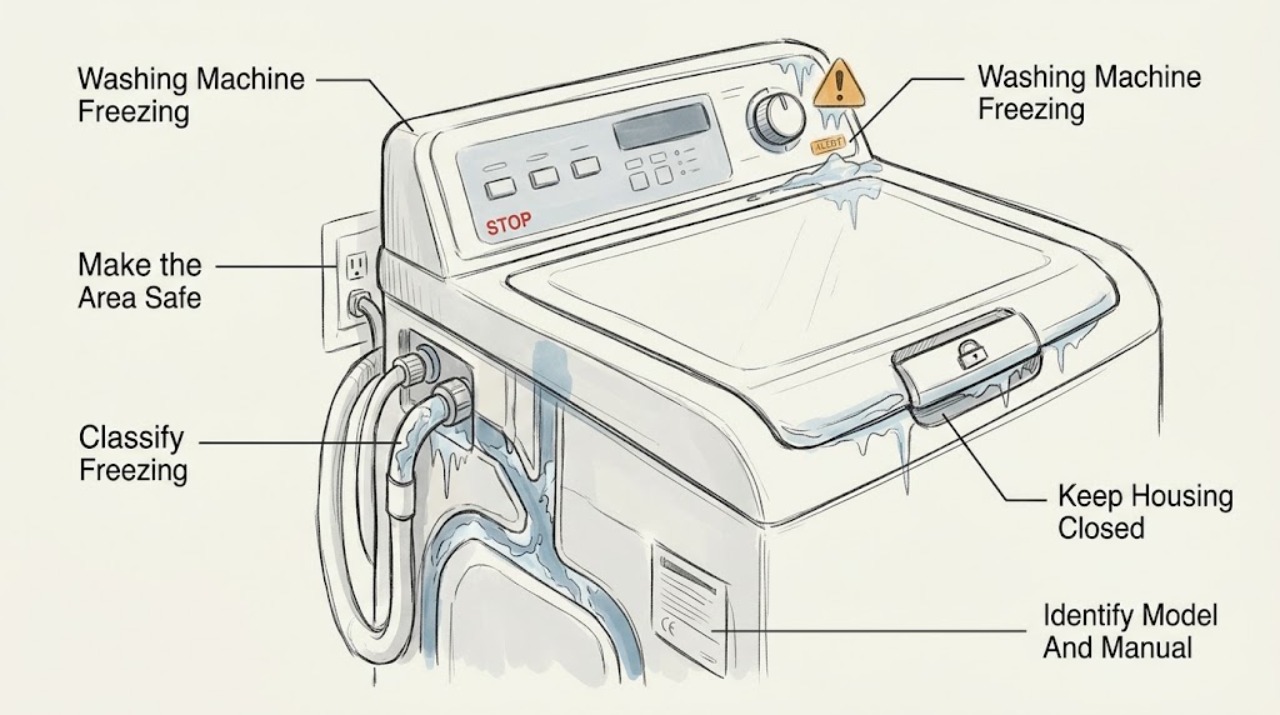
Work through in order
Diagnostic checks
Use only checks that match the exact appliance or system and its official guide.
-
Check 1
Stop the cycle and inspect the area from a dry, stable position. Keep hands away from the tub, door or lid, cord, outlet, and controls until you know the floor and appliance exterior are dry; do not move or tilt the washer.
Expected result: Record whether water is near the cord or outlet, the floor is flooding, the cord or plug is damaged or hot, there is smoke or an electrical smell, a breaker has tripped, or there is visible frost, ice, bulging, or cracking.
Next step: For any immediate hazard, keep clear and isolate power or water only from a dry, safe location if that can be done without touching the wet appliance; arrange qualified appliance or emergency help. Otherwise continue without opening the cabinet.
Stop if: Stop for water near electrical parts, flooding, smoke, burning or electrical odor, arcing, shock, a hot or damaged connection, or a hose or valve that is frozen, split, or bulging.
Why this matters
Why: Wet electrical areas, fire or shock symptoms, and a physically damaged or frozen water path are immediate safety conditions. A dry appliance with no damage can proceed to symptom classification.
-
Check 2
With the washer untouched, classify the symptom as an unresponsive display or buttons, visible ice or frost in a cold location, or a cycle that stopped with water, a locked door or lid, or a normal-looking room temperature.
Expected result: Note whether any indicator or button responds, whether the tub or drum contains water, whether the door or lid is locked, and whether the supply or drain path shows frost or deformation.
Next step: Use the matching diagnostic path below and record the symptom in the service notes; do not combine a control reset with a forced thaw or a lock bypass.
Stop if: Do not reach into the tub, force the door or lid, or open panels to decide which category applies.
Why this matters
Why: No control response without ice points toward power, a lock or mode, or the user interface/control path. Ice or a cold-space location points toward a water-path restriction. Water and a locked door or lid point toward drain, cycle, or interlock behavior rather than a frozen control.
-
Check 3
Read the complete Kenmore model number from its visible rating label and use Kenmore’s official manual search; record the washer style, control-lock wording, cancel or drain instructions, and any displayed message without copying a procedure from another model.
Expected result: The exact manual is available and describes a user-level lock, cancel, drain, or power-recovery step, or the model cannot be identified or the symptom is not covered.
Next step: Follow only the manual’s ordinary control instructions. If the model cannot be identified, preserve photos and the visible label for service rather than opening the machine.
Stop if: Stop if the manual calls for cabinet access, live testing, interlock bypass, or a procedure you cannot perform from a dry, ordinary user position.
Why this matters
Why: An identified model provides the only reliable basis for interpreting a lock indicator or recovery sequence. An unidentified model or a missing instruction means the step is not safe to invent.
-
Check 4
From normal user access, test only the documented power, Start or Pause, Cancel, and control-lock indicators for the identified model; do not remove the console or press a guessed key combination repeatedly.
Expected result: The display is blank, the display is lit but every button is ignored, a lock or special-mode indicator appears, or controls respond but the cycle does not progress.
Next step: Use the exact model’s documented user step once. If the display remains frozen, a code returns, or the washer will not progress, stop user diagnosis and arrange appliance service.
Stop if: Do not open the control panel, bypass a lock, jumper wiring, use live electrical test equipment, or keep resetting a tripped breaker.
Why this matters
Why: A blank display favors power or control diagnosis; a lock or mode indicator may have a manual-defined user action; responsive controls with no progress shift attention to water supply, drain, door or lid confirmation, or a fault code.
-
Check 5
If the washer is in a cold space and the exterior is dry, visually inspect the accessible inlet hoses, faucet connections, drain hose, and nearby exposed piping for frost, ice, bulging, cracks, kinks, or an abnormal hose position; do not disconnect fittings.
Expected result: The path is visibly frozen or damaged, the path is cold but intact with no ice, or there is no physical cold-path evidence and the washer is merely unresponsive or holding water.
Next step: Keep water and power isolated when a hose or valve is damaged or frozen, and arrange qualified service for safe thawing or replacement. If no ice is visible, return to the model-specific control or retained-water path.
Stop if: Do not force a valve, twist a frozen hose, apply an open flame, heat gun, boiling water, or improvised high heat, or disconnect a pressurized connection.
Why this matters
Why: Visible ice or damage supports a frozen or restricted water path and creates a leak risk when thawing. An intact cold path does not prove the controls are frozen; no ice makes the control, drain, cycle, or lock branches more likely.
-
Check 6
If water remains in the tub or drum, note its level and whether the door or lid is locked; use only the exact manual’s user-authorized cancel or drain procedure, and do not reach through or defeat the lock.
Expected result: The manual-authorized drain clears the water and releases the lock, the washer is silent with water retained, the pump makes abnormal noise without moving water, or no safe drain procedure is provided.
Next step: Stop after one authorized attempt and arrange service if water remains, the lock stays engaged, a code returns, or the pump is noisy or silent; protect the floor from a leak without moving the machine.
Stop if: Do not force the door or lid, bypass the interlock, remove a filter or hose without the exact model procedure and safe water containment, or open the cabinet.
Why this matters
Why: Retained water with a locked door or lid is a drain, cycle, or interlock symptom, not evidence of a frozen control. A silent or abnormal drain result can require pump, hose, control, or interlock diagnosis.
-
Check 7
Only when the area is dry, there is no ice or damage, the washer is not locked with retained water, and the exact manual permits it, make one power or user-control recovery attempt from a safe location; then run no more than one supervised normal test.
Expected result: The display returns, the washer accepts the cycle and completes fill, wash, drain, and spin normally, or the frozen state, code, leak, abnormal noise, or failure to progress returns.
Next step: Stop testing when the symptom returns and provide the model, room or location conditions, exact phase, display state, water or ice observations, and recovery result to appliance service.
Stop if: Do not repeat resets, operate with a leak, continue through smoke or abnormal noise, or use the washer if the door or lid cannot safely latch or release.
Why this matters
Why: A one-time recovery that remains normal can indicate a transient control or power state, but it does not prove the underlying cause is fixed. A repeated symptom is a service result; a physical leak or abnormal noise raises urgency.
-
Check 8
Before service, photograph the display and visible model label from a safe position and write a short timeline of location temperature, water or ice, cycle stage, door or lid state, codes, noises, leaks, and what happened after the one authorized recovery attempt.
Expected result: The record distinguishes a control-only freeze, a physical cold-path issue, or a retained-water and lock condition, or the evidence remains mixed.
Next step: Arrange qualified Kenmore or appliance service for a persistent or unclear condition and keep the washer out of service when any stop condition is present.
Stop if: Do not dismantle the washer or perform energized measurements to improve the record.
Why this matters
Why: A symptom timeline helps the technician choose the correct manual and inspect the relevant control, inlet, drain, pump, or interlock path without assuming the word “freezing” means ice.
Use your observations
Decision map
Find the observation that best matches what you see, then follow the next safe action.
-
PATH 01Next step
What you see
The display is blank or lit but buttons do not respond, while the washer is dry and there is no visible frost, ice, retained water, or door or lid damage.
Do this next
Use one documented user-level recovery step, then arrange service if the controls remain frozen or the condition returns.
Why this path and its safety boundary
Why it matters: A power, lock or mode, user-interface, or control condition is more likely than physical freezing; the exact model manual is needed to separate user settings from a fault.
-
PATH 02Next step
What you see
The washer is in a cold or unheated location and an accessible inlet, drain, faucet, or exposed pipe shows actual ice, frost, bulging, cracking, or abnormal deformation.
Do this next
Keep clear, isolate water or power only from a dry safe location when possible, avoid force and improvised heat, and arrange qualified service for safe thawing and inspection.
Why this path and its safety boundary
Why it matters: A frozen or damaged water path is more likely and can leak as it thaws; the control panel symptom may be secondary or unrelated.
-
PATH 03Next step
What you see
Water remains in the tub or drum and the door or lid stays locked, with no visible ice required.
Do this next
Use only the model-authorized cancel or drain procedure once; if water remains or the lock does not release, arrange appliance service without bypassing it.
Why this path and its safety boundary
Why it matters: Drain, cycle-control, or interlock behavior is more likely than a frozen control. A lock may be protecting against opening with water or movement.
-
PATH 04Next step
What you see
The display is completely dead or a breaker or protected outlet trips, especially when the washer is selected or restarted.
Do this next
Do not keep resetting the circuit or use an extension cord. Have the electrical or appliance fault assessed from a safe boundary, particularly if moisture or heat is present.
Why this path and its safety boundary
Why it matters: A supply, cord, outlet, moisture, or appliance electrical fault is more likely than a software-like frozen display; repeated resets could increase shock or fire risk.
-
PATH 05Next step
What you see
The controls respond, no physical ice is visible, but the washer stops at fill, wash, drain, or spin, or shows a lock or code.
Do this next
Record the exact phase, code, water level, and lock state; follow only the manual’s user checks and call service if the phase-specific failure repeats.
Why this path and its safety boundary
Why it matters: The relevant path is the model-specific water supply, drain, load, door or lid confirmation, or control logic for that stage, not a generic freezing reset.
-
PATH 06Next step
What you see
The symptom returns after the single documented recovery, the model is unclear, or there is a leak, abnormal noise, smoke, electrical odor, repeated trip, damaged hose, or unsafe lock condition.
Do this next
Keep the washer off and provide the service record, exact model, photos, and safe observations to qualified appliance service.
Why this path and its safety boundary
Why it matters: The condition is no longer a safe user-level troubleshooting question; internal controls, pump, valve, wiring, cabinet, or interlock diagnosis may be required.
Helpful context
Understand the symptom
Decide what “freezing” describes before troubleshooting
A blank or unresponsive control panel is a control or power symptom, not proof that water has frozen. A washer in an unheated garage, shed, or other cold space may instead have ice or a restricted inlet or drain path. A machine that stops with water still in the tub can be a drain, cycle, or door/lid-interlock problem even when the room is warm. Write down which meaning fits, because each path has a different safe next step. Kenmore’s official manual search asks for the model number, and the washer catalog shows that front-load and top-load designs use different controls and access arrangements.
Use the exact Kenmore manual for controls and recovery
Find the full model number from a visible rating label without moving the washer, then use Kenmore’s manual page for that model. The manual is the authority for control-lock indicators, cancel or drain behavior, door or lid handling, and any permitted power-reset step. A control that accepts no button input may have lost power, be in a lock or special mode, or have a control fault; do not assume a generic button combination applies. Do not remove the console, cabinet, or rear panel to make the controls respond.
Treat actual ice and retained water as separate physical paths
From a dry, safe position, look at the accessible supply hoses, shutoff area, drain hose, tub or drum, and door or lid seal. Frost, ice, bulging, cracking, or a hose that cannot move normally supports a cold water-path concern. Water remaining in the tub without visible ice supports a drain or cycle concern instead. Do not force a frozen valve or hose, pour boiling water on fittings, use an open flame or heat gun, or reach into a locked tub. Thawing and any internal inspection should follow the exact model instructions or be handled by a qualified technician.
One controlled observation is enough
If there is no water or electrical hazard and the manual permits it, make only one normal user-level recovery attempt: restore power from a dry, safe location or use the documented cancel or drain control, then observe whether the display returns and whether the washer fills, tumbles, drains, and releases the lock normally. A returning frozen display, a repeated stop, a code, a leak, abnormal noise, or failure to release the door or lid is a service result, not a reason to repeat resets or bypass an interlock.
Safety boundary
Stop conditions
- Stop immediately for water near the washer cord, plug, outlet, controls, or other electrical parts; do not touch a wet plugged-in appliance.
- Stop for flooding, smoke, burning or electrical odor, arcing, shock, a hot or damaged cord or connection, or a breaker that trips again. Do not restart to test.
- Stop for a visibly frozen, bulging, cracked, or leaking hose, valve, faucet connection, exposed pipe, or cabinet area; do not force it or apply an open flame, heat gun, or boiling water.
- Do not move, tilt, or drag the washer to reach a hose, rating label, drain, or outlet; request help when safe access requires moving it.
- Do not force a door or lid open, reach into a moving or locked tub, or bypass a door or lid interlock, even if water remains.
- Do not remove the cabinet, console, pump, valve, filter, or wiring, and do not perform live electrical tests or change a breaker or fuse rating.
- Do not use another Kenmore model’s reset, drain, lock, code, or thawing instructions when the full model manual is unavailable.
- Stop after one model-authorized recovery attempt when the display remains frozen, a code returns, the cycle stalls, water remains, or abnormal noise or a leak appears.
- Arrange qualified service when the symptom cannot be classified safely as control behavior, physical cold-path freezing, or a retained-water and lock condition.
Only after diagnosis
Potential parts
- user interface or control board
Consider this category only after the exact model shows a persistent unresponsive display or controls and qualified diagnosis rules out the supply, lock or mode, moisture, and external power paths.
Kenmore control assemblies vary by washer platform and model. Confirm the complete model and service diagnosis before selecting any component; do not replace it from the word “freezing” alone. - water inlet valve or supply hose
Consider this category only when a qualified inspection finds an inlet restriction, freeze damage, crack, or valve failure after the accessible supply path is safely isolated.
Hose routing, valve connectors, and washer platforms differ. Confirm the exact model and installation requirements; never substitute a part to overcome a frozen or pressurized connection. - drain pump, filter, or drain hose
Consider this category only when water remains, the exact manual’s user-level drain path is clear or inaccessible, and qualified diagnosis identifies a blocked, frozen, damaged, or failed drain component.
Drain arrangements and filter access vary by Kenmore model. Confirm the full model and diagnosis; internal access is not an owner repair step here. - door or lid interlock
Consider this category only when the door or lid closes normally but the exact model reports an interlock condition or prevents safe progression after the drain and control paths are assessed.
Front-load and top-load interlocks are not interchangeable. Confirm the complete model and qualified diagnosis, and never bypass the lock.
When checks do not resolve it
Need a professional?
Arrange qualified Kenmore or appliance service when the control remains unresponsive after the exact model’s single user-authorized recovery, when water remains or a door or lid stays locked, when a code returns, when a drain or fill path is inaccessible or physically frozen, or when the washer repeatedly stalls. Treat wet electrical parts, flooding, smoke, electrical odor, arcing, shock, repeated breaker trips, damaged or bulging hoses, and any need to bypass an interlock as immediate stop conditions.
Safety scope: Keep the washer off for wet electrical areas, flooding, smoke, electrical or burning odor, arcing, shock, repeated breaker trips, damaged or frozen hoses, or an unsafe lock. Do not open the cabinet, bypass an interlock, move the appliance, force frozen fittings, apply improvised heat, or perform live electrical testing.
Common questions
FAQ
Does “freezing” mean the Kenmore washer has ice inside?
Not necessarily. It can describe an unresponsive display, actual ice in a cold location or water path, or a cycle that stopped with water and a locked door or lid. Look for physical frost or deformation before treating it as a freeze-up.
How can I tell a frozen control from a frozen water path?
A lit or blank panel that ignores controls with no frost favors power, lock or mode, user-interface, or control diagnosis. Frost, ice, bulging, or cracking at an accessible hose, valve, or pipe favors a physical cold-path problem. Water in the tub without ice favors a drain, cycle, or interlock problem.
Can I unplug a Kenmore washer that seems frozen?
Only if the area is dry, there is no retained-water lock hazard, and the exact model manual permits that user-level recovery. Use one documented attempt from a safe location; do not keep resetting a breaker or assume another model’s sequence.
What if the tub is full and the door or lid will not open?
Treat it as a retained-water and interlock condition, not proof of ice. Use only the exact model manual’s safe cancel or drain procedure once. Never force or bypass the lock or open the cabinet.
Can I thaw a frozen washer hose with a heat gun or boiling water?
No. Do not use open flame, a heat gun, boiling water, or improvised high heat around hoses, valves, water, and electrical parts. Keep water and power isolated when there is damage or a leak risk and arrange qualified service.
What information should I give appliance service?
Provide the complete model number, washer style, location and cold exposure, display and button behavior, code or lock text, cycle stage, water level, door or lid state, visible ice or damage, breaker events, noises, leaks, and the result of the one model-authorized recovery attempt.
Read the exact guide
Official sources
- Find Your Manual | Kenmore Appliance Manuals & GuidesKenmore · Kenmore washer owner's manuals and model-specific appliance resources
- Washers | Laundry | KenmoreKenmore · Kenmore washer product families and washer platform distinctions
- Customer Care & Support | Kenmore AppliancesKenmore · Kenmore manuals, safety/compliance, parts literature, and repair support routes
- Washing MachinesU.S. Consumer Product Safety Commission · U.S. washing-machine safety-standard information
Community feedback
Share a repair observation
Share a plain-text repair observation. Accepted observations are published automatically; this page may take a moment to update.