
On this page
Start here
Quick answer
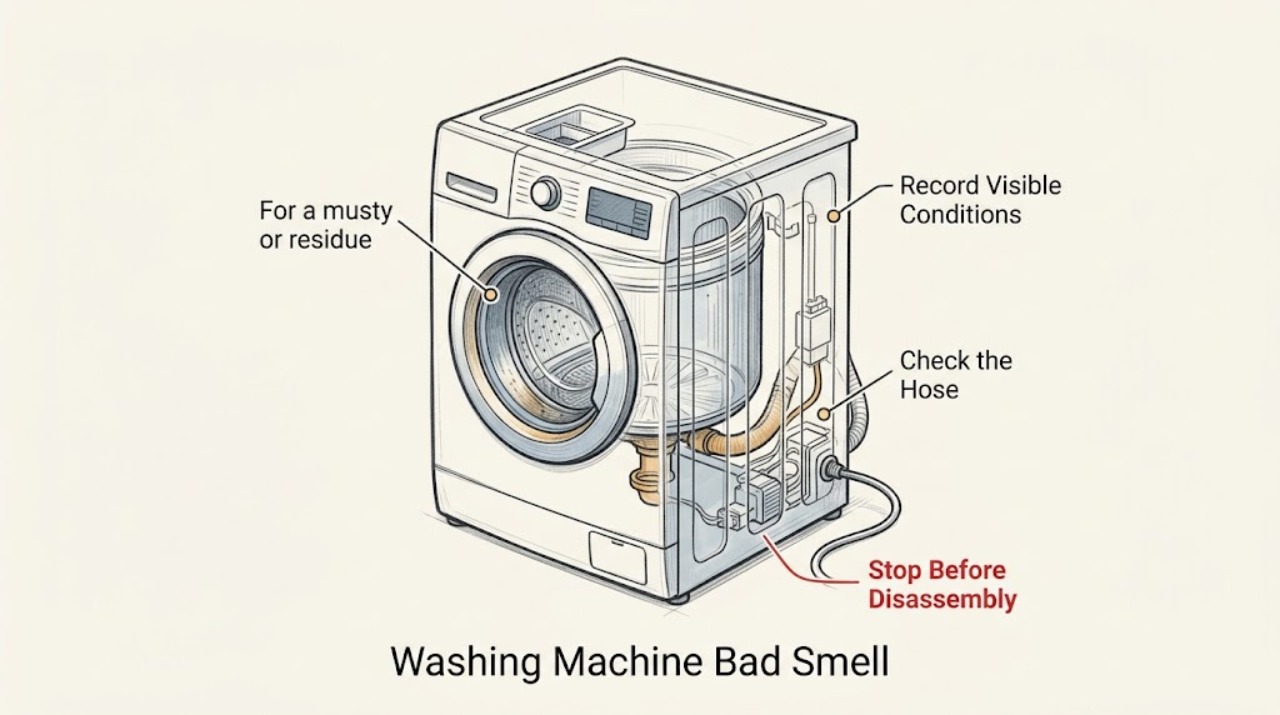
First classify the odor before cleaning a Kenmore washing machine. A musty or earthy smell usually points toward retained moisture or residue, so inspect the door or lid, gasket, dispenser, tub opening, drain area and nearby hoses; Health Canada specifically recommends leaving a washing-machine door open between uses and checking that it drains without splashing. A sewage-like smell that returns after a cycle needs the drain hose, standpipe and any model-specific pump or filter guidance checked without opening the cabinet. A sharp burning, hot-plastic or electrical smell is a stop condition: stop the cycle, do not keep resetting the breaker, and disconnect power only from a safe dry position before arranging qualified service. Use a Clean Washer cycle or cleaner only if the exact Kenmore manual lists that option and product, and never mix cleaning chemicals.
Work through in order
Diagnostic checks
Use only checks that match the exact appliance or system and its official guide.
-
Check 1
Stop the washer and classify the odor from a safe position without putting your face inside the tub. Record whether it is musty or earthy, sour or sewage-like, detergent-heavy, or sharp like burning insulation or hot plastic. Also note when it appears: while idle, during fill, agitation, drain, spin or immediately after a cycle. Stop immediately for smoke, visible sparks, abnormal heat, a shock, a damaged cord or a breaker that trips again.
Expected result: The odor is musty and strongest when the washer is closed, sewage-like during or after draining, or sharp and electrical while the machine is powered or running.
Next step: Follow only the matching low-risk branch. For a hot or electrical odor, leave the washer off and arrange qualified service rather than repeating the cycle.
Why this matters
Why: A closed damp interior points toward moisture or residue; a drain-stage odor points toward the discharge path or retained water; a hot or electrical odor is a possible fire or shock hazard and is not a cleaning branch.
-
Check 2
With the washer stopped, inspect the accessible door or lid, gasket or rim, dispenser area, tub opening, floor and visible hose connections. Look for retained water, slime, detergent buildup, clothing trapped in a seal, discoloration, a damp wall or floor, a leak, or a drain hose that splashes outside its drain. Do not remove a gasket, pump cover or cabinet panel as part of this check.
Expected result: Residue or water is visible at the door or lid area, dispenser, tub, hose connection or floor, or all accessible areas look dry and clean.
Next step: Correct an obvious external spill and wipe only surfaces that the manual identifies as user-cleanable. Shut off water and request service for a continuing leak or for any source behind the cabinet.
Why this matters
Why: Visible residue or moisture gives the odor a correctable external source and should be handled according to the model guide. A clean exterior with a persistent smell suggests retained water, a hidden drain issue or a non-washer source that needs further evaluation.
-
Check 3
For a musty or residue odor only, find the exact Kenmore model manual and confirm that it lists a Clean Washer or equivalent empty-tub cycle. If it does, remove all clothing and follow that guide for the approved cleaner and amount; do not add detergent or a second chemical unless the guide explicitly says to. If no such cycle is listed, clean only the accessible surfaces and dispenser by the manual's method.
Expected result: The manual provides an empty-tub cleaning procedure, the manual has no such procedure, or the odor remains after one correctly completed procedure.
Next step: Leave the door or lid open to dry when the design permits it and continue to the drain and moisture check. Do not keep repeating chemical cycles or use unapproved mixtures.
Why this matters
Why: A model-authorized cleaning cycle can address residue in the areas it is designed to reach, but it cannot prove or repair a leak, blocked drain, failed seal or electrical fault. Recurrence means the moisture or residue source remains or the odor is coming from another path.
-
Check 4
For a sour or sewage-like odor, observe the drain hose outlet and the area around the standpipe or laundry sink during one otherwise safe drain event. Look for a slow discharge, water backing up, splashing outside the basin, standing water left in the tub, or odor that comes from the room drain rather than the washer. Do not reach into standing water, remove a pump or filter, or open plumbing connections while the machine is energized.
Expected result: The drain backs up or splashes, water remains in the tub, the room drain smells independently, or the washer drains normally but the odor returns from inside it.
Next step: Stop using the washer for overflow or a leak and arrange plumbing or appliance service as appropriate. Do not pour drain chemicals into the washer or dismantle the drain system to chase an odor.
Why this matters
Why: A discharge or plumbing symptom shifts attention to the drain installation or a model-specific drain path. Normal visible drainage with odor retained inside the washer needs the exact manual and qualified service rather than a guessed pump or filter repair.
-
Check 5
For a burning, hot-plastic or electrical odor, stop the cycle and do not restart it. From a dry, safe position, look only for an externally damaged cord, hot or discolored plug, smoke, sparks or heat at the receptacle; do not touch a hot part, pull the cord, open the washer or reset the breaker repeatedly.
Expected result: Smoke, sparks, a hot or discolored plug or receptacle, damaged insulation, a shock, abnormal heat or a repeated trip is present, or the odor stops but its source is uncertain.
Next step: Keep the washer out of service and obtain a qualified appliance technician or electrician. Do not resume washing merely because the smell has faded.
Why this matters
Why: These signs can indicate an appliance or wiring defect capable of shock or fire. The absence of a visible sign does not make a recurring electrical odor safe to reproduce.
-
Check 6
After a non-hazardous musty-odor correction, prevent moisture from being trapped. Remove laundry promptly, leave the door or lid open between uses when the model permits it, dry accessible gasket and dispenser surfaces, and keep the visible drain outlet and hose connections free of leaks or splashing. Do not leave the washer open if children or pets can reach the tub or if the model manual prohibits it.
Expected result: The odor disappears as the interior dries, returns only after the washer sits closed, or returns despite drying and a model-authorized cleaning cycle.
Next step: Keep the washer dry and request model-specific service if the smell returns, if visible mold is extensive, or if the moisture source is not clear.
Why this matters
Why: A drying-dependent odor supports retained moisture or residue. Recurrence despite drying suggests an unresolved leak, drain issue, hidden contamination or component problem and should not be covered with fragrance.
Use your observations
Decision map
Find the observation that best matches what you see, then follow the next safe action.
-
PATH 01Next step
What you see
The odor is musty or earthy and is strongest after the washer sits closed, with no heat, smoke or electrical symptom.
Do this next
Inspect accessible damp or residue areas, then use the exact Kenmore manual for a model-authorized empty-tub cleaning cycle and drying routine.
Why this path and its safety boundary
Why it matters: Retained moisture or residue is the first branch; musty odor can accompany mold, but odor alone does not identify the material or its extent.
-
PATH 02Next step
What you see
The odor is sour or sewage-like and becomes strongest during drain or spin.
Do this next
Observe the visible discharge for backup, splashing and standing water; stop for overflow and arrange plumbing or appliance service instead of opening the pump.
Why this path and its safety boundary
Why it matters: The drain outlet, standpipe, retained water or a model-specific drain path needs to be separated from an interior residue odor.
-
PATH 03Next step
What you see
The odor is sharp, burning, hot-plastic or electrical, or is accompanied by smoke, sparks, abnormal heat, shock, a damaged cord or a repeated breaker trip.
Do this next
Stop using the washer, isolate power only from a safe dry position and obtain qualified appliance or electrical service. Do not keep resetting the breaker.
Why this path and its safety boundary
Why it matters: This is an electrical or fire-safety boundary, not a washer-cleaning problem.
-
PATH 04Next step
What you see
The odor returns after one correct model-authorized cleaning cycle and the interior has been allowed to dry.
Do this next
Keep the model manual and odor timing available and request service; do not keep adding chemicals or remove internal parts.
Why this path and its safety boundary
Why it matters: An unresolved moisture, drain, gasket, dispenser or hidden contamination problem remains possible.
Helpful context
Understand the symptom
The odor type changes the safe next step
Musty or earthy odor is most consistent with damp residue or a moisture problem, but odor alone does not prove mold. A sewage-like odor is more useful when it is tied to draining, a wet standpipe or water left in the machine. A sharp burning, hot-plastic or electrical odor is not a cleaning problem; stop the appliance and treat it as a possible electrical fault. Do not mask any of these odors with fragrance or run repeated cycles to reproduce them.
Empty-machine cleaning is model dependent
Kenmore sells different washer designs and its official manual page asks for the model number before showing the relevant guide. Some Kenmore washer product materials describe a Clean Washer cycle for reducing musty smells, but that does not make the cycle universal. Use the exact manual for the detergent, cleaner, bleach and cycle instructions; never combine bleach, vinegar, ammonia or other cleaners.
Drying and drainage prevent recurrence
After the washer is safe and clean, let the door or lid remain open between uses when the model design permits it, remove wet laundry promptly, and keep the surrounding laundry area dry. Check the visible hose connections and the drain discharge for leaks or splashing. If the smell returns after the moisture source is corrected, or if the odor is strong and no source is visible, arrange professional evaluation rather than opening hidden cavities.
When checks do not resolve it
Need a professional?
Call for qualified appliance or electrical service when the odor is electrical, the washer leaks or backs up, the smell returns after one manual-authorized cleaning and drying cycle, or the source is behind the cabinet or otherwise unclear.
Common questions
FAQ
Is a musty smell proof that my Kenmore washer has mold?
No. A musty odor suggests retained moisture or residue, but it does not identify the material or its extent. Inspect for dampness and visible growth, fix the moisture source, and follow the exact Kenmore manual for an approved empty-tub cleaning procedure.
Can I run an empty Clean Washer cycle?
Only if the exact Kenmore model manual lists that cycle and gives the cleaner or chemical instructions. Some Kenmore washer materials describe model-specific cleaning features, so do not assume that a cycle, amount or product applies to every washer, and never mix cleaners.
Why does the washer smell like sewage after it drains?
Separate the washer from the room drain by observing the visible hose outlet and standpipe or sink during a safe drain event. Backing up, splashing or water left in the tub needs plumbing or appliance service; do not pour drain chemicals into the washer or open the pump without model-specific instructions.
What should I do if the smell is burning or electrical?
Stop the cycle and do not restart it. If it is safe to do so from a dry position, disconnect power; do not pull a damaged cord or repeatedly reset the breaker. Keep the washer out of service and obtain qualified appliance or electrical help.
Read the exact guide
Official sources
- Laundry Appliances | Washers & Dryers | KenmoreKenmore · Supports the need to distinguish Kenmore laundry models; it is not a universal cleaning procedure.
- MoldCenters for Disease Control and Prevention · General public-health guidance for damp or moldy areas; it does not identify a washer component.
- Find Your Manual | Kenmore Appliance Manuals & GuidesKenmore · Use the exact washer model manual before selecting a cleaning cycle, chemical, user-accessible filter or service step.
- Guide to addressing moisture and mould indoorsHealth Canada · General laundry-room moisture and mold prevention; not a Kenmore internal repair manual.
- CPSC Guide to Home Wiring HazardsU.S. Consumer Product Safety Commission · General electrical safety guidance; it is not a Kenmore washer diagnosis.
Community feedback
Share a repair observation
Share a plain-text repair observation. Accepted observations are published automatically; this page may take a moment to update.