
On this page
Start here
Quick answer
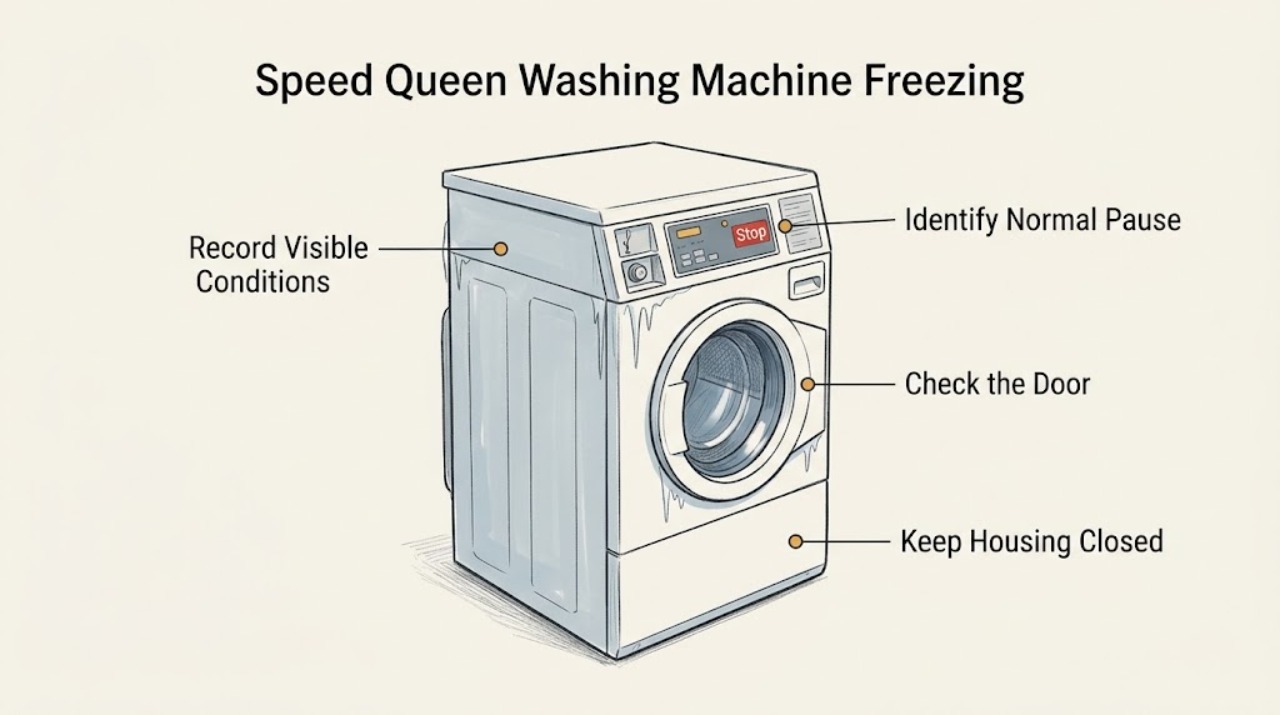
If a Speed Queen washing machine seems to freeze, first decide whether it is in a normal pause or has stopped making progress. Speed Queen guides describe brief pauses during tumbling and before spin as normal, while an unbalanced load can stop a spin and then restart it. A true stall is more likely when the same stage, display, beep, or light pattern remains, the washer cannot fill or drain, or the door or lid will not safely release. Record the stage and indicators, verify the door or lid, visible power, water supply, drain path, and load condition from safe access, then use the model-specific guide. Stop for a leak, smoke, burning smell, exposed wiring, a moving drum, a locked tub containing water, or any condition requiring panels or safety-device bypass; if the washer was delivered or stored below freezing, do not operate it until it has warmed to room temperature.
Before you begin
Safety first
- This article covers observation and ordinary-access checks only. Do not open panels, test energized wiring, remove a locked door or lid, bypass safety devices, reach into a moving tub, or substitute internal parts.
Work through in order
Diagnostic checks
Use only checks that match the exact appliance or system and its official guide.
-
Check 1
From a dry, stable position, look at the control panel, door or lid, tub water level, and floor around the washer. Do not reach into the tub or remove a locked door or lid. Note the selected cycle, the stage where progress stopped, remaining time if shown, beeps, flashing or steady lights, and any visible error indication.
Expected result: The washer is quietly pausing and the stage changes, or it remains on one stage with repeated lights or beeps, no movement, water left inside, or an unresolved lock.
Next step: Photograph the display or lights and continue only with the matching fill, drain, balance, door or lid, and model-guide checks below. If there is smoke, a burning smell, sparking, a leak, exposed wiring, or water near electrical parts, stop use and arrange qualified service.
Stop if: Do not reach into a moving drum, force a locked door or lid, operate with panels removed, or bypass a door or lid switch.
Why this matters
Why: A progressing pause can be normal cycle behavior. A repeatable stalled state, water that does not leave, or a persistent indicator is a symptom to diagnose rather than evidence that the machine is simply frozen.
-
Check 2
Watch from outside the washer for one complete transition without opening a locked door or lid. Compare the pause with the cycle stage: front-load tumbling may reverse after a short pause, and a top-load model may pause before a wash or rinse spin.
Expected result: The drum or agitator resumes and the status changes, or the washer remains in the same state beyond the expected transition and the same lights or time display persist.
Next step: If it resumes, let the cycle finish while observing for recurrence. If it does not, record the exact stage and indicator pattern and perform only the relevant safe checks; do not repeatedly force-start the cycle.
Stop if: Stop if the tub is moving abnormally, the cabinet is smoking or overheating, the door or lid remains locked with a hazard, or the washer makes a new harsh or electrical sound.
Why this matters
Why: A short, stage-related pause is documented normal operation. A non-progressing pause points toward a fill, drain, balance, door or lid, power, or control problem; the exact cause is model-dependent.
-
Check 3
With the washer stopped and the tub safe, verify from ordinary access that the front-load door is fully closed or the top-load lid is fully closed, the selected controls are set, and the power cord is fully seated. Use the Start/Pause control only as the model guide describes; do not hold or defeat a safety switch to make the washer run.
Expected result: The washer begins or resumes normally after the door or lid is properly closed, or it refuses to start, repeats the same lock or light indication, or stops again immediately.
Next step: If the control does not recover, leave the washer out of service and provide the model number, indicator pattern, and whether water is inside to an authorized servicer. Use only a model-specific reset documented by Speed Queen; do not guess from another model.
Stop if: Do not pry the door or lid open, bypass the latch or switch, remove panels, or test live wiring.
Why this matters
Why: A closed-door or lid condition and a valid start command are prerequisites for fill, agitation, tumble, or spin on the documented models. A repeated lock or start failure suggests a latch, lid-switch, control, or power issue that cannot be identified safely by forcing the cycle.
-
Check 4
If the stall occurs before or during filling, verify that both hot and cold supply faucets are open and that the visible fill hoses are not kinked, crushed, or disconnected. If the model guide permits screen cleaning, shut off the water and disconnect electrical power before any hose or screen work; do not loosen a pressurized connection.
Expected result: Water enters normally, enters slowly or not at all, one hose is restricted, or the inlet and faucet screens are visibly obstructed when inspected by the documented procedure.
Next step: Restore only the model-specified screen and hose arrangement, then make one supervised test. If fill remains absent or slow, stop and arrange qualified diagnosis rather than substituting a valve or opening the console.
Stop if: Stop for a burst, bulging, leaking, frozen, or damaged hose, water near electrical components, or any need to open the control panel.
Why this matters
Why: The Speed Queen guides list closed faucets, kinked hoses, and dirty mixing-valve or hose-end screens as fill causes. A persistent fill fault after those external checks can involve the inlet valve, pressure sensing, controls, or house supply and is not proven by the symptom alone.
-
Check 5
If water remains when the washer appears frozen, inspect only the visible drain hose and drain receptacle for a kink, crush point, or obvious blockage. On a model with a user-accessible pump foreign-object trap, follow that model's maintenance instructions; do not reach into standing water or open a trap that can spill hot or contaminated water without the specified procedure.
Expected result: The drain path is visibly clear and the washer drains, or water remains and the hose, receptacle, or documented pump trap is restricted or inaccessible.
Next step: Keep the washer out of service if water cannot be safely contained. Give the technician the water level, drain-hose observations, cycle stage, and any fault lights; do not tilt the appliance or remove the pump unless the exact manual explicitly supports it.
Stop if: Stop for hot water, sewage-like water, a leak, an inaccessible trap, or any need to remove panels or work near energized parts.
Why this matters
Why: Speed Queen troubleshooting lists a kinked or clogged drain hose, blocked receptacle, incorrect drain installation, and a clogged pump trap as possible no-drain causes. If the visible path is clear but draining still fails, the pump, wiring, control, or installation needs professional assessment.
-
Check 6
If the washer stops at or near spin, wait until movement has stopped and the door or lid is safely unlocked before observing the load. Look for a tightly bunched or very small load, excessive suds, or a washer that rocks; redistribute clothing only from safe access and use the detergent type and amount specified for the model.
Expected result: The load is evenly distributed and the washer completes a supervised spin, or it repeatedly stops, leaves clothing dripping wet, rocks, or shows a balance or suds indication.
Next step: Run only the model-recommended rinse or spin recovery if the washer is safe and the door or lid closes correctly. If the symptom returns, arrange service and report load size, detergent, cycle stage, movement, and remaining water.
Stop if: Do not reach into a moving tub, hold the lid or door switch, brace the washer while it spins, or continue using it if it walks, bangs violently, leaks, or smells electrical.
Why this matters
Why: The guides say an unbalanced load can limit or stop spin and may restart automatically, while excessive suds, an overloaded load, or an unlevel installation can interfere with operation. Repeated stops with a reasonable load are not proof that the drive system is sound.
-
Check 7
If the washer was delivered or stored in an unheated area during freezing weather, leave it disconnected and allow it to warm naturally to room temperature before any operating test. After warming, inspect the accessible cabinet, hoses, fittings, and floor for cracking or leakage without applying direct heat.
Expected result: The washer was cold-soaked but warms without visible damage, or a hose, fitting, cabinet, or control shows cracking, leakage, frost damage, or another abnormal condition.
Next step: If damage or leakage is present, keep the water supply closed and arrange qualified service. If no damage is visible, use the exact model guide for a supervised test and stop immediately if filling, draining, locking, or movement is abnormal.
Stop if: Do not thaw with an open flame, heat gun, space heater against the appliance, boiling water, or by forcing frozen hoses or valves.
Why this matters
Why: Speed Queen cold-weather guidance says not to operate a washer delivered or stored below freezing until it has warmed. A warm cabinet does not prove that frozen water caused no damage, so a leak or damaged component remains a service condition.
Use your observations
Decision map
Find the observation that best matches what you see, then follow the next safe action.
-
PATH 01Safety boundary
What you see
The washer pauses only at a documented cycle transition, then resumes with changing status or drum motion and completes the cycle.
Do this next
Monitor one supervised cycle and note the model if the pause becomes longer, repeats at an unusual stage, or leaves the load wet.
Why this path and its safety boundary
Why it matters: This pattern is consistent with normal pause or ramping behavior rather than a frozen control.
Safety stop: Stop for smoke, a burning smell, a leak, abnormal movement, or a persistent lock.
-
PATH 02Next step
What you see
The washer stops near spin, the load is bunched or dripping wet, or the tub rocks and the machine later attempts to restart.
Do this next
After movement stops and the door or lid unlocks, redistribute the load or correct only obvious, model-permitted conditions; stop and call service if the pattern recurs.
Why this path and its safety boundary
Why it matters: An unbalanced load, excess suds, or leveling issue is more plausible than a generic frozen control, although repeated stops still need service diagnosis.
-
PATH 03Safety boundary
What you see
The washer remains at fill with little or no water, or remains with water after the cycle should drain.
Do this next
Perform only visible and model-documented checks, then leave the washer out of service if the water does not enter or leave safely.
Why this path and its safety boundary
Why it matters: Supply faucets, kinked hoses, inlet screens, drain hose, receptacle, installation, or pump-trap conditions are the first safe distinctions; a failed internal part is not established.
Safety stop: Close the water supply and stop for a leak, hot or contaminated water, a frozen or burst hose, or any panel access.
-
PATH 04Safety boundary
What you see
The same light or beep pattern persists, the Start/Pause command does not restore operation, or the door or lid repeatedly fails to lock or release after visible conditions are correct.
Do this next
Use the exact model manual once, record the indicator sequence and water state, and arrange an authorized Speed Queen service visit if the fault remains.
Why this path and its safety boundary
Why it matters: A model-specific door or lid, power, sensor, or control fault is possible, but a public symptom cannot identify the failed component or justify a board or latch replacement.
Safety stop: Do not repeatedly unplug and force-start the washer, bypass a safety device, or open the console.
-
PATH 05Safety boundary
What you see
The washer was delivered or stored below freezing, especially in an unheated room, before the freezing symptom began.
Do this next
Do not operate until the washer has warmed to room temperature, then inspect for leaks or damage and obtain service before testing if anything is abnormal.
Why this path and its safety boundary
Why it matters: This is a cold-weather operating restriction rather than evidence of a normal cycle pause; frozen water or cold-related damage has to be ruled out safely.
Safety stop: Do not apply direct flame or improvised heat, force valves or hoses, or energize a visibly damaged appliance.
Helpful context
Understand the symptom
What freezing can mean on a Speed Queen washer
A washer that appears frozen may be paused by its programmed wash action, waiting for a balance correction, waiting for water to enter or leave, or showing a control or door-state fault. The front-load guide says tumbling includes a brief pause and that the machine can stop and restart a spin automatically when a load is severely unbalanced. The top-load guide likewise describes a normal pause before wash and rinse spins. A pause that never advances, repeats with the same lights or code, or leaves water in the tub needs a different check.
Use the exact model guide before interpreting lights
Speed Queen directs owners to its Manuals & Downloads page and says the model number is needed to find the applicable literature. Controls, status-light sequences, door or lid behavior, and reset instructions vary by model. Photograph the control panel and record the model and serial information rather than treating an internet reset sequence for another washer as a repair. Never bypass a door or lid switch, run the washer with panels removed, or reach into a moving drum.
Separate a frozen control from a fill or drain delay
If the washer is stuck while filling, visible faucet, hose, and inlet-screen conditions are more relevant than the motor. If it is stuck with water remaining, a kinked or blocked drain hose, receptacle, or pump trap may be involved. If the machine stops near a spin and the load is wet or bunched, balance and suds are more relevant. These observations narrow the next safe step; they do not prove that a control board, pump, latch, or motor is defective.
Cold-weather storage is a separate safety case
Speed Queen user guidance says a washer delivered on a below-freezing day or stored in an unheated area should not be operated until it has warmed up. Do not energize a washer that may contain frozen water or attempt to thaw hoses with a flame, heater placed against the appliance, or other improvised method. Once the appliance has warmed naturally, check for leaks or damage before asking it to run; arrange service if a hose, cabinet, or control was damaged.
Safety boundary
Stop conditions
- Stop using the washer for smoke, burning smell, sparking, exposed wiring, water near electrical parts, a new harsh or electrical sound, or a damaged power cord.
- Do not reach into a moving drum, force a locked door or lid, bypass a door or lid switch, or operate the washer with panels removed.
- Close the water supply and arrange service for a burst, frozen, bulging, or leaking hose, water escaping onto the floor, or a tub that cannot drain safely.
- Do not repeatedly force-start or reset a washer with the same fault; use only the exact model guide and leave it out of service when the condition returns.
- If delivered or stored below freezing, do not operate until the washer has warmed to room temperature; do not thaw it with flame, direct improvised heat, or force.
Only after diagnosis
Potential parts
- door or lid latch assembly
Consider this category only if the exact model guide and a qualified diagnosis confirm that the washer repeatedly fails to recognize a correctly closed door or lid or cannot safely lock or release it.
Confirm the exact model and revision with Speed Queen or the servicer; do not bypass the latch or infer compatibility from a similar-looking washer. - drain pump or pump foreign-object trap
Consider this category only if the exact model's drain procedure and a qualified diagnosis identify a pump or trap restriction or damage after the visible drain path is checked.
Confirm the exact model, pump configuration, and manufacturer fit information; do not open a trap with unsafe standing water or substitute a pump from another model.
When checks do not resolve it
Need a professional?
Arrange qualified or authorized Speed Queen service when the washer remains frozen at one stage after the visible door or lid, power, fill, drain, and load checks; the same light or beep sequence returns; the door or lid will not safely lock or release; water remains; the washer rocks or stops repeatedly; or any hose, cabinet, control, or wiring is damaged. Provide the exact model number, cycle and stage, indicator pattern, water level, load and detergent details, cold-weather history, and the checks already performed.
Safety scope: This article covers observation and ordinary-access checks only. Do not open panels, test energized wiring, remove a locked door or lid, bypass safety devices, reach into a moving tub, or substitute internal parts.
Common questions
FAQ
Is a pause during a Speed Queen wash cycle normal?
Often, yes. Speed Queen guides describe brief pauses during front-load tumbling and before some top-load wash or rinse spins. A pause that never advances, repeats with the same lights or beep, leaves water, or prevents a safe door or lid state is not established as normal; record the stage and use the model-specific troubleshooting path.
Why does my Speed Queen washer freeze near spin?
An unbalanced or bunched load can make the washer stop or limit spin, and excessive suds or an unlevel installation can also interfere with the result. Wait until movement stops, redistribute clothing only when the door or lid is safely open, and arrange service if the same symptom returns with a reasonable load.
Should I keep unplugging a Speed Queen washer that is frozen?
No. Use only a reset or indicator procedure in the exact model guide and do not repeatedly force-start the washer. A returning stall, light sequence, locked door or lid, or water left inside needs qualified diagnosis rather than a guessed reset sequence.
What if the washer itself may have frozen in an unheated room?
Do not operate it until it has warmed to room temperature, as Speed Queen cold-weather guidance directs. Do not use flame or improvised direct heat. After warming, check for leaks or visible damage and arrange service before testing if any hose, fitting, cabinet, or control is abnormal.
Read the exact guide
Official sources
- User's Guide for Topload WasherAlliance Laundry Systems · Official Alliance Laundry Systems user guide for the compatible Speed Queen top-load models listed in that document; model-specific controls and codes take precedence.
- User's GuideAlliance Laundry Systems · Official Alliance Laundry Systems user guide for the compatible Speed Queen front-load models listed in that document; use the exact model guide when available.
- Speed Queen washer stops randomly?!Reddit / r/appliancerepair · Community symptom report used only to illustrate what to record when a Speed Queen washer appears to freeze; it is not a verified diagnosis or repair result.
- Manuals & DownloadsSpeed Queen · Official Speed Queen support page; the model number is required to locate the applicable washer documentation.
Community feedback
Share a repair observation
Share a plain-text repair observation. Accepted observations are published automatically; this page may take a moment to update.