
On this page
Start here
Quick answer
Before troubleshooting a Breville BOV900 that does not heat in Germany, verify the power supply. The opened BOV900 instruction book rates this model at 120 V, 60 Hz, and 1800 W, while an official German government source describes Germany's grid as 230 V and 50 Hz. A plug adapter changes the plug shape and does not make a 230 V supply compatible with a 120 V oven. Do not connect the U.S. BOV900 directly to a German outlet or keep testing it through an unverified converter. If it has already been connected to the wrong supply and now will not heat, unplug it from a safe, dry position and arrange Breville or qualified electrical/appliance service. Frequency differences alone do not establish which internal part failed.
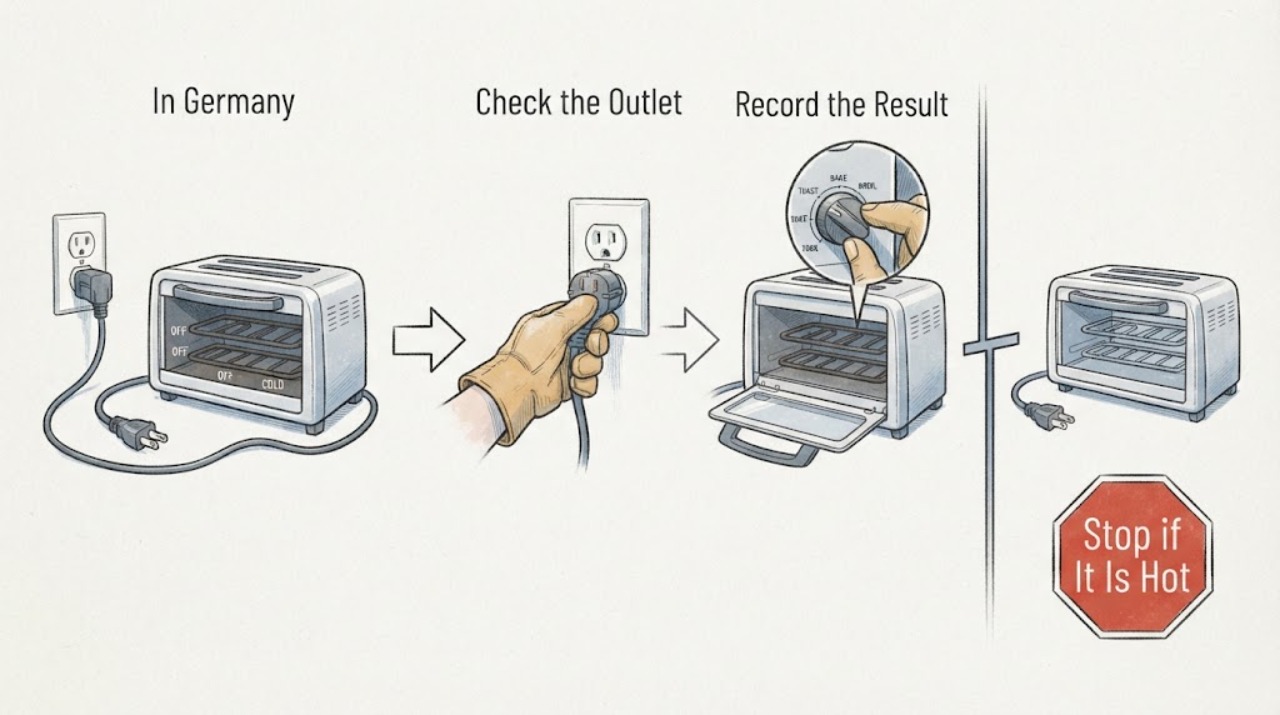
Work through in order
Diagnostic checks
Use only checks that match the exact appliance or system and its official guide.
-
Check 1
With the oven unplugged, read the BOV900 rating label and record the exact model suffix, the stated voltage, frequency, wattage, plug type, and the country in which it was purchased. Separately identify the outlet or conversion equipment's rated output without opening either device.
Expected result: The oven is marked 120 V ~ 60 Hz and the available German outlet is 230 V ~ 50 Hz, or the conversion output cannot be verified against the label.
Next step: Do not energize the oven. Have a qualified electrical professional verify a compliant supply arrangement, or use Breville's model-specific support route. Do not rely on a plug-shape adapter.
Stop if: Stop immediately for a hot plug, melted plastic, smoke, burning odor, sparking, a tripped breaker, damaged cord, liquid near the appliance, or any exposed conductor. Disconnect only from a safe, dry position.
Why this matters
Why: The opened BOV900 manual establishes a 120 V, 60 Hz, 1800 W input, while the German grid source establishes 230 V, 50 Hz. A direct or unverified connection is not an ordinary no-heat troubleshooting condition.
-
Check 2
Only after a qualified person has confirmed that the BOV900 is receiving a supply compatible with its rating, use the exact manual's external control sequence: select a documented cooking function, set a temperature and time, press START/STOP, and watch the display from outside. Do not open the enclosure or probe the outlet.
Expected result: The display starts a documented cycle and the oven heats normally, the display runs but the oven remains cold, or the control will not start the cycle.
Next step: If the oven remains cold or will not start on a confirmed compatible supply, stop user testing and contact Breville or qualified appliance service with the model suffix and supply record.
Stop if: Do not perform a live voltage test, bypass a door or thermal control, use undocumented button combinations, or continue if the oven produces smoke, odor, arcing, abnormal heat, or repeated breaker operation.
Why this matters
Why: A confirmed compatible supply separates a setup or control-state issue from a no-heat fault. If the cycle runs but heat is absent, the remaining possibilities include internal power, switching, sensing, thermal protection, or heating hardware that cannot be identified safely by appearance.
-
Check 3
If the BOV900 was previously connected to the German mains or an unverified converter and then stopped heating, unplug it and record what happened: whether the display survived, whether a breaker opened, whether the cord or converter became hot, and whether there was smoke, odor, sound, or visible damage. Inspect only the external cord, plug, and casing after the unit is cool.
Expected result: There was an overvoltage event or other electrical symptom, or the unit has no visible damage but still does not heat.
Next step: Leave the oven out of service and give Breville or a qualified technician the model, rating, supply/converter details, and event record. Do not reconnect it to compare outlets or repeat the failed test.
Stop if: Do not remove the cover, replace a fuse, reset protection repeatedly, touch a hot or damaged connector, or operate near smoke, burning odor, sparking, liquid, or damaged wiring.
Why this matters
Why: A visible display or intact casing does not rule out internal damage after an incompatible supply. The symptom alone cannot distinguish the power section, control, thermal protection, or heating elements.
Use your observations
Decision map
Find the observation that best matches what you see, then follow the next safe action.
-
PATH 01Next step
What you see
The BOV900 is marked 120 V ~ 60 Hz, but it is connected directly to a German 230 V ~ 50 Hz outlet or the converter output is unknown.
Do this next
Keep the oven unplugged and have the supply arrangement evaluated by a qualified electrical professional before any further operation. Use Breville's BOV900 support route for model-specific guidance.
Why this path and its safety boundary
Why it matters: The supply is incompatible or unverified, so the no-heat symptom cannot yet be treated as an element or control diagnosis.
-
PATH 02Next step
What you see
A qualified person has confirmed a supply compatible with the BOV900 rating, the documented cycle starts, and the oven still does not heat.
Do this next
Stop further user diagnosis and arrange Breville or qualified appliance service with the exact model suffix and the confirmed supply information.
Why this path and its safety boundary
Why it matters: An internal power, switching, sensing, thermal-protection, or heating fault becomes more likely, but the external checks do not identify the failed component.
-
PATH 03Safety boundary
What you see
The oven or converter has a hot plug, melted material, smoke, burning odor, sparking, a breaker event, damaged wiring, liquid exposure, or an unexplained electrical sound.
Do this next
Keep people away, isolate power only from a safe position, and arrange qualified electrical or appliance service. Follow local emergency guidance for smoke or fire.
Why this path and its safety boundary
Why it matters: The symptom has crossed an electrical or fire-safety boundary regardless of whether the display still works.
Safety stop: Do not re-energize the appliance, reset the breaker repeatedly, open the enclosure, or reproduce the event.
Helpful context
Understand the symptom
Check the rating before checking the heater
The BOV900 instruction book is a North American model document and gives a 120 V, 60 Hz, 1800 W rating. Germany's public grid is 230 V, 50 Hz. That makes direct connection to a German wall outlet a supply-compatibility problem before it is a heating-element problem. Do not use the display, a brief test cycle, or a plug adapter to decide that the oven is safe: a plug adapter changes the connector, not the electrical supply. Breville's product hub should be used for the exact model support route, and any conversion arrangement should be verified by a qualified electrical professional before the oven is energized.
A no-heat symptom after the wrong supply needs service
If the BOV900 was connected directly to 230 V, or through a converter whose voltage, frequency, capacity, grounding, or protection was not verified for this 1800 W appliance, stop repeated tests. A working display does not prove that the heating or power sections are undamaged, and a no-heat symptom does not identify a fuse, relay, element, sensor, or control board. Keep the model and supply details for Breville or a qualified technician rather than selecting a part from the symptom.
Common questions
FAQ
Can I plug a U.S. Breville BOV900 into a German outlet?
Do not connect it directly. The opened BOV900 manual rates the oven at 120 V and 60 Hz, while Germany's grid is 230 V and 50 Hz. A plug adapter changes the connector shape and does not convert the supply. Have compatibility verified by a qualified electrical professional before using the oven.
Why does my BOV900 have power but not heat in Germany?
First determine whether it was connected to the 230 V German mains or an unverified converter. A display can remain active while an incompatible supply has affected internal power or heating circuitry. Unplug the oven and arrange qualified service rather than repeatedly testing it or ordering a part from the symptom.
Is the 50 Hz frequency alone enough to explain no heat?
No. The manual confirms that this BOV900 is rated for 60 Hz, but the frequency difference alone does not identify a failed component or prove the cause of the no-heat symptom. The 120 V versus 230 V supply mismatch and any converter arrangement must be resolved first.
Should I replace the fuse or heating element after using the BOV900 on German power?
No. Do not open the oven or choose an internal part from the symptom. Record the supply and converter details, keep the oven out of service, and use Breville's BOV900 support route or a qualified appliance technician.
Read the exact guide
Official sources
- the Smart Oven Air Fryer Pro – OVENS Support & FAQsBreville · Official Breville BOV900 product hub used for exact-model support and repair routing; it does not certify that a U.S. BOV900 is compatible with the German mains.
- Kernseminar unter Strom: Elektrizität ist Kritische InfrastrukturBundesakademie für Sicherheitspolitik · Official German federal institution page states that the German and European network is operated at 230 volts and 50 hertz; it is used only to establish the supply context, not to certify any converter or appliance repair.
- the Smart Oven Air Fryer Pro Instruction Book – BOV900Breville · Official BOV900 instruction book for the U.S./North American model; its rating information states 120 V ~ 60 Hz, 1800 W and its safety/troubleshooting sections apply to this model.
Community feedback
Share a repair observation
Share a plain-text repair observation. Accepted observations are published automatically; this page may take a moment to update.