
On this page
Start here
Quick answer
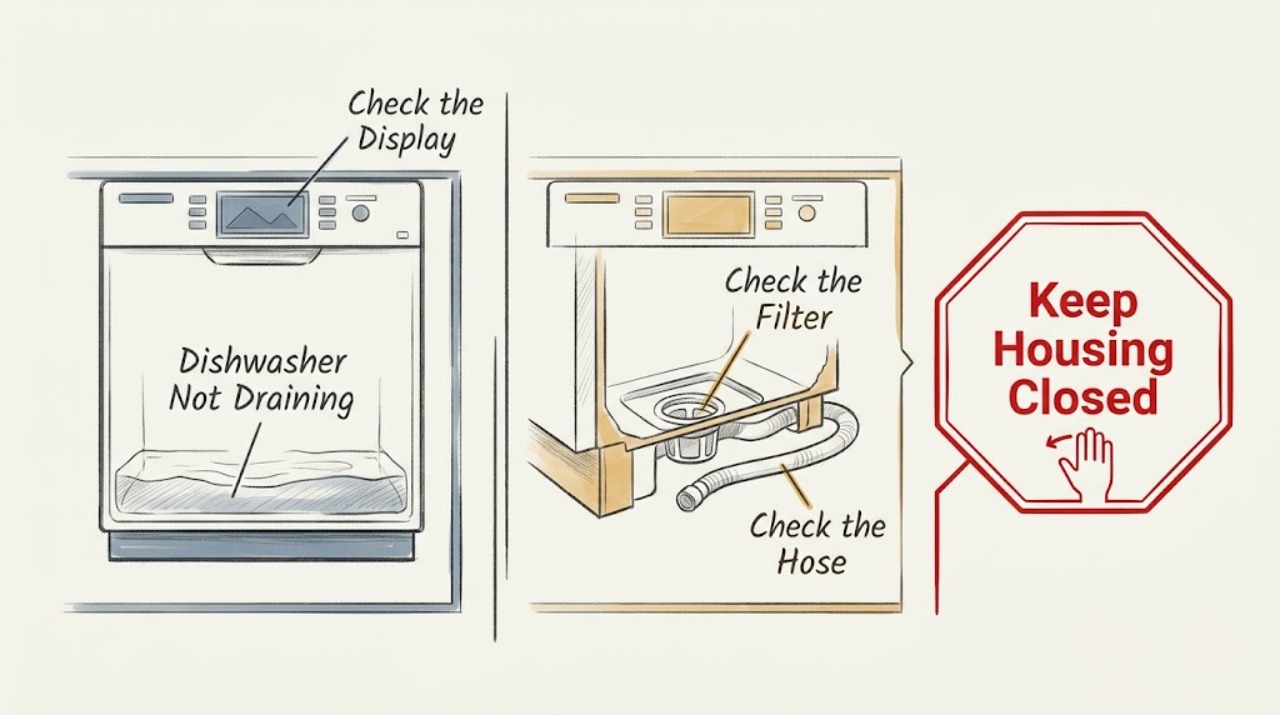
If a Candy dishwasher leaves water in the tub, first make sure the cycle actually reached its drain phase, then switch the appliance off, unplug it, and turn off the water supply before cleaning or maintenance. With the machine safe to handle, clean and correctly reseat the filters, inspect the visible sump area for a removable obstruction without reaching into the pump, and check the accessible drain hose for kinks, crushing, blockage, or an incorrectly routed connection. If the hose runs to a sink, the sink outlet or siphon connection can also restrict flow or let water return. Candy's opened manual for the CF 5C7F0W-80 family labels E3 as a no-drain condition and directs checks of the drain pipe, filter, and siphon, but codes and flash patterns vary by model. If water remains after those model-appropriate checks, the pump, internal hose, valve, wiring, or a leak-protection condition needs qualified service; do not dismantle the pump or test live electrical parts.
Before you begin
Safety first
- This article covers programme observation, power and water isolation, filter cleaning, visible sump inspection without pump access, accessible hose routing, normal sink-side connection checks, and model-specific code lookup. A qualified professional must handle the drain pump, impeller, internal hose, valve, water-level or leak sensor, control board, hardwired supply, inaccessible plumbing, and energized testing.
Work through in order
Diagnostic checks
Use only checks that match the exact appliance or system and its official guide.
-
Check 1
Confirm that the selected programme ended or stopped at its drain stage and note what remains: a shallow amount of water, a full tub, dirty water that returns after draining, a drain-pump hum with no flow, or no pump sound. Record the exact display code or the number and pattern of flashing lights. Do not restart a cycle if there is a leak, unusual heat, smoke, damaged wiring, or a protection trip.
Expected result: The programme was interrupted, water remains only at the end, water returns from the sink connection, a code such as E3 is shown, or no-drain behavior occurs with no code.
Next step: Use the exact model manual to interpret the code, then switch off and make the safe filter and external drain-path checks below. Treat a recurring code or no-drain symptom after those checks as a service case.
Stop if: Do not run repeated cycles with standing water, reach into the sump, or continue if water is leaking toward electrical parts.
Why this matters
Why: An interrupted programme can leave the drain step unfinished. Returning water points toward hose routing or a sink/siphon connection. The CF 5C7F0W-80 manual uses E3 for no drain, but other Candy models may use another code or a flash count; absence of a code does not rule out a blockage or pump fault.
-
Check 2
Switch the dishwasher off, unplug it, and turn off the water supply before cleaning or maintenance. After allowing hot water and the tub to become safe to handle, remove the lower basket and clean the filter assembly exactly as the model manual shows. Inspect the visible filter plate and sump opening for food residue or a clearly removable object, but do not reach into a pump impeller or use tools to probe it.
Expected result: The filter or plate is clogged, the filter is damaged or not seated, a visible obstruction is present, or the filter and visible sump area are clear.
Next step: Rinse the permitted filter parts, remove only a loose visible obstruction without forcing anything, and reinstall the filter fully and correctly. If the filter was clear or the dishwasher still will not drain, inspect the external hose and sink connection next.
Stop if: Do not work with power connected, remove a pump cover unless the exact manual explicitly permits that user step, handle broken glass with bare hands, or operate without the filters installed.
Why this matters
Why: A clogged or incorrectly seated filter can restrict the drain path and allow debris to reach the pump. A clear filter does not prove the pump or internal hose is clear, and a sharp or inaccessible object is a professional boundary.
-
Check 3
With the appliance still isolated and the floor protected from residual water, inspect only the accessible drain hose route and its visible connection to the sink waste or siphon. Look for kinks, crushing, sharp bends, a hose end sitting in standing water, a blocked visible connection, or a recent installation change. Do not pull out a built-in dishwasher, disconnect a hose that may spill, or alter the plumbing layout without a qualified person.
Expected result: The hose is kinked or crushed, the connection or siphon is blocked, the hose routing is too low or immersed, the connection appears normal, or access would require moving the appliance or disconnecting plumbing.
Next step: Correct only a clearly accessible kink or hose position described by the manual, and clear a sink-side blockage only through the normal household connection without dismantling the appliance. If the route is normal or the symptom persists, stop and arrange service.
Stop if: Do not disconnect a pressurized or inaccessible hose, move a full built-in appliance, cut a hose, pour drain chemicals into the dishwasher, or work near wet electrical connections.
Why this matters
Why: A restricted hose or sink connection can prevent discharge even when the dishwasher filter is clean; poor routing can also allow dirty water to return. Normal visible routing makes an internal hose, pump, valve, sensor, or control issue more likely but does not identify which part.
-
Check 4
Compare the recorded code or flash pattern with the exact Candy manual for the full model number. For the opened CF 5C7F0W-80 family only, E3 is the no-drain entry and the manual directs checks of the drain pipe, filter, and siphon. If your model has no display, count the flash sequence as the manual describes rather than converting it to E3 by guesswork.
Expected result: The model manual confirms a no-drain code, gives a different code meaning, reports only a flash pattern, or no code is present.
Next step: Follow only the matching manual's low-risk checks once. If the code returns after the filter and external path are clear, leave the dishwasher off and contact Candy Technical Assistance with the code and model.
Stop if: Do not substitute an error-code procedure from another Candy model, bridge a sensor, or reset repeatedly while water remains in the tub.
Why this matters
Why: A matching no-drain code strengthens the case for a drain-path check, but it does not distinguish a filter, hose, siphon, pump, or control fault. A different code may indicate a leak, water-level, inlet, or other condition and needs its own manual entry.
-
Check 5
After one permitted filter clean, correct hose-position check, or sink-side blockage correction, verify whether the tub drains on the next normal drain attempt. Keep the appliance supervised and stop the attempt if water leaks, the pump makes an abnormal grinding sound, the breaker trips, or the code returns.
Expected result: The tub drains normally, water returns from the sink, the pump hums or grinds without flow, the no-drain condition returns, or the appliance has a leak or electrical warning.
Next step: If draining is not restored or the fault recurs, switch off, unplug when safe, turn off the water supply, and arrange Candy or qualified appliance service. Provide the model, code or flash pattern, filter result, hose route, and any pump sound.
Stop if: Do not dismantle the pump, remove internal panels, bypass leak protection, run a live test, or keep using the dishwasher with standing water or a recurring fault.
Why this matters
Why: A stable drain after a clear external obstruction supports that obstruction as the immediate cause. Return flow points to routing or the household connection. Humming without flow, grinding, recurrence with a clear path, a leak, or electrical symptoms makes an internal pump, impeller, hose, valve, sensor, or control fault more likely.
Use your observations
Decision map
Find the observation that best matches what you see, then follow the next safe action.
-
PATH 01Safety boundary
What you see
The filter or filter plate is visibly clogged, the filter was not seated correctly, or a loose visible residue is blocking the sump area, with no leak or electrical warning.
Do this next
With power and water isolated and the machine safe to handle, clean and correctly reinstall the permitted filter parts, then make one supervised normal drain attempt. If water remains, continue to the external hose and sink connection check.
Why this path and its safety boundary
Why it matters: A filter or visible sump restriction is more likely than a confirmed pump failure and can limit the water reaching the drain path.
Safety stop: Do not reach into an inaccessible pump, handle sharp debris bare-handed, or operate without the filter assembly.
-
PATH 02Safety boundary
What you see
The filter is clear but the drain hose is kinked, crushed, blocked, immersed, incorrectly routed, or connected to a blocked sink waste or siphon.
Do this next
Correct only an accessible hose position or normal sink-side blockage described by the matching manual, protect the floor, and retest once. If the path cannot be accessed safely or the dishwasher still does not drain, arrange service.
Why this path and its safety boundary
Why it matters: An external drain-path restriction or return-flow condition is more likely than an internal pump fault.
Safety stop: Do not move a full built-in machine, disconnect inaccessible plumbing, use drain chemicals, or work around wet electrical connections.
-
PATH 03Safety boundary
What you see
The exact Candy manual confirms a no-drain code or flash pattern, but the filter and accessible hose and sink connection are clear and correctly installed.
Do this next
Leave the dishwasher off and contact Candy Technical Assistance with the full model, code or flash pattern, standing-water description, and checks already completed.
Why this path and its safety boundary
Why it matters: An internal pump, impeller, hose, valve, water-level sensor, control, or leak-protection condition is more likely; the code does not select a component by itself.
Safety stop: Do not copy another model's code procedure, bypass a sensor, dismantle the pump, or keep restarting the programme.
-
PATH 04Safety boundary
What you see
The drain path and filter are clear, but the pump hums or grinds without flow, water remains or returns, the fault recurs, or there is a leak, electrical warning, or repeated protection trip.
Do this next
Switch off, unplug only from a safe dry position, turn off the water supply, keep the dishwasher out of service, and arrange prompt Candy or qualified appliance service.
Why this path and its safety boundary
Why it matters: An internal pump, impeller, hose, valve, sensor, control, or safety fault is more likely and may cause flooding, shock, or further damage if operation continues.
Safety stop: Do not open panels, access the pump, bypass leak protection, reset protection repeatedly, or perform an energized test.
Helpful context
Understand the symptom
Standing water has more than one possible boundary
Water left at the end of a Candy dishwasher cycle can come from a dirty filter or filter plate, a visible obstruction near the sump, a kinked or blocked drain hose, a sink or siphon connection, an installation that lets water return, or an internal pump or control fault. Start with the parts a user can inspect safely. Do not infer a failed pump merely because the tub is full, and do not assume an error code has the same meaning on every Candy family.
Filters, hose routing, and the sink connection change the next step
Candy's opened manual says the filter system traps larger and smaller particles and must be correctly reassembled at the bottom of the dishwasher. It also specifies a no-kink drain route and warns that a hose end immersed in water can allow siphoning back. Candy's consumer guidance adds the sink siphon as a separate blockage point. These are different checks: cleaning the filter does not clear a blocked household drain, and clearing a siphon does not prove the dishwasher pump is sound.
Use the code only with the matching model manual
For the opened CF 5C7F0W-80 manual, E3 is the no-drain entry, while the same manual gives different meanings for other codes and says machines without a display report faults by a model-specific flash sequence. Treat a code or flashing light as a clue, not as a universal Candy diagnosis. If the drain path and filters are clear but the fault returns, keep the dishwasher out of service and use Candy's model-specific technical assistance route.
Safety boundary
Stop conditions
- Stop using the dishwasher for a leak toward electrical parts, damaged cord or plug, smoke, burning odor, sparks, abnormal heat, or a breaker that trips again; isolate power and water only if safe and arrange prompt professional help.
- Before cleaning or maintenance, switch off, unplug, turn off the water supply, and allow hot water and parts to become safe to handle; do not work with power connected.
- Do not dismantle the drain pump, remove internal panels, bypass a water-level or leak-protection device, use drain chemicals, or perform an energized electrical test.
- If the filter and accessible drain path are clear but water remains, returns, or the code recurs, leave the dishwasher out of service and arrange Candy or qualified appliance service.
Only after diagnosis
Potential parts
- Candy model-matched drain filter or filter plate
Consider this category only if the matching manual and inspection show a damaged, missing, or permanently clogged filter or filter plate after proper cleaning and reseating; standing water alone does not prove the filter needs replacement.
Confirm the full Candy model and the manufacturer's fit information before ordering; keep the filter installed during operation. - Candy model-matched drain hose or drain pump assembly
Consider this category only after a qualified technician confirms a damaged hose or internal pump fault when the filter, accessible hose route, and sink connection are clear and the no-drain symptom persists.
Confirm the complete model and professional component identification before ordering; pump access, hose disconnection, and electrical checks are service work.
When checks do not resolve it
Need a professional?
Safety scope: This article covers programme observation, power and water isolation, filter cleaning, visible sump inspection without pump access, accessible hose routing, normal sink-side connection checks, and model-specific code lookup. A qualified professional must handle the drain pump, impeller, internal hose, valve, water-level or leak sensor, control board, hardwired supply, inaccessible plumbing, and energized testing.
Common questions
FAQ
Why is my Candy dishwasher leaving water in the bottom?
A dirty filter, visible sump obstruction, kinked or blocked drain hose, sink or siphon blockage, return-flow routing, or an internal pump or control fault can all produce standing water. Isolate power and water before cleaning the permitted filter and checking the accessible drain path; if the path is clear and water remains, arrange service.
What does E3 mean on a Candy dishwasher?
In the opened CF 5C7F0W-80 manual, E3 means the dishwasher does not drain, with checks for the drain pipe, filter, and siphon. Do not assume E3 has that meaning on every Candy model; use the manual for the full model number or the model's flash-code table.
Can a clogged filter stop a Candy dishwasher from draining?
Yes. Candy's manual describes filters that trap food particles and says they must be cleaned and correctly reassembled at the bottom of the dishwasher. Clean only the user-accessible filter parts with power and water isolated; a clear filter does not rule out a pump or hose fault.
Can the sink siphon or drain hose cause a Candy dishwasher not to drain?
Yes. Candy identifies a kinked, trapped, blocked, or poorly positioned drain hose and a clogged sink siphon as separate causes. Check only accessible routing and the normal sink-side connection; do not pull out a built-in machine or disconnect plumbing that can spill.
When should I call for Candy dishwasher drain service?
Arrange service when the filter and accessible hose or sink path are clear but water remains or returns, a no-drain code recurs, the pump hums or grinds without flow, or any leak, electrical warning, or repeated protection trip appears. Internal pump, sensor, valve, control, and wiring work should be handled by a qualified professional.
Read the exact guide
Official sources
- De l'eau remonte dans mon lave-vaisselleCandy France · Official Candy France troubleshooting article; the article is general guidance and does not replace the manual for a specific Candy dishwasher model or code.
- CF 5C7F0W-80 EN (70048142.A)Candy · Official Candy-hosted product manual linked from the Candy product page for the CF 5C7F0W-80 family; use its code and installation details only for the matching model family.
- Comment déboucher un lave-vaisselle ?Candy France · Official Candy France advice article; apply its cleaning sequence as general guidance only when it agrees with the full model manual.
- Technical assistance for our appliancesCandy · Official Candy UK technical-assistance page; support channels and service availability vary by country, warranty status, and model.
Community feedback
Share a repair observation
Share a plain-text repair observation. Accepted observations are published automatically; this page may take a moment to update.