
On this page
Start here
Quick answer
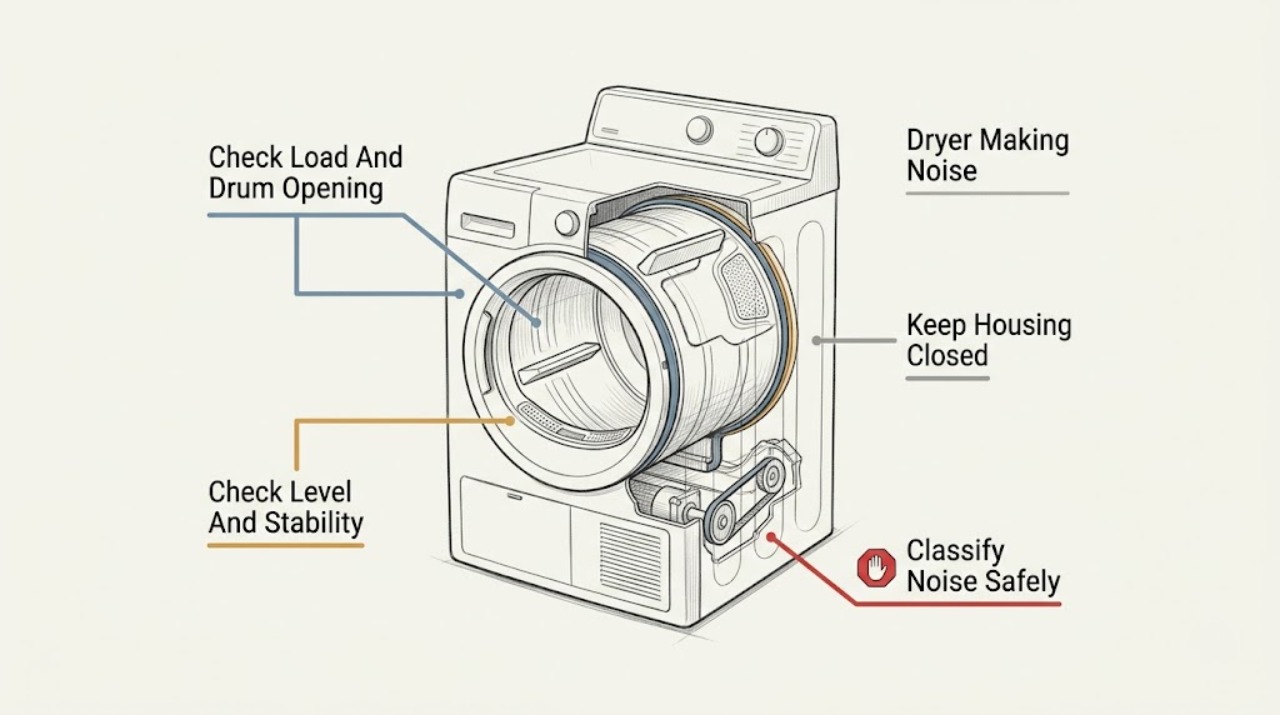
A Candy dryer that suddenly makes a new scraping, grinding, rumbling, vibrating, tapping, or creaking sound should be stopped and classified before it is run again. Candy's own troubleshooting guidance links scraping or grinding with drum contact that can be worsened by an unlevel appliance, vibrating or rumbling with an imbalanced position or loose pads, and creaking with the tension-pulley area. First remove the load after the drum has stopped, check for an object or damaged seal at the door opening, and confirm that the dryer is stable and level from ordinary safe access. If the sound is metal-on-metal, the drum stops, the cabinet moves, a burning smell or smoke appears, or the noise remains after the safe external checks, stop using it and arrange qualified Candy appliance service rather than opening the cabinet or replacing a part by guesswork.
Before you begin
Safety first
- This article covers stopping the appliance, safe observation, ordinary-access inspection, and model-approved external checks only. Do not open the cabinet, handle internal wiring, release belt tension, lubricate parts, bypass interlocks, or keep testing a hazardous noise.
Work through in order
Diagnostic checks
Use only checks that match the exact appliance or system and its official guide.
-
Check 1
If the dryer is currently running, stand clear and note the sound briefly; then stop the cycle and wait for the drum to come to a complete stop before touching the load or appliance.
Expected result: Classify the sound as scraping or grinding, vibrating or rumbling, creaking, rattling or tapping, or an electrical hum; record whether it starts with drum rotation, changes with speed, occurs only with one load, or is present while the drum is stationary.
Next step: Keep the dryer off while recording the sound, cycle, load size, and whether the drum still turns; continue only with the safe external checks below when there is no smoke, burning odor, electrical hazard, or visible damage.
Stop if: Do not put hands into a moving drum, repeat a loud metal-on-metal test, or continue operating after smoke, burning odor, sparking, a tripped breaker, or a drum that stops unexpectedly.
Why this matters
Why: Candy identifies scraping or grinding, vibration or rumbling, and creaking as different clues: drum contact or an unlevel position, installation imbalance or loose pads, and a possible tension-pulley issue respectively. A burning smell, smoke, harsh metal contact, or a sound with no moving drum raises the urgency and should not be tested further.
-
Check 2
With the dryer off and cool enough to handle, remove the laundry and inspect the drum opening, door seal, lint-filter area, and visible drum edge for a coin, zipper, button, bra wire, debris, torn seal, or loose item; do not remove panels or reach into concealed gaps.
Expected result: A loose object or debris is visible; the seal or drum edge looks cut, displaced, or rubbed; the opening looks clear; or the suspected source cannot be seen without disassembly.
Next step: Remove only a loose item that is plainly accessible without force, photograph any rubbing or damage, and use the Candy manual to confirm any permitted filter or seal cleaning; arrange service when the object is trapped, the seal is damaged, or the cause is not visible.
Stop if: Do not pry the drum seal, pull hidden objects with tools, cut lint or fabric from a moving part, or operate the dryer with a torn seal, exposed sharp edge, or object that could contact the heater or drum.
Why this matters
Why: A load-specific rattle or a visible object can explain tapping without proving an internal failure. A rubbed or damaged seal can allow drum contact and needs service if it cannot be restored using the exact manual procedure. An apparently clear opening does not rule out a pulley, bearing, motor, support, or concealed-object fault.
-
Check 3
From a stable standing position, inspect whether the Candy dryer sits squarely on a firm floor, whether it rocks when gently tested at the cabinet edge, whether a visible foot or pad is loose or missing, and whether the cabinet is contacting a wall or adjacent appliance; use a spirit level only if it can be placed without moving the appliance unsafely.
Expected result: The dryer is level and stable with clearance; it rocks or is visibly tilted; a foot or pad is loose or missing; or the appliance is wedged against another surface.
Next step: If safe and allowed by the model instructions, correct only the visible leveling or clearance issue, then perform at most one short empty observation; if the noise remains, stop and arrange service rather than repeatedly testing.
Stop if: Do not lift, tip, stack, drag, or dismantle the dryer alone; stop if the floor is unstable, the unit is stacked or built in, a foot is broken, the cabinet is damaged, or leveling would require moving gas, water, vent, or electrical connections.
Why this matters
Why: Candy states that an unlevel position can pull the drum toward other components and contribute to scraping or grinding, while an imbalanced position or loose pads can contribute to vibration or rumbling. Stability findings support correcting the installation only as the exact manual permits; they do not explain persistent metal contact by themselves.
-
Check 4
Only after the dryer passes the external safety checks and the model instructions permit a test, run one brief empty observation with the door closed and people clear; stop immediately if the sound is harsh, worsens, or the drum fails to turn normally.
Expected result: The noise disappears when empty, remains with the drum turning, occurs only at startup or shutdown, or the drum hesitates, stops, scrapes, or produces a burning odor.
Next step: Stop the test, save the sound recording and result, and request qualified service when the noise remains, the drum motion changes, or any odor or damage appears; do not proceed to cabinet disassembly.
Stop if: Do not run repeated cycles to reproduce the noise, bypass a safety switch, operate with panels removed, or continue if the drum stops, the cabinet moves, or the sound is metal-on-metal.
Why this matters
Why: A noise that disappears when empty makes load balance or a loose item more plausible, but it does not prove the dryer is healthy. Noise that remains without laundry, changes with drum speed, or comes with hesitation supports a moving-part or support diagnosis; a startup-only click still needs the model manual or service assessment if it is new or severe.
-
Check 5
Use Candy's official manual portal to record the exact model or product code and compare the symptom with the model's safety and service instructions; prepare the noise recording, load result, leveling result, and visible damage notes for a qualified technician.
Expected result: The manual gives a model-specific user check that resolves the symptom; it directs the user to service; or the exact model, access procedure, or failed component remains uncertain.
Next step: Leave the dryer unplugged or otherwise out of service as appropriate and arrange Candy-authorized or otherwise qualified appliance repair; provide the model identity and symptom record without opening the cabinet.
Stop if: Do not remove covers, disconnect internal wiring, release belt tension, oil a pulley or bearing, bypass interlocks, or order a component until a qualified diagnosis confirms the part and exact model compatibility.
Why this matters
Why: Model-specific instructions control which cleaning, leveling, and user-access steps are safe. An unresolved pulley, belt, bearing, support, motor, seal, or internal-object possibility requires diagnosis rather than a guessed part replacement, especially when the dryer is noisy even when empty or has stopped spinning.
Use your observations
Decision map
Find the observation that best matches what you see, then follow the next safe action.
-
PATH 01Safety boundary
What you see
The sound occurs only with one load and a loose object or load-specific contact is visible at the opening.
Do this next
Remove only the plainly accessible item without tools, inspect for resulting seal or drum damage, and stop if the noise returns or damage is visible.
Why this path and its safety boundary
Why it matters: A load-related rattle is plausible, but a damaged seal or sharp object can still injure the drum or heater area.
Safety stop: Do not reach into moving parts, pry the seal, or run the dryer with an object trapped in a concealed gap.
-
PATH 02Safety boundary
What you see
The dryer rocks, is tilted, has a loose or missing visible pad, or is pressing against a wall or adjacent appliance, and the symptom is vibration or rumbling.
Do this next
Correct only the safe, model-permitted external leveling or clearance issue, then make one brief observation; arrange service if the noise persists.
Why this path and its safety boundary
Why it matters: Installation imbalance can contribute to vibration and, according to Candy, an unlevel dryer can allow drum contact with other components.
Safety stop: Do not move a stacked, built-in, or connected appliance without the required assistance and model-specific procedure.
-
PATH 03Safety boundary
What you see
Scraping or grinding remains after the visible load and safe leveling checks, or the drum edge or seal shows rubbing.
Do this next
Keep the dryer out of service and arrange qualified diagnosis with the model code, sound recording, and photos of visible rubbing.
Why this path and its safety boundary
Why it matters: Persistent metal-on-metal contact or a rubbed seal may involve an internal support, seal, drum, pulley, bearing, or alignment problem and can worsen with operation.
Safety stop: Do not run additional cycles, open the cabinet, or select a replacement part from the sound alone.
-
PATH 04Safety boundary
What you see
A creaking sound follows drum movement and is not explained by a visible loose object or installation issue.
Do this next
Stop using the dryer and have a qualified technician inspect the drive system; give the exact model and whether the drum still turns normally.
Why this path and its safety boundary
Why it matters: Candy identifies the tension-pulley area as a possible source, but a sound alone cannot distinguish a pulley from a belt, support, seal, or motor-related fault.
Safety stop: Do not spray lubricant, release belt tension, remove panels, or replace a pulley without model-specific diagnosis.
-
PATH 05Safety boundary
What you see
The drum stops or hesitates, the cabinet moves severely, smoke or a burning odor appears, or electrical symptoms accompany the noise.
Do this next
Stop the appliance, isolate it from use without touching damaged wiring or hot parts, and arrange urgent qualified appliance service. Seek emergency help for an active fire or immediate electrical danger.
Why this path and its safety boundary
Why it matters: This is no longer an ordinary noise adjustment; continued operation can increase mechanical, fire, or electrical risk.
Safety stop: Do not restart the dryer, bypass an interlock, open energized equipment, or handle smoke, sparks, or burning components.
Helpful context
Understand the symptom
The sound and when it occurs narrow the next check
Listen only while standing clear of the running appliance and stop the cycle before touching it. A scraping or grinding sound suggests possible contact around the drum or another moving part; a deep rumble or strong vibration makes installation stability and leveling worth checking; a creak that follows drum movement points toward the belt-and-pulley area. A short rattle that occurs only with one load may instead be a loose object or fastener in clothing, so the sound pattern matters more than a guess based on age alone.
Use the Candy manual for model-specific access
Candy's official manual portal asks for the product line, model, or product code. Use it to identify the exact permitted cleaning, leveling, transit-hardware, and service instructions for the dryer. A generic procedure cannot confirm which panels, seals, pulleys, or fasteners are user-serviceable on a particular Candy model, so do not remove the rear or top cover just to locate a noise.
A persistent mechanical noise is a stop-and-service condition
If the dryer continues to scrape, grind, or creak after the safe external checks, repeated test cycles can turn a small alignment, seal, pulley, belt, support, or motor problem into more damage. A relevant community report describes a Candy heat-pump dryer that became progressively louder and then stopped spinning, but the discussion did not establish a confirmed repair result. Treat that report as a reason to document the sound and stop escalating DIY disassembly, not as proof of a particular failed part.
Safety boundary
Stop conditions
- Stop using the dryer for smoke, sparks, burning odor, severe cabinet movement, a tripped breaker, or a drum that stops or hesitates.
- Do not put hands into a moving drum or run repeated cycles to reproduce a loud or metal-on-metal noise.
- Do not remove covers, disconnect internal wiring, release belt tension, oil the drive system, or bypass a safety interlock as a user check.
- Do not force a trapped object, pry a seal, or operate the dryer with visible rubbing, torn sealing material, exposed sharp edges, or damaged wiring.
- Stop and arrange qualified service when the noise remains after the safe external checks or when the exact model-specific access procedure is uncertain.
Only after diagnosis
Potential parts
- dryer leveling foot or anti-vibration pad
Consider this category only if the exact model instructions and inspection confirm a missing or damaged external foot or pad is causing instability or vibration.
Confirm the exact Candy model, mounting arrangement, floor condition, and manufacturer fit information; do not use a pad to mask persistent grinding or drum contact. - dryer tension pulley
Consider this category only after a qualified diagnosis links a creak or drive noise to the tension-pulley assembly rather than the belt, drum support, motor, or another component.
Confirm the exact Candy model and complete drive-system design before ordering; this is not a user-selected repair based on sound alone. - dryer drum seal
Consider this category only when inspection or service confirms a torn, displaced, or worn seal is allowing drum-edge contact or another documented symptom.
Confirm the exact Candy model, seal position, installation method, and technician assessment; do not pry or cut the installed seal.
When checks do not resolve it
Need a professional?
Arrange qualified Candy appliance service when scraping, grinding, or creaking remains after the load, opening, and safe leveling checks; when the dryer is noisy while empty; when the drum hesitates or stops; when a seal, cabinet, foot, or pad is damaged; or when the suspected pulley, belt, bearing, support, motor, or internal object cannot be inspected through the model-approved user steps. Seek urgent service for smoke, sparks, a burning odor, severe movement, or electrical symptoms.
Safety scope: This article covers stopping the appliance, safe observation, ordinary-access inspection, and model-approved external checks only. Do not open the cabinet, handle internal wiring, release belt tension, lubricate parts, bypass interlocks, or keep testing a hazardous noise.
Common questions
FAQ
Why is my Candy dryer making a grinding or scraping noise?
Candy says grinding or scraping can be associated with an unlevel dryer allowing the drum to contact another component, but a foreign object, seal, support, pulley, belt, bearing, or another internal fault can sound similar. Stop the appliance, check the load and visible opening, confirm safe external stability, and arrange service if the sound remains.
Why is my Candy dryer vibrating or rumbling?
Check from a safe standing position that the dryer is on a firm, level surface, is not rocking, has no visible loose or missing pad, and is not touching a wall or adjacent appliance. Candy links vibration or rumbling with imbalance and loose pads. If the cabinet moves severely or the noise continues after a permitted external correction, stop using it and request service.
Can I lubricate the pulley or open my Candy dryer to find the noise?
Do not lubricate the drive system or open the cabinet as a sound test. A creak may involve the tension-pulley area, but the belt, drum support, seal, motor, or another component can produce similar symptoms. Use the exact Candy manual for ordinary user checks and have a qualified technician diagnose internal parts.
Should I keep running a Candy dryer that is making noise?
Stop for persistent grinding, metal-on-metal contact, a worsening noise, a drum that hesitates or stops, cabinet movement, smoke, sparks, a burning smell, or electrical symptoms. Even without those urgent signs, do not keep repeating cycles after the safe load and external installation checks fail; arrange qualified appliance service.
Read the exact guide
Official sources
- Product user manualsCandy · Use to locate the exact manual for the installed Candy dryer before any model-specific cleaning, leveling, transit-hardware, or service step.
- Why your tumble dryer is making noiseCandy · Directly applies to Candy tumble dryers making scraping, grinding, vibrating, rumbling, or creaking sounds.
- Heat pump tumble dryer making grinding noiseReddit · A user-reported Candy Smart Pro CSOEH9A2DE80 grinding-noise example used only as an anecdotal escalation cue, not as a verified diagnosis.
Community feedback
Share a repair observation
Share a plain-text repair observation. Accepted observations are published automatically; this page may take a moment to update.