
On this page
Start here
Quick answer
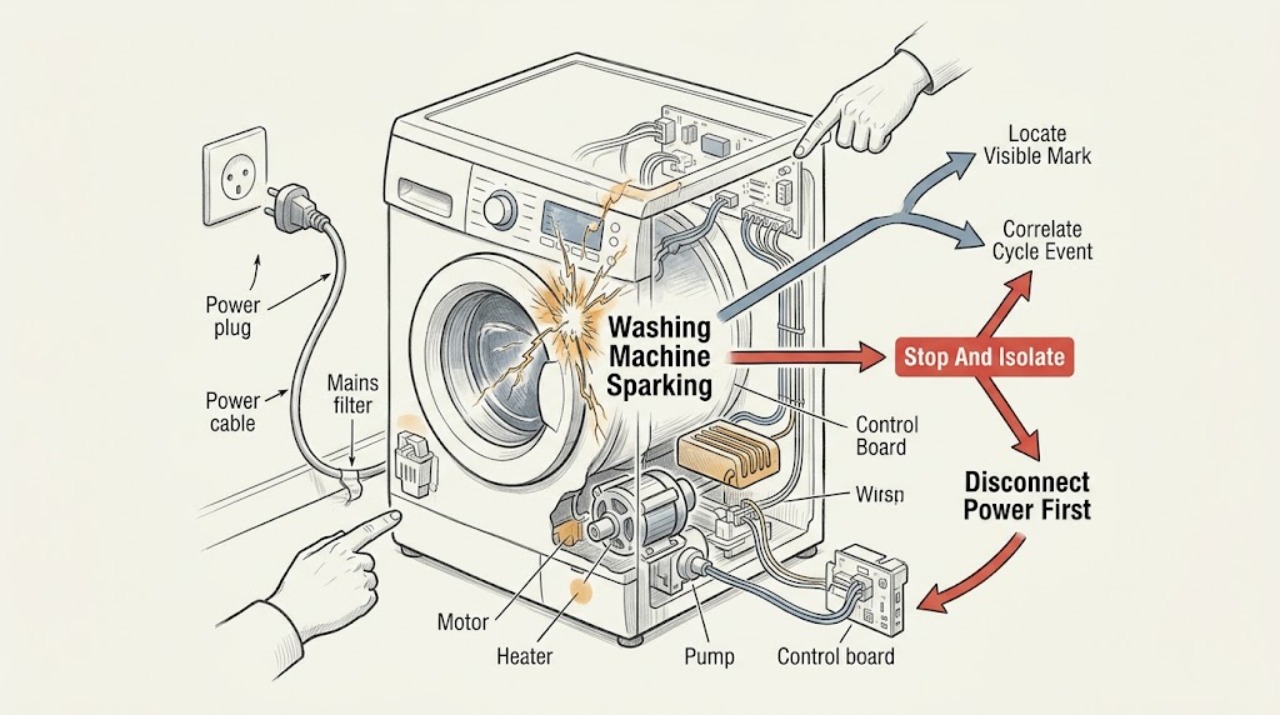
Visible sparks from a Candy washing machine, its plug, socket, cable, or interior are not a normal troubleshooting symptom. Stop the cycle, keep people away from water and exposed electrical parts, and isolate power only if the plug or switch can be reached without touching a hot, wet, damaged, smoking, or arcing area. Do not run the washer again to see whether the spark returns, and do not open the cabinet. Check only from a safe position for scorch marks, melted plastic, a hot plug or socket, a frayed cable, water near electricity, and whether the spark occurred at the outlet, plug, control panel, drum area, or underneath. Fire-safety guidance treats sparks, smoke, burning smell, overheating, and damaged cables as stop signs; Candy directs users to the model manual and trained technical support for faults. Keep the machine out of service and arrange qualified appliance or electrical service, with an emergency response if there is fire, smoke, or immediate danger.
Before you begin
Safety first
- Only dry, non-invasive external observation is appropriate after a spark. Plug or socket work, internal wiring, power-entry components, motor, heater, pump, door lock, control board, and live electrical diagnosis require qualified service.
Work through in order
Diagnostic checks
Use only checks that match the exact appliance or system and its official guide.
-
Check 1
Stop the cycle and isolate the washer from use; reach the plug or wall switch only if it is dry, cool, intact, and away from the spark, smoke, water, or scorch mark.
Expected result: Record whether there is a visible flame, smoke, burning odor, hot plastic, water near electricity, a damaged cable, or a breaker that trips again.
Next step: Move people away, use the appropriate local emergency response for fire or immediate danger, and arrange qualified appliance or electrical service for a non-emergency fault.
Stop if: Stop immediately if isolation would require touching a wet or arcing area, moving the washer, or approaching smoke, flame, or exposed wiring.
Why this matters
Why: Any of these signs can indicate fire or shock risk, so the problem is not suitable for a restart or cabinet-level troubleshooting.
-
Check 2
From a safe, dry position, inspect only the visible plug, socket face, power cable, control area, lower front, and floor around the Candy washer; do not remove panels or pull the machine forward.
Expected result: Note whether the spark or scorch is at the wall socket, plug pins or body, cable, control panel, door area, lower front, or beneath the appliance, and whether there is a leak.
Next step: Keep the washer out of service and give the location and photographs to the appropriate qualified technician; do not substitute a socket or cable to continue washing.
Stop if: Do not touch a hot plug, damaged cable, wet area, loose socket, exposed conductor, or soot-covered surface.
Why this matters
Why: A mark at the socket or plug points to an electrical connection or supply assessment. A mark inside or beneath the washer points to an appliance fault. Water near either location raises the immediate risk.
-
Check 3
Using the display history and memory of the event, identify when the spark appeared without powering the machine again: on plug-in, at Start, during filling, heating, drain, spin, door locking, or when the machine was idle.
Expected result: Record the program, water level, drum movement, any error or light pattern, unusual sound, smell, leak, recent repair, and whether the household protection operated.
Next step: Keep the washer disconnected or switched off as appropriate and send the symptom sequence, model, and serial information to qualified service.
Stop if: Do not repeat the program, run an empty cycle, or use a reset to see whether the spark disappears.
Why this matters
Why: Timing helps a technician narrow the affected circuit, but it cannot make an internal electrical test safe. A spark on plug-in or while idle is especially unsuitable for a restart; a spark during a water or heat phase still requires isolation.
-
Check 4
Without touching electrical parts, check whether water is present around the hose connections, door, pump-filter area, or floor and note whether the spark happened during a fill, wash, or drain phase.
Expected result: Record a visible leak, pooled water, damp plug or socket, water under the machine, or a dry machine with no leak evidence.
Next step: Keep away from the appliance and arrange service for any leak or water near power. Do not open the filter or hoses after a spark unless a qualified person confirms the appliance is safely isolated and the model instructions permit it.
Stop if: Stop for any water near the plug, socket, cable, lower electrical area, or an inaccessible leak.
Why this matters
Why: Water can make an electrical fault more dangerous and may explain why a protection device operated. A dry machine does not rule out an internal electrical failure.
-
Check 5
From the outside only, check that the washer was not connected through an overloaded adaptor or extension, that the visible cable is not crushed, and that the socket and appliance remain dry.
Expected result: Note scorch marks, loose fit, melted plastic, fraying, cable compression, multiple high-load appliances at the socket, or signs of a recent move or installation.
Next step: Do not reconnect the machine. Have the socket or household circuit assessed when the mark is external, and have the washer assessed when the event originated inside it.
Stop if: Do not replace a plug, repair a cable, use an adaptor, or move the appliance as a do-it-yourself test.
Why this matters
Why: Fire-safety guidance links damaged cables, hot or scorched plugs and sockets, and overloaded sockets with electrical risk. A normal-looking installation still does not clear a washer that visibly sparked.
-
Check 6
Prepare a service handoff while the Candy washer remains out of service; do not open the cabinet or perform live electrical checks.
Expected result: Provide the model and serial information, exact spark location, program phase, plug and socket condition, cable condition, water or odor evidence, error display, protection-trip history, and recent installation or repair details.
Next step: Arrange qualified appliance service and, when the plug or socket is marked or hot, qualified electrical service before any reconnection. Follow Candy's model-specific technical-support route.
Stop if: Do not test live voltage, bypass an interlock, bridge a component, replace an internal part, or reconnect the washer to confirm a diagnosis.
Why this matters
Why: These details help distinguish a socket or supply fault from the washer's power filter, heater, motor, door lock, pump, control, or internal wiring without exposing the user to the fault.
Use your observations
Decision map
Find the observation that best matches what you see, then follow the next safe action.
-
PATH 01Safety boundary
What you see
There is smoke, flame, a strong burning smell, exposed arcing, a hot socket, or immediate danger.
Do this next
Leave the hazard area, use the appropriate local emergency response, and keep the washer out of service.
Why this path and its safety boundary
Safety stop: Do not approach the appliance, pour water on an electrical fire, or attempt a repair.
-
PATH 02Safety boundary
What you see
Water is near the plug, socket, cable, or lower electrical area, or the spark occurred during a water phase.
Do this next
Do not touch the appliance or water together; isolate the area and arrange qualified appliance and electrical assessment.
Why this path and its safety boundary
Safety stop: Do not open the pump filter, pull the washer forward, or handle wet connections after a spark.
-
PATH 03Safety boundary
What you see
The visible mark or spark is at the plug, socket, or power cable.
Do this next
Keep the washer disconnected and have the electrical installation and appliance connection assessed by a qualified person.
Why this path and its safety boundary
Safety stop: Do not use another socket, an adaptor, an extension lead, or a replacement plug as a workaround.
-
PATH 04Safety boundary
What you see
The plug and socket look normal but the flash came from the control, door, lower front, drum area, or beneath the washer.
Do this next
Keep the machine out of service and arrange qualified Candy appliance diagnosis using the event timing and model details.
Why this path and its safety boundary
Safety stop: Do not remove panels, run a reset, bypass the door lock, or test internal wiring.
-
PATH 05Safety boundary
What you see
The origin of the spark cannot be identified or the machine was moved, repaired, or rewired recently.
Do this next
Treat the washer as unsafe to operate and provide the full history to qualified appliance and electrical service.
Why this path and its safety boundary
Safety stop: Do not power the machine to reproduce the symptom.
Helpful context
Understand the symptom
Treat a spark as an electrical safety event
A brief click from a normal control is different from a visible flash, arc, or spark. A spark at the plug or socket can involve the household supply; a spark inside the washer can involve the power filter, heater, motor, lock, pump, or control wiring. You do not need to identify which component failed before stopping use. If there is smoke, flame, a hot socket, burning odor, water on electrical parts, or a repeated breaker trip, move away and use the appropriate local emergency response.
Make only a safe external observation
After the machine is stopped and isolated when it is safe to do so, look without moving the washer or removing covers. Record whether the mark is on the plug, socket, cord, control panel, door area, lower front, or floor. A wet floor or leak changes the boundary: do not touch the appliance, plug, or water together. Do not use an extension lead or a different socket as a diagnostic workaround, because that can hide a supply or connection fault.
Separate a plug or socket fault from an appliance fault
If the plug or wall socket is scorched, loose, hot, or discolored, a qualified electrician should assess the installation before the washer is powered again. If the socket appears normal but the flash came from inside the washer, the appliance needs qualified diagnosis. Candy's support pages provide the model-manual and technical-service route; an error display, recent repair, leak, or unusual noise should be included in the service history.
Do not turn a safety symptom into a parts experiment
A spark does not prove that the motor, heater, mains filter, door lock, pump, or control board is the failed part. Do not bypass an interlock, bridge a component, test live voltage, or replace an internal part based on appearance. Preserve the plug, cord, socket, and appliance condition for the technician, and follow the exact Candy manual only for information and safe user checks.
Only after diagnosis
Potential parts
- power-entry or mains-filter component
Consider only after a qualified diagnosis links a spark or protection event inside the power-entry circuit to this component.
Do not select or replace an internal mains component from a spark symptom alone; confirm the exact model and electrical rating through qualified service. - power cable or plug assembly
Consider only when the cable or plug is visibly damaged and a qualified person confirms the connection fault and required assembly.
A marked wall socket may also need electrical repair; do not replace the cord while the washer is connected or wet. - door lock, pump, heater, or motor component
Consider only when the spark timing and qualified testing identify a component circuit during door locking, draining, heating, or drum movement.
Model-specific diagnosis and safe isolation are required; do not bypass or bridge a safety component. - control board or internal wiring
Consider only after service identifies an internal arc, burnt connection, or control fault that matches the event.
Verify the exact model and revision through qualified service; appearance alone does not establish a safe replacement.
When checks do not resolve it
Need a professional?
Keep the washer out of service and arrange qualified appliance or electrical service for any visible spark, arc, smoke, burning odor, scorch mark, hot plug or socket, damaged cable, water near electricity, repeated protection trip, or unexplained electrical event.
Safety scope: Only dry, non-invasive external observation is appropriate after a spark. Plug or socket work, internal wiring, power-entry components, motor, heater, pump, door lock, control board, and live electrical diagnosis require qualified service.
Have this ready
- Provide the Candy model and serial information, exact spark location, program phase, plug and socket condition, cable condition, water or odor evidence, error display, protection-trip history, and recent installation or repair details.
Common questions
FAQ
Is it normal for a Candy washing machine to spark?
No. A visible spark, arc, flash, or scorch mark is a stop condition. Do not run the machine again to see whether it repeats; isolate it only if that can be done without approaching a wet, hot, smoking, or arcing area and arrange qualified service.
What should I do if the spark came from the plug or wall socket?
Keep the washer out of service and do not try another socket, adaptor, or extension lead. A qualified electrician should assess a marked, loose, hot, or scorched socket or plug before reconnection.
Can I unplug the Candy washer after it sparks?
Only if the plug and path to it are dry, cool, intact, and away from the spark, smoke, water, and scorch mark. If not, do not touch it; move away and use the appropriate qualified or emergency response.
Could water cause a washing-machine spark?
Water near electrical parts can increase shock and fire risk, and a leak may coincide with a fault. Do not touch a wet appliance, plug, socket, or pooled water together after a spark; arrange qualified assessment.
Which part causes a Candy washing machine to spark?
The spark location and cycle timing can help a technician narrow the fault, but they do not identify a part safely. Possible circuits include the power entry, heater, motor, lock, pump, control, and wiring, all of which require model-specific diagnosis.
Read the exact guide
Official sources
- Technical assistance for our appliancesCandy · Candy technical-assistance page; available service routes and regional support vary by product and location.
- White goods - Fire safety at homeLondon Fire Brigade · Applies to household white goods including washing machines; local emergency procedures and appliance instructions still govern the response.
- Electrical SafetyUK Government · General household electrical-safety guidance; use the local emergency and manufacturer procedures for the installed Candy appliance.
- The washing machine won't drain, what should I do?Candy · Candy washing-machine guidance for a different symptom; used only for its explicit disconnect-before-access and trained-technician boundary, not as a spark diagnosis.
- User manualCandy · Use the exact Candy model or product code to obtain the applicable manual; the generic manual page is not a substitute for model instructions.
Community feedback
Share a repair observation
Share a plain-text repair observation. Accepted observations are published automatically; this page may take a moment to update.