
On this page
Start here
Quick answer
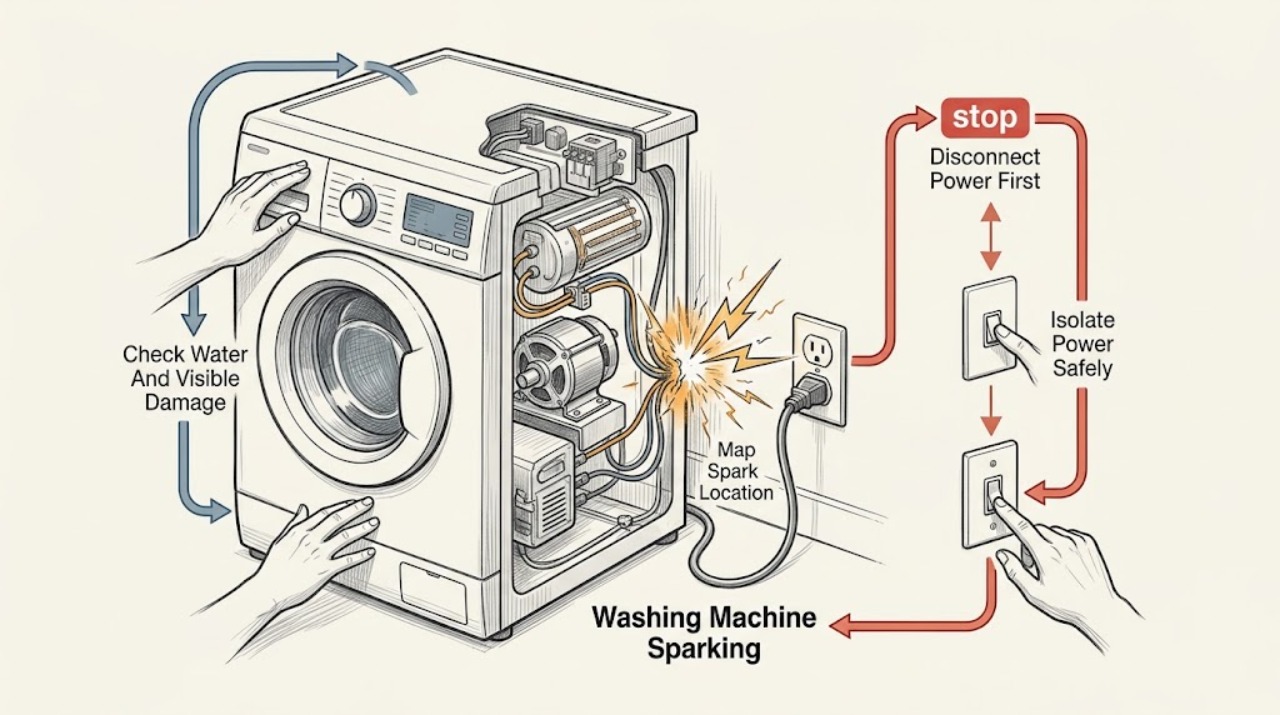
Treat any visible spark or electrical arc from an LG washing machine as a stop-use event. Do not run another cycle, press controls near the spark, touch a hot or damaged plug or outlet, or open the cabinet to find the source. If the plug can be switched off or removed without approaching an active arc and the area is dry, isolate power; otherwise leave the area and have qualified help isolate it. Keep water away from electricity and arrange appliance or electrical service. Record whether the flash came from the outlet, cord, control panel, door area, motor or heater area, and whether a breaker tripped, but do not reproduce it. A loose connection, damaged cord, moisture, control fault, motor or heater circuit, or internal wiring may be involved. Smoke, burning smell, heat, repeated arcing, water near electricity, or a breaker that trips again requires urgent professional handling.
Before you begin
Safety first
- This article covers safe observation and power isolation only when the connection is cool, dry, intact, and safely reachable. Do not approach an active arc, open the cabinet, touch wiring, move a wet washer, bypass a safety device, or perform live electrical work.
Work through in order
Diagnostic checks
Use only checks that match the exact appliance or system and its official guide.
-
Check 1
From a safe distance with the washer stopped, record whether the flash came from the wall outlet, plug, cord, control panel, door or lid area, beneath the cabinet, or a nearby connection, and note whether it occurred at startup, during fill, spin, heat, or shutdown without attempting to repeat it.
Expected result: The spark was a single flash at the plug or outlet, repeated at the control or cord, associated with a wet area or leak, or accompanied by smoke, burning smell, heat, crackling, or a breaker trip.
Next step: Use the immediate-isolation branch first, then provide the symptom map to qualified appliance or electrical service. Do not start another cycle to compare locations.
Stop if: Do not approach an active arc, touch the plug or outlet, press controls, or reach under the washer.
Why this matters
Why: Location and timing help a technician separate supply or connection damage from moisture, control, motor, heater, or internal wiring concerns, but a visible arc is hazardous in every location.
-
Check 2
If the plug and outlet are cool, dry, undamaged, and reachable without approaching a spark, turn the washer off and isolate its power using the normal plug or a clearly labeled breaker; if an arc is active or the connection is hot, wet, scorched, or smoking, leave it alone and leave the area when needed.
Expected result: Power is isolated without another flash, the breaker is already tripped, the plug or outlet is hot or damaged, the area is wet, or the washer remains energized or unsafe to approach.
Next step: Keep people away and arrange qualified appliance or electrical help. Use local emergency procedures for smoke or fire; do not restore power until the cause is inspected.
Stop if: Do not pull a hot or wet plug, operate a switch in an unsafe area, repeatedly reset the breaker, or touch exposed wiring.
Why this matters
Why: Safe isolation prevents another event. A hot, wet, damaged, or energized connection needs qualified electrical handling rather than an owner inspection.
-
Check 3
Only after power is safely isolated and the area is dry, look from outside for a puddle, leaking inlet or drain hose, water under the machine, a damaged door gasket, a scorched plug or outlet, a pinched cord, or visible damage; do not move the washer or open a cover.
Expected result: Water is near the machine or outlet, a hose or gasket leaks, the plug or cord is scorched or cracked, or no external damage is visible.
Next step: Keep the water source and power isolated as appropriate and request qualified washer or electrical service. Do not reconnect a wet or damaged appliance to see if it works.
Stop if: Do not reach into standing water, disconnect wet hoses, tape a damaged cord, or open the cabinet or control area.
Why this matters
Why: LG identifies hose, drain, gasket, filter-cover, and connection conditions as leak sources, while a damaged cord or outlet can create heat or arcing. No visible damage does not clear an internal fault.
-
Check 4
With power still isolated, document whether the panel showed an error, whether the spark occurred when Power or Start was pressed or during a motor, heater, fill, drain, or spin phase, and whether the washer had recently been cleaned, moved, or exposed to moisture; do not energize it for a controlled test.
Expected result: The flash followed a button press, appeared during motor or heater operation, followed cleaning or water exposure, or occurred at the outlet independent of a washer cycle.
Next step: Give the complete timing and exposure history to the technician and leave the washer isolated. Do not clear a code by cycling power or run a different program.
Stop if: Do not press buttons with damaged controls, perform live measurements, bypass a safety device, or reproduce an arc.
Why this matters
Why: The event timing can guide a technician toward the control, motor, heater, moisture, supply, or outlet path, but it cannot prove which component failed without safe service tests.
-
Check 5
Record whether the washer was recently installed, relocated, connected through a power strip or extension cord, exposed to a leak, or serviced; compare only the visible cord route and wall connection with the exact LG installation guidance while leaving the appliance in place.
Expected result: The washer uses a strip or extension, the cord is pinched or strained, the outlet is shared or ungrounded, the appliance was moved across a wet floor, or the installation appears correct.
Next step: Keep the washer off and have an electrician or qualified LG technician correct or verify the installation. Do not change the connection while a spark or damage remains.
Stop if: Do not use an extension cord or shared strip, move the appliance, cut a ground prong, or reconnect a damaged cord.
Why this matters
Why: LG advises a single grounded wall connection and warns against damaged or pinched power cords. A recent move or wet exposure can stress connections, but an apparently correct installation does not rule out an internal fault.
-
Check 6
After safe isolation, prepare the exact LG model, spark location, cycle phase, outlet and cord condition, water exposure, panel message, and breaker history for qualified service; do not perform a live electrical or internal component test.
Expected result: The event is fully explained by a repaired external connection, or it remains unexplained, recurs after inspection, or involved smoke, heat, burning odor, water, or a trip.
Next step: Keep the washer isolated until qualified appliance or electrical service clears it. Use local emergency procedures for active smoke or fire and seek medical help for injury or electric-shock symptoms.
Stop if: Do not restore power, restart the washer, open panels, bypass an interlock, or replace a part as a trial.
Why this matters
Why: A corrected external connection may explain a one-time event only after qualified inspection. Any unexplained or recurring arc can involve the control, motor, heater, wiring, or supply and remains unsafe to operate.
Use your observations
Decision map
Find the observation that best matches what you see, then follow the next safe action.
-
PATH 01Safety boundary
What you see
A spark or arc is active, or there is smoke, fire, a hot connection, a strong burning smell, exposed wiring, or a rapidly worsening event.
Do this next
Do not approach or operate controls. Leave the area when needed, keep people away, and use local emergency procedures; qualified personnel must isolate and inspect the appliance before reuse.
Why this path and its safety boundary
Why it matters: This is an immediate electrical or fire safety event, not a troubleshooting cycle.
Safety stop: Do not touch the outlet or plug, reset protection, use water on an electrical fire, or restart the washer.
-
PATH 02Safety boundary
What you see
A spark occurred with a puddle, leaking hose, wet outlet, water under the washer, or damp control or cord area.
Do this next
Keep away from standing water and obtain qualified appliance or electrical help. Do not disconnect wet connections or move the washer.
Why this path and its safety boundary
Why it matters: Water and electricity create a shock and fire risk; the washer must remain isolated.
Safety stop: Do not reach into water, mop around an energized connection, or reconnect the washer to test it.
-
PATH 03Next step
What you see
The flash came from the plug, cord, wall outlet, or a shared power connection, with no visible internal source.
Do this next
Keep the appliance off and have the outlet, circuit, cord, and washer inspected by qualified electrical or appliance service. Do not substitute a strip or extension cord.
Why this path and its safety boundary
Why it matters: A loose, damaged, overloaded, or incorrectly grounded supply connection may be involved, and the washer input may also be affected.
-
PATH 04Next step
What you see
The flash occurred when Power or Start was pressed or during a motor, heater, fill, drain, or spin phase, while the external supply appears intact.
Do this next
Leave power isolated and provide the phase and model record to qualified LG washer service. Do not energize a different cycle.
Why this path and its safety boundary
Why it matters: A control, motor, heater, moisture, or internal wiring fault may be involved; phase timing is useful evidence but not a safe owner test.
-
PATH 05Next step
What you see
A single flash was seen with no smoke, heat, water, damage, or repeat event, and power is safely isolated.
Do this next
Do not restore power as a test. Arrange qualified inspection and provide the exact timing, location, and installation history.
Why this path and its safety boundary
Why it matters: The cause is still unverified; a one-time event does not establish that the washer is safe.
-
PATH 06Next step
What you see
The breaker trips again after a reset, or the washer loses power during use after a spark or electrical symptom.
Do this next
Keep the washer off and arrange qualified electrical and appliance service. Do not reset the breaker again to collect more evidence.
Why this path and its safety boundary
Why it matters: LG treats a repeated trip as an electrical or appliance service issue rather than a reason to keep resetting protection.
Helpful context
Understand the symptom
A spark is not a normal washer sound
A visible flash, arc, crackle, or spark from the plug, outlet, control area, door area, or beneath the cabinet is different from an ordinary operating click. The washer can have a supply, moisture, motor, heater, control, or internal wiring fault, and the visible location may not be the electrical source. Do not touch the machine to locate it or run a cycle to see whether it happens again.
Remove power only from a safe position
If the plug is cool, dry, undamaged, and reachable without approaching an active arc, switch the washer off and isolate power as the installation permits. If the connection is hot, wet, scorched, smoking, or actively arcing, do not approach it; leave people away from the area and obtain qualified electrical or emergency help. LG advises a grounded wall connection, an accessible plug, and a cord that is not pinched or damaged.
Water and a spark make the boundary stricter
A puddle, leaking hose, wet outlet, damp control, or water under the machine can provide a path for current and makes hands-on inspection unsafe. LG's leak guidance covers hoses, drain conditions, door gaskets, and filter covers, but an owner should not reach into standing water or disconnect a wet connection after a spark. Keep the washer isolated and let qualified personnel inspect it.
Safety boundary
Stop conditions
- Stop immediately for any visible spark or arc, smoke, fire, burning smell, hot or damaged plug, outlet, cord, exposed wiring, or repeated breaker trip.
- Stop for water leaking or pooling where it can reach the plug, outlet, controls, or wiring; do not reach into standing water near electricity.
- Do not run another cycle, press controls near a spark, restore power as a test, or repeatedly reset a breaker.
- Do not open the cabinet, perform live electrical measurements, bypass an interlock, tape a damaged cord, or replace an internal part as a trial.
- Use only safe front-access observation and exact LG installation guidance; every unexplained spark needs qualified appliance or electrical inspection.
Only after diagnosis
Potential parts
- washer power cord or input filter
Consider this category only when qualified inspection identifies damage or failure in the cord or input path after the wall outlet and circuit are verified safe.
Confirm the exact LG model and electrical requirements; never reconnect a damaged cord or use a replacement as a spark test. - washer door or lid interlock
Consider this category only when qualified diagnosis links an arc or electrical symptom to a damaged lock or interlock circuit after the appliance is isolated.
Confirm exact LG model and lock design; do not bypass the interlock or test it while energized. - washer main control or motor circuit
Consider this category only when qualified diagnosis traces a cycle-linked spark to the control, motor, heater, or internal wiring after external supply and moisture causes are ruled out.
Confirm exact model and technician diagnosis; no live test or cabinet access is part of this article.
When checks do not resolve it
Need a professional?
Keep the LG washer out of use and request qualified appliance or electrical service after any visible spark or arc, even if it happened only once. Provide the model, location, cycle phase, outlet and cord condition, water exposure, panel message, and breaker history. Use local emergency procedures for smoke or fire, and seek urgent medical help for electric-shock injury or symptoms.
Safety scope: This article covers safe observation and power isolation only when the connection is cool, dry, intact, and safely reachable. Do not approach an active arc, open the cabinet, touch wiring, move a wet washer, bypass a safety device, or perform live electrical work.
Common questions
FAQ
What should I do if my LG washer sparks?
Stop the washer and do not reproduce the event. If the plug is cool, dry, intact, and safely reachable, isolate power; otherwise leave the area and have qualified help isolate it. Keep water away from electricity and arrange qualified appliance or electrical service.
Can I reset the breaker after an LG washer sparks?
Do not keep resetting it. LG directs users to electrical or appliance service when a breaker trips again, and a spark means the cause is not safely cleared by restoring power. Keep the washer off until the supply and appliance are inspected.
What if the spark came from the outlet or plug?
Keep the washer off and do not touch a hot, wet, scorched, loose, or damaged connection. An electrician or qualified appliance technician should inspect the outlet, circuit, cord, and washer input. Do not substitute an extension cord or shared power strip.
Is water near a sparking LG washer dangerous?
Yes. Keep away from standing water and do not reach into it or disconnect a wet connection. Leave power and water isolated as safely possible and arrange qualified appliance or electrical help.
Could an LG washer spark only during one cycle?
The phase can help a technician distinguish a control, motor, heater, moisture, or supply path, but it is not safe evidence for another test. Record whether it occurred at startup, fill, spin, heat, or shutdown and keep the washer isolated.
When is an LG washer spark an emergency?
Treat active arcing, smoke, fire, a burning smell, a hot or damaged cord or outlet, water near electricity, exposed wiring, or a repeated breaker trip as an immediate stop-use event. Leave when needed and use local emergency procedures; do not restart the washer.
Read the exact guide
Official sources
- LG Washer – Troubleshooting an Electrical or Burning Rubber SmellLG · Official LG USA support guidance for applicable LG front-load washer odor symptoms; model and age affect diagnosis.
- LG Washers - How to Install the Power Supply on an LG Washing MachineLG · Official LG USA support guidance for LG washing machines; exact electrical requirements vary by model and local code.
- [LG Front Load Washing Machine] Troubleshooting LeaksLG · Official LG USA support guidance for front-load washers; access and parts vary by model.
- LG Washer - Circuit Breaker is TrippedLG · Official LG USA support guidance for LG washers and washer-dryer products; circuit requirements vary by model and installation.
Community feedback
Share a repair observation
Share a plain-text repair observation. Accepted observations are published automatically; this page may take a moment to update.