
On this page
Start here
Quick answer
Any visible spark or arc from a Whirlpool washing machine, its plug, outlet, cord, control area, or wet cabinet is abnormal. Stop the cycle and keep people away; do not run another load, reset a breaker repeatedly, use an extension cord, or open the washer. From a dry, safe position, isolate power at the plug or breaker only if doing so does not bring you near water, heat, smoke, or an arc. A snap that occurs only while handling dry clothing may be static, but a spark seen at the appliance or electrical connection must be treated as an electrical fault. Whirlpool requires a grounded three-prong outlet, no adapter or extension cord, and a properly grounded dedicated supply for applicable models; recurring trips, burning smell, smoke, heat, water near electrics, or any spark from the machine require qualified electrical or appliance service.
Before you begin
Safety first
- Keep the washer disconnected for any appliance-associated spark or unresolved event. Do not use an extension cord, repeatedly reset a breaker, open panels, take live measurements, touch wet equipment, bypass protection, or run another cycle until qualified service clears it.
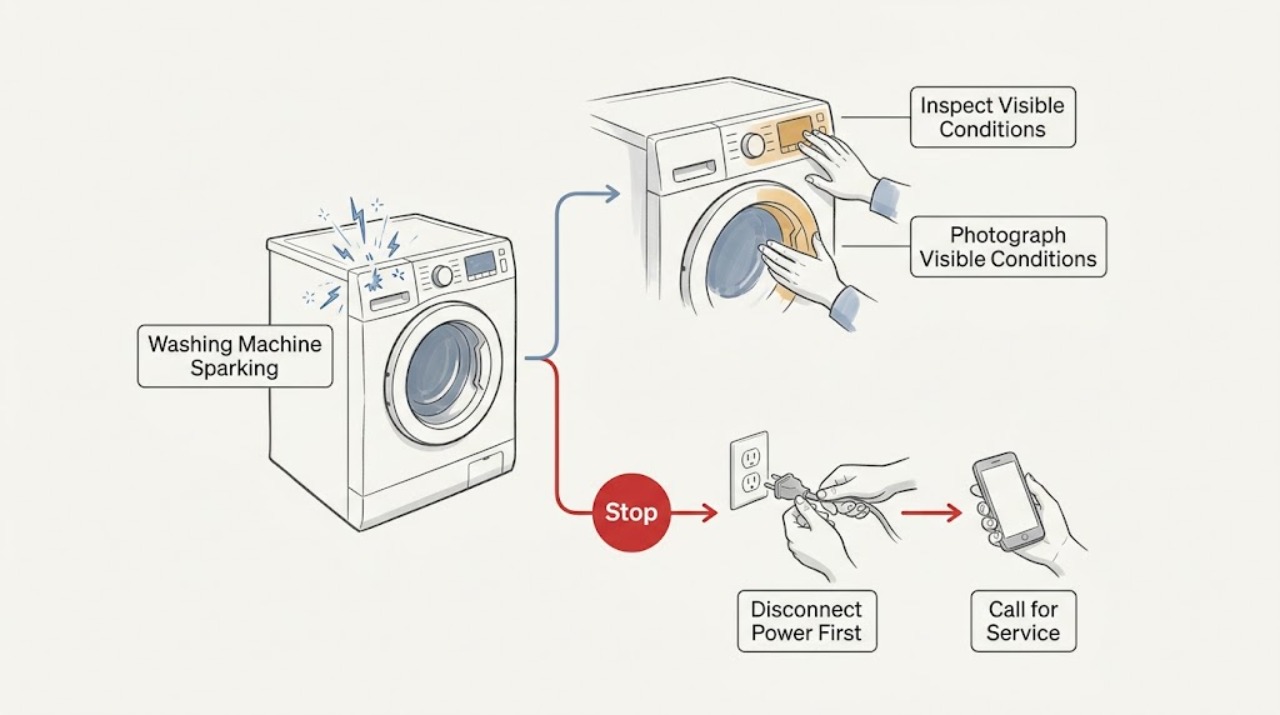
Work through in order
Diagnostic checks
Use only checks that match the exact appliance or system and its official guide.
-
Check 1
Stop the washer and observe from a safe position. Note whether the flash or arc came from the wall outlet, plug, cord, washer cabinet or controls, inside the drum, or only while handling clothing. Also note smoke, burning smell, heat, water, buzzing, a damaged cord, or a breaker/GFCI trip.
Expected result: The spark came from the washer or its electrical connection, an arc is continuing, there is smoke or a burning smell, a connection is hot or damaged, water is near the electrical area, or the breaker trips.
Next step: Keep everyone away. From a dry safe position, isolate power at the plug or breaker only if it can be done without approaching water, heat, smoke, or an arc. Otherwise leave the area and call qualified electrical or emergency help.
Stop if: Do not restart the washer, reset a tripped breaker repeatedly, pull a wet cord, touch an arcing connection, or open any cover.
Why this matters
Why: This is an electrical, fire, or shock hazard and should not be investigated by another run or by touching the appliance.
-
Check 2
Once the washer is isolated and the area is dry, record the exact event and cycle stage without moving the machine: idle, filling, washing, spinning, draining, or after the cycle. Photograph only from a safe distance if useful; do not make another test to reproduce the spark.
Expected result: The event is repeatable at a particular stage, occurred when the pump or motor started, occurred while water was present, or has no clear appliance-stage relationship.
Next step: Keep the washer out of service and give the stage, load, water condition, breaker behavior, and exact spark location to the technician. Do not energize it for a second observation.
Why this matters
Why: Stage information helps a technician distinguish supply or connection faults from a motor, pump, control, or water-related fault, but it does not make an internal repair safe for a homeowner.
-
Check 3
From outside the hazard area and only when dry, look at the accessible plug, cord jacket, outlet face, and surrounding wall for scorch marks, melted plastic, looseness, moisture, or discoloration. Do not remove the outlet cover, pull out a hard-wired washer, bend prongs, or touch a hot or damaged connection.
Expected result: The outlet or plug is loose, hot, discolored, melted, wet, visibly damaged, or the cord insulation is cut; or the accessible supply looks normal but the washer produced the spark.
Next step: Leave the circuit isolated and arrange qualified electrician or Whirlpool appliance service. Do not substitute an adapter, extension cord, outlet, fuse, or cord and then retest.
Stop if: Stop for any heat, odor, damage, looseness, moisture, or visible arc at the outlet, plug, cord, or cabinet.
Why this matters
Why: The supply connection may be the source, or the washer may have an internal fault. Neither can be cleared by a visual check alone.
-
Check 4
Check whether water is involved without touching the energized appliance: look for a burst or loose inlet hose, drain overflow, cabinet leak, wet floor, or water that could have reached the plug or lower cabinet. Do not stand in water, reach behind the washer, tilt it, or remove a panel.
Expected result: Water is at or near the washer or electrical connection, the washer leaked during the spark event, or the area is fully dry and there is no leak evidence.
Next step: If water is present, keep power isolated without entering water and arrange qualified electrical/appliance inspection. If the area is dry, keep the washer disconnected and continue documenting the event for service rather than reconnecting it.
Why this matters
Why: Water near electrical equipment raises shock and fire risk; a dry area does not rule out an internal fault but permits only a safer visual handoff, not a live test.
-
Check 5
Consider a possible static snap only if no appliance, plug, outlet, cord, or drum component visibly sparked and the sensation occurred solely while handling dry clothing. Do not use this possibility to dismiss a flash, smell, scorch, noise, or trip associated with the washer.
Expected result: The event was only a brief snap from handling dry fabric with no visible appliance arc, no odor or damage, and no breaker trip; or any appliance-related sign is present or the source is uncertain.
Next step: For a clearly handling-only event, avoid deliberately creating another discharge and monitor without touching exposed connections. For any uncertainty or appliance sign, keep the washer isolated and arrange service.
Stop if: Do not reconnect the washer merely to decide whether the event was static, and do not touch the drum or controls while a fault remains possible.
Why this matters
Why: A handling-only static event may be separate from the washer, while any uncertain or appliance-associated spark must be treated as an unresolved electrical fault.
-
Check 6
Check the Whirlpool installation requirements only as documentation for the service handoff: the model's grounding, outlet, circuit, and no-extension-cord requirements. Do not modify the circuit or make electrical measurements yourself.
Expected result: The washer uses an unsuitable adapter or extension cord, the outlet is not grounded as required, the circuit is shared or repeatedly trips, or the installation appears compliant but a spark occurred.
Next step: Stop using the washer and have a qualified electrician correct supply or grounding concerns; have an appliance technician inspect the washer if the installation is compliant or the spark came from the machine.
Why this matters
Why: An installation issue can create shock or fire risk, while a compliant installation with sparking points toward a washer or connection fault that still requires diagnosis.
-
Check 7
Prepare the service handoff with the exact Whirlpool model and serial information, spark location, cycle stage, load contents, water or leak evidence, plug/outlet condition, smoke or odor, breaker/GFCI behavior, and whether anyone felt a shock. Do not identify a failed component from the symptom alone.
Expected result: The washer has any visible spark, recurring trip, scorch, odor, water-related electrical event, or unresolved source.
Next step: Keep the washer disconnected and request qualified Whirlpool appliance and/or electrical service. Provide the recorded facts and ask for model-specific diagnosis before any part is selected.
Stop if: Do not reconnect for a technician video, run an empty cycle, bypass a safety device, or perform live measurements.
Why this matters
Why: A spark is a symptom, not proof of a particular motor, pump, control, cord, or outlet part, and further energizing can increase risk.
Use your observations
Decision map
Find the observation that best matches what you see, then follow the next safe action.
-
PATH 01Next step
What you see
A visible spark or arc came from the washer, plug, outlet, cord, controls, or cabinet.
Do this next
Keep the washer off and isolate power only from a dry safe position; arrange qualified electrical or appliance inspection. Do not repeat the cycle.
Why this path and its safety boundary
Why it matters: Treat it as an abnormal electrical fault regardless of whether the washer still runs.
-
PATH 02Next step
What you see
The event occurred only while handling dry clothing, with no visible appliance or outlet spark, no odor or damage, and no breaker trip.
Do this next
Do not deliberately reproduce the discharge or touch electrical connections. If any appliance-related sign appears, keep the washer disconnected and arrange service.
Why this path and its safety boundary
Why it matters: A separate static discharge is possible, but the washer has not been cleared if the source is uncertain.
-
PATH 03Next step
What you see
The outlet, plug, cord, or wall connection is hot, loose, wet, scorched, melted, or damaged.
Do this next
Leave power isolated and call a qualified electrician. Do not replace the outlet, use an adapter, or test with an extension cord as a workaround.
Why this path and its safety boundary
Why it matters: The supply connection itself may be unsafe and can cause shock or fire.
-
PATH 04Next step
What you see
Water or a leak is present near the appliance or electrical connection.
Do this next
Do not touch the washer or plug while standing in water. Isolate power only from a dry safe location, or leave and call qualified help; do not reconnect until inspected.
Why this path and its safety boundary
Why it matters: Wet electrical equipment and standing water create an immediate shock hazard.
-
PATH 05Next step
What you see
The breaker or GFCI trips when the washer runs, especially with a spark, smoke, odor, or heat.
Do this next
Keep the washer off and have the circuit and appliance checked by qualified electrical/appliance service.
Why this path and its safety boundary
Why it matters: The protection device may be responding to a fault; repeated resets are unsafe and do not diagnose the cause.
-
PATH 06Next step
What you see
No source can be confidently classified as clothing static, and the washer or connection may have sparked.
Do this next
Treat the event as an appliance electrical fault, preserve the observations, and request qualified service.
Why this path and its safety boundary
Why it matters: Uncertainty is itself a reason not to energize the washer for another observation.
Helpful context
Understand the symptom
Treat appliance sparks as a stop condition
A visible spark at the washer, plug, outlet, cord, control area, or cabinet is different from a harmless static snap from dry clothing. Do not keep running the cycle to find the source. Stop, keep clear, and isolate power only from a dry safe position. If water, smoke, heat, or active arcing makes the power point unsafe to reach, leave it alone and get qualified help.
The first safe split is where the spark occurred
Record whether the flash came from the wall outlet or plug, the cord, the washer cabinet or controls, the drum while metal items were tumbling, or only while clothing was being handled. Also record whether the washer was filling, agitating, spinning, draining, or idle. A spark at an electrical connection or inside the appliance needs service; a possible static snap does not justify testing a live washer.
Water makes an electrical symptom more urgent
A leaking hose, wet floor, water inside the cabinet, or a spark during a wet cycle can place live equipment and water in the same area. Do not touch the washer or plug while standing in water. Do not pull a wet cord or remove a cover. Use the main breaker only when it can be reached without entering water or approaching the arc, otherwise leave and call an electrician or emergency service as appropriate.
Do not choose a part from a spark description
The visible event can come from the supply, plug, outlet, cord, motor or control area, a metal object in the drum, or a water-related electrical fault. Whirlpool's model-specific manual and a qualified diagnosis are needed before considering any part. Repeated resets, extension-cord tests, and internal disassembly can turn an intermittent fault into a shock or fire hazard.
Safety boundary
Stop conditions
- Stop immediately for any visible spark or arc from the washer, plug, outlet, cord, controls, cabinet, or drum; do not restart or repeat the cycle.
- Stop for smoke, burning or melting-plastic odor, a hot or damaged connection, buzzing, repeated breaker/GFCI trips, or a washer that shocks or tingles. Do not reset protection repeatedly or perform a live test.
- Stop for water near the washer or electrical connection. Do not touch a wet appliance while it is plugged in or stand in water to reach a switch; isolate power only from a dry safe location or call qualified help.
- Do not use an extension cord, adapter, modified ground, bypassed safety device, or open washer panel. Do not pull a hard-wired machine out or inspect internal wiring yourself.
Only after diagnosis
Potential parts
- power cord, plug, or outlet connection
Consider only after a qualified electrician or technician confirms that the visible spark originated at a damaged or unsuitable supply connection.
Verify the exact model, local electrical requirements, grounding, and approved service method; do not substitute an adapter or extension cord. - motor, pump, or drum-area electrical component
Relevant only after qualified diagnosis links a repeatable cycle-stage spark to the model-specific motor, pump, drum, or wiring path.
Do not infer fit or failure from a spark description; confirm exact model documentation and technician diagnosis. - control or wiring component
Consider only when qualified inspection finds an internal control, harness, or connection fault after supply and water hazards are addressed.
Internal electrical parts are model-specific and require qualified service; never bypass protection or perform live testing.
When checks do not resolve it
Need a professional?
Request qualified Whirlpool appliance and/or electrical service for any visible appliance spark, a spark at the plug or outlet, recurring breaker/GFCI trips, burning smell, smoke, heat, damaged wiring, water-related sparking, shock or tingling, or an event whose source cannot be confidently identified as clothing static.
Safety scope: Keep the washer disconnected for any appliance-associated spark or unresolved event. Do not use an extension cord, repeatedly reset a breaker, open panels, take live measurements, touch wet equipment, bypass protection, or run another cycle until qualified service clears it.
Common questions
FAQ
Is a spark from a Whirlpool washing machine normal?
No. A visible spark or arc from the washer, plug, outlet, cord, controls, cabinet, or drum is abnormal. Stop using it, isolate power only from a dry safe position, and arrange qualified electrical or appliance service. A brief snap while handling dry clothing may be static only when no appliance or connection visibly sparked and no odor, damage, or trip occurred.
What should I do if my washer sparked and tripped the breaker?
Do not repeatedly reset the breaker or run another cycle. Keep the washer off and have the circuit, grounding, outlet, cord, and appliance checked by qualified electrical or appliance service. Whirlpool recommends appropriate supply and dedicated-circuit arrangements and directs owners to service when the problem continues.
Can water cause a Whirlpool washer to spark?
Water near an electrical connection can create shock and fire risk. Do not touch the wet washer or plug while standing in water, do not pull a wet cord, and do not open a panel. Isolate power only from a dry safe location or leave and call qualified help; do not reconnect until the leak and electrical condition are inspected.
Could the spark just be static from laundry?
A handling-only snap can be separate static when no visible arc came from the washer or electrical connection and there is no smell, scorch, heat, noise, or breaker trip. Do not deliberately reproduce it. If the source is uncertain or any washer-related sign exists, keep the washer disconnected and arrange service.
Which part should I replace after a Whirlpool washer sparks?
Do not choose a part from the spark description alone. The source may be the outlet or cord, a connection, a motor or pump path, the control area, the drum, or a water-related fault. A qualified electrician or appliance technician should diagnose the exact model before any part is selected.
Read the exact guide
Official sources
- Owner's ManualWhirlpool Corporation · Specific Whirlpool washer manual family; use the exact manual for a different model.
- Tripping Breaker - Washer - Product HelpWhirlpool Corporation · Whirlpool top-load washer guidance; exact model installation instructions and local electrical requirements control.
- CPSC Urges Flood Victims to Take Steps to Prevent CO Poisoning, Electrocution, Explosion and FiresU.S. Consumer Product Safety Commission · General household safety guidance; apply the same wet-electrical precautions to a washer and follow local emergency instructions.
- Electrical Supply Needed for a Washer - Product HelpWhirlpool Corporation · General Whirlpool washer installation guidance; verify the exact model's installation instructions and local code.
Community feedback
Share a repair observation
Share a plain-text repair observation. Accepted observations are published automatically; this page may take a moment to update.