
On this page
Start here
Quick answer
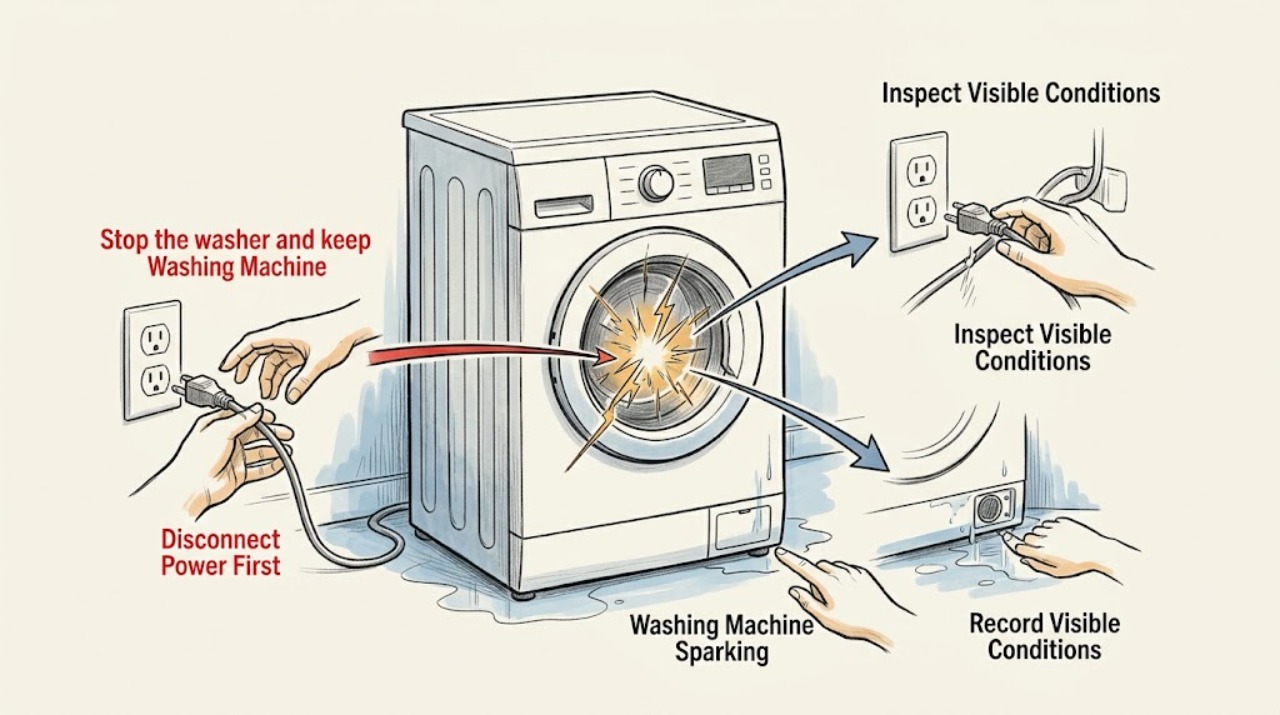
Visible sparking from a washing machine, its plug, cord, outlet, controls, or interior is not a normal operating symptom. Stop the cycle and keep people away; use the normal power control only if the area and controls are dry and there is no immediate arc, smoke, heat, flame, shock, or damaged cord. If the plug, outlet, or machine is wet, hot, discolored, arcing, or unsafe to reach, do not touch it or reconnect it. Do not reset the breaker repeatedly, move the plug to another outlet, use an extension, open the cabinet, or run another cycle. Smoke, flame, a strong burning odor, or an active electrical hazard calls for emergency help; otherwise keep the washer isolated and arrange qualified appliance service, with an electrician when the outlet or fixed wiring is involved.
Work through in order
Diagnostic checks
Use only checks that match the exact appliance or system and its official guide.
-
Check 1
Stop the washer and keep everyone clear. From a safe, dry position, note whether there is smoke, flame, a burning odor, crackling, visible arcing, heat, a shock, water near the electrical connection, or a tripped protective device; do not touch the machine or cord to obtain the observation.
Expected result: The event is over with no warning sign, or one or more of smoke, flame, odor, heat, shock, water, continuing arc, or a trip is present.
Next step: For smoke, flame, strong odor, continuing arc, or an unsafe approach, leave and obtain emergency help. For any other warning, keep the washer isolated and arrange qualified appliance or electrical service; do not resume the cycle.
Why this matters
Why: A visible spark is already abnormal, and any accompanying fire, water, heat, or electrical warning raises the risk beyond a routine washer symptom.
-
Check 2
Without moving the washer or touching the electrical parts, identify the already observed spark location from a safe distance: receptacle or plug face, cord or cord entry, outside cabinet, control area, beneath the machine, or inside the drum; also record whether it happened during fill, wash, drain, spin, or power-up.
Expected result: The spark was at the outlet or plug, along the cord, near the washer body or controls, or only appeared while a particular cycle phase was active.
Next step: Keep the machine out of service. Use an electrician for a receptacle, plug, cord, or fixed-wiring symptom and qualified appliance service for a machine or cycle symptom; use both when the boundary is unclear.
Why this matters
Why: The location and phase help a professional distinguish household electrical work from an appliance fault, moisture path, or cycle-specific load; they do not authorize opening or reconnecting the washer.
-
Check 3
Record whether water, condensation, a leak, detergent residue, or a recently moved or cleaned washer was present at the time of the event, and whether the floor, plug area, or cord looked wet; do not wipe, handle, or reach behind the machine while it is connected or when the area is unsafe.
Expected result: The spark coincided with a leak or moisture, or there was no visible water and the surrounding area appeared dry.
Next step: Keep people away from wet electrical equipment and request appliance and, when applicable, electrical inspection. Do not dry by operating the machine, pull it forward, remove panels, or handle wet connections.
Why this matters
Why: Moisture can create a shock or short-circuit hazard, while a dry area does not rule out a damaged cord, receptacle, connection, control, or motor circuit. A historical leak is useful evidence even if the floor has since dried.
-
Check 4
If and only if the controls are dry, the plug and cord are cool and undamaged, there is no smoke, flame, smell, shock, water, or active arc, and the washer can be reached without stepping in water, use the normal stop or power control and follow the exact manual's isolation guidance; otherwise do not approach the plug or cabinet.
Expected result: The washer can be stopped without touching a hazardous part, or safe access is not available because of heat, moisture, damage, smoke, or ongoing arcing.
Next step: When safe access is unavailable, leave the area and use emergency or qualified help from a safe location. When the washer has been safely stopped and isolated, leave it disconnected and do not move it or reconnect it for another cycle.
Why this matters
Why: Safe isolation depends on the actual conditions. A damaged or wet connection may become more dangerous when touched, and reconnecting after an arc can create another fault event.
-
Check 5
From outside only, record any visible heat mark, soot, melted plastic, looseness, cut or burned insulation, damaged plug, discolored receptacle, extension lead, power strip, or cord path; do not remove a receptacle cover, open the washer, reset protection, or use another outlet to compare behavior.
Expected result: Damage is visible at the receptacle or cord, damage is visible on the washer, an extension or multi-plug was involved, or no external damage is visible.
Next step: Keep the affected outlet and washer out of service and arrange the appropriate qualified professional. Never bypass a fuse, safety device, door lock, or grounding arrangement, and do not reconnect to a different outlet for a trial.
Why this matters
Why: Outlet or fixed-wiring evidence points to an electrician, while washer-side evidence or a cycle-timed spark points to appliance service. No visible damage cannot clear hidden faults.
-
Check 6
Prepare a service handoff with the brand and model, serial if available, spark location and timing, active cycle phase, load contents, any water or leak, odor or sound, visible external damage, protective-device response, and the fact that the washer was kept out of service.
Expected result: The record points primarily to the appliance, the receptacle or fixed wiring, moisture exposure, or an unresolved combination.
Next step: Request qualified appliance service for a washer-side or cycle-related spark, qualified electrical service for a plug, receptacle, cord, or wiring symptom, and emergency help for smoke or fire. Do not authorize a restart merely to reproduce the event.
Why this matters
Why: A precise event record lets the professional choose an appliance or electrical safety assessment without unsafe user disassembly or repeated energizing.
Use your observations
Decision map
Find the observation that best matches what you see, then follow the next safe action.
-
PATH 01Next step
What you see
Smoke, flame, a strong burning smell, crackling, continuing visible arcing, or a hot/discolored electrical part is present.
Do this next
Leave the area, keep clear, and contact emergency services from a safe location. Do not touch the appliance, reset the breaker, use water on an electrical fire, or return to look for the source.
Why this path and its safety boundary
Why it matters: This may be an active fire or shock hazard rather than a contained washer fault.
-
PATH 02Next step
What you see
The already observed flash came from the plug face, receptacle, cord, cord entry, or fixed wiring.
Do this next
Do not reconnect or move the plug to another outlet. Keep the area clear and arrange qualified electrical assessment; include appliance service if the cord or washer side is implicated.
Why this path and its safety boundary
Why it matters: The household connection or power cord may be involved, and repeated plugging can worsen a damaged connection.
-
PATH 03Next step
What you see
The flash appeared at the cabinet, controls, beneath the machine, or during filling, washing, draining, or spinning.
Do this next
Keep the washer isolated and request qualified appliance service. Do not remove panels, bypass the door lock, or energize the washer to reproduce the symptom.
Why this path and its safety boundary
Why it matters: An internal appliance, motor, control, harness, or moisture-related fault is possible even when the outlet looks normal.
-
PATH 04Next step
What you see
A leak, standing water, wet plug area, damp floor, shock, or water-contact electrical part was present.
Do this next
Do not step into the water or touch the washer. Keep others clear and obtain qualified appliance and electrical help; use emergency help if smoke, flame, or continuing arcing occurs.
Why this path and its safety boundary
Why it matters: Water and electricity create an immediate shock and short-circuit concern; a dry surface later does not prove the appliance is safe.
-
PATH 05Next step
What you see
No flash from the washer, plug, cord, or outlet was seen and the report is limited to a small static-like sensation.
Do this next
Do not deliberately recreate the sensation. Keep the washer out of service if the sensation involved the cabinet or controls, record when it occurred, and arrange qualified assessment if it repeats or any warning sign appears.
Why this path and its safety boundary
Why it matters: Static may have a different cause, but a shock, tingling, repeated sensation, odor, heat, trip, or any later visible arc must not be dismissed.
Helpful context
Understand the symptom
Treat any visible equipment spark as abnormal
A brief static sensation on clothing is different from a visible flash at a plug, receptacle, switch, control, cord, or washer cabinet. Because a washing machine combines water and mains electricity, do not dismiss a flash as harmless. A spark can be associated with a loose or damaged connection, moisture, a damaged cord, an outlet or wiring problem, a failing control or motor circuit, or an object contacting an electrical part. The symptom location and the exact moment it happened matter, but they do not make a user-level internal repair safe.
Make the area safe before looking for information
Keep children and pets away and do not stand in pooled water. If there is smoke, flame, a strong burning smell, crackling, a hot or discolored outlet, an electric shock, or continuing arcing, leave the area and use emergency help from a safe location. Do not touch a wet, hot, damaged, or actively arcing plug, cord, outlet, or machine. If there is no immediate hazard and the controls are dry and accessible, stop the cycle with the normal control and isolate the washer only in the manner allowed by its manual. Do not reconnect it elsewhere or try to make the spark happen again.
Separate appliance service from electrical service
A spark at the washer, behind its controls, or during filling, washing, draining, or spinning belongs with qualified appliance service. A spark, heat mark, looseness, discoloration, or crackling at the receptacle, plug face, cord entry, or fixed wiring also needs a qualified electrician. A normal-looking exterior does not clear the machine for use. Give the professional the exact model, where the event occurred, which cycle phase was active, whether water or a leak was present, and what the breaker or residual-current protection did.
Safety boundary
Stop conditions
- Stop using the washer immediately for visible sparking, smoke, flame, burning odor, crackling, shock, water near electrical equipment, a hot or discolored plug or outlet, damaged cord, repeated protective-device trips, or continuing heat.
- Do not reconnect the washer, move it to another outlet, use an extension or multi-plug, repeatedly reset a breaker, or run a cycle to reproduce the spark.
- Do not open the cabinet, remove an outlet cover, handle wet or hot electrical parts, probe wiring, perform a live electrical check, bypass a fuse or door lock, or attempt an internal repair.
- If smoke, flame, a strong burning odor, or active arcing is present, leave the area and use emergency help from a safe location; do not use water on an electrical fire.
When checks do not resolve it
Need a professional?
Use emergency help for smoke, flame, a strong burning odor, or active arcing. Keep the washer out of service and call qualified appliance service for a spark from the machine, controls, motor area, or during a cycle. Call a qualified electrician for a spark, heat mark, looseness, discoloration, crackling, or damage at the receptacle, plug, cord, or fixed wiring, and involve both trades when the source is unclear.
Common questions
FAQ
Is a spark from a washing machine normal?
A visible spark from the washer, plug, cord, outlet, controls, or cabinet is not a normal symptom. Keep the machine out of service and arrange qualified assessment; smoke, flame, strong burning odor, or continuing arcing requires emergency help.
Should I plug the washer into another outlet to see whether it works?
No. After a spark, do not reconnect the washer or move it to another outlet. A receptacle may be part of the fault, and a machine with an internal fault can create a second hazard. Arrange qualified appliance or electrical service.
What if the spark happened near water?
Do not step into pooled water or touch the washer, cord, or plug. Keep people clear and obtain qualified appliance and electrical help. A surface that later looks dry does not prove that the equipment is safe.
Can I reset the breaker after the washer sparks?
Do not repeatedly reset a tripping breaker or energize the washer to reproduce the event. Keep the appliance isolated and have a qualified professional assess the appliance and the circuit; use emergency help for smoke or fire.
Read the exact guide
Official sources
- What to do if your Washing Machine has no powerSamsung UK Support · Samsung washer support guidance used for safety principles and examples; exact controls and isolation method depend on the appliance and installation.
- What are the safety tips to handle a Washing Machine?Samsung India Support · Samsung washing-machine safety guidance used for general handling boundaries; model-specific instructions and regional requirements take priority.
- Guide to Home Wiring HazardsU.S. Consumer Product Safety Commission · General U.S. electrical-safety guidance used for hazard recognition and stop conditions; it is not a washer repair manual or permission for user electrical work.
- LG Washers - How to Install the Power Supply on an LG Washing MachineLG USA Support · LG installation guidance used to illustrate outlet and power-cord boundaries; the washer's exact electrical requirements must come from its model documentation.
Community feedback
Share a repair observation
Share a plain-text repair observation. Accepted observations are published automatically; this page may take a moment to update.