
On this page
Start here
Quick answer
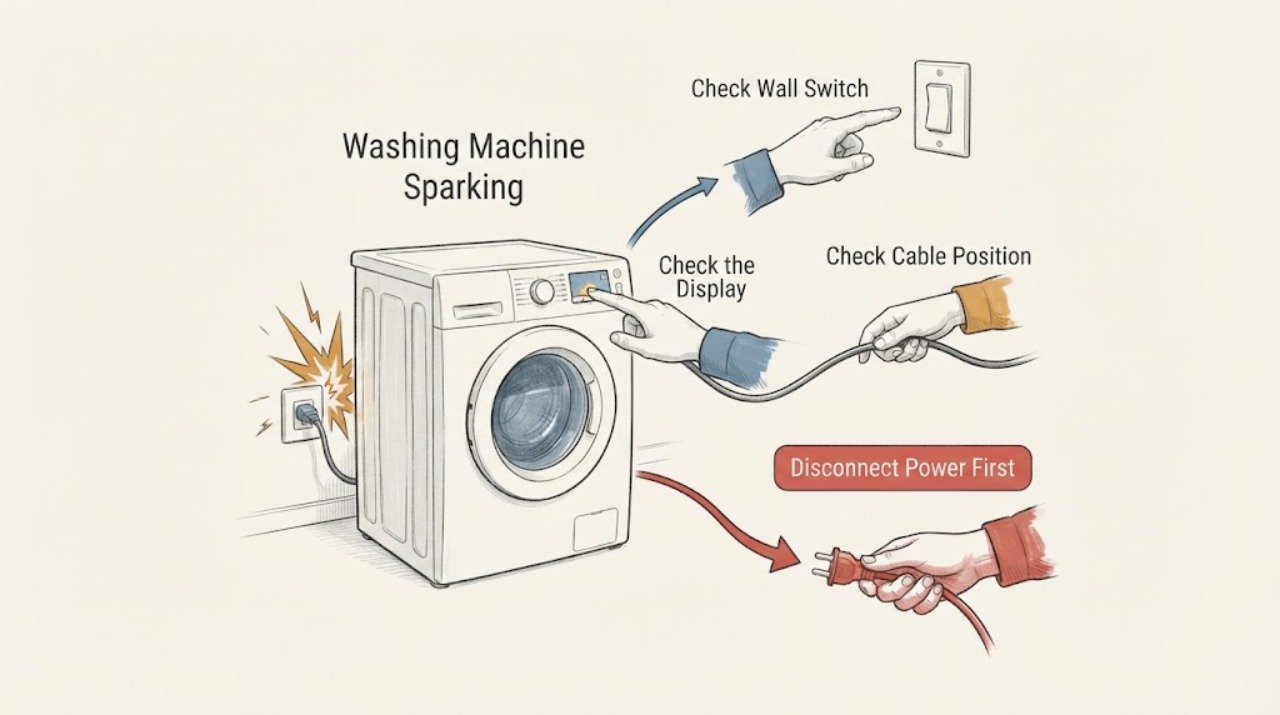
Stop the Indesit washing machine immediately if you saw a spark, arc, smoke, a burning smell, a hot or marked plug/socket, or a breaker trip. Do not restart it to see whether the spark returns. If the area is dry and there is no active arcing, smoke, or heat, switch it off and isolate it at the socket; if the plug, socket, floor, or appliance is wet, isolate power from a safe dry location instead. Do not touch wet equipment, pull a damaged lead, remove the cabinet, or bypass a door lock. Note where and when the spark occurred—at the socket, plug, control panel, door area, underneath, or inside the drum—and arrange a qualified appliance technician or electrician to inspect it. A normal indicator light is not a reason to continue using a machine that has arced.
Work through in order
Diagnostic checks
Use only checks that match the exact appliance or system and its official guide.
-
Check 1
Stop the cycle and keep away from the machine. If there is no active arc, smoke, flame, heat, or water at the electrical connection and you can do so without touching a damaged or wet part, switch the appliance off and isolate it at the socket; otherwise isolate the circuit from a safe, dry location.
Expected result: Record whether the spark is still visible, whether smoke or a burning smell remains, whether water is present, and whether the breaker or RCD has operated.
Next step: Do not restore power or retest. Leave the area if smoke or fire develops and obtain emergency help from a safe location; otherwise arrange a qualified electrician or appliance technician.
Why this matters
Why: Active arcing, smoke, heat, wetness, or repeated protective-device operation is an immediate electrical or fire hazard. A single flash still means the appliance must not be treated as safe to run.
-
Check 2
From a dry position and with the machine isolated, identify the apparent origin without opening anything: socket or wall, plug or lead, control area, door-lock area, underside, or drum.
Expected result: Note the location, the cycle stage, whether the drum was moving, and whether the flash was accompanied by crackling, a smell, a code, or a trip.
Next step: Give these observations and photographs taken only from a safe distance to the professional; do not move a wet machine or remove a panel to improve the view.
Why this matters
Why: A socket/plug location implicates the supply connection; a stage-specific flash may implicate a motor, pump, heater, lock, or control circuit. Location alone cannot prove which part failed.
-
Check 3
Inspect only the visible plug face, socket face, and accessible power lead after isolation, without pulling on the cable or plugging the washer into another outlet.
Expected result: Look for scorching, melted plastic, a loose or hot outlet, a damaged plug or lead, crackling marks, or a smell that remains after isolation.
Next step: Keep the socket and washer out of use and have the supply checked by a qualified electrician; do not substitute an extension lead, adapter, or unverified fuse.
Why this matters
Why: Any mark, heat, looseness, or damage can be an installation or appliance-supply fault and may remain dangerous even when the washer display is dark.
-
Check 4
Check the floor, hoses, detergent drawer area, door seal, and the visible front and sides for water or a wet path, but do not touch the appliance if water may have reached the plug, socket, or internal wiring.
Expected result: Classify the situation as dry, damp externally, or actively leaking, and note whether the spark happened during filling, draining, or spinning.
Next step: Keep power isolated from a safe location, close the water supply only if it is safely reachable, and request professional inspection. Do not handle a wet plug or pull the washer forward.
Why this matters
Why: Water near an electrical connection raises shock risk and can make a power fault intermittent. A leak also needs its own repair; it is not corrected by resetting a breaker.
-
Check 5
Read the display and indicator pattern without restoring power or repeatedly pressing buttons; write down the exact code, flashing lights, and model number from the rating label or handbook.
Expected result: Compare the recorded code only with the exact Indesit model documentation. Note whether it indicates a door lock, motor, heater, pump, or electronic fault, if the model page says so.
Next step: Give the exact code and model to the technician. Stop at the external record; do not replace a lock, heater, motor, board, or wiring as a trial.
Why this matters
Why: Indesit lists model-dependent codes such as F02 motor, F03 temperature sensing, F06 door lock, F07/F08 heater-related, and F18 data faults, but a code is a diagnostic lead rather than permission to keep using a sparking appliance.
-
Check 6
If the spark occurred while the door was being closed or the programme was starting, inspect the door edge and lock opening for a visible obstruction only after isolation; do not force the door or bypass the lock.
Expected result: Record whether the door closes normally, whether the lock area is cracked or scorched, whether water remains inside, and whether the machine refused to start.
Next step: Leave the washer isolated and provide the door symptom and any code to a qualified technician. Do not run a cycle with an unreliable interlock.
Why this matters
Why: Indesit identifies a door-lock fault as one reason a programme will not start, but arcing, scorching, or a damaged lock makes this a service issue rather than a user adjustment.
-
Check 7
If the spark happened during spin or drain, note the drum motion, unusual vibration, pump sound, and whether the machine stopped with water inside, using observation only after power is isolated.
Expected result: Distinguish no motion, a sudden stop, a pump that ran continuously, severe vibration, or a normal completed drain; do not restart to verify the distinction.
Next step: Keep the washer out of service. If water remains, do not open a filter or move the appliance while it is connected to power; arrange safe draining and inspection.
Why this matters
Why: Indesit describes separate motor, pump, drain, and unbalanced-load symptoms. None explains away an electrical arc, and an internal motor or pump fault requires professional testing.
-
Check 8
If the spark happened during a warm or hot programme, record the selected temperature, stage, and any heat, smoke, or odor from the front or rear without touching hot surfaces or testing the heater.
Expected result: Note whether the event occurred while heating, after the drum stopped, or when the programme paused, and whether a heater-related code was displayed.
Next step: Provide the programme stage and code to a qualified technician. Do not remove the rear panel, probe a heater, or restore power for a heating test.
Why this matters
Why: Indesit lists heating-circuit and heater faults that can pause a programme, but the presence of a spark, burning odor, smoke, or a trip means the machine must remain isolated regardless of the code.
-
Check 9
Confirm the installation context for the professional: dedicated socket or extension lead, recent relocation, recent plumbing work, prior trips, and whether other appliances are affected, without changing the connection.
Expected result: Record whether the socket is shared or an extension is used, whether the breaker trips only with the washer, and whether the outlet or plug is marked or warm.
Next step: Do not use an extension lead or a different outlet as a workaround. Have the appliance and fixed supply assessed before use resumes.
Why this matters
Why: Large appliances can overload extension leads, and a socket fault can be separate from the washer. Repeated trips are protective warnings, not a reset challenge.
-
Check 10
Prepare a service handoff with the model, serial or product information if safely readable, event location, cycle stage, exact code, water status, photos from a safe distance, and the time power was isolated.
Expected result: Check that the record does not require another power-up, cabinet opening, wet handling, or a repeat cycle to complete.
Next step: Give the record to an authorized Indesit service route, qualified appliance technician, or electrician as appropriate; keep the washer isolated until cleared.
Why this matters
Why: A precise history helps separate supply-side arcing from a stage-dependent internal fault while preserving the safety boundary.
Use your observations
Decision map
Find the observation that best matches what you see, then follow the next safe action.
-
PATH 01Next step
What you see
Active arc, smoke, flame, burning smell, hot or marked outlet, wet electrical connection, or repeated trip
Do this next
Do not touch or retest. Isolate from a safe dry location, leave if smoke or fire is present, and obtain emergency or qualified electrical help.
-
PATH 02Next step
What you see
Spark appears to come from the plug, socket, or visible lead
Do this next
Keep both the appliance and outlet out of use and have the fixed supply checked; do not change outlets or use an extension as a workaround.
-
PATH 03Next step
What you see
Water or dampness is near the electrical connection
Do this next
Do not handle the plug or move the washer. Isolate power safely, close water only if safely reachable, and request professional leak and electrical inspection.
-
PATH 04Next step
What you see
Door-area event or door-lock code with no visible damage
Do this next
Do not bypass the interlock or run a cycle. Provide the exact model and door symptom to service; visible arcing or scorching requires immediate isolation.
-
PATH 05Next step
What you see
Spin or drain-stage event with no external supply damage
Do this next
Keep the machine isolated and report drum, pump, vibration, and water observations; internal motor, pump, or wiring work belongs to a professional.
-
PATH 06Next step
What you see
Heating-stage event, hot smell, smoke, or heater-related code
Do this next
Do not run another warm programme or test the heater. Leave power isolated and arrange professional diagnosis.
-
PATH 07Next step
What you see
Only a code or flashing pattern is present and there is no spark, heat, smoke, water, or damage
Do this next
Record the exact model and code and consult the matching Indesit manual, but if sparking was actually observed, maintain isolation and arrange service.
Helpful context
Understand the symptom
What sparking changes
A flash may come from the installation outside the washer, the plug or socket, a damaged lead, or an internal component that becomes energized during a particular stage. The location and timing are more useful than guessing a part. Sparking during fill, drain, spin, or heating points to different circuits, but it is not safe to reproduce the event. Electrical Safety First says not to ignore arcing sounds, scorching, hot outlets, blown fuses, or tripped breakers; isolate the appliance and obtain competent help.
Keep the check external
Only make observations from a dry, safe position after power has been isolated. Look at the plug, visible lead, socket face, controls, door seal, and floor without moving a wet machine or removing panels. Indesit notes that the correct fuse, a live socket, the on/off control, and a firmly closed door affect operation, while its error-code guidance sends motor, heater, and electronic faults to service. Those checks do not authorize a live test or cabinet repair.
Why a model and stage matter
Record the full model number, displayed lights or code, and the exact moment of the spark. Indesit models use different indicator patterns and fault codes, and the official support pages advise checking the model manual because functions vary. If the machine is wet, smells burnt, trips power again, or shows any damage, leave it isolated until a qualified professional has assessed both the appliance and the supply.
When checks do not resolve it
Need a professional?
Call for professional help immediately for any visible spark or arc, scorching, hot outlet, smoke, burning smell, damaged lead, wet electrical connection, repeated breaker or RCD trip, or suspected internal fault. Do not restore power to see whether the symptom returns. If fire or heavy smoke is present, leave and contact emergency services from a safe location.
Common questions
FAQ
Should I run the Indesit washer again to find where the spark comes from?
No. A second test can turn an intermittent arc into a shock or fire event. Record the stage and location from a safe position and keep the appliance isolated.
What if the spark was at the wall socket rather than inside the washer?
Keep the washer and socket out of use. Scorching, crackling, heat, or a trip can indicate a supply-side fault; have the outlet and appliance checked rather than trying another outlet or an extension lead.
Can water cause a washing machine to spark?
Water near a plug, socket, lead, or internal wiring increases shock risk. Do not touch wet electrical equipment or pull the machine forward; isolate power safely and arrange professional inspection.
Could an Indesit error code identify the part that sparked?
It may narrow the circuit, but it does not prove a failed part and does not make a sparking appliance safe to use. Record the exact code and model for the technician.
Is it safe to replace the fuse or reset the breaker?
Do not use a fuse change or reset as a repair or repeat the cycle. A protective device may have operated because of a fault; recurring trips, heat, marks, or arcing require qualified electrical inspection.
Can I open the washer to inspect the motor or wiring?
No. Internal testing and repair should be left to a qualified appliance professional, especially after a visible arc, water exposure, smoke, or a trip. Do not bypass the door lock or work on a connected machine.
Read the exact guide
Official sources
- Indesit Safety Notices | Indesit ServiceIndesit Service · Indesit appliance safety notices and recall information
- Indesit | Washing Machine Faq | Indesit ServiceIndesit Service · Indesit washing machine troubleshooting, power, door, water, drain, and indicator guidance
- Indesit | Washing Machine Error Codes | Indesit ServiceIndesit Service · Indesit washing machine error-code meanings and service guidance
- Help and Advice | Indesit ServiceIndesit Service · Indesit appliance help and model-specific manual guidance
- Fire prevention tipsElectrical Safety First · Electrical product fire prevention, arcing, damaged outlets, and appliance isolation
- Electrical Safety Advice for Washer Machines / Washing Machines SafetyElectrical Safety First · Electrical safety advice for washing machines and their plugs, sockets, leads, and use
Community feedback
Share a repair observation
Share a plain-text repair observation. Accepted observations are published automatically; this page may take a moment to update.