
On this page
Start here
Quick answer
Treat any visible spark from a Samsung washer as an abnormal electrical event until its location and cause are clear. Stop the cycle, keep away from water and moving parts, and disconnect power only from a dry, safe position. Do not repeat a test, touch a wet plug, use an extension or power strip, remove a panel, or bypass a lock. A single snap when a person touches metal may be static, but a spark from the outlet, plug, power cord, controls, cabinet, underside, or washer during operation is not a user repair. Smoke, burning odor, a hot connection, arcing, a leak near electrics, or a repeated breaker trip requires the washer to remain out of use and qualified service.
Before you begin
Safety first
- User checks are limited to normal controls and dry, visible external observations. Do not reconnect the appliance to test it, handle a wet or damaged connection, open panels, probe live parts, bypass an interlock, or move a connected washer.
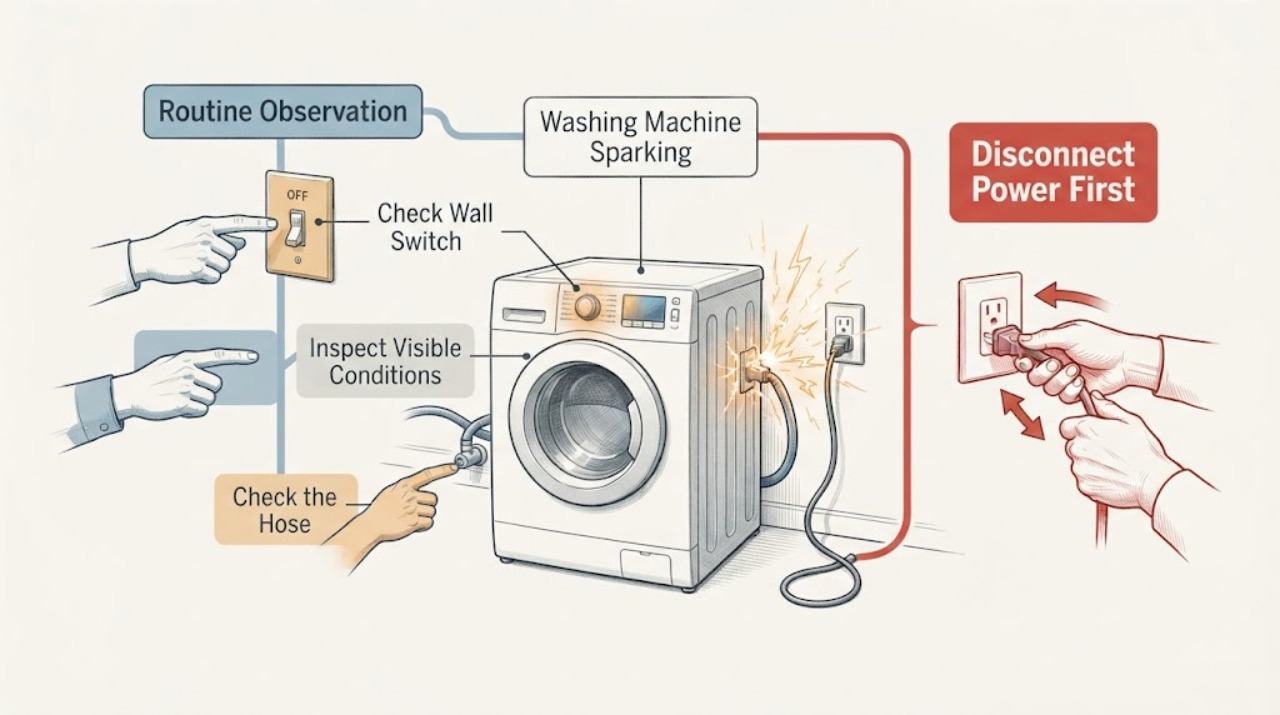
Work through in order
Diagnostic checks
Use only checks that match the exact appliance or system and its official guide.
-
Check 1
Stop the washer using its normal control if it responds, keep the door or lid closed while the drum is moving, and observe from a dry position. Record where the spark appeared, whether it was a single snap or repeated arc, what the washer was doing, and whether there was smoke, burning odor, heat, water, or a breaker trip.
Expected result: The event came from an outlet, plug, power cord, control area, cabinet, underside, or wet location; or it happened only once when a person touched metal and there is no damage, odor, heat, or repeat event.
Next step: For any uncertain, repeated, or appliance-origin event, stop using the washer and continue only with safe external documentation for service. Do not restart a cycle to see whether the spark returns.
Stop if: Stop immediately for visible arc, smoke, burning smell, hot plug or outlet, water near electrics, or a breaker that trips.
Why this matters
Why: A source in the power path or washer, a repeated event, or any associated heat or moisture is an electrical and fire risk. A single static-like snap is not proof that the appliance is safe to operate.
-
Check 2
If the floor, hands, plug, and outlet are dry and there is no smoke or active arc, switch the washer off and disconnect it only from a safe position as directed by the model manual. If the plug, outlet, or floor is wet, or reaching the connection would cross the hazard, leave it alone and isolate the circuit from a dry safe location.
Expected result: The appliance can be disconnected without touching water or damaged material, or the connection is wet, hot, loose, scorched, sparking, or inaccessible without moving the washer.
Next step: Keep the washer isolated and arrange qualified electrical or appliance service. Do not plug it into another outlet, use a power strip, use an extension, or handle a wet plug.
Stop if: Do not touch the plug, outlet, cord, or washer if water, smoke, heat, arcing, or exposed conductors are present.
Why this matters
Why: A safe isolation point limits further energy, while a wet, loose, or damaged connection can arc again and must not be handled as a routine plug check.
-
Check 3
With power isolated and the area dry, look without removing covers for a cracked, abraded, pinched, sharply bent, crushed, loose, or heat-marked power cord; a loose or discolored plug; outlet damage; a scorch mark; or a cord trapped behind the washer. Do not pull the washer forward over connected hoses or reach behind it if that would disturb a wet or damaged connection.
Expected result: The cord, plug, outlet, or accessible connection is damaged or loose, or all visible external parts look intact but the washer produced a spark.
Next step: Photograph the condition from a safe position and provide it to a qualified technician or electrician. Do not tape, splice, bend back, open the plug, or continue operation to confirm the diagnosis.
Stop if: Stop for scorch marks, melted plastic, exposed conductor, a loose wall outlet, a hot connection, or any uncertainty about the circuit.
Why this matters
Why: Visible damage is enough to stop use and replace or repair the affected connection through an approved service path. An intact exterior does not rule out an internal electrical fault.
-
Check 4
From a dry standing position, inspect the visible supply hoses, drain hose, door seal area, floor, and underside edge for fresh water, a split or bulging hose, a loose connection, flooding, or a drip toward the plug or controls. Do not remove the rear cover, tilt the washer, or reach under it.
Expected result: Water is present near the electrical connection, the washer is flooded, a hose is damaged, water entered the cabinet, or the visible area is dry.
Next step: For a leak or flood, stop use, close the water valves if they are dry and safe to reach, isolate power from a safe position, and request service. If dry, continue only with event records and the model manual; do not perform a live test.
Stop if: Stop for standing water, water entering the cabinet, a wet plug, an active leak that cannot be isolated, or any need to move the washer while connected.
Why this matters
Why: Water exposure can create shock and short-circuit risk and may explain a spark during filling, draining, or spinning. A dry exterior still does not clear an internal fault.
-
Check 5
Compare only the recorded location and circumstances; do not recreate the event. A brief snap when a person touches metal after walking on a dry floor may be static, while a flash or crackle at the plug, outlet, cord, controls, cabinet, underside, or during a cycle is an appliance or installation event until inspected.
Expected result: The event was appliance-origin, repeated, visible, audible from the connection, associated with moisture or odor, or its origin cannot be confirmed.
Next step: Keep the washer disconnected and give the technician the event location, cycle stage, moisture status, odor, breaker behavior, and photos. Do not touch the cabinet again to test for a shock.
Stop if: Stop all user testing for any visible spark, repeat snap, tingle, smoke, burning odor, heat, or uncertain source.
Why this matters
Why: An uncertain or appliance-origin event cannot be cleared by appearance alone. Static may explain a personal shock, but it does not explain arcing from the washer or supply connection.
-
Check 6
Without energizing the washer, record whether the event happened at power-on, when Start/Pause was pressed, during filling, draining, spinning, or when another appliance shared the circuit. Note any display code or unexpected shutdown, and use the exact Samsung manual only for model-specific information.
Expected result: The event is tied to a particular cycle stage, a breaker trip, a wet or recently cleaned condition, a shared supply, or no repeatable stage can be established.
Next step: Leave the washer out of service and provide the full record to qualified appliance service; use a qualified electrician when the outlet, circuit, grounding, or breaker is implicated. Do not keep cycling the breaker or swap outlets as a test.
Stop if: Stop for repeated breaker operation, a shared or overloaded circuit, abnormal display behavior with arcing, or any sign of heat or smoke.
Why this matters
Why: Timing can help a technician distinguish a supply connection, pump, motor, valve, control, or moisture-related fault, but it does not make a user electrical repair safe.
Use your observations
Decision map
Find the observation that best matches what you see, then follow the next safe action.
-
PATH 01Next step
What you see
The spark is visible or repeated, comes from the washer or supply connection, or is accompanied by smoke, burning odor, heat, arcing, or a breaker trip.
Do this next
Stop use immediately. Isolate power only from a safe dry position, keep people away, and arrange qualified appliance or electrical service. Do not repeat the test or open the cabinet.
-
PATH 02Next step
What you see
A leak, flood, wet plug, water in the cabinet, or moisture near the controls or outlet is present.
Do this next
Close the water valves if dry and safe to reach, isolate power without crossing the wet area, and request service. Do not move, tilt, or reconnect the washer.
-
PATH 03Next step
What you see
The cord, plug, outlet, or accessible connection is loose, crushed, cracked, scorched, hot, or otherwise damaged.
Do this next
Leave the washer isolated and have the connection assessed by a qualified electrician or Samsung service provider. Do not tape, splice, bend, or substitute a cord or outlet.
-
PATH 04Next step
What you see
The event cannot be confidently identified as a one-time static snap, or it occurred near the washer without a clear location.
Do this next
Treat it as an appliance event: keep the washer out of use, do not recreate the snap, and provide the timing, sound, location, moisture, odor, and breaker record to service.
-
PATH 05Next step
What you see
There was only one dry snap when a person touched metal, with no visible arc, appliance-origin sound, odor, heat, moisture, damage, or repeat event.
Do this next
Do not deliberately repeat the contact. Keep the area dry, inspect only from outside for damage, and use the exact manual or qualified service if the event recurs or its origin remains uncertain.
-
PATH 06Next step
What you see
The event tracks power-on, a specific cycle stage, breaker behavior, or another appliance on the circuit, even when no exterior damage is visible.
Do this next
Keep the washer isolated and request qualified appliance and, when appropriate, electrical assessment. Supply the stage and circuit record; do not keep resetting the breaker or try another outlet.
Helpful context
Understand the symptom
A spark is a stop signal, not a troubleshooting cycle
A dry, one-time static snap when a person touches a metal surface is different from light, crackling, or a flash at the outlet, plug, cord, control panel, cabinet, or beneath the washer. You cannot safely prove the difference by starting another cycle. Note the location, timing, sound, odor, moisture, and breaker behavior from a safe position, then keep the washer off if the source is uncertain.
Water and electrical damage can overlap
A hose leak, flood, wet plug, or liquid that has entered the cabinet can turn a fill or drain problem into an electrical hazard. Do not reach through standing water or move the machine while it is connected. If a water supply is running continuously or the washer is flooded, isolate water and power only from a safe dry position and arrange service.
The power path is model- and installation-dependent
Samsung washer models can have different controls and installation requirements. The exact model manual governs the rated supply, grounding, circuit, and any permitted external inspection. A user may look for visible damage from outside, but diagnosing an internal line filter, control board, motor circuit, or wiring fault requires qualified service.
Safety boundary
Stop conditions
- Stop using the washer for any visible or repeated spark, arc, smoke, burning odor, hot plug or outlet, or repeated breaker trip.
- Stop for water near the plug, outlet, controls, cabinet, or underside; close water valves and isolate power only from a safe dry position.
- Never touch a wet plug, operate the washer with a damaged cord, use an extension or power strip, or test a different outlet to recreate the event.
- Do not remove panels, probe live wiring, bypass a door or lid lock, reach into a moving drum, tilt the washer, or splice a cord.
- If smoke or fire is present, leave the area and use local emergency procedures; do not re-enter to retrieve the washer.
Only after diagnosis
Potential parts
- power cord or plug assembly
Consider this only after a qualified assessment identifies external cord or plug damage and confirms the exact replacement specification.
Confirm the exact washer model and electrical specification through Samsung or qualified service; do not substitute a generic cord. - washer electrical protection or control component
Consider internal electrical parts only when qualified diagnosis identifies a washer-internal fault after safe isolation; a spark alone does not identify a replaceable component.
Internal parts and access differ by model and require qualified service. No user-accessible fit is implied.
When checks do not resolve it
Need a professional?
Arrange qualified appliance or electrical service before using the washer again when a spark came from the appliance or supply connection, the source is uncertain, the event repeats, or there is any cord, plug, outlet, water, heat, odor, smoke, or breaker symptom. Use Samsung service for washer-internal diagnosis and a qualified electrician when the outlet, circuit, grounding, or breaker is implicated.
Safety scope: User checks are limited to normal controls and dry, visible external observations. Do not reconnect the appliance to test it, handle a wet or damaged connection, open panels, probe live parts, bypass an interlock, or move a connected washer.
Common questions
FAQ
Is a single snap from my Samsung washer always dangerous?
A single static-like snap when a person touches dry metal may have a different cause from a flash or crackle at the washer or outlet, but do not recreate it. Any appliance-origin, repeated, visible, wet, hot, odorous, or uncertain event should be treated as unsafe until qualified service checks it.
Can I run the washer once to find where the spark comes from?
No. Repeating an electrical event can worsen arcing or fire risk. Record the location and cycle stage from a safe position, isolate power only when safe, and arrange qualified appliance or electrical assessment.
What if the spark is near a wet floor or leaking hose?
Do not step into the wet area or touch the plug. Close the water valves only if dry and safe to reach, isolate power from a safe location, keep people away, and request service.
Should I reset the breaker after the washer sparks?
Do not keep resetting a breaker or use another outlet as a test. If the circuit has tripped after a spark, leave the washer out of use and have the appliance and circuit assessed by qualified professionals.
Can I replace the Samsung washer cord myself?
Do not splice, tape, open, or substitute a cord based on appearance. Samsung's safety guidance calls for the specified supply and qualified service when a cord is damaged; the exact model and installation determine the proper repair.
Read the exact guide
Official sources
- Home Appliance Terms and ConditionsSamsung · Samsung appliance electric, water, fire, cord, plug, and washing-machine safety
- Samsung washing machine is leakingSamsung · Samsung washing-machine water supply connections, hose condition, door seals, and drain routing
- Power issues with Samsung washing machineSamsung · Samsung washing-machine power cords, outlets, circuits, breakers, and service escalation
- Samsung Washer FAQ | Product, Shipping & Support | Samsung USSamsung · Samsung washer support, model information, common power, water, and door checks
- Samsung washing machine information and error codesSamsung · Samsung washing-machine model-specific error and indicator lookup
- Water fill issues with Samsung washing machinesSamsung · Samsung washing-machine fill behavior, continuous fill, water valves, hoses, and service escalation
Community feedback
Share a repair observation
Share a plain-text repair observation. Accepted observations are published automatically; this page may take a moment to update.