
On this page
Start here
Quick answer
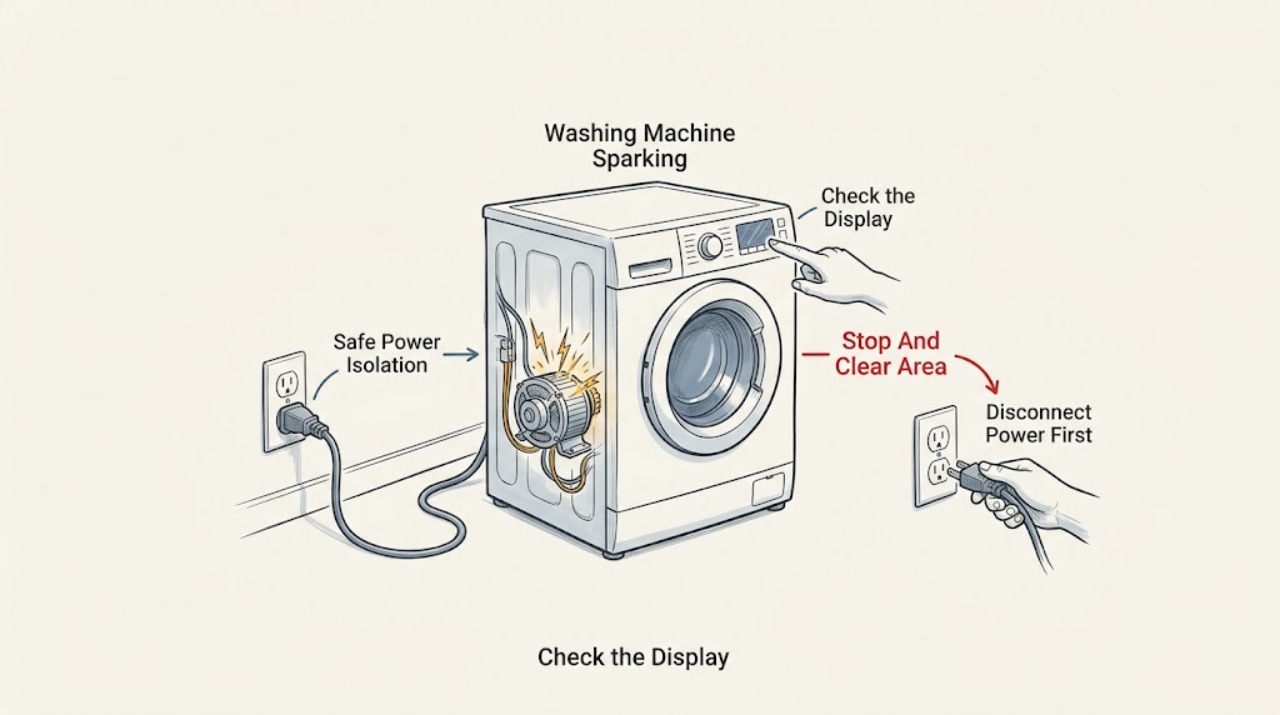
If a GE washing machine is sparking, stop the cycle immediately and keep people away. Do not run it again, touch the cord, plug, receptacle, water, or exposed metal, and do not stand in water to reach a disconnect. If there is smoke, flame, a strong burning smell, a sustained arc, or rapidly spreading heat, leave the area and use the local emergency path; do not operate an electrical switch in a potentially flammable atmosphere. If the area is dry and the disconnect can be reached without touching a wet or damaged appliance, disconnect power from a safe position; otherwise leave it alone and have an electrician or qualified appliance technician isolate it. Keep the washer's water supply closed when a hose or valve is leaking. A spark can involve the outlet or house wiring, the cord or plug, a motor or control component, a shorted heater or timer in a washer-dryer, or another failed part, so visual observations are the safe limit until the cause is professionally diagnosed.
Work through in order
Diagnostic checks
Use only checks that match the exact appliance or system and its official guide.
-
Check 1
Stop the wash cycle from a safe, dry position if the control can be reached without approaching water, smoke, flame, arcing, or a damaged cord; then step away and keep children and pets out of the laundry area.
Expected result: From a distance, note whether the spark stopped, whether there is smoke or flame, a strong burning odor, continuing crackling or arcing, abnormal cabinet heat, standing water, or a tripped breaker or outlet device.
Next step: Leave the area and use the local emergency path for fire, smoke, or sustained arcing. For a stopped spark with no immediate fire, keep the washer unused and arrange qualified appliance and electrical inspection.
Stop if: Do not reach through water, touch the washer, plug, outlet, cord, or breaker with wet hands, or operate any switch in a potentially flammable atmosphere.
Why this matters
Why: Any continuing arc, smoke, flame, significant heat, or water near electrical equipment is an emergency or immediate professional stop condition. A single flash that stops still means the washer must not be operated again until its electrical cause is checked.
-
Check 2
Only if the floor, hands, plug area, and disconnect path are dry and visibly safe, isolate the washer's power from a position that does not require touching a damaged cord, wet receptacle, exposed conductor, or the appliance cabinet; otherwise do not attempt the disconnect.
Expected result: Confirm only from a safe distance whether the washer is no longer energized and whether the breaker or outlet protection has operated; do not remove a cover or use a meter to prove isolation.
Next step: Keep the appliance isolated and arrange service. Do not restore power for a test run, even if the spark is no longer visible.
Stop if: Stop immediately if isolation would require standing in water, pulling a cord by its cable, touching a wet plug or receptacle, opening the electrical panel, or approaching smoke or flame.
Why this matters
Why: A safe disconnect prevents another cycle from energizing the fault. An inaccessible, wet, damaged, or hard-wired installation requires an electrician or qualified technician to isolate it; a breaker that trips again is not a reset-and-retry invitation.
-
Check 3
From a dry, safe position, observe whether a fill hose, drain hose, or washer connection is leaking; if a water shutoff is reachable without approaching energized or damaged equipment, close the affected supply, and otherwise leave the water and appliance alone until qualified help arrives.
Expected result: Record whether water is actively spraying, pooling beneath the washer, slowly dripping, or absent, and whether the water path is near the receptacle, cord, or other electrical equipment.
Next step: Keep the supply closed when it can be done safely, avoid the wet area, and tell the service provider where water and sparking were observed.
Stop if: Do not stand in pooled water, touch wet equipment, move the washer, loosen a hose, or reach behind the appliance to close a valve when the area is electrically unsafe.
Why this matters
Why: Water can create a second shock and property hazard and may make an otherwise reachable electrical disconnect unsafe. A leak also needs plumbing or appliance attention; it does not explain away a spark or make another test safe.
-
Check 4
Without touching or opening anything, observe from outside the appliance whether the flash appeared at the wall receptacle or plug, along the visible cord, beneath the washer, near the control area, or only inside the cabinet; do not use a flashlight or camera in a way that requires approaching a live fault.
Expected result: Write down the apparent location, timing in the cycle, whether the basket or pump was moving, whether a breaker or outlet device tripped, and whether the washer was wet or overloaded.
Next step: Keep power isolated and give the location and timing to an electrician or qualified appliance technician; do not remove panels or attempt a continuity or live-voltage check.
Stop if: Do not open the console, front, rear, motor area, or junction box, and do not probe wiring or touch an arc-damaged part.
Why this matters
Why: A receptacle, plug, or cord location makes house wiring and the supply connection a priority. A location inside or beneath the cabinet makes an appliance component, motor, control, or wiring fault possible. Timing and location guide the professional but do not prove a part diagnosis.
-
Check 5
From outside the hazard area, record whether the circuit breaker, fuse, AFCI, or GFCI operated and whether any visible receptacle, plug, cord jacket, cabinet, or nearby material shows discoloration, melting, soot, or damage; do not reset or replace protection to test the washer.
Expected result: Classify the response as no protection operation, one operation, immediate repeated operation, or unknown; record visible damage without touching it.
Next step: Leave the circuit and washer in the safest isolated state and provide the record and photos to a licensed electrician or appliance technician; do not substitute a larger fuse or breaker.
Stop if: Do not reset repeatedly, replace a fuse without qualified direction, remove an outlet cover, change breaker size, or handle charred or melted material.
Why this matters
Why: Immediate repeated operation can indicate house wiring or an appliance fault. Visible heat or arc damage needs professional inspection even if protection did not operate. No trip does not make the washer safe because a localized arc can still damage a connection.
-
Check 6
Record the GE model number, serial information if safely visible, installation type, spark location and timing, water or odor symptoms, protection response, and the safe isolation state; give that record to the service professional without reconnecting the washer.
Expected result: Confirm whether the washer remains unused and isolated, whether water is controlled, and whether any smoke, heat, odor, arcing, or damage remains.
Next step: Arrange qualified appliance and, when the outlet or house circuit is implicated, electrical service. Keep the washer out of service until the cause is repaired and the professional confirms it is safe.
Stop if: Do not run a diagnostic cycle, reconnect power, bypass a lid switch, open the cabinet, or perform internal repair as an ordinary-user check.
Why this matters
Why: The model and installation details determine the correct electrical requirements and service procedure. A persistent odor, heat, damage, or unknown isolation state means the hazard is unresolved even when no spark is currently visible.
Use your observations
Decision map
Find the observation that best matches what you see, then follow the next safe action.
-
PATH 01Safety boundary
What you see
Sparking continues, there is smoke or flame, a strong burning smell, rapidly spreading heat, or material is igniting.
Do this next
Leave the area, keep others away, and use the local emergency path from a safe location. Do not operate electrical switches or return to the appliance to retrieve items.
Why this path and its safety boundary
Why it matters: This is an immediate fire and life-safety event, not a washer troubleshooting situation.
Safety stop: Do not throw water on an electrical fire, approach the appliance, or re-enter until responders say it is safe.
-
PATH 02Safety boundary
What you see
Water is standing or spraying near the washer, plug, receptacle, cord, or disconnect path.
Do this next
Stay out of the wet area, close the water supply only if it can be reached safely without approaching electrical equipment, and contact qualified service; use emergency help for an immediate electrical or life-safety danger.
Why this path and its safety boundary
Why it matters: The water makes touching or isolating the electrical equipment unsafe and creates a separate flood risk.
Safety stop: Do not stand in water, touch a wet cord or outlet, pull the washer forward, or reach behind it for a valve or breaker.
-
PATH 03Safety boundary
What you see
A breaker, fuse, AFCI, or GFCI trips again immediately or whenever the washer is connected.
Do this next
Leave the washer disconnected and have an electrician or qualified appliance technician diagnose the circuit and appliance together as needed.
Why this path and its safety boundary
Why it matters: GE identifies house wiring and appliance faults as possible causes; repeated operation can worsen damage and does not identify which part failed.
Safety stop: Do not keep resetting protection, install a larger fuse or breaker, use an extension cord, or reconnect the washer for comparison.
-
PATH 04Safety boundary
What you see
The visible flash or discoloration was at the wall receptacle, plug, or power cord.
Do this next
Keep the circuit and washer unused and arrange a licensed electrician or qualified service professional to inspect the connection and appliance; provide photos from a safe distance.
Why this path and its safety boundary
Why it matters: The supply connection, grounding, receptacle, or cord is a priority and may remain hazardous even after the flash stops.
Safety stop: Do not touch arc-damaged plastic or metal, remove the receptacle cover, replace the cord, or plug the washer into another outlet as a test.
-
PATH 05Safety boundary
What you see
The flash appeared beneath the washer or inside the cabinet, or its source cannot be located safely.
Do this next
Keep power isolated, do not run another cycle, and arrange qualified appliance service using the model and event record.
Why this path and its safety boundary
Why it matters: A motor, timer, control, wiring, heater, or another appliance component may be involved, and the source cannot be established from external observation.
Safety stop: Do not remove panels, reach into the cabinet, bypass an interlock, or perform live or internal tests.
-
PATH 06Safety boundary
What you see
A gas smell or other flammable vapor is present in the laundry area while sparking or electrical switching is possible.
Do this next
Do not operate switches, plugs, breakers, or the washer; leave the area, extinguish flames only if this can be done without risk, and contact the gas utility or emergency responders from a safe location.
Why this path and its safety boundary
Why it matters: A spark can ignite a flammable atmosphere, so the electrical troubleshooting path must stop immediately.
Safety stop: Do not use a mobile or other electrical device inside the suspected gas area, and do not re-enter until the responsible emergency or utility professional clears it.
Helpful context
Understand the symptom
Treat a spark as an immediate stop condition
Push the normal stop control only if it can be done without entering a wet or hazardous area, then step back. Do not reach into a moving tub, touch the plug or receptacle, pull a cord through water, or remove a cover. A cycle selector set to Off is not the same as electrical isolation. If smoke, flame, continuing arcing, a strong burning odor, or abnormal heat is present, leave the area and follow the local emergency procedure. If there is a gas smell from another appliance, do not operate electrical switches and contact the gas utility from a safe location.
Separate the visible location from the hidden cause
A flash at the receptacle or plug points toward the supply connection, grounding, or cord area; a flash seen inside the cabinet, at the motor, or near a control is an appliance fault. A breaker or ground-fault device that trips immediately after a spark may be responding to an arc or short, but the trip location does not identify the failed part. Do not restore power to see whether the symptom repeats. Photograph only from a safe, dry distance and let a qualified person inspect the de-energized system.
Use the model and installation information for service
GE washer electrical requirements and wiring arrangements vary by model and by whether the unit is a standalone washer or a stacked or unitized washer-dryer. Record the model number, where the spark was seen, whether the breaker or outlet protection operated, what the washer was doing, and whether any water or odor was present. The technician or electrician can then compare the installation with the exact manual and determine whether the supply or appliance is at fault.
Only after diagnosis
Potential parts
- power cord or plug assembly
Consider this only if a qualified inspection identifies cord or plug damage and rules out the receptacle, house wiring, and an internal appliance fault.
Confirm the exact GE model and installation requirements before any replacement; do not substitute a cord by appearance. - electronic control or timer
Consider this only when a technician traces the spark or repeated protection trip to the control or timer rather than the circuit, cord, motor, or wiring.
A qualified technician must identify the failed component and verify exact model fit before ordering. - drive motor or motor wiring
Consider this only when professional diagnosis links the flash to the motor or its wiring during a specific cycle operation.
Do not assume compatibility across GE washer families; confirm model-specific service information.
When checks do not resolve it
Need a professional?
Professional service is required for any spark, flash, arc mark, burning odor, damaged cord or receptacle, breaker or outlet protection trip, unexplained power loss, or suspected internal fault. Use the emergency path for smoke, flame, sustained arcing, rapidly spreading heat, or a flammable-gas atmosphere. Do not operate the washer again until a qualified professional has inspected the appliance and implicated circuit.
Common questions
FAQ
Should I run my GE washer again to see where the spark comes from?
No. Stop using it and keep it isolated. A second cycle can turn a brief arc into fire, shock, or further equipment damage.
Can I reset the breaker after my GE washer sparks?
Do not reset it as a test. If the breaker or outlet protection operated, leave the washer disconnected and have the circuit and appliance professionally inspected.
What if the floor is wet and I cannot reach the plug?
Do not stand in water or touch the plug, cord, receptacle, or washer. Stay clear, control the water only if it is safe, and obtain qualified electrical or appliance help.
When is sparking an emergency?
Smoke, flame, sustained arcing, rapidly spreading heat, or a flammable-gas smell requires leaving the area and using the local emergency or utility path from a safe location.
Read the exact guide
Official sources
- Washer - Electrical Requirements and Breaker SizeGE Appliances · GE washer model-specific electrical and grounding requirements
- GE Appliance - Circuit Breaker TripsGE Appliances · GE washer, dryer, and appliance circuit-breaker and fuse trip guidance
- zqce305.PDFGE Appliances · GE washer operating and electrical safety instructions
- 49-90060-1GE Appliances · GE washer safety, power isolation, malfunction, and water-supply precautions
Community feedback
Share a repair observation
Share a plain-text repair observation. Accepted observations are published automatically; this page may take a moment to update.