
On this page
Start here
Quick answer
A burning-plastic smell and a warming plate that remains hot after a coffee maker is switched off are safety symptoms, especially when the brand and model are unknown. Stop brewing, unplug the maker by the plug if it is safe to do so, keep hands away from the hot plate and let it cool on a clear, nonflammable surface. Check only for a spill, residue, damaged cord, cracked carafe or obvious exterior damage; do not open the base or keep testing it. Manufacturer guidance says a warming plate may remain hot after the coffee maker is off, but a plate that does not turn off as intended or a burning smell requires model-specific support or replacement rather than a guessed repair.
Before you begin
Safety first
- Do not reconnect a smoking, sparking, melted, cracked or burnt-smelling maker; do not touch the hot plate, open the base, bypass controls or perform live electrical tests. Unplug only by the plug when safe and use qualified electrical/emergency help for active hazards.
Work through in order
Diagnostic checks
Use only checks that match the exact appliance or system and its official guide.
-
Check 1
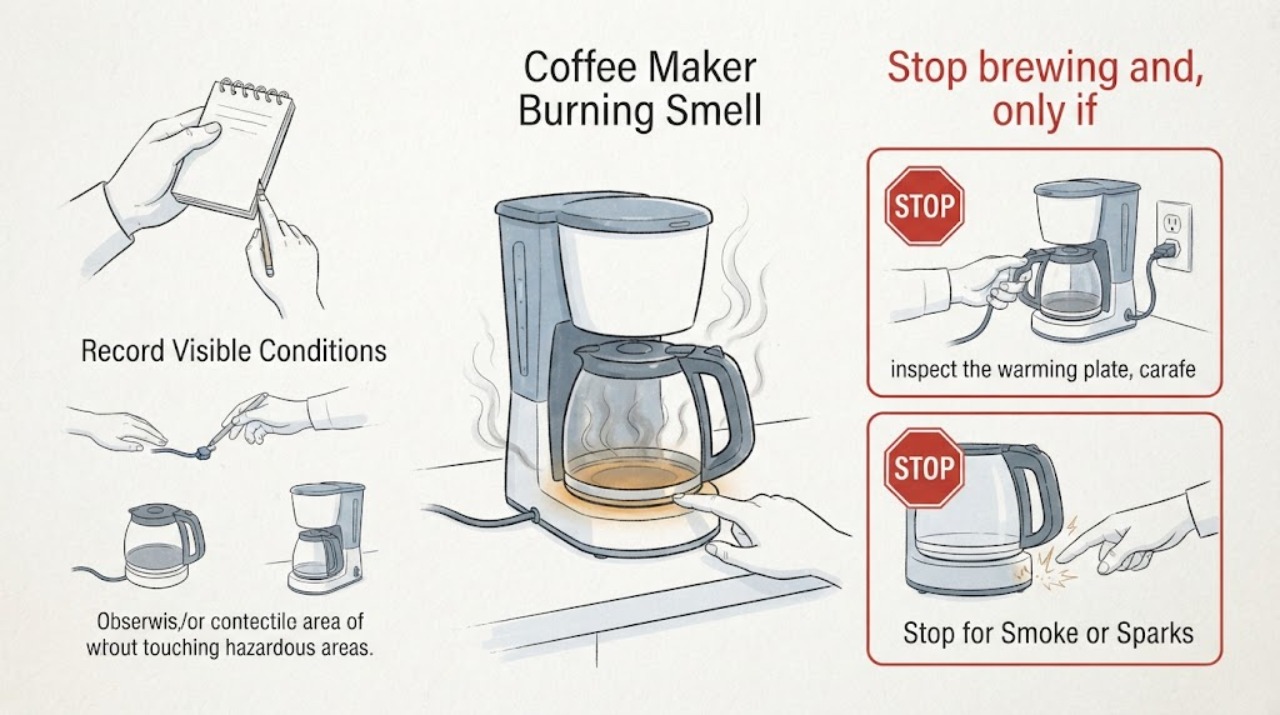
Stop brewing and, only if there is no smoke, flame, sparking or hot damaged plug, unplug the coffee maker by grasping the plug. Move it away from paper, fabric and other combustibles without touching the warming plate; let the plate and carafe cool completely.
Expected result: The smell stops after power is removed, or smoke, flame, sparking, a melted plug, cord damage or continuing odor is present.
Next step: For smoke, flame, sparking or a damaged hot cord/plug, leave the area safe and use appropriate emergency or qualified electrical help; do not reconnect. Otherwise keep the maker unplugged while it cools and continue only with a visual check.
Why this matters
Why: Residual heat can remain after shutoff, but smoke, burning damage or a continuing odor is an active electrical/fire warning rather than a normal keep-warm observation.
-
Check 2
After the appliance is cool and unplugged, inspect the warming plate, carafe base, cord, plug and accessible exterior for spilled coffee, dried residue, peeling/discoloration, cracks, melted plastic or a pinched cord. Do not remove the bottom cover or probe the base.
Expected result: Residue or a cracked/damaged component is visible, or the exterior appears intact.
Next step: Do not power a visibly damaged maker. Photograph the model/rating label and damage for the manufacturer, retailer or qualified service; if no damage is visible, keep it unplugged until its exact manual/support route is known.
Why this matters
Why: A spill or residue can explain an odor around a hot plate, but visible melting, peeling, cracking or cord damage is evidence of a safety defect; an intact exterior does not prove the heater control is safe.
-
Check 3
Record the complete nameplate information, the coffee maker type/capacity, whether it has a glass carafe and warming plate, when the smell first appeared, and whether the plate remained hot after the power switch was turned off or after unplugging. Do not repeat a brew cycle to compare temperatures.
Expected result: A complete brand/model is found, or the machine remains unbranded/unidentified.
Next step: Use the exact model manual or manufacturer support if the label is available. If the label is absent or the unit is visibly low-quality/unidentified, do not resume use merely because the plate eventually cools; replace or have it assessed through a qualified route.
Why this matters
Why: Warming-plate timing and automatic shutoff are model-specific. KitchenAid treats failure to turn on/off or stay on as a support concern; its instruction cannot establish the correct timing or parts for an unidentified maker.
-
Check 4
Do not open the base, bypass a switch, replace a thermostat, or make live electrical measurements. If the warming plate repeatedly stays on, smells burnt, peels, smokes or heats the empty plate unexpectedly, keep the coffee maker disconnected and provide the model and symptom record to support or a qualified technician.
Expected result: Support provides an exact model procedure, or only a generic suggestion to keep testing/replacing a part.
Next step: Follow only the exact model’s documented user-maintenance instructions. Otherwise retire the unknown maker from service or use qualified repair; do not conduct repeated powered tests.
Why this matters
Why: An exact manual or qualified diagnosis is needed to distinguish normal residual heat from a failed control. Generic instructions cannot establish safe parts or wiring for this unidentified maker.
Use your observations
Decision map
Find the observation that best matches what you see, then follow the next safe action.
-
PATH 01Next step
What you see
The plate is warm after power removal but there was no burning smell, smoke, discoloration, cord damage or abnormal operation, and the exact manual says residual heat is expected.
Do this next
Keep hands away until cool and follow the exact manual. Do not generalize this branch to the unbranded report if burning odor or damage returns.
Why this path and its safety boundary
Why it matters: A hot surface after shutoff can be a normal heat-retention condition, but the timing is model-specific.
-
PATH 02Next step
What you see
The plate stays on or stays hot beyond the model’s documented behavior, or the plate peels/discolors or produces a recurring burning odor.
Do this next
Stop use, unplug when safe, and contact the manufacturer or qualified service for the exact model. Do not bypass or replace internal controls by guesswork.
Why this path and its safety boundary
Why it matters: KitchenAid treats failure to turn on/off or stay on as desired and a peeling warming plate as a support concern; the exact component is not established.
-
PATH 03Next step
What you see
There is smoke, flame, sparking, melted plastic, a damaged cord/plug or a burning odor that continues after unplugging.
Do this next
Do not touch hot/damaged parts or reconnect the maker. Move people away and use appropriate emergency/electrical help from a safe location.
Why this path and its safety boundary
Why it matters: This is a potential electrical or fire hazard, not a break-in or adjustment issue.
-
PATH 04Next step
What you see
The maker has no readable brand/model or the exact support manual cannot be located.
Do this next
Keep it unplugged after the reported smell; obtain the exact identity or replace/retire the unknown appliance rather than running another test.
Why this path and its safety boundary
Why it matters: Automatic shutoff, warming-plate heat retention and internal serviceability cannot be safely inferred from another brand.
Helpful context
Understand the symptom
Treat the smell and heat as a stop-use decision
The original lead describes an unbranded drip coffee maker with a burning-plastic-like smell near the warming plate and a plate that stayed warm after unplugging. The direct Reddit page could not be opened, so the public guidance does not assume the maker’s certification, wiring or exact shutoff design. A hot plate can retain heat after power is off, but a burning smell, smoke, discoloration or a plate that does not turn off as designed is enough reason to stop using an unidentified maker.
Do not turn an unknown countertop appliance into a live test
KitchenAid’s official warming-plate guidance routes a plate that does not turn on, turn off or stay on as desired to contact/support. Hamilton Beach’s official coffee-maker safety instructions say not to remove the bottom cover because there are no user-serviceable parts inside. Those sources support an external safety boundary, not a diagnosis of a thermostat, relay or heating element in this unbranded machine.
When checks do not resolve it
Need a professional?
Contact the manufacturer or qualified service for a recurring burning smell, plate that does not turn off as the exact manual specifies, peeling/discoloration, cord/plug damage or any uncertain internal fault. Use emergency or qualified electrical help for smoke, flame or sparking.
Safety scope: Do not reconnect a smoking, sparking, melted, cracked or burnt-smelling maker; do not touch the hot plate, open the base, bypass controls or perform live electrical tests. Unplug only by the plug when safe and use qualified electrical/emergency help for active hazards.
Have this ready
- Provide the complete rating-label information, photos of the warming plate/cord/plug, carafe type, when the smell occurs, whether smoke or discoloration was present, and how long the plate remains warm after unplugging.
Common questions
FAQ
Is it normal for a coffee-maker warming plate to remain hot after unplugging?
A manufacturer manual warns that a warming plate may remain hot after the coffee maker is turned off, but the amount of residual heat and the automatic shutoff design are model-specific. Burning smell, smoke or damage is not a reason to keep testing an unidentified maker.
Can I open the bottom to check the thermostat?
No. The opened Hamilton Beach safety instructions say not to remove the bottom cover because there are no user-serviceable parts inside; use the exact manufacturer or qualified service route instead.
What if the warming plate stays on too long?
KitchenAid’s official warming-plate guidance treats failure to turn on, turn off or stay on as desired as a support concern. Record the exact model and stop using an unbranded maker with a burning smell rather than borrowing another brand’s timing or part.
Read the exact guide
Official sources
- Warming Plate Concerns - Automatic Coffee MakerKitchenAid Product Help · Opened official KitchenAid support page. It says a warming plate that does not turn on, turn off or stay on as desired, or that is peeling, should be taken to manufacturer support. It does not establish timing or parts for the unbranded coffee maker in this task.
- 4 Cup Coffee Maker: Read Before UseHamilton Beach · Opened official Hamilton Beach coffee-maker manual. It is not claimed as the exact manual for the unbranded task device; it is used only for general manufacturer safety boundaries: warming plates may remain hot after shutoff, unplugging before cleaning, avoiding hot/empty carafe use, and not removing the bottom cover.
Community feedback
Share a repair observation
Share a plain-text repair observation. Accepted observations are published automatically; this page may take a moment to update.