
On this page
Start here
Quick answer
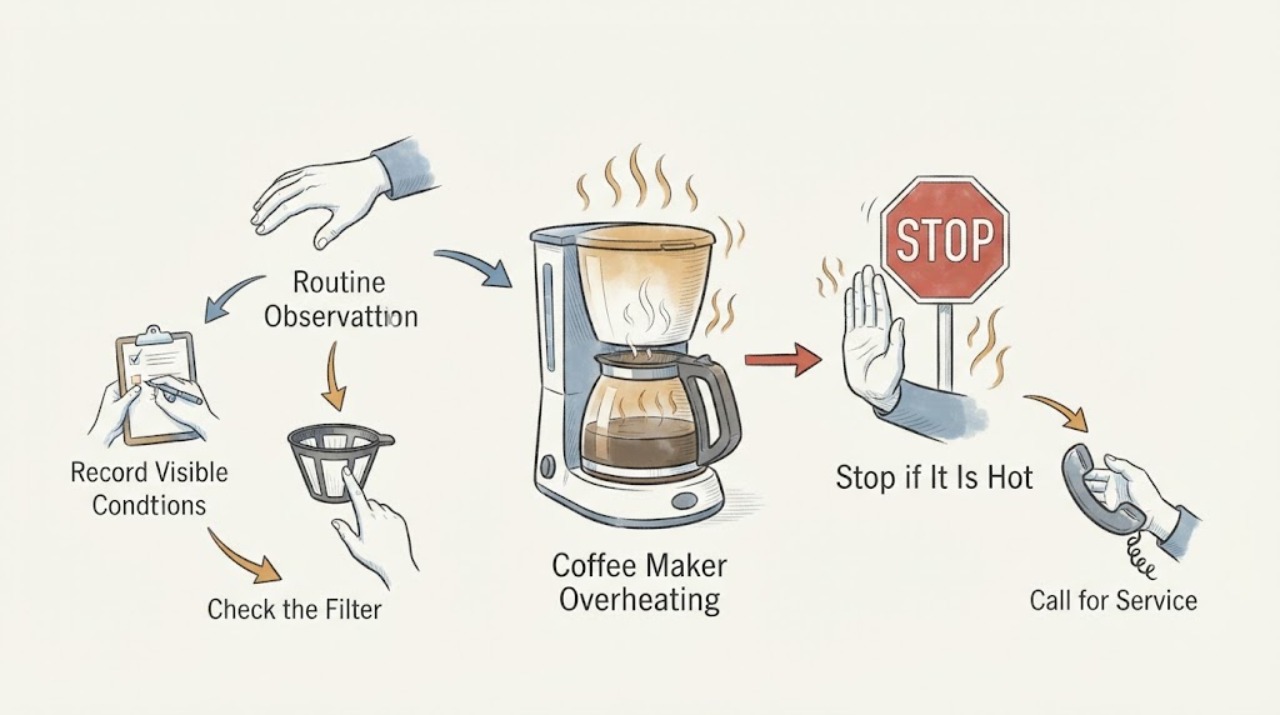
Treat a coffee maker that becomes unusually hot, smells burnt, smokes, or leaves the cord or plate dangerously hot as a stop condition. Unplug it when safe and let it cool. After cooling, inspect only airflow, water/filter/carafe seating, and visible damage; do not open the base or keep brewing to see whether the heat clears.
Work through in order
Diagnostic checks
Use only checks that match the exact appliance or system and its official guide.
-
Check 1
Turn the controls off and note where heat is concentrated: plate, reservoir, casing, cord/plug, or steam path; record timing and odor.
Expected result: Normal brew heat is different from casing/connection overheating or burning odor.
Next step: For smoke, odor, or hot electrical parts, unplug when safe and stop.
Why this matters
Why: This observation narrows the likely cause but does not identify an internal part by itself.
-
Check 2
Let the maker cool fully, then inspect the accessible cord, plug, outlet, reservoir, filter basket, carafe, and ventilation space.
Expected result: Damage, a blocked path, or a dry/poorly seated water system can contribute; no visible issue does not clear internal controls.
Next step: Do not touch hot surfaces or open the bottom cover.
Why this matters
Why: This observation narrows the likely cause but does not identify an internal part by itself.
-
Check 3
Check whether the carafe is empty/misaligned, the filter is blocked, or the reservoir is empty/overfilled according to the model manual.
Expected result: Incorrect water or carafe/filter conditions can cause overflow or abnormal heating; they do not prove the heater is safe.
Next step: Correct only accessible setup issues after cooling and use one supervised cycle if no hazard remains.
Why this matters
Why: This observation narrows the likely cause but does not identify an internal part by itself.
-
Check 4
Observe whether heat returns immediately or only after a full brew/keep-warm period; do not leave it unattended.
Expected result: Immediate recurrence or heat after shutdown is more concerning than expected brew warmth.
Next step: Unplug and arrange service for recurrence or any damage.
Why this matters
Why: This observation narrows the likely cause but does not identify an internal part by itself.
-
Check 5
Record model, heat location, cycle stage, water/filter/carafe state, odor, smoke, and outlet behavior.
Expected result: This helps service separate normal warm surfaces, flow problems, thermal control, and electrical faults.
Next step: Arrange qualified service; do not replace a thermostat or heater without model diagnosis.
Why this matters
Why: This observation narrows the likely cause but does not identify an internal part by itself.
Use your observations
Decision map
Find the observation that best matches what you see, then follow the next safe action.
-
PATH 01Next step
What you see
Only the plate is warm during the documented keep-warm period, with no odor or case heat.
Do this next
Monitor with the correct carafe and follow automatic-shutoff guidance.
Why this path and its safety boundary
Why it matters: Normal operation is more likely.
-
PATH 02Next step
What you see
Casing/cord becomes very hot, or burning smell/smoke appears.
Do this next
Unplug when safe and call qualified service.
Why this path and its safety boundary
Why it matters: Electrical/fire hazard.
-
PATH 03Next step
What you see
Heat follows blocked filter, empty reservoir, or overflow condition but clears after safe setup correction.
Do this next
Use one supervised cycle and service if heat returns.
Why this path and its safety boundary
Why it matters: Flow/setup may have contributed, but recurrence remains unproven.
-
PATH 04Next step
What you see
Overheating recurs when setup is correct or after shutdown.
Do this next
Keep unplugged and arrange service.
Why this path and its safety boundary
Why it matters: Thermal control/heater fault remains possible.
Helpful context
Understand the symptom
A warm warming plate or steam during brewing differs from a hot casing, burning odor, smoke, or heat after shutdown. The symptom does not identify a thermostat or heater part.
Water level, blocked flow, empty carafe, scale, and unattended keep-warm behavior can alter heat, but exact limits are model-specific.
When checks do not resolve it
Need a professional?
Call qualified service for recurring overheating, hot cord/plug, smoke, burning odor, cracked carafe, or heat after shutdown.
Common questions
FAQ
Why is the warming plate hot?
A warming plate can be hot during keep-warm, but a very hot casing, cord, burning smell, or heat after shutdown needs service.
Can I continue brewing to test it?
No. Unplug when safe, cool fully, and inspect only accessible setup. Repeated heating tests can increase risk.
Can I replace the thermal fuse?
No. The bottom cover is not a user repair area; use qualified service.
Read the exact guide
Official sources
- Coffee Maker 5713238051_01_0618De’Longhi · Coffee-maker thermal safety, automatic shutoff, unplugging and cooling before maintenance.
- COFFEE MAKER Owner’s ManualHamilton Beach · General coffee-maker overheating/fire/electric-shock safeguards and no-user-serviceable-bottom-cover boundary.
Community feedback
Share a repair observation
Share a plain-text repair observation. Accepted observations are published automatically; this page may take a moment to update.