
On this page
Start here
Quick answer
The spelling “Keuirg” may refer to a Keurig brewer, but the assigned topic has no verified model and the manufacturer support material is model-specific. Start by reading the nameplate and recording the controls, then use only the matching owner's guide. With the brewer unplugged and cool, perform only the user-accessible checks that the matching guide supports: a seated water reservoir, adequate water, and a water-only cycle into a heat-safe mug. Do not assume a failed heater, open the bottom cover, measure live voltage, or bypass a thermal or brew safety. If the model cannot be confirmed, the water remains cold, the brewer leaks, smells hot, trips power, or stops during heating, stop and use authorized service.
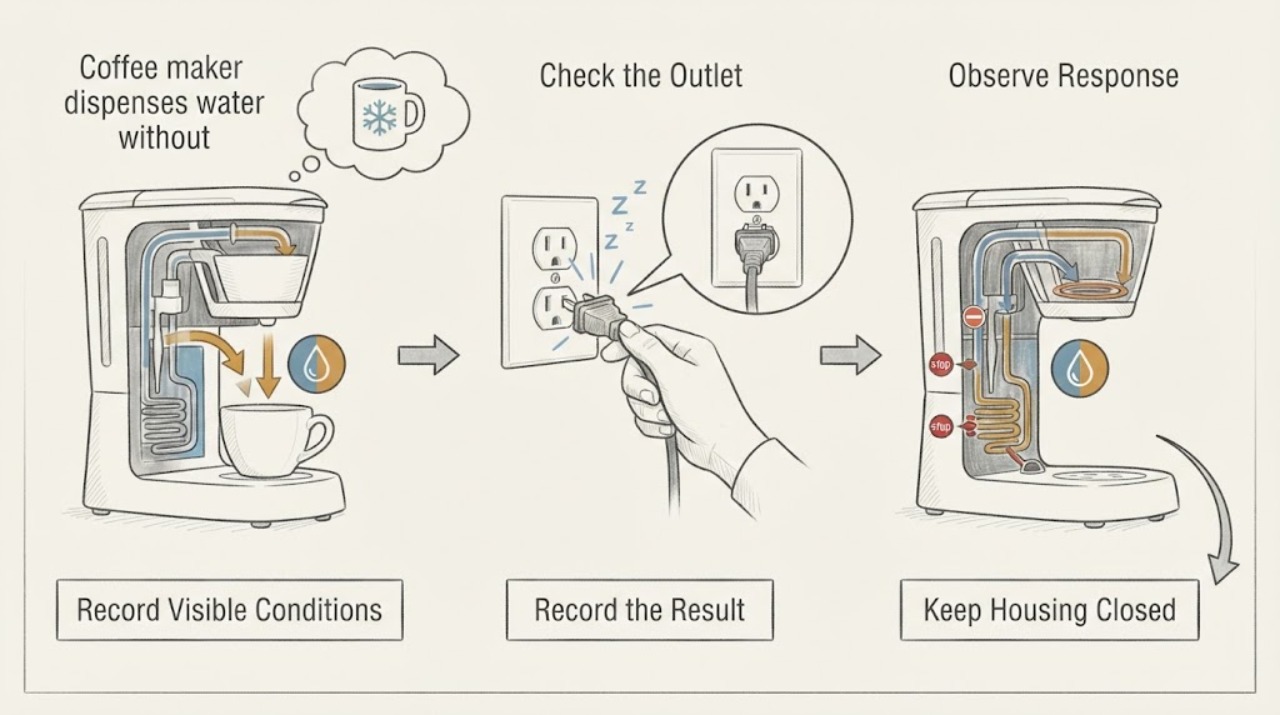
Work through in order
Diagnostic checks
Use only checks that match the exact appliance or system and its official guide.
-
Check 1
Read the complete nameplate and record the brand, model, suffix, control labels, and any visible status-light pattern without opening the brewer. Compare the result with the manufacturer support family list.
Expected result: The label clearly identifies a Keurig family/model, identifies another brand, or cannot be read.
Next step: Continue only with the guide that names the recorded model. If the identity remains unknown, limit the work to the safety and external checks below and arrange model-specific support for a continuing fault.
Stop if: Do not remove panels or move the brewer in a way that exposes wiring to find a hidden label.
Why this matters
Why: A Keurig-family identity makes the matching Keurig guide a possible source; another or unreadable identity means that Keurig K10/K200 instructions must not be transferred.
-
Check 2
With the brewer switched off and cool, confirm that the power cord and plug are undamaged, the outlet is appropriate, the water reservoir contains water below its marked maximum, and the reservoir is seated as the confirmed model guide shows.
Expected result: The brewer has no power, the cord or plug is damaged, the reservoir is empty or mis-seated, or these external conditions are normal.
Next step: Correct only a clearly external setup issue according to the matching guide, then make one controlled observation. If power and water are normal but the output remains cold, continue to the model-specific symptom check rather than naming a failed heater.
Stop if: Do not use a damaged cord, immerse the brewer, or continue after smoke, a burning smell, leaking onto electrical areas, or a tripped circuit.
Why this matters
Why: The official K10 troubleshooting guide treats power, reservoir water and reservoir position as prerequisites for brewing. A damaged cord or malfunctioning appliance is a stop condition, not a reason to open the case.
-
Check 3
If the confirmed model's guide supports a water-only or cleansing brew, run one cycle without a pod into a heat-safe mug while keeping hands away from the outlet and hot water. Do not force a handle or use a button sequence borrowed from another model.
Expected result: No water flows, only a partial amount flows, water flows but stays cold, or the brewer heats and dispenses normally.
Next step: Use the exact model guide for the observed light pattern or water-path check. If the model is unknown or the water remains cold, stop user troubleshooting and arrange service rather than inferring a heater or pump failure.
Stop if: Stop immediately if water sprays, the brewer leaks, the handle or pod holder binds, or the water is unexpectedly hot where the user guide does not describe it.
Why this matters
Why: No flow and partial flow indicate a water-path or model-specific brew condition, while cold water with otherwise normal flow leaves the heating cause unresolved. Normal hot output would show that the reported condition is intermittent or tied to a different brew mode.
-
Check 4
If the confirmed guide calls for descaling or shows a descale indication, follow only that guide's solution, sequence, rinse requirement, and model scope. Do not substitute vinegar, a different brewer's button sequence, or a generic heating-part repair.
Expected result: The model guide specifically calls for descaling, or it does not provide a matching descaling instruction for the recorded model.
Next step: Use the exact guide if it applies, rinse completely, and reassess once. If the brewer is still cold or the model cannot be confirmed, request authorized service.
Stop if: Do not pour any cleaner into the reservoir unless the matching guide expressly permits it, and do not continue if the brewer leaks or overheats.
Why this matters
Why: Keurig's K200 guide explains that scale can hinder performance and gives a model-specific procedure, but that does not prove scale is the cause of a cold-water symptom on an unknown brewer.
-
Check 5
Stop after the external checks if the brewer still dispenses cold water, shuts off during heating, trips the circuit, smells hot, leaks, or has a damaged cord or housing.
Expected result: The fault persists or a safety symptom is present.
Next step: Unplug it when safe, preserve the model and symptom details, and arrange authorized service for the confirmed brand/model. If the identity remains unresolved, provide the nameplate information before any repair decision.
Stop if: Never remove the bottom cover, bypass a safety, probe live wiring, or test the heater directly.
Why this matters
Why: The opened official material does not authorize a user diagnosis of the heater, thermostat, pump, thermal cutoff, or control board; one official guide explicitly states that the brewer is not user-serviceable beyond recommended maintenance.
Use your observations
Decision map
Find the observation that best matches what you see, then follow the next safe action.
-
PATH 01Next step
What you see
The nameplate identifies a Keurig family and the control labels match the opened family guide.
Do this next
Follow only that guide and record the exact model and light behavior; do not import a K10 or K200 button sequence unless the label matches it.
Why this path and its safety boundary
Why it matters: The manufacturer instructions may be applied within that named family, including the guide's own heat-light and water-only checks.
-
PATH 02Next step
What you see
The label is missing, unreadable, another brand, or the control panel does not match the candidate Keurig guide.
Do this next
Stop at generic safety and external observation, obtain the exact manual or use qualified service, and do not add a brand to the canonical identity.
Why this path and its safety boundary
Why it matters: The brand/model identity is not established well enough for a heater, descale, reset, or part procedure.
-
PATH 03Next step
What you see
The exact guide supports a water-only cycle, and water flows normally but remains cold after the documented heating interval or the guide's heat indication does not complete.
Do this next
Stop testing and arrange authorized service for the confirmed model; do not open the bottom cover or measure the heater.
Why this path and its safety boundary
Why it matters: A heating problem remains possible, but the opened sources do not identify which internal part failed and the K10 timing is not transferable to another model.
-
PATH 04Next step
What you see
The brewer leaks, smells of overheated plastic, trips power, has a damaged cord, or dispenses unexpectedly hot water while a control or handle is being operated.
Do this next
Stop use, unplug only if it is safe to reach the plug without touching water, and arrange qualified service. Keep hands out of the pod holder and do not open the brewer.
Why this path and its safety boundary
Why it matters: The appliance may present an electrical, burn, or water-damage hazard and should not be treated as a routine descaling problem.
Helpful context
Understand the symptom
Treat the spelling and model as unresolved
The assigned problem says “Keuirg,” which may be a misspelling of Keurig, but it does not provide a model number. The opened Keurig support site lists separate brewer families, and the opened manuals are explicitly for particular families such as K10 or K200. A cold-water symptom alone does not establish the heater, pump, thermostat, control board, or any other part. Use the identity check first and keep every model-specific instruction conditional.
A cold-water report is not permission to open the brewer
Keurig's opened safety guide says to turn the brewer off and unplug it before cleaning or maintenance, and it places a “do not open” warning over the bottom cover. The safe path here is limited to the reservoir, controls, and other user-accessible steps supported by the confirmed model guide. A heater or electrical diagnosis belongs to authorized service.
When checks do not resolve it
Need a professional?
Use authorized service when model identity is unresolved or the brewer remains cold after the matching user guide's safe checks. Stop immediately for a damaged cord, leak near electrical parts, burning smell, tripped power, smoke, unexpected hot water, or any need to open the bottom cover.
Common questions
FAQ
Is “Keuirg” definitely a Keurig brewer?
The spelling suggests Keurig, but the assigned topic has no verified model and the public lead cannot establish a model-specific identity for the article. Read the nameplate first and use the exact guide that matches it.
Can I test whether the brewer heats without a pod?
Only if the confirmed model's owner guide supports a water-only or cleansing cycle. Use a heat-safe mug, keep hands away from the outlet and hot water, and stop if the model is unknown, the unit leaks, or the result is still cold.
Does a cold cup prove the heating element is bad?
No. The symptom can involve model-specific water flow, controls, maintenance, or an internal fault. The opened official sources do not support identifying a heater, pump, thermostat, or control board without a confirmed model and service diagnosis.
Can I open the bottom cover to check the heater?
No. The opened Keurig safety guide warns not to open the bottom cover, says there are no user-serviceable parts inside, and directs repair to authorized service personnel.
Read the exact guide
Official sources
- Keurig K10 Brewer Use and Care GuideKeurig · Opened the official K10 PDF. It is used only conditionally when the reader's nameplate and controls match K10; its heat-light timing and water-only steps are not generalized to an unknown brewer.
- Keurig K200 Series Use and Care GuideKeurig · Opened the official K200 Series guide. It supports general safety boundaries and is not used to claim that the assigned unknown brewer is a K200 or that its descaling procedure applies to another model.
- Keurig Customer Service | Troubleshooting, How To Videos & FAQsKeurig Green Mountain · Opened the official Keurig support page. It confirms that Keurig support is organized by brewer family, but it does not identify the assigned misspelled topic as a specific model and is not used for a model-specific repair claim.
Community feedback
Share a repair observation
Share a plain-text repair observation. Accepted observations are published automatically; this page may take a moment to update.