
On this page
Start here
Quick answer
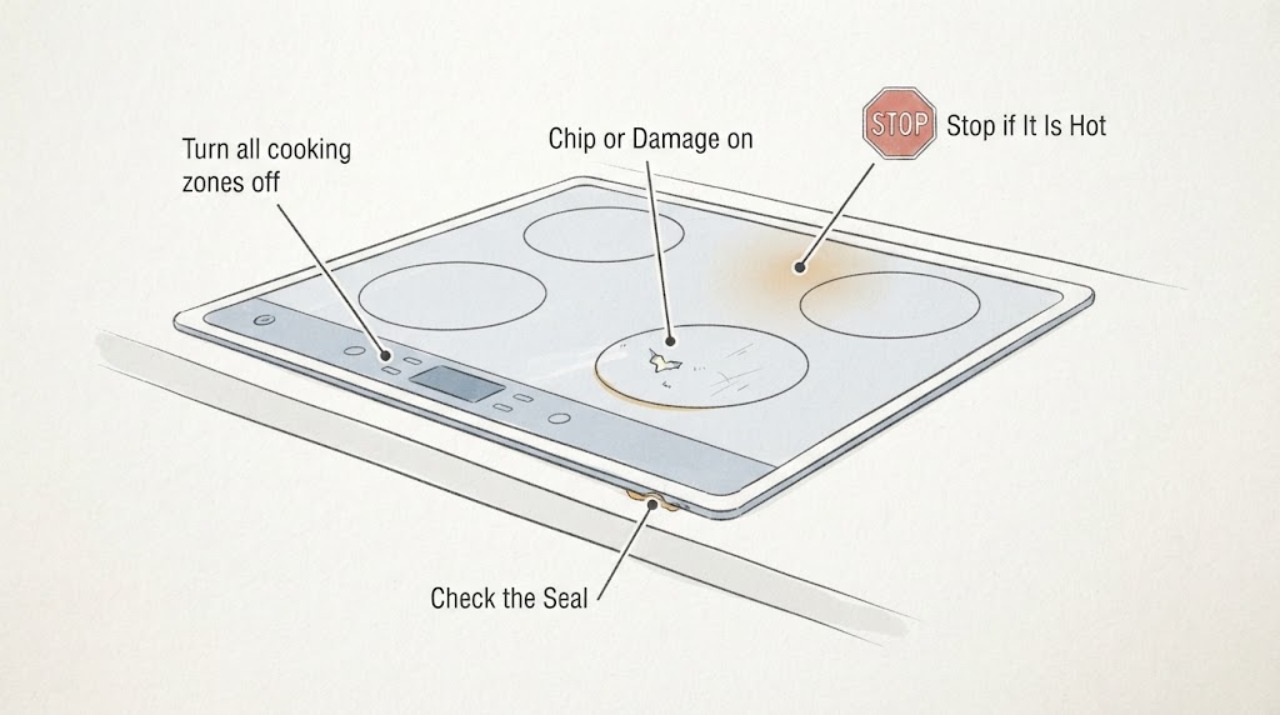
A chip on a cooktop may be a true break in glass or ceramic, a pit or indentation, or a surface mark that only looks like damage. Turn every cooking zone off, let the surface cool, and do not use the cooktop if you can see a crack, sharp or missing edge, opening, spreading line, exposed layer, or any moisture or control problem. GE says a cracked or pitted ceramic-glass surface needs service and should not be used until repaired; its cleaning guidance also says some metal, mineral, burned-on, or pan-residue marks can be removable while scratches may remain. Because this task has no brand or model, use only the exact manual's cleaner and limits, never glue or epoxy the spot, and arrange model-matched service whenever the appearance is uncertain.
Work through in order
Diagnostic checks
Use only checks that match the exact appliance or system and its official guide.
-
Check 1
Turn all cooking zones off and let the cooktop cool completely. If there is a safe, dry way to isolate power, do so before looking closely; do not touch a sharp edge or reach through a break. Keep the oven off as well when it vents over the cooktop surface.
Expected result: You can see a line that continues from the chip, a missing or sharp edge, an opening, a raised or loose layer, moisture entering the damage, or the surface is not safe to inspect.
Next step: Leave the cooktop and, if applicable, the oven unused; keep hands and cookware away from the damaged area and arrange qualified service for the exact model. Do not run a heating test.
Stop if: Stop immediately for smoke, burning odor, sparking, exposed conductive material, a hot control area, or water near electrical parts.
Why this matters
Why: Those findings are consistent with structural glass or ceramic damage rather than an ordinary mark. GE says cracked or pitted glass surfaces require service and recommends not using the cooktop until repaired; on a range it also advises against using the oven until the cooktop is fixed.
-
Check 2
From a safe distance, compare the suspected chip with the surrounding surface under good light. Look for a flat discoloration, metallic sheen, raised residue, or a scratch that has no missing material; do not scrape a mark that might be a crack.
Expected result: The mark is flat and changes in appearance with lighting, or there is a clear groove, missing material, sharp edge, indentation, or spreading line.
Next step: If there is missing material, an indentation, or uncertainty, keep the appliance off and go to service. If it is clearly a flat residue on intact glass, continue only with the cool-surface cleaning check below.
Why this matters
Why: A flat mark can be mineral, pan-metal, burned-on, or other residue; GE says some such marks can be cleaned. A scratch may stay visible, while pitting or indentation is treated as permanent glass damage requiring service.
-
Check 3
Only when the surface is cool, intact, dry, and clearly free of a crack or chip edge, use the exact model manual to select an approved ceramic-glass cooktop cleaner and a soft approved pad or cloth. Apply it as directed and remove all residue before any future heating; do not substitute abrasive cleaners or improvised sealants.
Expected result: The visible mark lifts without exposing a pit or changing into a sharp edge, or it remains after the approved cleaning method.
Next step: If the mark remains, the surface feels uneven, or any line or edge is present, stop using the cooktop and have the exact model assessed. Never use glue, epoxy, or a sealant as a repair.
Why this matters
Why: A mark that lifts is more consistent with surface residue than a structural chip. A mark that remains may be a scratch or permanent damage; cleaning cannot prove that a suspected crack is safe. GE warns that unapproved sponges or cleaners can damage the cooktop and says not to heat until cleaner residue is removed.
-
Check 4
Find the complete brand and model number on the appliance label or in its manual, and record whether the unit is radiant, induction, gas-on-glass, or a range. Photograph the damage without touching it and give the image, model, location, and whether the damage appeared after impact, heat, or a spill to the service provider.
Expected result: The model is identified and the manual or service channel describes the same surface, or the model cannot be identified.
Next step: Use the model-matched service path and do not order a glass panel or part from appearance alone. If the model remains unknown, keep a possibly damaged surface out of use until a qualified technician identifies it.
Why this matters
Why: The model determines the correct glass assembly, cleaner limits, and service instructions. GE's cracked-glass guidance covers its radiant, induction, and gas-on-glass surfaces, but it does not establish fitment or repair instructions for an unidentified or different-brand cooktop.
Use your observations
Decision map
Find the observation that best matches what you see, then follow the next safe action.
-
PATH 01Next step
What you see
A crack, sharp missing edge, opening, spreading line, or pitting/indentation is visible or cannot be ruled out.
Do this next
Stop using all cooktop zones; on a range, leave the oven off if its vent discharges onto the cooktop. Arrange qualified, model-matched service.
Why this path and its safety boundary
Why it matters: Treat the surface as structural glass or ceramic damage. The exact cause and failed assembly cannot be determined safely from the symptom alone.
-
PATH 02Next step
What you see
The surface is intact and the mark is flat, such as a metallic sheen, pan transfer, burned-on residue, or mineral mark, and it is clearly not a break.
Do this next
When cool, follow the exact model manual and approved glass-cooktop cleaner instructions; remove all residue before heating again.
Why this path and its safety boundary
Why it matters: The appearance is more consistent with surface residue than a chip. GE documents cleaning paths for these marks on its glass cooktops.
-
PATH 03Next step
What you see
The mark is a groove or scratch with no missing material and no crack, but it does not disappear with approved cleaning.
Do this next
Do not abrade, fill, or glue it. Ask the manufacturer or qualified service provider to assess the model and decide whether the surface is safe or needs replacement.
Why this path and its safety boundary
Why it matters: A scratch may be permanent even when it is cosmetic; a deep or uncertain groove must not be treated as harmless.
-
PATH 04Next step
What you see
The appearance is uncertain, the model is unknown, or there is moisture, a control malfunction, odor, sparking, or exposed material near the damage.
Do this next
Keep the appliance isolated and unused, avoid touching the damaged area, and provide the model and photos to qualified service. Do not perform a heat or power test.
Why this path and its safety boundary
Why it matters: The available symptom does not support a safe cosmetic classification, and electrical or moisture risk takes priority.
Helpful context
Understand the symptom
First decide whether the surface is structurally damaged
The word “chip” does not identify the failure. A true chip can leave a sharp missing edge or join a crack; a pit or indentation can be permanent damage even when there is no long crack. A flat mark, mineral deposit, burned-on residue, pan transfer, or scratch may look similar in photos. With no brand or model in the request, this page gives external triage only; it does not select a replacement glass, cleaner, or repair method.
Do not turn a cosmetic guess into a heat test
A surface that may be cracked, pitted, or sharp should stay out of service. Do not heat the area to see whether the mark changes, scrape a suspected break, pour cleaner into an opening, or seal the damage with glue or epoxy. If the surface is intact and the issue is clearly a removable residue, clean only after it is cool and only with the product and method allowed by the exact model manual.
When checks do not resolve it
Need a professional?
Call the manufacturer or a qualified appliance technician when there is a crack, chip with missing material, sharp edge, pit/indentation, spreading line, persistent mark that might be damage, or any uncertainty about the surface. Provide the complete model number and photos; do not choose a replacement glass assembly by appearance alone.
Have this ready
- Complete brand/model, cooktop type if known, location and size of the damage, whether it followed impact or a spill, whether any zone or control behaved abnormally, and whether moisture or odor was present.
Common questions
FAQ
Can I seal a cooktop chip with glue or epoxy?
No. The official guidance used here supports service or replacement for cracked or pitted glass; it does not establish a glue or epoxy repair. Keep the surface out of use and have the exact model assessed.
Can I use the cooktop if the chip is small?
Do not use it when the chip has a crack, missing material, sharp edge, pit, moisture path, or uncertain appearance. A small flat mark on intact glass may be residue, but classify it only after the cool, model-approved cleaning check.
How can I tell a chip from a pan mark or scratch?
A flat metallic, mineral, or burned-on mark may lift with the exact model manual's approved glass-cooktop cleaner. Scratches may remain, while a missing edge, indentation, opening, or spreading line should be treated as damage requiring service.
Read the exact guide
Official sources
- Cooktop - Glass CrackedGE Appliances · GE radiant, induction, and gas-on-glass cooktop or range surfaces with cracked or pitted ceramic glass; service and stop-use guidance
- Electric Range & Cooktop - Glass Cooktop Cleaning InstructionsGE Appliances · GE glass-cooktop cleaning, removable metal/mineral/burned-on marks, pan residue, and permanent pitting or indentation
- Electric Range & Cooktop - Scratches on Glass CooktopGE Appliances · GE glass-cooktop distinction between scratches and marks that only look like scratches
Community feedback
Share a repair observation
Share a plain-text repair observation. Accepted observations are published automatically; this page may take a moment to update.