
On this page
Start here
Quick answer
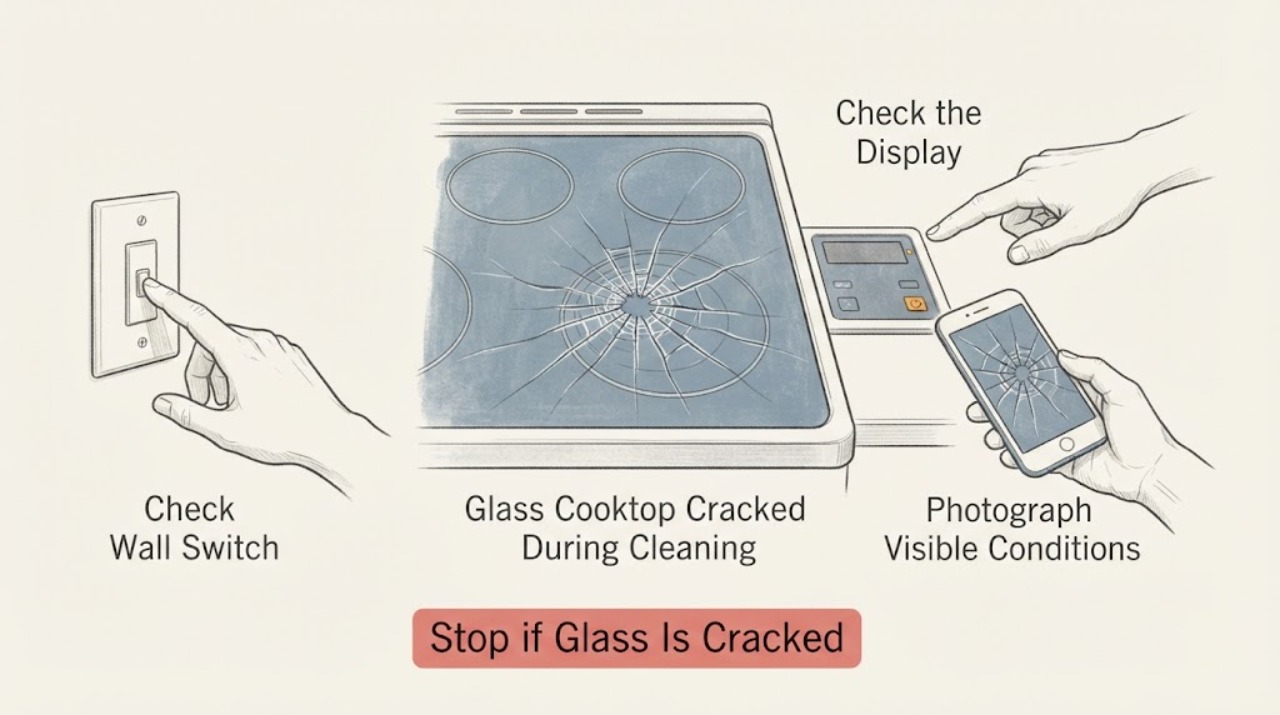
Stop using a glass cooktop as soon as you see a real crack, and do not keep cleaning, heating or testing it. GE's official cooktop guidance says a cracked ceramic-glass surface needs service and should not be used; an official GE safety manual warns that spillovers or cleaning solution can penetrate broken glass and create an electrical-shock risk. A house cleaner may damage a surface coating or leave a film, but that does not prove it caused a structural crack. Turn all controls off, isolate electrical power at the accessible disconnect or breaker only if it is safe, keep hands and liquids away from the crack, and arrange qualified appliance service. Do not use a scraper, abrasive, chemical or temporary seal over a crack, and do not use an oven on a range until the cooktop is repaired.
Work through in order
Diagnostic checks
Use only checks that match the exact appliance or system and its official guide.
-
Check 1
Stop cleaning and turn every cooktop control off. Do not touch the crack, pour water or cleaner over it, or place a pan on the surface. If the appliance is a range, do not use the oven while the cooktop is cracked. If there is smoke, sparking, a burning smell or liquid entering the appliance, move away and use the building's emergency or qualified electrical service channel.
Expected result: The glass has a split, branching line, chip, hole or opening, or there is no confirmed structural crack and only a film/mark is visible.
Next step: For a crack or any electrical warning sign, keep the cooktop out of service and continue only with safe documentation. Do not proceed with household cleaning. If no crack is confirmed, wait until cool and identify the exact model before using any cleaner.
Why this matters
Why: A structural crack is a stop-use safety condition. A surface mark may be a cleaning or cosmetic issue, but trying to polish or heat it to find out can worsen damage or expose the user to an electrical hazard.
-
Check 2
After the appliance is cool and controls are off, photograph the damage without pressing on the glass. Note whether the line reaches an edge, burner outline, control area or a chip, and record the cleaner name, amount, dwell time and whether the surface was hot. Do not remove trim, lift the glass or make a continuity or voltage test.
Expected result: The line is a through-crack/chip or reaches an edge/opening, or it appears to be a removable film, residue or shallow mark with intact glass.
Next step: Send the model/serial label and photos to the appliance owner, landlord or qualified service provider. Do not claim the cleaner caused the structural failure without inspection.
Why this matters
Why: A photo and product history help service distinguish glass replacement from a surface-cleaning issue, but visual uncertainty does not make a cracked surface safe to energize. The official cracked-glass guidance does not require the user to identify the crack's cause before stopping use.
-
Check 3
If the glass is definitely cracked, isolate the appliance only through a safe, accessible control: unplug a countertop unit, or switch off the dedicated breaker/disconnect if it is clearly identified and can be reached without touching wet or damaged equipment. Do not remove the cooktop or access wiring.
Expected result: The plug, breaker/disconnect and surrounding area are dry and undamaged, or there is moisture, heat, scorching, an inaccessible disconnect or uncertainty about the circuit.
Next step: If isolation is not clearly safe, keep people away and contact qualified electrical/appliance service or building management. Do not restore power to see whether the cooktop still works.
Why this matters
Why: A dry accessible isolation point can prevent accidental heating while awaiting service. Moisture or damaged electrical parts increase shock risk; attempting to reach them can be more dangerous than leaving the appliance untouched.
-
Check 4
If no crack is visible and the issue is only cleaner residue or discoloration, wait until the surface is fully cool and consult the exact owner's manual before any further cleaning. Do not use a household glass cleaner, bleach, ammonia, abrasive powder, steel wool or coarse pad unless the model instructions explicitly allow it.
Expected result: The mark lifts with the model-approved method on a cool, intact surface, or it remains, scratches the glass, pits it or becomes a visible crack.
Next step: Stop cleaning and request service for pitting, a chip, a crack or damage that does not respond to the exact manual's safe cleaning method. Do not use the surface to test the result.
Why this matters
Why: Whirlpool lists harsh chemicals and abrasive materials as potential sources of surface damage, and GE says to remove cleaner residue before heating. Persistence, pitting or a real crack cannot be safely treated as ordinary residue.
-
Check 5
Before requesting service, record whether the cooktop is radiant, induction or gas-on-glass and provide the full model number, photos of the crack and the cleaning product label. Do not order a replacement glass panel by appearance or assume a panel from another brand or model will fit.
Expected result: The equipment type and complete model are known, or the type/model remains unknown.
Next step: Keep the appliance out of service and have the owner, landlord or qualified technician identify the correct repair path. Do not disassemble the appliance to find the label or panel number.
Why this matters
Why: GE's cracked-glass guidance covers several cooktop technologies, but the replacement and service procedure is still model-specific. Unknown identity blocks safe compatibility decisions, not the stop-use instruction.
Use your observations
Decision map
Find the observation that best matches what you see, then follow the next safe action.
-
PATH 01Next step
What you see
A true crack, chip, hole or branching split is visible in the ceramic-glass cooktop.
Do this next
Isolate power only through a safe accessible point, keep liquids and people away, and arrange qualified appliance service. Do not use the cooktop or the oven of a range.
Why this path and its safety boundary
Why it matters: The cooktop is not safe to operate. GE says cracked ceramic glass requires service and recommends not using the cooktop until repaired.
-
PATH 02Next step
What you see
The glass is intact and the mark is only cleaner film, discoloration or a shallow scratch with no split or chip.
Do this next
Use only the exact manual's cool-surface, non-abrasive method and approved cleaner. Stop if the mark becomes a chip, pitted area or crack; do not heat the surface until cleaner residue is removed.
Why this path and its safety boundary
Why it matters: The official cleaning guidance addresses surface residue and abrasive/chemical damage, but the exact method depends on the cooktop model and surface coating.
-
PATH 03Next step
What you see
The crack is accompanied by liquid, smoke, sparks, a burning smell or visible electrical damage.
Do this next
Do not touch or wipe the damaged area. Move away, isolate the area if safely possible and contact qualified electrical/appliance service or emergency help as appropriate.
Why this path and its safety boundary
Why it matters: Broken glass can allow spillover or cleaning solution to reach energized areas, creating an electrical-shock or fire risk.
-
PATH 04Next step
What you see
The user cannot tell whether the line is a crack or a surface mark, or the brand/model is unknown.
Do this next
Treat it as damaged until a qualified technician or the appliance owner confirms the surface is intact. Provide the model label and photos; do not scrape, polish, seal or heat the area.
Why this path and its safety boundary
Why it matters: Unknown identity prevents model-specific cleaning and part decisions, but it does not justify powering a questionable glass surface to test it.
Helpful context
Understand the symptom
A cleaner mark is not the same as a crack
The task supplies no brand, model or cooktop type and says a house cleaner damaged the glass during cleaning. A cloudy film, discoloration or scratch-like mark can be a surface or cleaner problem, while an actual split, branching line, chip through the glass or opening is a stop-use condition. Do not scrub harder to decide which it is: once the glass is genuinely cracked, the safety boundary is the same across radiant, induction and gas-on-glass surfaces.
Cleaning products need model-specific boundaries
Official cleaning directions differ by product. GE recommends approved cooktop cleaner and says not to heat until residue is removed; Whirlpool's WipeClean guidance calls for a cool surface, a soft non-abrasive sponge and no coarse sponges, abrasive powders, bleach, rust remover, ammonia or window cleaner. Those instructions apply to an intact surface and do not authorize further cleaning of a cracked one or prove that the house cleaner caused the crack.
When checks do not resolve it
Need a professional?
Arrange qualified appliance service for any visible crack, chip, pitting or uncertainty about whether the glass is structurally damaged. Use emergency or qualified electrical help for smoke, sparks, burning smell, wet electrical areas or other shock/fire signs.
Common questions
FAQ
Can I keep using the cooktop if the cleaner caused only a hairline crack?
No. Do not use a cracked ceramic-glass surface, even if the crack is small or appeared during cleaning. GE says cracked glass requires service and the cooktop should remain out of use until repaired.
Can I remove the crack with a scraper or cover it with sealant?
No. Scrapers and cleaners are for compatible surface residue, not structural glass repair. Do not scrape, seal or disassemble a crack; arrange qualified service.
Could a house cleaner damage a glass cooktop without cracking it?
Yes, incompatible or abrasive cleaners can damage a surface or leave residue, but that does not prove they caused a structural crack. For an intact surface, follow the exact model's cool-surface and approved-cleaner instructions; stop immediately if a chip or split is visible.
Read the exact guide
Official sources
- WipeClean - Glass Cooktop CleaningWhirlpool Product Help · Opened official Whirlpool cleaning guidance and use it only as cross-brand surface-care corroboration, not as a model-specific repair instruction.
- Electric Range & Cooktop - Glass Cooktop Cleaning InstructionsGE Appliances · Opened official GE cleaning guidance and use it only to explain why cleaner identity and an intact surface matter; it is not a model-specific instruction for the unidentified cooktop.
- GE Range Important Safety InstructionsGE Appliances · Opened official GE safety PDF and use it only for the general broken-glass electrical-shock warning; it is an older GE manual and is not presented as the assigned appliance's model manual.
- Cooktop - Glass CrackedGE Appliances · Opened official GE support guidance and use it as a cross-brand safety boundary for an unidentified glass cooktop; no GE identity is assigned to the task.
Community feedback
Share a repair observation
Share a plain-text repair observation. Accepted observations are published automatically; this page may take a moment to update.