
On this page
Start here
Quick answer
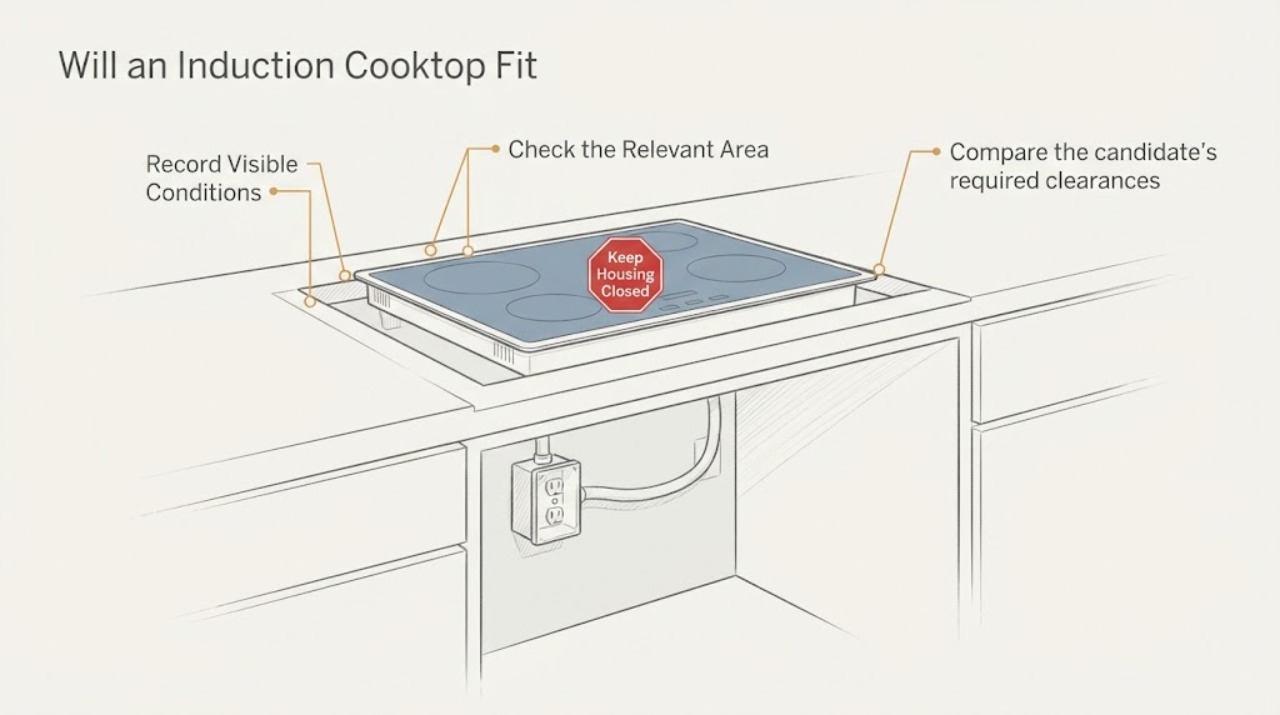
An old gas cooktop cutout cannot be declared compatible with an induction cooktop from the nominal width alone. Whirlpool says appliance dimensions and cutout dimensions are different, and cutout dimensions can vary between models with the same surface size. Identify the exact induction model, compare its installation-guide cutout width, depth, height and clearances with the smallest measured opening, then have a qualified professional confirm the electrical service and gas-line conversion. Do not cut the countertop, disconnect the gas line, or wire the induction unit before that comparison is complete.
Work through in order
Diagnostic checks
Use only checks that match the exact appliance or system and its official guide.
-
Check 1
Choose the exact induction cooktop model before altering the counter, and obtain its installation guide or dimension sheet; record the required cutout width, depth, height, cabinet clearance, wall/hood clearance and electrical rating.
Expected result: The candidate has a complete installation document, or only a nominal product width and no verified cutout/electrical data.
Next step: Use the complete model-specific guide as the comparison source. Do not order a cut or assume the old gas opening is interchangeable while any required dimension is missing.
Why this matters
Why: The nominal width identifies a size class, not a verified opening or service requirement. Without the exact document, compatibility remains unresolved.
-
Check 2
Have the existing cooktop made safe and accessible, then measure the countertop opening at the front and rear for width and on both sides for depth; record the smallest value in each direction and note the opening height.
Expected result: The measurements agree, or one edge is narrower, out of square, obstructed by a cabinet rail, or inaccessible without disconnecting the gas appliance.
Next step: Compare the measured opening to the exact guide without cutting. If access requires gas disconnection, stop and have the licensed installer expose and measure the opening as part of the conversion.
Why this matters
Why: The smallest opening controls the fit, and an obstruction or inaccessible measurement can invalidate a surface-size comparison. Removing a gas appliance is not a user measurement shortcut when the line has not been professionally isolated.
-
Check 3
Compare the candidate’s required clearances around the cutout with the cabinet sides, rear wall, countertop edge, drawer or oven below, and hood or other material above.
Expected result: All listed clearances are met, or a cabinet, wall, drawer, oven, or hood falls inside a model-specific minimum.
Next step: Treat any clearance conflict as a design or installation review. Do not solve it by trimming a cabinet or moving a hood until the model instructions and a qualified installer or countertop professional have approved the change.
Why this matters
Why: A cooktop can have a matching opening yet still fail its installation requirements because the surrounding space or underside is different.
-
Check 4
Ask a qualified electrician to compare the selected induction model’s electrical rating with the existing service, junction-box location and circuit capacity; provide the model guide rather than relying on the old gas appliance’s wiring, if any.
Expected result: The existing service is documented as suitable, or the electrician finds that the voltage, amperage, wiring route or junction-box arrangement does not match the new model.
Next step: Have the electrician specify the permitted service changes under local code. Do not connect the cooktop, alter a breaker, or test exposed conductors yourself.
Why this matters
Why: The old gas cooktop does not establish that the kitchen has the electrical service an induction model requires; a mismatch is an installation change, not a cutout adjustment.
-
Check 5
Have the gas fitter or other locally licensed professional plan the old gas connection’s isolation and capping together with the final induction installation, and confirm the countertop work sequence before anyone cuts or removes the appliance.
Expected result: The gas line and electrical work have a documented professional plan, or the proposed conversion relies on a homeowner disconnecting, capping or rewiring the old installation.
Next step: Use the licensed installation route and keep the gas appliance out of service during the conversion. If the plan has no qualified person responsible for the gas and electrical portions, do not proceed.
Why this matters
Why: The change crosses gas, electrical and countertop-safety boundaries. Whirlpool specifically routes turning off the gas line, removing the old appliance and capping the line to a licensed contractor.
Use your observations
Decision map
Find the observation that best matches what you see, then follow the next safe action.
-
PATH 01Next step
What you see
The smallest measured opening meets every width, depth and height requirement in the exact induction model’s installation guide, and surrounding clearances also pass.
Do this next
Give the measurements and guide to the installation professionals for a final site check before ordering countertop work or connecting the appliance.
Why this path and its safety boundary
Why it matters: The physical opening appears compatible on paper, but that result does not approve the gas disconnection or electrical connection.
-
PATH 02Next step
What you see
The existing cutout is smaller than the candidate guide, is not square, or conflicts with a cabinet, drawer, oven, wall or hood clearance.
Do this next
Pause the purchase or countertop change and have the selected model, an alternate model, or a professionally designed modification reviewed against the full installation guide.
Why this path and its safety boundary
Why it matters: The candidate is not a drop-in fit as measured; forcing it into the opening could compromise support, clearances or serviceability.
-
PATH 03Next step
What you see
The opening passes, but the electrician cannot verify the selected model’s required electrical service or the gas line has no qualified isolation plan.
Do this next
Use the licensed electrician and gas professional to design the service work. Do not energize the induction cooktop or disturb the gas connection while that work is unresolved.
Why this path and its safety boundary
Why it matters: The conversion is blocked by services even though the counter may fit.
-
PATH 04Next step
What you see
No exact induction model or installation guide is available, or the old gas cooktop cannot be safely exposed for measurement.
Do this next
Obtain the candidate model documentation and have the licensed installer measure the exposed opening as part of the conversion assessment before making any cut or purchase decision.
Why this path and its safety boundary
Why it matters: There is not enough identity and site data to claim a fit; a generic 30-inch or 36-inch label is not a compatibility result.
Helpful context
Understand the symptom
Treat the cutout and the new cooktop as separate measurements
The glass or metal surface size is the part you see; the cutout is the opening below it. They are not interchangeable measurements. Because this task names no replacement model, there is no honest universal width or depth that proves the new induction cooktop will fit. Use the selected model’s own installation guide and preserve the smallest measured opening when the front and rear or left and right measurements differ.
A gas-to-induction change is also a services conversion
Even a physically suitable opening does not make the replacement a simple appliance swap. Induction needs the electrical service specified for the selected model, while the old gas connection must be safely isolated and capped. The final gas and electrical work belongs to appropriately licensed professionals under local rules.
When checks do not resolve it
Need a professional?
Use a qualified countertop professional for any opening change, a licensed electrician for the induction circuit and connection, and a locally licensed gas professional for isolating or capping the old gas connection. Arrange the site review before buying or cutting when the model, measurements or clearances do not match.
Have this ready
- Provide the exact replacement model and installation guide, smallest cutout width/depth/height measurements, cabinet and wall clearances, countertop material, below-counter obstructions, hood details, existing electrical-service information, and the location/status of the gas connection.
Common questions
FAQ
Does a 30-inch induction cooktop fit any 30-inch gas cutout?
No. Whirlpool says appliance size and cutout size are different and that cutout dimensions can vary between models with the same surface size. Compare the exact replacement model’s installation guide with the smallest measured opening.
Can I reuse the old gas connection when switching to induction?
Induction uses an electrical connection. Whirlpool says a gas-to-induction replacement can require capping the gas line and adding electrical work, and routes those steps to licensed professionals.
What measurements matter besides cutout width?
Compare cutout depth and height, the smallest front/rear and side-to-side measurements, cabinet and wall clearances, space above for the hood, and any drawer or oven below. The exact model guide is the controlling source for final dimensions.
Should I cut the counter before ordering the induction cooktop?
No. Obtain the exact model’s installation guide, measure the existing opening and surrounding clearances, and have the conversion reviewed before cutting. A nominal surface width cannot approve the fit or the electrical and gas work.
Read the exact guide
Official sources
- Replacing your gas stove with electric: A complete guideWhirlpool · Supports the conversion safety boundary and planning checks; local licensing and code requirements still control.
- A guide to cooktop dimensionsWhirlpool · Supports the general measurement and comparison method; it does not certify any unspecified replacement model or countertop.
- How to install an induction cooktop or rangeWhirlpool · General manufacturer planning guidance; exact dimensions and electrical ratings remain model-specific.
Community feedback
Share a repair observation
Share a plain-text repair observation. Accepted observations are published automatically; this page may take a moment to update.