
On this page
Start here
Quick answer
Clicking or audible on/off cycling at a low setting can be normal, but the meaning depends on the cooktop type. Electric radiant and induction elements commonly pulse power to maintain a low heat; official LG and Wolf guidance describes this as normal. A gas cooktop can also click when an automatic re-ignition system cycles a low flame, and Whirlpool says occasional sparking may occur on low. First determine whether the sound is a relay or element pulse, or a gas igniter sparking. If a gas burner clicks with the knob OFF, will not establish a stable flame, or there is a gas odor, turn the burner and gas supply off when safe and arrange service. If an electric or induction surface clicks while the control is OFF, shows an error, trips the breaker, smells hot, or does not heat, stop using it and request model-specific service.
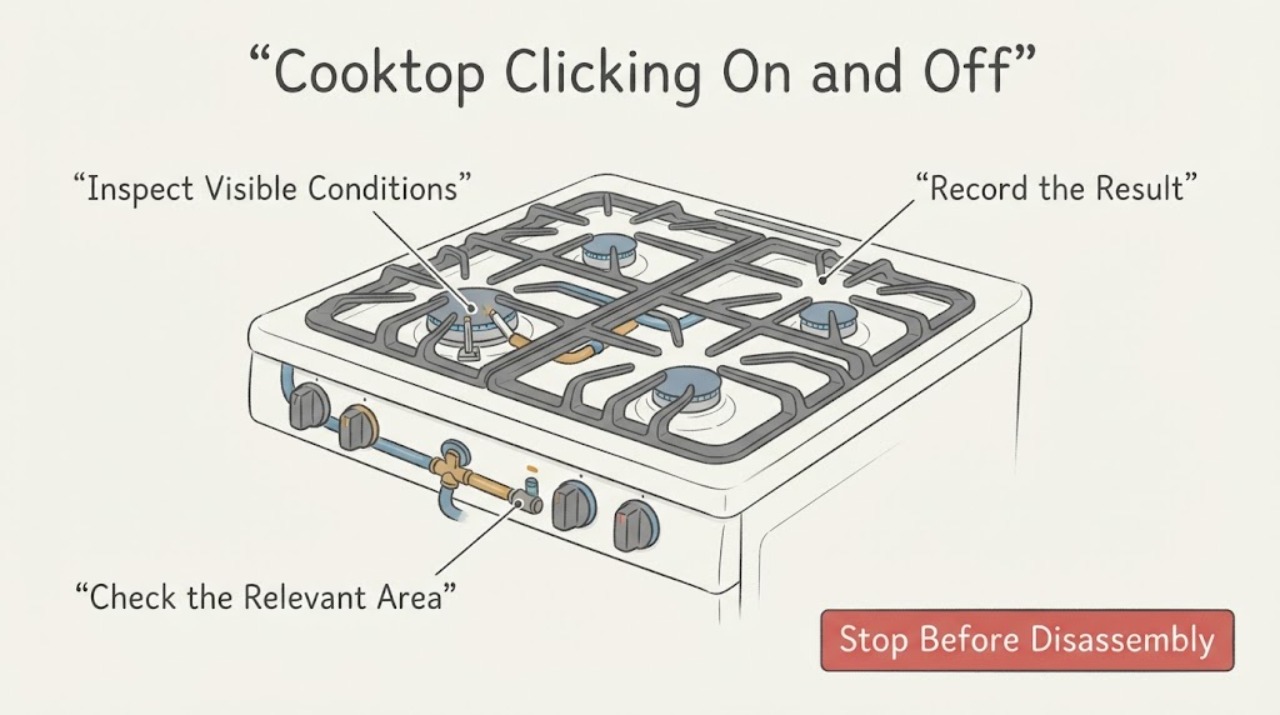
Work through in order
Diagnostic checks
Use only checks that match the exact appliance or system and its official guide.
-
Check 1
With the surface cool enough to observe safely, identify the cooktop technology without removing panels: look for a visible gas flame and burner cap, a radiant element that glows through glass, or induction controls and cookware-detection behavior. Note whether the sound is a sharp spark click, a softer relay/control click, or only the element changing from hot to dark.
Expected result: There is a gas flame and spark sound, a glowing radiant element, or an induction zone with a power display; or the appliance type cannot be identified.
Next step: Use the matching gas or electric/induction branch below. Record the model from an accessible label or control panel; if the type remains uncertain, stop troubleshooting and ask the manufacturer or a qualified appliance technician to identify it.
Why this matters
Why: A gas spark and an electric/induction power pulse are different operating behaviors and require different checks. If the type or sound source is unclear, the available evidence cannot support a component diagnosis.
-
Check 2
For an electric radiant or induction cooktop, run only the normal low setting with a suitable pan already positioned as the owner's manual requires, and observe from the controls and surface: note whether heat returns in pulses, the display remains normal, and the cookware temperature is maintained. Do not test with the glass removed, wiring exposed or an improvised pan.
Expected result: The element or induction zone cycles while the setting and display remain normal and the food heats, or it stops without recovering, displays an error, trips the breaker, smells hot or has visible damage.
Next step: If heating and controls remain normal, use the exact model manual for cookware and low-setting operation. If any fault sign appears, turn the control off, isolate power only from a safe accessible control or breaker, and arrange model-specific service; do not open the cooktop or measure live wiring.
Why this matters
Why: Normal pulsing at a low setting is consistent with manufacturer descriptions of power regulation. A failure to recover, a code, breaker trip, burning odor or visible damage is not established as normal cycling.
-
Check 3
For a gas cooktop, observe only with the burner knob intentionally in a lighting or operating position: check whether the flame lights, stays blue and stable for the appliance's normal operation, and whether clicking stops after the flame is established. Do not put hands near the burner and do not keep releasing gas if it does not ignite.
Expected result: The flame is stable and the clicking occurs only during low-setting re-ignition, or the burner continues clicking without a stable flame, clicks with the knob OFF, or gas is smelled.
Next step: If there is gas odor or a burner will not ignite, turn the knob OFF, avoid flames and electrical switching, ventilate only if this can be done safely, and follow local gas-emergency guidance. If the sound persists with controls OFF or after the area is dry and cool, shut off the appliance gas supply when safe and arrange qualified gas-appliance service.
Why this matters
Why: Whirlpool and Thermador describe occasional low-setting or re-ignition clicking as possible gas-cooktop behavior. Clicking with the control OFF, failed ignition, a disturbed flame or gas odor needs a safety response rather than a generic reset or part diagnosis.
-
Check 4
After the cooktop is off and cool, inspect only accessible surfaces for a wet or recently spilled burner area, displaced gas burner cap, visible food debris, damaged glass, or a control that is physically stuck. Do not remove the cooktop, disconnect ignition wires, bypass a sensor or probe inside the appliance.
Expected result: A gas burner is visibly damp or its cap is displaced, or the surface is dry and correctly assembled but clicking continues or the electric/induction fault remains.
Next step: For a gas unit, let accessible wet areas dry fully and reseat only a cool, visibly removable burner cap as the owner's manual permits; if clicking continues, use service. For electric or induction units, keep power isolated after a fault sign and request service rather than opening the appliance.
Why this matters
Why: Whirlpool and Thermador identify moisture, burner-cap position and debris as possible contributors to gas ignition clicking. A clean-looking surface does not prove that an internal switch, control or heating circuit is good.
Use your observations
Decision map
Find the observation that best matches what you see, then follow the next safe action.
-
PATH 01Next step
What you see
A radiant or induction zone cycles on a low setting, the control display remains normal, heat returns, and there is no odor, damage or breaker trip.
Do this next
Continue only within the exact owner's manual instructions for the identified model and cookware. Escalate if the behavior changes to an error, no heat, overheating, odor or electrical trip.
Why this path and its safety boundary
Why it matters: The observed pattern matches the documented power-regulation behavior of electric and induction cooktops; low settings can make the pulses more frequent or longer.
-
PATH 02Next step
What you see
A gas burner clicks only while it is lit or re-igniting at a low setting, the flame is present and stable, and there is no gas odor.
Do this next
Follow the exact gas cooktop manual and keep the burner cap, ports and ignition area clean and dry. If clicking becomes continuous, occurs with the knob OFF or the flame will not stay lit, stop using the burner and arrange service.
Why this path and its safety boundary
Why it matters: Whirlpool documents occasional low-setting sparking and Thermador documents automatic re-ignition clicking for its ExtraLow feature; this can be normal for the applicable gas design.
-
PATH 03Next step
What you see
A gas odor is present, a burner will not ignite or remain lit, or a gas cooktop clicks with all knobs OFF.
Do this next
Turn controls OFF, avoid flames and electrical switching, leave the area if the odor is strong or persistent, and follow local gas-emergency guidance. Keep the appliance out of use and arrange qualified gas-appliance service; do not dismantle the cooktop.
Why this path and its safety boundary
Why it matters: The condition is not established as normal low-power cycling and may involve gas ignition or re-ignition behavior that requires qualified assessment.
-
PATH 04Next step
What you see
An electric or induction cooktop clicks while OFF, trips a breaker, shows an error, has a burning odor or visible glass/control damage, or does not recover heat after cycling.
Do this next
Stop using the affected zone, isolate power from a safe accessible point if needed, and request model-specific appliance service. Do not open the cooktop, bypass sensors or perform live electrical tests.
Why this path and its safety boundary
Why it matters: The available generic evidence supports normal cycling only during documented operation; these observations are outside that normal pattern and cannot identify a safe user repair.
Helpful context
Understand the symptom
The word clicking covers two different behaviors
A smooth electric or induction cooktop can make a relay or control sound as power is applied in short periods. The element may glow, darken or stop heating briefly while the controller maintains the selected low setting. Gas cooktops use a different mechanism: a spark igniter may click while a burner lights or while an automatic re-ignition system restores a flame. The sound alone does not identify a failed part, and the lack of a model means a generic diagnosis would be unsafe. Identify the heat source and whether the sound is tied to an active burner before deciding whether it is normal.
Low heat can make normal cycling more noticeable
LG states that electric surface elements cycle on and off even on high and do so more frequently at lower temperatures. Its induction guidance likewise says that lower power can make the burner turn off more often or remain off longer while the cookware temperature is maintained. Wolf describes the same low-power pulsation for induction and electric burners. These statements apply to the documented technologies and brands; they do not approve a gas igniter that keeps clicking when all controls are off or a cooktop that has a gas odor, visible damage or an electrical fault.
Common questions
FAQ
Is clicking at a low setting normal on an electric or induction cooktop?
Often it is. LG says electric elements cycle on and off to maintain the selected setting and that lower settings make the cycling more frequent. LG and Wolf also describe induction power pulsing at low levels. It is not normal to assume the same explanation if the unit clicks while OFF, trips a breaker, smells hot or does not heat.
Why does a gas burner click when it is on low?
Some gas cooktops use re-ignition to restore a low flame, and Whirlpool notes that sparking may occasionally occur at a low setting. Thermador says its ExtraLow feature cycles the flame and clicks when it reignites. The exact behavior depends on the model; continuous clicking, clicking with the knob OFF, failed ignition or gas odor needs service and a safety response.
Can I open the cooktop or disconnect the igniter to stop the clicking?
No. The topic does not establish a model, and internal ignition, heating and control wiring are not safe generic user repairs. Keep the unit out of use when the abnormal branches above apply and arrange qualified service rather than bypassing a sensor or disconnecting a component.
What if I cannot tell whether the cooktop is gas, electric or induction?
Do not guess from the sound. Use the accessible model label and owner's documentation, or ask the manufacturer or a qualified technician to identify the appliance. The normal low-power behavior and the safe response to clicking differ between gas ignition and electric or induction power cycling.
Read the exact guide
Official sources
- Electric burners cycling on/offLG USA Support · Opened official LG support guidance for electric cooktops. It supports the bounded statement that surface elements cycle on and off to maintain heat and do so more frequently at lower settings; it is not a model-specific diagnosis for the unbranded task.
- Troubleshooting | Gas Cooktops & Rangetops SupportThermador · Opened official Thermador troubleshooting guidance. It supports the model-bounded examples that ExtraLow may cycle and click, and that moisture, cap position, clicking with controls OFF, gas odor or persistent ignition issues require different checks or service; it is not used to map the unbranded topic to Thermador.
- Burner(s) Sparking or Clicking - Gas CooktopWhirlpool Product Help · Opened official Whirlpool gas-cooktop guidance. It supports the bounded statements about all burners clicking during ignition, damp burners, automatic re-ignition and occasional low-setting sparking; it is not used to claim a Whirlpool identity for the task.
- LG Range - Troubleshooting An Induction Range Turning Off During OperationLG USA Support · Opened official LG induction guidance. It supports the bounded statement that low power can make the burner turn off more often or remain off longer while maintaining heat; it is not used to map the unbranded task to an LG model.
- Wolf Induction or Electric Cooktop Burner PulsatingSub-Zero, Wolf, and Cove · Opened official Wolf support FAQ. It provides a second manufacturer example that low-power electric and induction burners rapidly cycle to maintain temperature; it is not a claim about a particular unbranded cooktop.
Community feedback
Share a repair observation
Share a plain-text repair observation. Accepted observations are published automatically; this page may take a moment to update.