
On this page
Start here
Quick answer
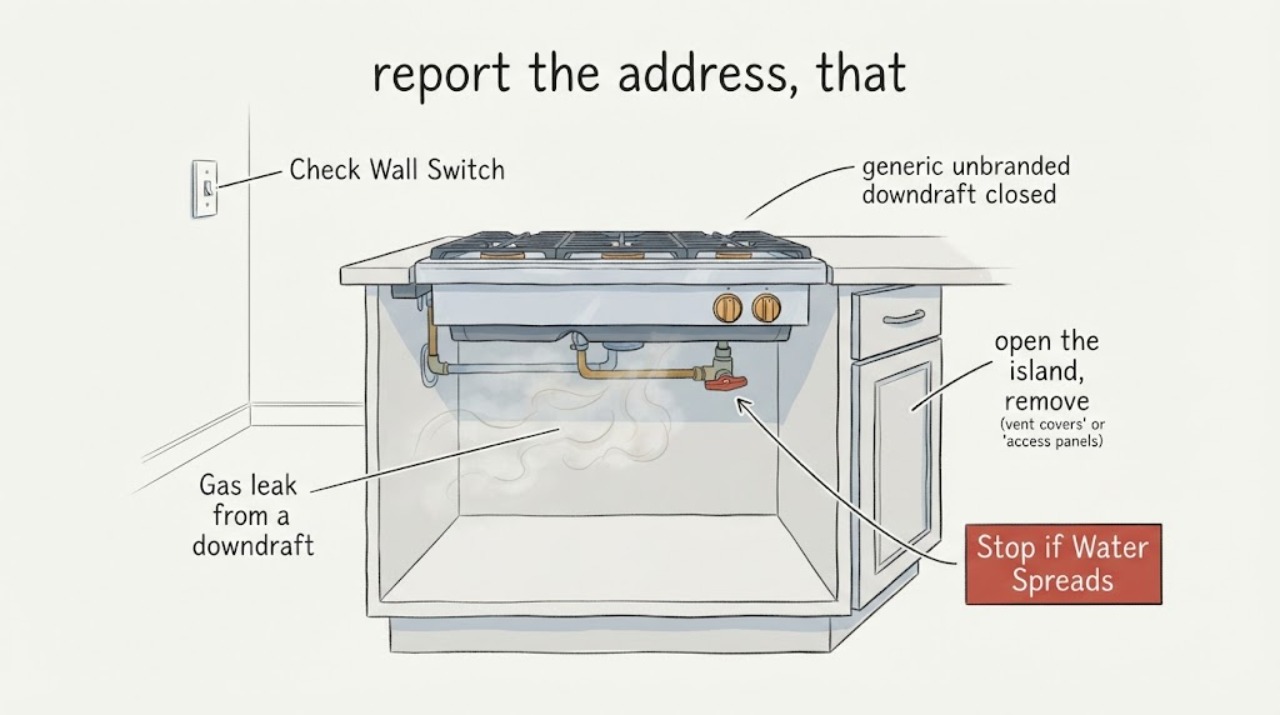
A suspected gas leak at a downdraft gas cooktop in an island is an emergency, not a DIY diagnosis. If you smell gas or hear hissing, leave the home immediately without turning lights or appliances on or off, using a phone inside, lighting a flame, or moving the island/cooktop to inspect a connector. Once outside and away from the suspected leak, call 911 or the local gas emergency number and follow the utility or emergency responder's instructions. Keep everyone out until qualified personnel say it is safe. Do not relight burners, test a valve, apply a leak solution, tighten a fitting, disconnect a connector, or modify the downdraft installation. The opened official guidance does not identify a model-specific repair for this unbranded, unmodeled cooktop; after the area is cleared, a qualified gas professional must locate and repair the source before the cooktop is used again.
Work through in order
Diagnostic checks
Use only checks that match the exact appliance or system and its official guide.
-
Check 1
If you smell gas, hear hissing, or a gas detector alarms, stop where you are and leave the home immediately. Do not turn a light, fan, burner, appliance, breaker, or other electrical switch on or off; do not light a match or candle and do not use a phone inside.
Expected result: The odor/hissing is present, a detector alarms, or nobody can safely confirm that the gas concern is absent.
Next step: Take people and pets out without stopping to inspect the island or cooktop. From outside or a neighbor's location, call 911 or the local gas supplier/emergency number.
Why this matters
Why: This is a suspected fuel-gas emergency. The odor source and fuel type do not need to be identified before evacuation.
-
Check 2
Once outside and away from the home, report the address, that a gas leak is suspected at a downdraft gas cooktop in an island, whether anyone smells gas or feels unwell, and whether you heard hissing or saw flames.
Expected result: The utility or emergency responder gives evacuation, shutoff, ventilation, or re-entry instructions, or instructs occupants to wait for a qualified technician.
Next step: Follow their instructions and do not return to operate, inspect, or restart the cooktop until they say it is safe.
Why this matters
Why: Only the gas authority or emergency responders can establish the immediate safe perimeter and decide when the home may be re-entered.
-
Check 3
Do not move the cooktop, open the island, remove the downdraft assembly, disconnect a connector, tighten a fitting, apply leak-detection fluid, test a valve, or relight a burner. Leave the installation exactly as found for the gas professional.
Expected result: The suspected leak appears to stop, the odor fades, or the appliance looks normal after the home is ventilated.
Next step: Keep the cooktop out of service and arrange qualified gas-appliance inspection and repair before any further operation.
Why this matters
Why: A fading odor or a normal-looking burner does not establish that a connector, valve, regulator, or concealed line is leak-free. Moving a weakened connector can create a larger leak.
-
Check 4
After the utility or emergency responder clears the immediate emergency, give a qualified gas professional the cooktop condition, fuel type if known, installation history, any recent cabinet or appliance movement, and whether the odor came from the appliance, island, or room. Do not attempt a repair from a generic part or fitting.
Expected result: The professional confirms a connector, valve, line, control, downdraft-related installation, or other source, or finds no leak during the initial inspection.
Next step: Use the professional's documented repair and safety clearance. If no source is found but odor or detector alarms recur, evacuate again and contact the gas authority rather than restarting the cooktop.
Why this matters
Why: The gas source and repair scope require professional testing; no brand/model was supplied to support a component or compatibility claim. A negative first check should not become permission for DIY disassembly.
-
Check 5
If anyone has headache, dizziness, nausea, breathing trouble, or other symptoms after a suspected leak, move to fresh air and tell 911 or emergency medical responders that a gas appliance incident is suspected. Do not re-enter to retrieve items or troubleshoot.
Expected result: Symptoms improve outside, persist, or multiple occupants are affected.
Next step: Follow emergency medical direction and remain outside until responders declare the area safe.
Why this matters
Why: Symptoms can signal exposure or another emergency; the home and appliance cannot be treated as a repair-only problem.
Use your observations
Decision map
Find the observation that best matches what you see, then follow the next safe action.
-
PATH 01Next step
What you see
Gas odor, hissing, or a gas-detector alarm is present or cannot be ruled out.
Do this next
Leave immediately without operating electronics, then call 911 or the gas supplier from outside; do not inspect or move the appliance.
Why this path and its safety boundary
Why it matters: Treat the situation as an active gas emergency regardless of whether the cooktop is on, off, or installed in an island.
-
PATH 02Next step
What you see
The odor fades after occupants leave or someone believes the cooktop burner is now off.
Do this next
Do not re-enter to test or relight the cooktop. Wait for utility/emergency clearance and qualified gas-appliance inspection.
Why this path and its safety boundary
Why it matters: The disappearance of an odor does not verify that a connector, valve, regulator, or concealed line is safe.
-
PATH 03Next step
What you see
A utility or emergency responder has made the immediate area safe, but the leak source has not been professionally located and repaired.
Do this next
Keep the gas cooktop out of service and have a qualified professional inspect and repair the complete installation before use.
Why this path and its safety boundary
Why it matters: The emergency response is complete only to the point of making the area safe; appliance use remains unresolved.
-
PATH 04Next step
What you see
A qualified professional repairs the confirmed source and gives a safety clearance, with no recurring odor or detector alarm.
Do this next
Follow the professional's operating instructions and the cooktop's exact manual. Stop and evacuate again if any odor, hissing, or alarm returns.
Why this path and its safety boundary
Why it matters: Only documented professional repair and clearance support returning the cooktop to service; a homeowner visual check is insufficient.
Helpful context
Understand the symptom
Treat smell or hissing as the decision point
The task identifies a gas leak at a downdraft gas cooktop in an island but provides no brand, model, fuel type, or confirmed leak location. Those missing details do not change the emergency response. CPSC says to leave immediately when gas is smelled or a leak is suspected and to avoid phones, flames, lights, and electrical switches inside. Do not stay to identify whether the odor is from a burner, connector, valve, regulator, or the island installation.
Do not move or open the island installation
A built-in cooktop and downdraft may have concealed connections, and the official CPSC bulletin specifically warns that moving an appliance to inspect a connector can cause a weakened connector to fail. Leave the cooktop and cabinetry in place. Do not lift the cooktop, remove panels, crawl into the island, tighten fittings, or test a suspected connector.
Return only after qualified clearance
After the gas utility or emergency responder makes the area safe, have a qualified gas professional identify and repair the leak and inspect the cooktop installation before use. CPSC says gas-control operation and repair are not DIY work and warns against relighting or altering controls when gas is smelled. A successful burner ignition later does not prove that the connector, valve, or concealed line is safe.
When checks do not resolve it
Need a professional?
Leave immediately and call 911 or the local gas supplier from outside for any suspected gas leak or alarm. After the area is cleared, use a qualified gas professional to inspect and repair the cooktop installation before operation. Never move the island cooktop, relight a burner, alter a valve, or test a connector yourself.
Common questions
FAQ
Should I turn off the cooktop or gas valve when I smell gas?
Do not stay inside to operate a burner, switch, breaker, phone, or valve unless emergency personnel or the gas utility gives instructions from a safe location. Leave immediately and call 911 or the gas supplier from outside; wait for professional direction.
Can I lift the downdraft cooktop to inspect the connector in the island?
No. CPSC warns that moving a gas appliance to inspect its connector can cause a weakened connector to fail and says only a qualified professional should check or replace it. Leave the installation in place and evacuate if a leak is suspected.
Can I relight the burner after the gas smell goes away?
No. A fading smell does not prove the installation is leak-free. CPSC says not to relight when gas is smelled and to have a utility or qualified contractor inspect a malfunctioning gas appliance. Use the cooktop only after professional repair and safety clearance.
Read the exact guide
Official sources
- Certain Older Gas Connectors May Be DangerousU.S. Consumer Product Safety Commission · Official CPSC safety bulletin used for the gas-leak emergency response and gas-connector boundary; it is not a model-specific cooktop repair manual.
- CPSC Issues Winter Safety WarningU.S. Consumer Product Safety Commission · Official CPSC gas-appliance safety warning used only to prohibit DIY valve/control work and require utility or qualified inspection.
- CPSC Warns of Generator, Carbon Monoxide and Fire Hazards Ahead of Hurricane SeasonU.S. Consumer Product Safety Commission · Official CPSC consumer safety release used for the immediate leave-and-call response; the advice is not a cooktop diagnosis.
Community feedback
Share a repair observation
Share a plain-text repair observation. Accepted observations are published automatically; this page may take a moment to update.