
On this page
Start here
Quick answer
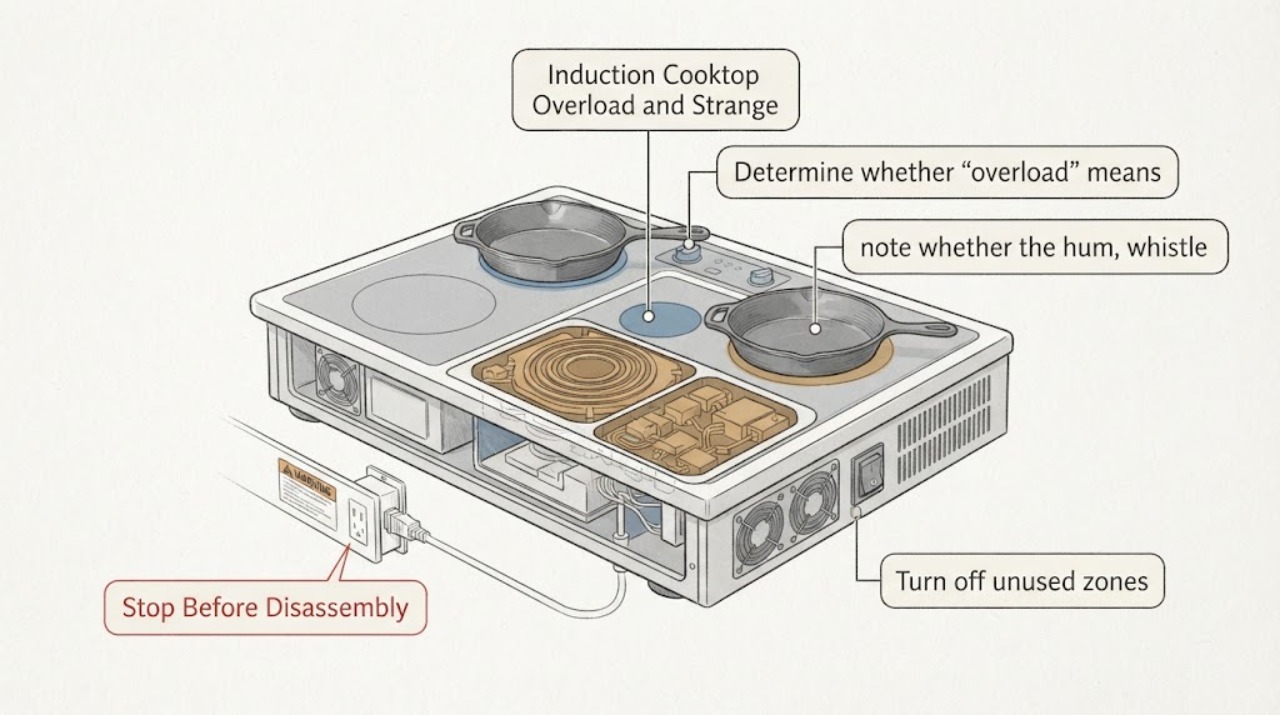
First separate two different meanings of “overload.” If a household breaker or fuse trips, or there is a burning smell, smoke, sparking, hot wiring or a crack in the glass, stop using the induction cooktop and leave the circuit off; a qualified electrician or appliance service must check it. If the cooktop itself limits power or a pan makes a hum, whistle or crackle while heating, manufacturer guidance says induction cookware and high-power or multi-zone operation can create normal sounds, while a power manager can reduce zone output to stay within the configured limit. With no brand or model supplied, lower the active zone settings, use one suitable pan at a time, keep the ventilation openings clear, and follow the exact owner manual. Do not change wiring, breaker size or a model-specific power limit as a guess.
Work through in order
Diagnostic checks
Use only checks that match the exact appliance or system and its official guide.
-
Check 1
Determine whether “overload” means a household breaker/fuse tripped or the cooktop limited a zone’s output. If there is smoke, burning smell, sparking, hot wiring, a damaged glass surface or repeated breaker operation, turn the cooktop off and leave the circuit off if doing so is safe.
Expected result: The home protection device trips, or only a cooktop display/power level changes while the electrical supply remains on.
Next step: For any repeated trip or hazardous sign, call a qualified electrician or appliance servicer. For power limiting without hazards, continue with reduced-load cookware checks and the exact owner manual.
Why this matters
Why: A breaker/fuse event is an electrical-supply or installation concern; power limiting is a model function that may distribute available power among zones.
-
Check 2
With the cooktop off and pans safe to handle, note whether the hum, whistle or crackle occurs only with one pan, only at high power, only with two adjacent zones, or also with no cookware. Do not put hands near a hot pan to perform this check.
Expected result: The sound quiets when power is reduced or the pan is changed, occurs with an empty pan, occurs with two zones at maximum, or continues with no cookware.
Next step: For pan- or power-dependent noise, reduce settings and change to suitable cookware. For noise without cookware, grinding, electrical smell or recurrence after shutdown, stop use and arrange service.
Why this matters
Why: Manufacturer guidance links these patterns to cookware construction, high power, multi-zone operation or the cooling fan; a sound with no cookware is outside the documented pan-noise examples.
-
Check 3
Turn off unused zones and reduce the active power levels. Do not change breaker size, wiring, or a model-specific power-limit setting unless the exact owner manual and a qualified installer support it.
Expected result: The cooktop resumes normal heating with lower total demand, or the overload/power-limiting behaviour remains.
Next step: Use the exact model manual to identify any user power-management setting. If the symptom persists at low demand or an electrical protection device trips, stop and call service.
Why this matters
Why: Bosch documents automatic power distribution when the configured total limit is reached; lower output can therefore be a control response rather than proof of a failed coil.
-
Check 4
Use one flat, induction-suitable pan centered on the zone that best matches its base; avoid empty cookware and do not place objects or hot pans over the controls.
Expected result: The noise or weak heating changes with a suitable pan, or it remains with a suitable pan on one zone.
Next step: Continue only if the sound matches the manufacturer’s normal examples and no electrical warning exists. Otherwise stop using the affected zone and arrange service.
Why this matters
Why: Pan material, multilayer construction, size and contents can alter induction sound and coupling. A persistent symptom with suitable cookware needs model-specific evaluation.
-
Check 5
Inspect the area around the cooktop for blocked ventilation openings, objects or liquid on the control panel, and signs of overheating. Let the electronics cool completely before any model-approved restart.
Expected result: Airflow is blocked, the controls are wet/covered, the cooktop has overheated and shut down, or no external issue is visible.
Next step: Clear only external obstructions and dry the controls when cool. If the cooktop overheats again, displays a fault, or the breaker trips, leave it off and call qualified service.
Why this matters
Why: Poor ventilation can cause overheating and shutdown, while objects or liquid can affect controls. No visible issue does not establish that the power electronics are safe.
Use your observations
Decision map
Find the observation that best matches what you see, then follow the next safe action.
-
PATH 01Next step
What you see
A household breaker/fuse trips, or the cooktop produces smoke, burning smell, sparking, hot wiring or a damaged-glass hazard.
Do this next
Stop using the cooktop, leave the circuit off if safely accessible, and contact a qualified electrician or appliance servicer. Do not repeatedly reset the breaker or open the cooktop.
Why this path and its safety boundary
Why it matters: This is an electrical or fire-safety boundary, not ordinary induction cookware noise or a user-adjustable overload setting.
-
PATH 02Next step
What you see
The cooktop remains powered, limits zone output only when several zones/high settings are used, and the hum or whistle becomes quieter when power is reduced.
Do this next
Turn off unused zones, reduce active levels and follow the exact owner manual’s power-management instructions; do not alter the electrical installation.
Why this path and its safety boundary
Why it matters: This pattern is consistent with configured power management and documented high-power/multi-zone induction noise.
-
PATH 03Next step
What you see
Crackling or whistling changes with the pan, pan contents, pan size or adjacent-zone settings, and no breaker or overheating event occurs.
Do this next
Use suitable flat induction cookware, add food or liquid before high heat, center the pan and lower the setting. Escalate if the noise persists without cookware or becomes electrical/burning.
Why this path and its safety boundary
Why it matters: The documented manufacturer examples associate these sounds with cookware construction/materials, empty cookware, high power or zone interaction.
-
PATH 04Next step
What you see
The cooktop overheats/shuts down, displays a fault or voltage warning, or the noise remains with cookware removed after the external checks.
Do this next
Keep the cooktop off, record the exact model and display code, and arrange qualified service; do not bypass protection or perform live electrical tests.
Why this path and its safety boundary
Why it matters: The symptom is outside the normal pan-dependent noise examples and may involve ventilation, supply voltage or an internal fault that cannot be diagnosed safely from the task.
Helpful context
Understand the symptom
Define “overload” before changing anything
An induction cooktop can report or behave as if it is overloaded in two different ways. Some models use a power manager that distributes a configured total limit across active cooking zones, so zone output can fall when several zones or high settings are used. A household circuit overload is different: a breaker trips, a fuse opens, or wiring becomes hot. The latter is an electrical safety issue, not a cooking-setting problem. Record which happened and stop immediately for smoke, burning smell, sparking or repeated breaker trips.
Match the sound to the cookware and power level
Induction manufacturers describe a deep hum at high power, a quiet whistle with an empty pan, crackling from multilayer or mixed cookware, louder whistling when two zones run at maximum, and a cooling-fan sound after high temperatures. A hum or whistle that quiets when the power is reduced or the pan is changed can be normal for induction. A grinding, electrical, burning or unexplained sound that continues with cookware removed is outside those documented normal examples and should be treated as a service concern.
Reduce demand without changing the installation
Turn off unused zones and reduce the active settings instead of changing wiring, breaker size or a hidden power-limit setting. Bosch explains that a power manager automatically distributes available power among zones to avoid exceeding its configured total. Use the exact owner manual if your model has a user-accessible power-limit setting; do not select a rating or electrical limit from a generic article.
Check the pan and airflow
Use a flat pan designed for induction and place it on the zone that best matches its base. Empty cookware, a small pan on a large zone, multilayer construction and different pan materials can create noise or weak heating. Keep the cooktop’s ventilation openings clear and allow the electronics to cool if the unit shuts down. Do not cover the controls or place hot cookware over them.
Stop at the electrical or fault boundary
If the breaker trips again after one safe reset, the voltage/fault display returns, the cooktop shuts off with a burning smell, or the noise is present without cookware, leave the circuit off and arrange service. The article has no brand or model, so it cannot assign a fault code, declare a component failed, or prescribe internal electrical testing.
When checks do not resolve it
Need a professional?
Stop using the induction cooktop and arrange qualified electrical/appliance service if a breaker or fuse trips again, there is smoke, burning smell, sparking, hot wiring, damaged glass, a fault/voltage display, overheating shutdown, or noise with cookware removed. Do not change breaker size or wiring, open the cooktop, bypass thermal/electrical protection, or diagnose a coil or control board from sound alone.
Common questions
FAQ
Is a humming or buzzing induction cooktop automatically broken?
No. Official Bosch, GE and Whirlpool guidance describes hum, whistle, crackle and fan sounds that can vary with cookware, power level and adjacent zones. The sound should be treated as a service issue when it occurs with no cookware, is accompanied by an electrical smell/sparking, or appears with a breaker trip or fault display.
Why does the cooktop seem overloaded when several zones are on?
Some models use power management to distribute a configured total across active zones, so individual zones may temporarily receive less output. Turn off unused zones or reduce settings and check the exact owner manual; do not alter breaker or wiring ratings.
What should I do if the breaker trips while using induction?
Stop using the cooktop. Whirlpool advises that if the circuit-breaker problem continues after the basic reset check, an electrician should be called. Do not keep resetting it to continue cooking or open the cooktop to test wiring.
Can cookware cause the strange noise?
Yes. Pan material, multilayer construction, size, contents and high-power or adjacent-zone operation can change induction noise. Try only the cookware and power changes supported by the exact owner manual; persistent noise without cookware needs service.
Read the exact guide
Official sources
- Nothing Will Operate - Induction Cooktop - Product HelpWhirlpool Product Help · Opened Whirlpool official support page used only for the external circuit-breaker/fuse boundary: check the supply and call an electrician if the problem continues. It does not support internal electrical testing.
- SIR_Induction_IU_en-us_fr-ca — Bosch Induction Slide-in RangesBosch Home Appliances / BSH Home Appliances Corporation · Opened the Bosch PDF and verified the cover/model list. Used only for its documented supply-voltage, overheating, disconnect and qualified-service boundary, not as a model-specific manual for this unidentified cooktop.
- Humming - Induction Cooktop - Product HelpWhirlpool Product Help · Opened Whirlpool official support page used for high-power hum, ferromagnetic cookware and the boundary to contact service. It is not treated as a model-specific rule for an unidentified cooktop.
- Not Operating Correctly - Induction Cooktop - Product HelpWhirlpool Product Help · Opened Whirlpool official support page used for the external ventilation/overheating and one-minute power-down boundary; exact ventilation requirements remain model-specific.
- Power Level Lower Than Level Requested - Induction Cooktop - Product HelpWhirlpool Product Help · Opened Whirlpool official support page used only to corroborate that a configured power regulator can limit available zone levels to avoid exceeding the selected total. It is not used to prescribe a setting for an unknown model.
- Electric Range & Cooktop - Induction Cooktop Humming SoundGE Appliances Support · Opened GE official support guidance used only as an additional manufacturer example that hum/buzz can vary with cookware, pan size/content and adjacent burner settings. It is not a universal repair diagnosis or a source for a particular model.
- Use and Care Manual NITP660SUC, NITP660UC | BoschBosch Home Appliances / BSH Home Appliances Corporation · Opened the Bosch manual and verified the cover/model list. Used as a manufacturer example for induction power management, cookware-dependent sounds, high-power/multi-zone noise and fan behaviour; no Bosch-specific setting is generalized as universal.
Community feedback
Share a repair observation
Share a plain-text repair observation. Accepted observations are published automatically; this page may take a moment to update.