
On this page
Start here
Quick answer
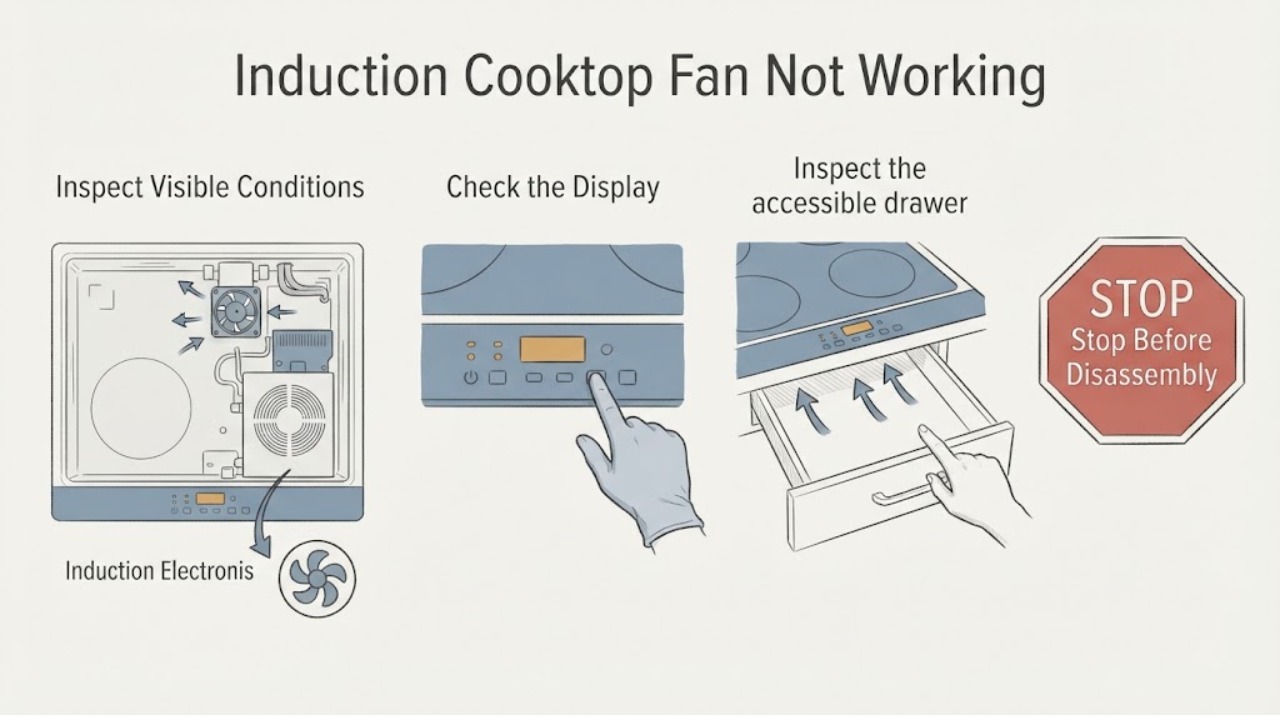
An induction cooktop fan may be temperature-controlled, may run only at higher heat or Power Boost, and may continue after cooking on some models. “I cannot hear the fan” is therefore not enough to prove a failed motor. Observe the cooktop during a normal high-heat use and during cool-down, keep any accessible underside or drawer area clear without reaching into the appliance, and follow the exact model manual. If the cooktop overheats, reduces power, shuts a zone off, shows a fault, or the fan never operates when the model says it should, stop using it and arrange model-specific service; do not open the glass top or test live wiring.
Work through in order
Diagnostic checks
Use only checks that match the exact appliance or system and its official guide.
-
Check 1
Find the complete model number and read the exact manual section for cooling-fan operation. Then observe the fan during a normal heating cycle and again after all zones are switched off.
Expected result: The manual says the fan is temperature-controlled or has run-on, and the fan starts or continues in the documented condition; or the fan remains silent when the manual says it should run.
Next step: Follow the exact manual if the behavior matches it. If it does not, stop using the cooktop and arrange model-specific service; do not borrow another brand’s fan test.
Why this matters
Why: A documented run-on or delayed start can be normal. Silence during a required cooling condition is a stronger service signal, but it still does not identify which internal component failed.
-
Check 2
Watch the control display and heating behavior while using the appliance normally; do not deliberately run an empty pan or boil a pan dry to force the fan.
Expected result: A zone reduces power, turns off, shows an overheat or fault indication, or the cooktop remains stable without a warning.
Next step: If an overheat or fault response occurs, switch off and let the cooktop cool as the matched manual directs. If it recurs, leave it off and request service rather than repeating the test.
Why this matters
Why: Power reduction or shutoff can be a protection response to heat on some models. A stable session does not prove that an unheard fan is defective, and an overheat response does not prove a failed fan.
-
Check 3
After the cooktop is cold and switched off, inspect the accessible drawer or underside area for stored paper, utensils, or other loose objects; clear only items that can be removed without reaching into the appliance.
Expected result: The accessible area is clear, or objects are stored where the exact manual warns they could interfere with the underside fan or airflow.
Next step: Keep the area clear and retest only under the exact manual’s normal conditions. Do not insert anything through vents or remove the cooktop from the counter.
Why this matters
Why: Clearance around an underside fan can matter, but an external obstruction check cannot confirm a blocked fan, failed motor, or control fault.
-
Check 4
Record whether the sound is absent, delayed, continuous, or abnormal, and whether the cooktop is still hot, showing a fault, or reducing power.
Expected result: The fan never runs when required, never stops after cool-down, or makes squealing, grinding, or squeaking; or it operates quietly and the cooktop cools normally.
Next step: For persistent or abnormal behavior, leave the appliance off and contact qualified service with the model, serial, display codes, and observations. Do not open the glass top or test live wiring.
Why this matters
Why: The first group is a service pattern in Samsung’s guidance; the second can be normal on some models but cannot certify an unidentified cooktop.
Use your observations
Decision map
Find the observation that best matches what you see, then follow the next safe action.
-
PATH 01Next step
What you see
The exact manual says the fan runs during heat or after shutoff, and the fan follows that pattern.
Do this next
Use the cooktop as directed and keep recording only if the behavior changes or becomes noisy.
Why this path and its safety boundary
Why it matters: The observed behavior is consistent with the model’s documented cooling strategy.
-
PATH 02Next step
What you see
The cooktop reduces power, shuts a zone off, or shows an overheat indication while the fan is not heard.
Do this next
Switch off, allow the electronics to cool, and follow the exact manual. If it repeats, arrange service without opening the appliance.
Why this path and its safety boundary
Why it matters: The appliance is responding to heat or a protection condition; the cause is not proven to be the fan alone.
-
PATH 03Next step
What you see
The fan never starts when the model requires it, never stops after cool-down, or makes a new squealing, grinding, or squeaking sound.
Do this next
Stop using the cooktop and request qualified model-specific service; do not bypass the fan or order an unverified replacement.
Why this path and its safety boundary
Why it matters: This is an abnormal fan behavior that manufacturer guidance treats as a service condition.
-
PATH 04Next step
What you see
The fan is not audible but there is no overheat, fault, power reduction, or abnormal noise.
Do this next
Confirm the model’s manual and monitor only under normal cooking conditions; seek service if the documented behavior is not met.
Why this path and its safety boundary
Why it matters: Silence alone does not establish a failure because fan thresholds and run-on behavior vary by model.
Helpful context
Understand the symptom
First decide whether the fan is supposed to be running
Induction cooktops do not all use the same fan control. GE says its fan can be triggered by rising temperature or Power Boost and can remain on after the element is off until the temperature falls. Samsung likewise describes a cooling fan that may continue after use while the electronics cool. A fan that is quiet during a low-demand moment can therefore be normal on one model, while a fan that never starts during the model’s required cooling condition can be a service symptom. Check the exact manual before treating silence as a failure.
Use heat and control behavior as evidence, not a guessed part diagnosis
If a cooktop becomes very hot, changes a burner to a lower setting, turns a zone off, or displays an overheat indication, stop adding heat and let the appliance cool according to its manual. GE describes power reduction or shutoff when its cooktop is very hot, and Bosch’s official manual tells the user to wait for the electronics to cool after overheat indications. These observations show a thermal or control protection response; they do not identify a fan motor, sensor, board, or wiring failure.
Keep the accessible airflow path safe
With the surface cool and the appliance off, remove only loose items stored around the accessible underside or drawer area. Bosch identifies an underside fan on the hob covered by its manual and warns against storing small or pointed objects below it. Do not insert tools or fingers through a vent, remove panels, or use a live test to make the fan spin.
Abnormal fan behavior needs model-specific service
A fan that never starts when the exact manual calls for cooling, never stops after the electronics are cool, or makes a new squealing, grinding, or squeaking noise should be treated as a service condition. Samsung gives that escalation for its described system. Use it as a safe boundary, not as permission to transplant Samsung timing or parts advice to another brand.
When checks do not resolve it
Need a professional?
Stop using the cooktop and call qualified service if the fan never operates when the exact manual requires it, never stops after the appliance cools, makes abnormal squealing/grinding/squeaking, the cooktop overheats or repeatedly shuts zones down, a fault code appears, or inspection would require opening the appliance or accessing live wiring.
Common questions
FAQ
Should an induction cooktop fan always run while cooking?
No universal rule applies. GE says its fan responds to temperature and Power Boost, while Samsung describes run-on until its electronics cool. Use the exact model manual and do not infer a failure from silence during a low-demand period.
Can I remove the cooktop or test the fan directly?
Do not do so as a user repair. Bosch’s official manual limits repairs to trained specialist staff and warns about the underside fan area. Use external observation and service instead.
What if a zone shuts off while the fan is not working?
Treat repeated power reduction, shutoff, or overheat indication as a stop-and-cool symptom. GE and Bosch describe protective thermal behavior; it does not identify the failed part, so arrange service if it recurs.
Read the exact guide
Official sources
- Samsung oven fan is making a noise or will not turn offSamsung · Samsung-specific service boundary: a cooling fan that never turns on/off or makes abnormal noise needs service; do not use this as a different brand’s diagnostic procedure.
- Information for Use PUE...HC..Bosch · Bosch-specific underside-fan clearance and repair safety; no Bosch model-specific procedure is being transferred to an unidentified cooktop.
- Induction Cooktop - FanGE Appliances · GE-specific explanation of cooling-fan operation; use as a manufacturer example, not as a universal timing or control rule for an unidentified cooktop.
- Induction Range & Cooktop - Burners Change Setting or Turned Off During UseGE Appliances · GE-specific overheating behavior and cool-down instruction; it does not establish another manufacturer’s fan logic.
- Samsung cooktop and range: common sounds and operational noisesSamsung · Samsung-specific normal cooling-fan and induction-sound explanation; use to distinguish manufacturer examples from a universal rule.
Community feedback
Share a repair observation
Share a plain-text repair observation. Accepted observations are published automatically; this page may take a moment to update.