
On this page
Start here
Quick answer
Stop the cycle if water is reaching the floor, wiring, or the dishwasher base, and keep hands away from wet electrical areas. First identify whether water is coming from the door/front, underneath, an inlet or drain connection, or foam overflowing from the tub. Crosley manuals point to a door gasket that is out of its channel, an unlevel dishwasher, a kinked or leaking connection, improper detergent or spilled rinse aid, and drain or overflow conditions; they also direct you to turn off the main water supply for an overflow and not restart with water in the base pan until it is safely removed. Do not pull the dishwasher out, open panels, or service the inlet valve, drain pump, tub, or wiring yourself.
Before you begin
Safety first
- Stop the dishwasher and isolate power only from a safe, dry position when water reaches electrical areas. Turn off the main water supply for an active overflow. Do not remove enclosure panels, pull out the appliance, disconnect supply or drain lines, reach into the base, test or replace the inlet valve or drain pump, tamper with controls, or restart while water remains in the base pan. Crosley manuals state that repairs should be performed by a qualified technician.
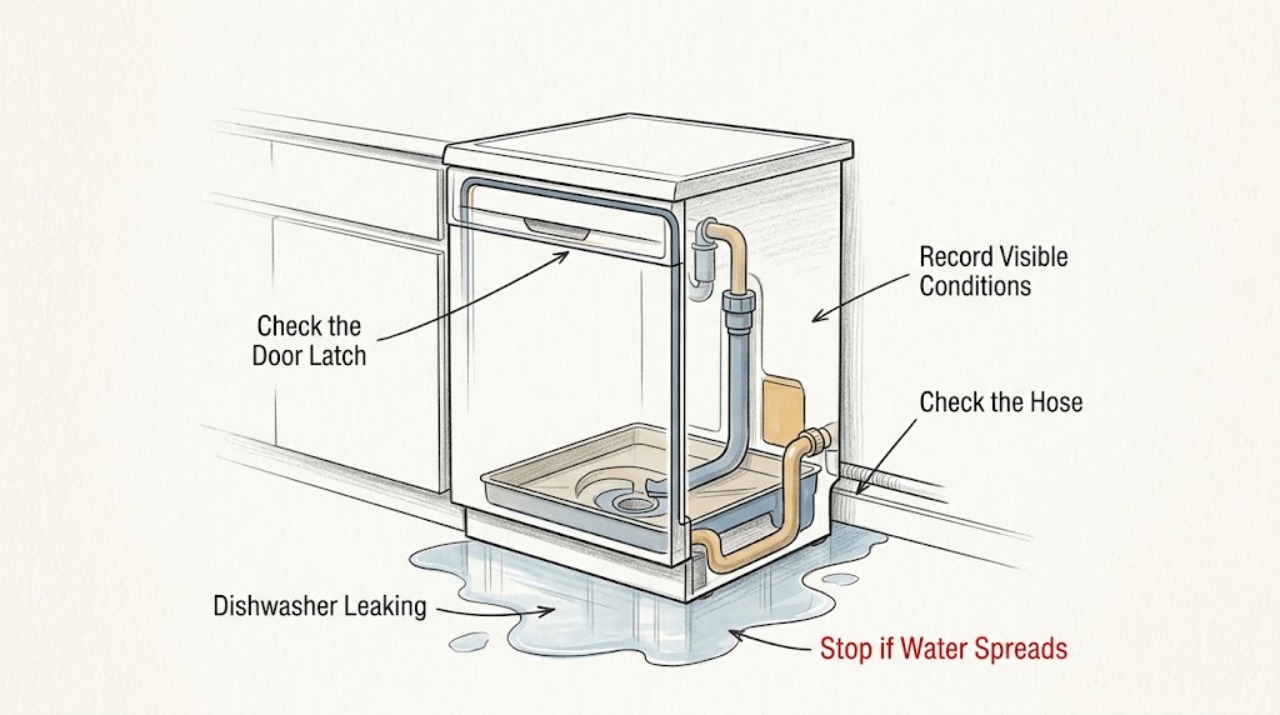
Work through in order
Diagnostic checks
Use only checks that match the exact appliance or system and its official guide.
-
Check 1
Stop the cycle and identify where the first water appears: at the lower door/front seam, from underneath or the base, at a visible supply or drain connection, or as suds/foam coming over the tub. If water is approaching an outlet or electrical connection, stop from a safe, dry position and keep the dishwasher off. Record the exact model and any displayed status.
Expected result: The leak location is clear, or water is spreading into the base/electrical area, the source is hidden, or an overflow is active.
Next step: For an active overflow, turn off the main water supply before calling service. Keep power isolated when safe to do so, and arrange a qualified Crosley technician when the source is hidden, under the unit, or near electrical parts.
Why this matters
Why: Door, foam, hose/drain, and internal pump or valve causes follow different checks. Water in the base or near electrics is a safety boundary, not a reason to run another cycle.
-
Check 2
For water at the lower door or front, wait until the cycle has stopped and inspect only from the outside and at the accessible gasket edge. Confirm the door latches squarely, no rack or dish protrudes, and the door gasket is seated in its mounting channel, reaches the bottom of the tub, and does not extend past its end rib. Wipe visible residue from the gasket with a damp cloth; do not remove the door or gasket hardware.
Expected result: The gasket is folded, displaced, dirty, damaged, or interfering with closure; the dishwasher is visibly tilted; or the gasket and closure look correct but water still reaches the floor.
Next step: Correct only a visible seating or loading issue and use the installation instructions for any leveling decision. If the gasket is torn, the door does not latch squarely, or the leak persists, stop using the dishwasher and arrange qualified service rather than forcing the door or dismantling it.
Why this matters
Why: Crosley identifies gasket position, door closure, and an unlevel dishwasher as leak contributors. A correctly seated visible gasket does not rule out a compressed seal, hinge, tub, spray-arm, or internal leak that needs service.
-
Check 3
For water under the dishwasher or at a visible inlet/drain connection, stop the cycle and close the dishwasher water supply if it can be reached safely without moving the appliance or touching wet electrics. From the accessible area only, look for a kinked drain hose, a loose visible connection, a backed-up air gap/disposer path, or water in the base pan; do not pull the unit out or disconnect a hose.
Expected result: A visible hose/connection or drain-path problem is present, the base pan contains water, the inlet continues filling, or no external source is visible.
Next step: Keep the dishwasher off and arrange qualified service for base water, continued filling, an inaccessible connection, or any leak that persists after a safe visible drain-path check. Do not remove panels, disconnect lines, or test the pump or valve.
Why this matters
Why: Crosley manuals associate poor drainage with an air gap/disposer or kinked hose and associate overflow/base water with leveling, water pressure, detergent, a micro-switch, or drain-pump conditions depending on model. A leak underneath can also involve an internal inlet valve, drain pump, tub, or seal.
-
Check 4
If foam or suds are coming out of the tub or door, stop the cycle and do not add more detergent. Check whether non-dishwasher detergent was used, too much detergent was added for the water hardness, or rinse aid spilled around the dispenser; wipe only accessible spills with a damp cloth and wait for the exact model's safe cleanup guidance.
Expected result: The foam follows an incorrect detergent or rinse-aid spill, or suds and leaking continue with the correct automatic-dishwasher detergent and no visible spill.
Next step: Use only the exact manual's cleanup and detergent guidance. If the tub continues to overflow, water enters the base, or the source is not clearly foam-related, turn off the water supply and arrange qualified service.
Why this matters
Why: Crosley identifies improper detergent and spilled rinse aid as causes of excessive suds, overflow, and leaks. Continued suds with correct products makes a trapped residue, dispenser, level, or other fault more likely and should not be chased by another wash cycle.
-
Check 5
Read the exact model's status or error display before resetting anything. On the ZDM6502AS, E1 indicates longer inlet time, E4 indicates water overflow into the motor compartment, Ed indicates a control-to-unit signal issue, E8 indicates a distribution-valve fault, and E9 indicates a control button held or contaminated. A recurring code or any water in the base is a service condition.
Expected result: The visible ZDM6502AS cause is corrected safely and the status clears, or an error repeats, is not covered by the exact manual, or water has entered the motor compartment/base.
Next step: For E4 or overflow, turn off the main water supply and keep the dishwasher off. For recurring or unlisted codes, contact Crosley service or the dealer with the model and code; do not bypass sensors, remove panels, or restart with base water present.
Why this matters
Why: The ZDM6502AS codes distinguish inlet restriction, overflow, control communication, valve orientation, and wet/held controls. They are model-specific and do not authorize a user to open the control or motor area.
-
Check 6
Once the leak source is controlled, inspect for secondary damage without powering the dishwasher: note warped flooring, wet cabinetry, a damaged cord or receptacle, a cracked tub or gasket, or water that returns while the machine is idle. Do not run a confirmation cycle if any water remains in the base pan or if the leak involves an internal component.
Expected result: The area is dry and the issue was limited to a corrected visible gasket, loading, detergent, or drain-path condition, or water returns/continues while idle or damage is visible.
Next step: Keep the dishwasher off for any returning leak, structural damage, or wet electrical area and arrange qualified service. If the cause was only a clearly corrected visible issue, follow the exact model manual before any cautious return to use and monitor for recurrence.
Why this matters
Why: A corrected external cause may stop the leak, but water returning while idle can indicate an inlet valve or supply issue, and visible damage or base water can involve the tub, pump, seals, wiring, or installation.
Use your observations
Decision map
Find the observation that best matches what you see, then follow the next safe action.
-
PATH 01Next step
What you see
Water appears at the lower door/front seam.
Do this next
Correct only the visible loading/gasket issue and consult the exact installation instructions for leveling. If damaged or persistent, stop the dishwasher and arrange qualified service; do not force the door or remove the gasket assembly.
Why this path and its safety boundary
Why it matters: The first patterns support a gasket, loading, closure, or leveling issue documented by Crosley. Persistence with a normal visible seal makes a hinge, tub, spray-arm, or internal leak more likely.
-
PATH 02Next step
What you see
Water appears underneath, in the base pan, or at an inlet/drain connection.
Do this next
Turn off the main water supply for an active overflow, isolate power safely, and arrange qualified service. Do not pull out the dishwasher, disconnect hoses, remove panels, or restart with base water present.
Why this path and its safety boundary
Why it matters: A visible drain or connection issue may be external, but base water, continued filling, or no visible source makes an internal inlet valve, drain pump, tub, seal, or overflow-control problem more likely.
-
PATH 03Next step
What you see
Foam or suds escape from the tub or door.
Do this next
Stop adding detergent and follow the exact manual's cleanup guidance. If overflow continues or the base is wet, turn off the water supply and call qualified service; do not run repeated rinse cycles as a test.
Why this path and its safety boundary
Why it matters: The first pattern supports Crosley's documented oversudsing cause. Persistent foam makes residue, dispenser, leveling, or another fault more likely and can drive water into the base.
-
PATH 04Next step
What you see
A Crosley status or error code accompanies the leak, or water is present near electrical parts.
Do this next
For overflow, turn off the main water supply; isolate power from a safe dry position and keep the dishwasher off. Arrange Crosley/qualified service, and contact emergency services for active electrical fire or dangerous smoke/heat.
Why this path and its safety boundary
Why it matters: A transient setup status can be user-correctable, but overflow/base water, recurring errors, and electrical exposure exceed a visible gasket or detergent check.
Helpful context
Understand the symptom
A leaking Crosley dishwasher is easier to triage by location than by replacing a part at random. Water at the lower door edge points first toward the gasket, door closure, leveling, rack or spray pattern; water under the machine points toward a hose, pump, valve, tub, or base-pan condition; and foam spreading out of the tub points toward detergent or rinse-aid error. The exact Crosley model matters because the ZDM6502AS and older CDB350 guides use different controls and error displays.
If water is near the outlet, junction box, cord, or other electrical equipment, stop the dishwasher and isolate power only from a safe, dry position. For an active overflow, close the dishwasher's main water supply before calling for service. Do not remove the toe-kick or enclosure panels, reach under the machine, disconnect hoses, test a pump or inlet valve, or restart while water remains in the base pan; Crosley says repairs should be done by a qualified technician.
When checks do not resolve it
Need a professional?
Arrange qualified Crosley service for a damaged or persistent door leak, water under the appliance, water in the base pan, continued filling, a recurring/unlisted error, a leak with no visible external cause, or any suspected pump, valve, tub, seal, overflow-control, wiring, or installation fault. Contact a qualified electrician for a damaged or repeatedly tripping household supply and emergency services for active fire or dangerous electrical smoke/heat.
Safety scope: Stop the dishwasher and isolate power only from a safe, dry position when water reaches electrical areas. Turn off the main water supply for an active overflow. Do not remove enclosure panels, pull out the appliance, disconnect supply or drain lines, reach into the base, test or replace the inlet valve or drain pump, tamper with controls, or restart while water remains in the base pan. Crosley manuals state that repairs should be performed by a qualified technician.
Have this ready
- Provide the full Crosley model, where the first water appeared, whether the leak occurs while filling/washing/draining or while idle, door/gasket and leveling observations, detergent/rinse-aid used, hose/drain observations, exact error code, whether the base pan is wet, and any cord, receptacle, smoke, odor, or breaker symptom.
Common questions
FAQ
Why is my Crosley dishwasher leaking from the door?
Check only the visible loading and seal conditions after stopping the cycle: a dish or rack may obstruct closure, the gasket may be out of its channel or dirty, or the dishwasher may be unlevel. If the gasket is damaged, the door does not latch squarely, or the leak continues, stop using it and arrange qualified service.
What should I do if water is leaking underneath my Crosley dishwasher?
Stop the cycle and close the water supply if it is safely accessible; do not pull the dishwasher out or disconnect hoses. Water in the base pan, continued filling, or a leak with no visible external source needs qualified service, and Crosley says an overflow requires the main water supply to be turned off before service.
Can the wrong detergent make a Crosley dishwasher leak?
Yes. Crosley identifies improper detergent, excess detergent, and spilled rinse aid as causes of suds and overflow. Stop adding detergent, wipe accessible rinse-aid spills, and follow the exact Use and Care Guide; if foam or leaking continues or reaches the base, turn off the water supply and call service.
What does a Crosley dishwasher E4 error mean during a leak?
On the ZDM6502AS manual, E4 means water overflow into the motor compartment. Turn off the main water supply and do not restart while water remains in the base pan; arrange qualified service. Do not assume E4 has the same meaning on another Crosley model.
Read the exact guide
Official sources
- All about the Use & Care of your Dishwasher — CrosleyCrosley · Crosley dishwasher door gasket, leveling, oversudsing, door closure, inlet/drain, electrical safety, and qualified-repair boundary
- CUSTOMER SERVICE - CROSLEY HOME PRODUCTSCrosley Home Products · Crosley dealer and Use and Care Guide service routing for major appliances
- Dishwasher Use & Care Manual — ZDM6502ASCrosley · ZDM6502AS leakage, door/gasket and level checks, detergent/suds, drain and inlet conditions, error codes, overflow, base-pan water, and service boundary
Community feedback
Share a repair observation
Share a plain-text repair observation. Accepted observations are published automatically; this page may take a moment to update.