
On this page
Start here
Quick answer
First confirm that the cycle actually finished and that the water is not simply from a paused or interrupted program. Then turn the dishwasher off and isolate power before reaching into the tub. Check the accessible filter or glass trap for food debris, inspect the drain hose for a kink or pinch, and verify that the sink or air gap drains normally. If the dishwasher connects to a food-waste disposer, the disposer must be clear and the inlet knockout plug must have been removed after installation. Crosley manuals cover these external and user-cleaning checks, but a pump that hums without moving water, a blocked internal passage, wiring fault, leak, or recurring failure needs service. Do not put hands into standing water before isolating power, disconnect hoses under the cabinet, open the pump or electrical enclosure, or repeatedly restart a leaking dishwasher.
Before you begin
Safety first
- The user may check cycle state, power from a safe location, the exact model's removable filter/trap, visible hose routing, and the receiving sink/air-gap/disposer condition. Qualified service personnel must handle cabinet movement, hose disconnection, pump/sump, check valve, wiring, controls, and live testing.
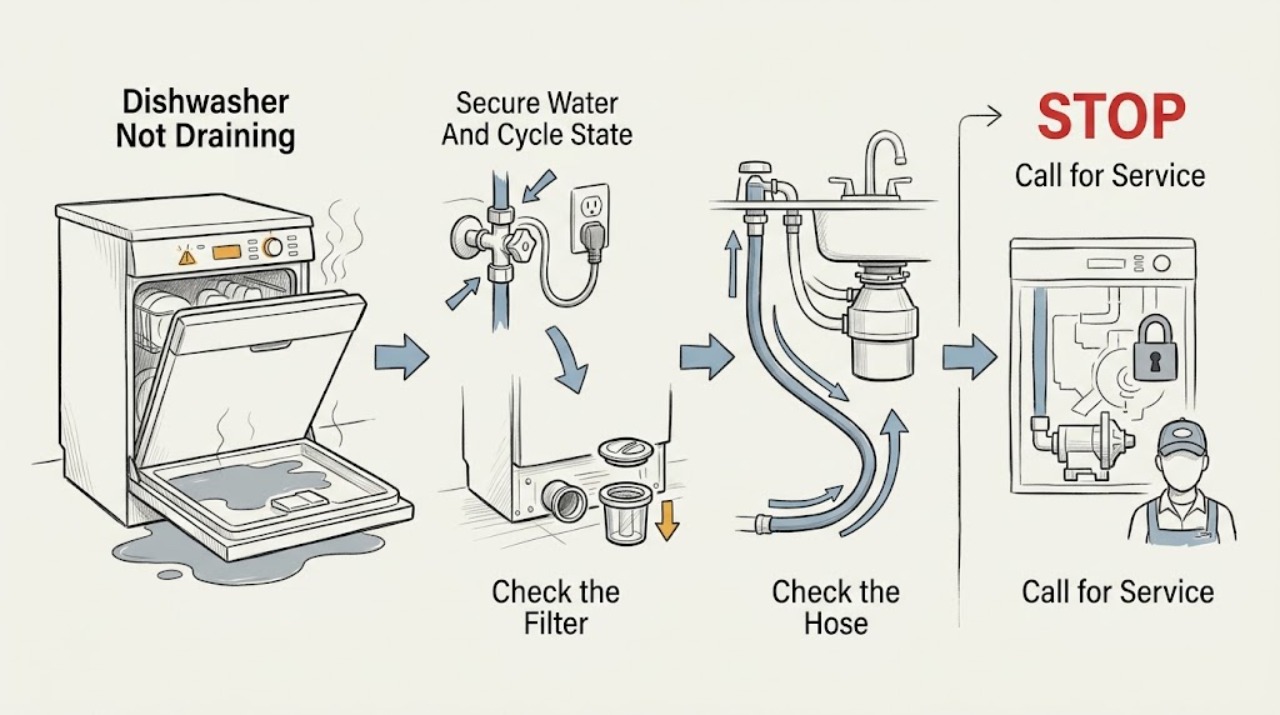
Work through in order
Diagnostic checks
Use only checks that match the exact appliance or system and its official guide.
-
Check 1
Stop the dishwasher and note whether water is only at the normal sump area or is spreading onto the floor/base or near electrical parts. Check the display or controls for a paused, delayed, interrupted, or incomplete cycle, and use the exact model's cancel/drain control only once if the door, cord, and area are safe. If there is a leak or standing water where power parts may be wet, isolate the appliance from power at a safe location first.
Expected result: The cycle was paused/interrupted, the tub has water after a confirmed completed cycle, water is leaking outside the tub, or water is near electrical parts.
Next step: If the cycle was paused, resume or cancel according to the model manual once and observe whether it reaches drain. For confirmed no-drain or any leak, isolate power and continue only with safe external checks before arranging service.
Stop if: Do not put hands into standing water while the dishwasher may be energized, repeatedly restart a leaking unit, or reset protection that trips again.
Why this matters
Why: A cycle that has not reached its drain stage is different from a true no-drain fault. Water outside the intended tub or near electrical components creates a leak/electrical boundary and should not be tested by restarting.
-
Check 2
With the dishwasher off, power isolated, and water safe to approach, remove only the user-accessible filter, coarse filter, or glass trap named by the exact Crosley manual. Look for food scraps, glass, labels, or grease blocking the screen or sump opening; rinse and reinstall it securely as documented. Do not reach beyond the removable filter area or remove a pump cover.
Expected result: The filter/glass trap is clogged or not seated, the accessible area is clear, or the filter cannot be removed without tools or unusual force.
Next step: Clear only loose debris from the documented removable part, reinstall it correctly, and use the exact model's normal drain/cancel procedure once. If water remains or the filter cannot be serviced safely, stop and arrange service.
Stop if: Do not use sharp tools to reach into the sump, force the filter, remove internal guards, or restore power with the filter or cover incorrectly installed.
Why this matters
Why: Crosley manuals link a clogged filter or glass trap to poor draining. A clear, correctly installed filter makes the hose, sink interface, pump, or internal passage more likely; an inaccessible filter is a model-specific service boundary.
-
Check 3
From outside the machine, inspect the visible drain hose route under the sink or behind the portable unit for a sharp kink, pinch, crush point, sag, or an end that has slipped from its secured connection. Correct only a clearly accessible routing problem without disconnecting the hose or moving a built-in dishwasher. Compare the connection with the exact installation instructions.
Expected result: The hose is kinked/pinched or incorrectly routed, the hose route appears open and secure, or the connection is hidden, leaking, or requires cabinet movement.
Next step: Straighten only the accessible hose path and secure it as the manual shows. If the hose must be disconnected, the unit must be pulled out, or draining still fails, stop and call a qualified appliance technician.
Stop if: Do not disconnect a hose under the cabinet with water present, pull a built-in dishwasher by the door, puncture the hose, or probe it with wire.
Why this matters
Why: Crosley troubleshooting tables identify a twisted, trapped, or kinked drain hose as a direct cause of water remaining. A clear visible hose does not rule out an obstruction inside the hose or pump, and a hidden or leaking connection needs service.
-
Check 4
Check the receiving end of the drain path without opening the dishwasher: run the sink only if there is no electrical or overflow hazard, observe whether it drains normally, inspect a visible air gap for blockage, and confirm that a disposer connected to the dishwasher is empty. If the dishwasher was newly installed or the disposer was replaced, have the installation documentation verify that the inlet knockout plug was removed; do not dismantle the disposer or plumbing to guess.
Expected result: The sink or air gap is clogged, the disposer is full, the disposer inlet knockout plug may still be present, or the household drain and connection appear clear.
Next step: Use a plumber for a blocked sink/air gap or disposer connection and use the exact installation documentation for a new connection. If the receiving path is clear but water remains, proceed to appliance service rather than disconnecting the drain line.
Stop if: Do not place hands in a disposer, remove its knockout plug while connected, pour chemical drain cleaner into the dishwasher, or open plumbing that may release standing water.
Why this matters
Why: A blocked receiving sink/air gap or a retained disposer knockout plug can stop a dishwasher from draining even when its filter and pump path are clear. Crosley identifies a non-draining sink as a plumbing issue rather than a dishwasher-servicer task.
-
Check 5
After the cycle, filter, visible hose, and receiving-sink checks, record whether the drain pump is silent, hums, runs without moving water, or produces an unusual noise, and whether water returns after one documented drain attempt. Record the exact model, installation type, filter result, hose/connection result, leak status, and any error or protection event for Crosley support.
Expected result: The dishwasher drains after a documented correction, the pump remains silent or hums with a clear path, water returns, the unit leaks, or an error/protection event appears.
Next step: If water remains, the pump does not move water, the problem recurs, or a leak/error appears, leave the dishwasher out of service as appropriate and contact Crosley or a qualified appliance service professional. Use a plumber when the household drain is the failed path.
Stop if: Do not run the pump dry repeatedly, open the pump or electrical enclosure, perform live tests, replace a pump from the symptom alone, or keep restarting a leaking appliance.
Why this matters
Why: Improvement after a filter, hose, cycle, or sink correction supports that external condition as the immediate cause. Persistent no-drain with a clear accessible path makes an internal pump, check valve, wiring, or hidden blockage more likely, but sound alone cannot identify the component.
Use your observations
Decision map
Find the observation that best matches what you see, then follow the next safe action.
-
PATH 01Safety boundary
What you see
The cycle is paused, delayed, or interrupted, and water has not yet reached a confirmed drain stage.
Do this next
Use the exact model's cancel/drain or resume sequence once with the door closed and the area safe. If water remains after a confirmed completed cycle, continue with the filter and hose checks.
Why this path and its safety boundary
Why it matters: The dishwasher may not have attempted its final drain, so the symptom does not yet prove a clogged filter, hose, or pump.
Safety stop: Do not repeatedly cycle the controls or restart if there is a leak, wet power connection, or repeated breaker trip.
-
PATH 02Safety boundary
What you see
Water remains after a completed cycle and the removable Crosley filter, coarse filter, or glass trap contains debris or is not seated correctly.
Do this next
Isolate power, clean and reinstall the exact model's removable filter/trap, then use one documented drain attempt. Call service if the water remains or the part cannot be safely removed.
Why this path and its safety boundary
Why it matters: A user-accessible filter restriction is more likely than a failed pump at this stage.
Safety stop: Do not probe the sump, force the filter, remove pump guards, or reach into energized standing water.
-
PATH 03Safety boundary
What you see
The filter is clear but the drain hose is kinked/pinched, the sink or air gap is blocked, the disposer is full, or the disposer inlet knockout plug may still be installed.
Do this next
Correct only visible hose routing, clear the receiving sink/air gap through appropriate plumbing service, or verify new-disposer installation with the exact instructions. Reassess once; call appliance service if the external path is clear but no-drain continues.
Why this path and its safety boundary
Why it matters: The receiving or external drain path is more likely than an internal dishwasher pump fault.
Safety stop: Do not disconnect cabinet-side hoses, reach into a disposer, remove a knockout plug while connected, or use chemical drain cleaner in the dishwasher.
-
PATH 04Safety boundary
What you see
The appliance is a portable Crosley with supplied hoses, or a built-in family with a disposer/filter-trap connection, and the visible layout does not match the assumed procedure.
Do this next
Use the exact model manual and identify the hose, filter, trap, air gap, and disposer arrangement before touching anything. If access requires moving or disconnecting the appliance, arrange qualified service.
Why this path and its safety boundary
Why it matters: The installation and service boundary differs by model; applying a built-in or portable procedure to the other architecture can create a leak or damage.
Safety stop: Do not pull out a built-in unit, lift a portable unit with water connected, or substitute parts/procedures from another Crosley model.
-
PATH 05Safety boundary
What you see
The filter, visible hose, sink/air-gap/disposer path, and cycle state are normal, but the pump is silent/humming without flow, water returns, a leak persists, or protection/error behavior occurs.
Do this next
Keep the dishwasher out of service as appropriate and contact Crosley or a qualified appliance technician; use a plumber if the household drain itself is blocked.
Why this path and its safety boundary
Why it matters: An internal pump, check valve, wiring, control, hidden blockage, or leak fault is more likely and is outside user diagnosis.
Safety stop: Do not perform live electrical checks, open the pump or sump, remove the dishwasher, disconnect hoses under the cabinet, or replace an internal part from sound alone.
Helpful context
Understand the symptom
Standing water does not identify the failed part
Water left in the tub can result from a paused or interrupted cycle, a filter or glass-trap restriction, a hose or sink connection problem, or a pump fault. Crosley manuals also distinguish built-in disposer connections from portable units with supplied hoses. Identify the model and connection before assuming every dishwasher has the same filter, disposer, air gap, or pump access.
The sink connection is part of the drain path
A dishwasher can be mechanically healthy while the kitchen sink or air gap is blocked. On a disposer connection, the inlet knockout plug left in place after installation can prevent draining. Check only the visible sink, air gap, disposer opening, and hose routing; work on household plumbing belongs to a plumber, and cabinet-side hose disconnection can create a leak.
Keep the pump and electrical boundary closed
A removable filter or glass trap can be a user-maintenance item on one Crosley family but not a universal permission to dismantle the sump or pump. Isolate power before removing the filter or clearing the tub, keep hands away from standing water until it is safe, and stop when diagnosis would require panels, wiring, a pump cover, or a hose connection under the cabinet.
Safety boundary
Stop conditions
- Isolate power before reaching into a tub with standing water or removing a user-accessible filter, and stop for leaks near electrical parts, smoke, burning odor, damaged wiring, or repeated breaker trips.
- Do not disconnect cabinet-side hoses, pull out a built-in dishwasher, reach into a disposer, or open a pump, sump, control, or electrical enclosure.
- Do not probe the drain path with wire or sharp tools, use chemical drain cleaner in the dishwasher, force a filter, or run a pump dry repeatedly.
- Do not use a portable-dishwasher procedure on a built-in model or vice versa; confirm the exact Crosley model and installation manual first.
- If the cycle, filter, visible hose, and receiving-sink checks do not restore draining, stop repeated tests and arrange Crosley or qualified appliance service; use a plumber for a blocked household drain.
When checks do not resolve it
Need a professional?
Safety scope: The user may check cycle state, power from a safe location, the exact model's removable filter/trap, visible hose routing, and the receiving sink/air-gap/disposer condition. Qualified service personnel must handle cabinet movement, hose disconnection, pump/sump, check valve, wiring, controls, and live testing.
Common questions
FAQ
Why is water left in the bottom of my Crosley dishwasher?
First confirm that the cycle completed rather than being paused or interrupted. Then isolate power and check the exact model's removable filter or glass trap, visible drain-hose routing, and sink/air-gap/disposer connection. Crosley treats water remaining after a completed cycle as abnormal; persistent water after these checks needs service.
Can a clogged filter cause a Crosley dishwasher not to drain?
Yes. Crosley manuals identify a clogged filter or glass trap as a no-drain cause on the applicable models. With power isolated, clean only the user-accessible part named in your manual and reinstall it securely. Do not reach into the sump or remove a pump cover; call service if draining does not return.
What should I check at the sink if my Crosley dishwasher will not drain?
Check whether the sink drains, inspect a visible air gap, and confirm a connected disposer is empty. On a new disposer installation, the dishwasher inlet knockout plug must have been removed according to the installation instructions. A blocked sink or household drain is plumbing work; do not disconnect the dishwasher hose under the cabinet yourself.
Can a kinked drain hose make a Crosley dishwasher retain water?
Yes. Crosley troubleshooting guidance lists a twisted, trapped, or kinked drain hose. Inspect the accessible route and correct only a clear kink without disconnecting the hose or moving a built-in unit. If the route is hidden, leaking, or clear but water remains, arrange service.
When should I call a professional for a Crosley dishwasher that is not draining?
Call when water remains after a completed cycle and the exact model's filter, visible hose, and sink/interface checks are clear; when the pump is silent or hums without moving water; when the problem returns; or when access requires moving the unit, disconnecting hoses, opening the pump, or testing wiring. Treat leaks near electrical parts and repeated breaker trips as urgent, and use a plumber for a blocked household drain.
Read the exact guide
Official sources
- CDPM1204AX Use and Care GuideCrosley Home Products · Official Crosley-hosted portable-dishwasher manual; its hose and filter details are not universal to built-in models.
- ZDM6502AS Use and Care ManualCrosley Home Products · Official ZDM6502-family manual; air-gap, disposer, code, and drain-pump details are model-specific.
- CDBEH960 Use and Care GuideCrosley Home Products · Official CDBEH960-family manual; apply its glass-trap, disposer, air-gap, hose, and cycle details only after confirming the exact model.
- CDBEH351USW/B/S Dishwasher Product PageCrosley Home Products · Specific built-in product page used to distinguish architecture; its filter and disposer design must not be assumed for another model.
- CDPMH1204AS/B/W Portable Dishwasher Product PageCrosley Home Products · Specific portable-dishwasher product page used to distinguish installation architecture; not a universal service procedure.
Community feedback
Share a repair observation
Share a plain-text repair observation. Accepted observations are published automatically; this page may take a moment to update.